
Norges billigste bøker

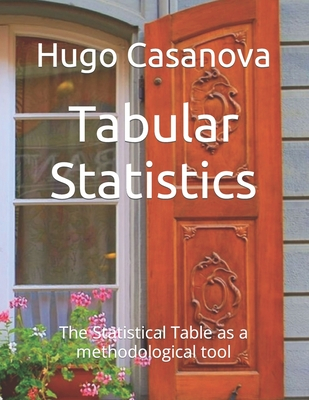
Tabular Statistics

- The Statistical Table as a methodological tool

Om Tabular Statistics

Two important aspects marked the need to write a Tabular Statistics, the first one is that the development of software has dynamized the statistical table, the second one is the inexistence of books on this subject beyond the technical manuals of the software. There was no general method that encompassed and unified a tabular method based on a logic that would generate a methodology of construction and communication of the process. Some structural and semantic disadvantages of statistical tables are the lack of definition of concepts such as table and subtable, layer, etc., beyond being intuitive elements, making the development of a tabular language and appropriate methodologies impossible. Secondly, the names of the percentages that are calculated do not refer to the predicates, generating confusion; their names are % row, % column, % row layer, etc., very confusing, very confusing; thirdly, only six or eight percentages are obtained referring to totals located in certain places of the table but as the size grows due to the number of variables the calculation is maintained on the same totals unjustifiably; on the contrary, if the table is small, the percentages are repeated unnecessarily assuming several names for similar percentages; indicating that they are fixed, not dynamic; finally, fourthly, there is no way to differentiate, nominally, one table from another, neither in its form nor in its content; that is, we could not communicate a tabular requirement; we would not know how to call them or differentiate them, linguistically, from the simplest to the most complex ones. Tabular Statistics does not focus on the numbers of the cells but on the semantic ones or items since they are the ones that the researcher seeks to measure, therefore it begins by redefining the frequency advancing towards the combination of items that make the tabular structure more complex and includes a classification of the frequencies that encompasses the indicators and new definitions are introduced for a holistic Tabular Structure since the statistical table is a combination of smaller tables.

Vis mer
  • Språk:
  • Engelsk
  • ISBN:
  • 9798884670198
  • Bindende:
  • Paperback
  • Utgitt:
  • 13. mars 2024
  • Dimensjoner:
  • 216x279x6 mm.
  • Vekt:
  • 290 g.
  Gratis frakt
Leveringstid: 2-4 uker
Forventet levering: 6. april 2026

Beskrivelse av Tabular Statistics

Two important aspects marked the need to write a Tabular Statistics, the first one is that the development of software has dynamized the statistical table, the second one is the inexistence of books on this subject beyond the technical manuals of the software. There was no general method that encompassed and unified a tabular method based on a logic that would generate a methodology of construction and communication of the process.
Some structural and semantic disadvantages of statistical tables are the lack of definition of concepts such as table and subtable, layer, etc., beyond being intuitive elements, making the development of a tabular language and appropriate methodologies impossible. Secondly, the names of the percentages that are calculated do not refer to the predicates, generating confusion; their names are % row, % column, % row layer, etc., very confusing, very confusing; thirdly, only six or eight percentages are obtained referring to totals located in certain places of the table but as the size grows due to the number of variables the calculation is maintained on the same totals unjustifiably; on the contrary, if the table is small, the percentages are repeated unnecessarily assuming several names for similar percentages; indicating that they are fixed, not dynamic; finally, fourthly, there is no way to differentiate, nominally, one table from another, neither in its form nor in its content; that is, we could not communicate a tabular requirement; we would not know how to call them or differentiate them, linguistically, from the simplest to the most complex ones.
Tabular Statistics does not focus on the numbers of the cells but on the semantic ones or items since they are the ones that the researcher seeks to measure, therefore it begins by redefining the frequency advancing towards the combination of items that make the tabular structure more complex and includes a classification of the frequencies that encompasses the indicators and new definitions are introduced for a holistic Tabular Structure since the statistical table is a combination of smaller tables.

Brukervurderinger av Tabular Statistics


Finn lignende bøker
Boken Tabular Statistics finnes i følgende kategorier:

Gjør som tusenvis av andre bokelskere

Abonner på vårt nyhetsbrev og få rabatter og inspirasjon til din neste leseopplevelse.