Norges billigste bøker

Reading Sartre's Second Ethics

Om Reading Sartre's Second Ethics

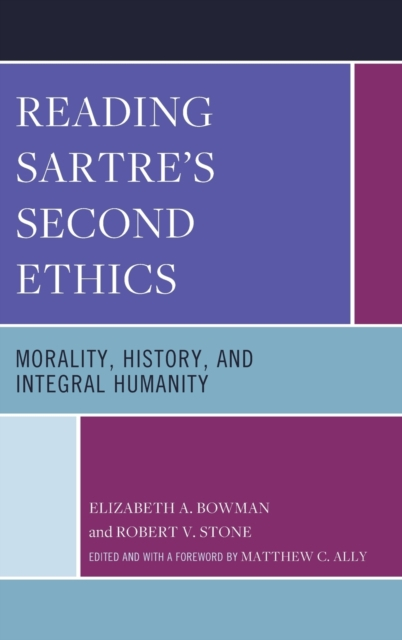
In Reading Sartre's Second Ethics, Elizabeth A. Bowman and Robert V. Stone provide a comprehensive, reconstructive, and critical interpretation of Jean-Paul Sartre's mature dialectical ethics. The key Sartrean texts are two posthumously published lectures, one delivered at the Gramsci Institute in Rome in 1964, the other scheduled to be delivered at Cornell University in 1965 but cancelled by Sartre in protest of U.S. foreign policy. Though different in content, method, and intended audience, Sartre gave both lectures the shared title "Morality and History." As Bowman and Stone argue, these texts comprise a single, systematic ethic in two parts. The Cornell lecture focuses primarily on a regressive and phenomenological analysis of normativity and its ambiguous place in lived moral experience; the Rome lecture focuses primarily on a progressive and dialectical synthesis of the ends or goals of historical conduct. Taken together, the two texts demonstrate that "integral humanity" is always possible because the means to it can always be freely invented.

Vis mer
  • Språk:
  • Engelsk
  • ISBN:
  • 9781793646514
  • Bindende:
  • Hardback
  • Sider:
  • 424
  • Utgitt:
  • 30. mars 2023
  • Dimensjoner:
  • 157x236x30 mm.
  • Vekt:
  • 735 g.
  Gratis frakt
Leveringstid: 2-4 uker
Forventet levering: 1. juni 2026

Beskrivelse av Reading Sartre's Second Ethics

In Reading Sartre's Second Ethics, Elizabeth A. Bowman and Robert V. Stone provide a comprehensive, reconstructive, and critical interpretation of Jean-Paul Sartre's mature dialectical ethics. The key Sartrean texts are two posthumously published lectures, one delivered at the Gramsci Institute in Rome in 1964, the other scheduled to be delivered at Cornell University in 1965 but cancelled by Sartre in protest of U.S. foreign policy. Though different in content, method, and intended audience, Sartre gave both lectures the shared title "Morality and History." As Bowman and Stone argue, these texts comprise a single, systematic ethic in two parts. The Cornell lecture focuses primarily on a regressive and phenomenological analysis of normativity and its ambiguous place in lived moral experience; the Rome lecture focuses primarily on a progressive and dialectical synthesis of the ends or goals of historical conduct. Taken together, the two texts demonstrate that "integral humanity" is always possible because the means to it can always be freely invented.

Brukervurderinger av Reading Sartre's Second Ethics


Finn lignende bøker
Boken Reading Sartre's Second Ethics finnes i følgende kategorier:

Gjør som tusenvis av andre bokelskere

Abonner på vårt nyhetsbrev og få rabatter og inspirasjon til din neste leseopplevelse.
