
Norges billigste bøker

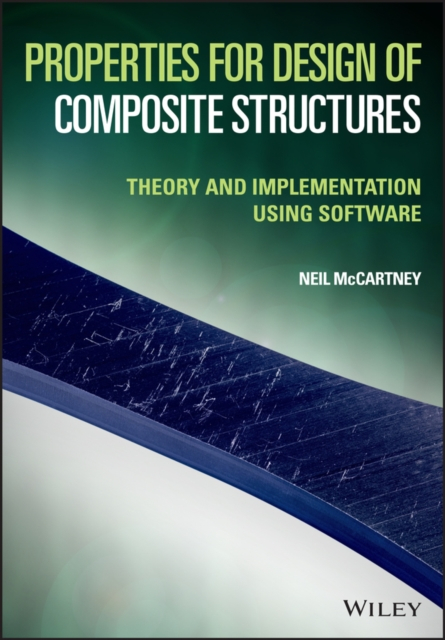
Properties for Design of Composite Structures

- Theory and Implementation Using Software

Om Properties for Design of Composite Structures

Properties for Composite Structures: Theory, Applications and Software L N McCartney, Materials Division, NPL, UK A comprehensive guide to analytical methods and source code predicting behaviour of undamaged and damaged composite materials The book provides readers with all relevant theoretical information to help them understand the ways in which thermoΓÇôelastic properties of two phase and multiΓÇôphase composites can be estimated using consistent methods from properties of reinforcement and matrix, and from geometrical data, especially volume fractions, for both undamaged and damaged composites. Properties for Composite Structures: Theory, Applications and Software focuses on the use of fibre properties that are transverse isotropic and the inclusion of the effects of thermal residual stresses. The book offers very useful explicit formulae and theoretical extensions that are not published in learned journals. Divided into four parts, the book covers: Principles, formulae for homogeneous materials and applications; Properties of undamaged composites; Properties of damaged composites; and Derivations of key results. Key features: Focuses on descriptions of the theoretical derivations using analytical methods that are the basis of estimating the undamaged and damaged effective properties of composite materials. Provides computer source code to enable readers to reproduce results given in the book, and for their own purposes. Includes previously unpublished results. Properties for Composite Structures: Theory, Applications and Software is an essential guide for designers of composite materials and composite engineering components.

Vis mer
  • Språk:
  • Engelsk
  • ISBN:
  • 9781118485286
  • Bindende:
  • Hardback
  • Sider:
  • 592
  • Utgitt:
  • 7. juli 2022
  • Dimensjoner:
  • 260x185x39 mm.
  • Vekt:
  • 1284 g.
  Gratis frakt
Leveringstid: 2-4 uker
Forventet levering: 30. mars 2026

Beskrivelse av Properties for Design of Composite Structures

Properties for Composite Structures: Theory, Applications and Software
L N McCartney, Materials Division, NPL, UK

A comprehensive guide to analytical methods and source code predicting behaviour of undamaged and damaged composite materials

The book provides readers with all relevant theoretical information to help them understand the ways in which thermoΓÇôelastic properties of two phase and multiΓÇôphase composites can be estimated using consistent methods from properties of reinforcement and matrix, and from geometrical data, especially volume fractions, for both undamaged and damaged composites.
Properties for Composite Structures: Theory, Applications and Software focuses on the use of fibre properties that are transverse isotropic and the inclusion of the effects of thermal residual stresses. The book offers very useful explicit formulae and theoretical extensions that are not published in learned journals. Divided into four parts, the book covers: Principles, formulae for homogeneous materials and applications; Properties of undamaged composites; Properties of damaged composites; and Derivations of key results.

Key features:
Focuses on descriptions of the theoretical derivations using analytical methods that are the basis of estimating the undamaged and damaged effective properties of composite materials. Provides computer source code to enable readers to reproduce results given in the book, and for their own purposes. Includes previously unpublished results.
Properties for Composite Structures: Theory, Applications and Software is an essential guide for designers of composite materials and composite engineering components.

Brukervurderinger av Properties for Design of Composite Structures


Finn lignende bøker
Boken Properties for Design of Composite Structures finnes i følgende kategorier:

Gjør som tusenvis av andre bokelskere

Abonner på vårt nyhetsbrev og få rabatter og inspirasjon til din neste leseopplevelse.