





Gjør som tusenvis av andre bokelskere
Abonner på vårt nyhetsbrev og få rabatter og inspirasjon til din neste leseopplevelse.
Ved å abonnere godtar du vår personvernerklæring.Du kan når som helst melde deg av våre nyhetsbrev.

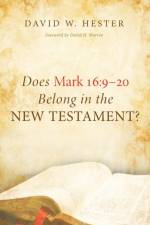
For almost fifty years, much has been written concerning Mark 16:9-20. During the same time period, evidence once counted against Mark 16:9-20 was shown to be otherwise. In this study, David W. Hester surveys modern scholarship (1965-2011) surrounding the passage. He examines the passage itself--the external evidence, with particular attention paid to the manuscripts and the patristics, especially those of the second and third centuries; and the internal evidence, featuring details that are problematic as well as those that favor Markan authorship. Finally, a proposal concerning the origin of the passage is presented. The first edition of Mark's Gospel ended at 16:8, resulting in the manuscript tradition that omits the passage, but this was not his intended ending. Later, his associates attached Mark's notes and published a second edition of the Gospel with the last twelve verses. This led to its inclusion. Given that the passage is cited by second- and third-century witnesses and attributed to Mark, along with the biblical prohibition against adding to or taking from Scripture, it is doubtful that an anonymous second-century author could have been successful in adding his own composition and it being widely accepted by the early church.""Dr. Hester's position on Mark 16:9-20 differs from the prevailing view that these twelve verses are not part of the original Gospel of Mark. After setting forth his arguments against their authenticity, he passionately presents the case for the other side--citing evidence he is convinced will persuade the open-minded critic that to omit these verses is to omit a part of Scripture."" --Rodney E. Cloud, Dean of the Turner School of Theology, Amridge University""Though covering well-worn ground, Dr. Hester highlights historical clues often overlooked or even ignored. If Mark 16:9¿20 was added to the text, then why did no early Christian writer ever voice any opposition? Why did the early church tacitly accept these verses as canonical? This careful and thorough review of the ancient evidence and of modern scholarship helped me reexamine the whole question afresh.""--David H. Warren, Associate Professor of Biblical Studies, Faulkner UniversityDavid W. Hester is Lecturer for the V. P. Black College of Biblical Studies and the F. Furman Kearley Graduate School of Theology at Faulkner University in Montgomery, Alabama. He is the director of the Faulkner Bible Lectureship, and coeditor of the graduate journal, ¿¿¿¿¿¿¿¿¿¿. He is the author of two books: Among the Scholars (1994) and Tampering With Truth (2007).
Spirituality is a hot topic in today's culture. Spirituality is essentially how one's beliefs and experiences influence the way one lives their life. Such influences for living are of critical importance to one's faith within the Christian community.What role does the Bible play in developing an expressed spirituality among the Christian community? How do one's religious traditions, cultural influences, and personal preferences influence the way Christian spirituality is perceived and expressed? All too often, and at times unintentionally, the foundational truths of the Bible are subordinated to tradition, culture, and personal preference.This book provides a context for understanding Paul's foundational components for Christian spirituality within the book of Galatians while showing how an accurate understanding of these components can and should serve as a corrective lens to various aspects of Christian spirituality as expressed and experienced today.
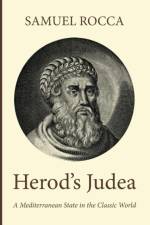
Samuel Rocca, born in 1968, earned his PhD in 2006. Since 2000, he worked as a college and high school teacher at The Neri Bloomfield College of Design & Teacher Training, Haifa; at the Talpiot College, Tel Aviv since 2005, and at the Faculty of Architecture at the Judaea and Samaria College, Ariel since 2006.
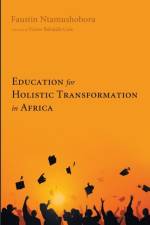
Research has revealed ineffectiveness among university graduates in Africa. Some possible causes include a lack of transformative teaching and learning methods. Most of the learning methods used in Africa today were installed by colonial educational systems, often reducing the learner to an empty container waiting to be filled with lecture after lecture. As a result, there is a cry throughout Africa for an education that can empower the learner to think critically, to love both God and others, and to bring change in his or her community. This is what education for holistic transformation is all about. This book came about as a result of a doctoral study conducted in Kenya, which featured both Christian higher educational institutions and public universities in a unique comparative analysis that will be helpful to educational leaders on both sides. Readers will learn that transformation is a discovery that takes place through change of perspective. As this research reveals, this new perspective is triggered by a new revelation, a new truth, a provoking thought, a shocking observation, or a new testimony. Thus, the process of holistic transformation takes place through divine revelation, self-reflection, written material, and ""the other.""""Our communities and churches need education that leads to holistic transformation. Too often education is equated with knowing something, or being able to do something, and does not form us and transform us into godly people who are salt and light in the world. Faustin introduces us to a better way, grounded in educational research, cultural history, and theological reflection.""--Kevin E. Lawson, Director, Talbot School of Theology, La Mirada, CA""This book will be a very useful resource for students and facilitators in institutions committed to change the future of communities and nations. Drawing from Mezirow's taxonomy of learning and types of reflection, Faustin has woven a beautiful tapestry of insights from pre- to post-colonial times concluding that the answer to the lack of transformational models of teaching and learning lies in the intervention of the One who deeply transforms from within.""--Faith W. Nguru, Deputy Vice Chancellor, Riara University, Nairobi, KenyaFaustin Ntamushobora (PhD, Biola University) is Associate Professor of Spiritual Formation at Africa International University (AIU) in Nairobi, Kenya. In addition to serving at AIU, Faustin is President of Transformational Leadership in Africa (TLAfrica, Inc.). He is the author of Transformation Through the Different Other (2013) and From Trials to Triumphs (2009). Faustin and his wife Salome have four children.
This book explores, in a manner that is readily accessible to those with little or no formal training in philosophy or theology, important questions concerning the rationality of belief in miracles. This book employs the time-honored literary device of dialogue, a practice that dates as far back as Plato. Done well, this form of philosophical investigation puts forward a thesis, yet genuinely engages with the views its author opposes.These dialogues are intended to provide a philosophical defense of the possibility of rationally justified belief in miracles. Such a defense can legitimately dispense with much of the paraphernalia that professional scholars in a discipline use in writing for other professional scholars in their discipline--some scholarly texts seem to be more references than argument--but it must not ""dumb down"" the material by oversimplifying the issues, or presenting ""straw man"" versions of the arguments it seeks to refute. My hope is that not only those who are already convinced of the rationality of belief in miracles will read this book, but also those who are unconvinced.
Lawrence M. Wills here traces the literary evolution of popular Jewish narratives written during the period 200 BCE-100 CE. In many ways, these narratives were similar to Greek and Roman novels of the same era, as well as to popular novels of indigenous peoples within the Roman Empire. Yet, as a group, they demonstrated a variety of novelistic innovations: the inclusion of adventurous episodes, passages of description and of dialogue, concern with psychological motivation, and the introduction of female characters.Wills focuses on five novels: Greek Esther, Greek Daniel, Judith, Tobit, and Joseph and Aseneth. Drawing on a wide range of theoretical works, he delineates the techniques and motifs of the Jewish novel, shows how the genre both initiated and distanced itself from nonfictional prose such as historical and philosophical writing, discusses its relation to Greco-Roman romance, and describes the social conditions governing its emergence and reception. Wills also places the novels in historical context, situating them between the Hebrew Bible, on the one hand, and subsequent developments in Jewish and Christian literature on the other.Wills sees the Jewish novel as a popular form of writing that provided amusement for an expanding audience of Jewish entrepreneurs, merchants, and bureaucrats. In an important sense, he maintains, it was a product of the ""novelistic impulse"": the impulse to transfer oral stories to a written medium to reach a more literate audience.
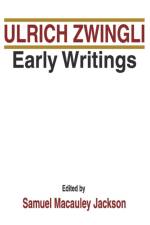
This volume contains several of Zwingli's pre-Reformation writings and his earliest Reformation treatises, which defended the freedom of Christians by attacking such issues as regulations governing Lenten fasts, clerical marriage and clerical celibacy.
Description:A collection of of Zwingli's later writings (1525-1531) , including such works as his treatise on original sin, essay on providence and his Short and Clear Exposition of the Christian Faith.
Secular assumptions underlie much formal communication between the West and Africa, and even intra-Africa. Secularism is dualistic by nature, but thinking in Africa is mostly monistic. This book suggests that it is better to be rooted in faith in Christ than in so-called secularism. The great respect given to the Bible in much of Africa verifies this idea. Communication of and through Christ is a bridge that can enable indigenous sustainable development. The same gospel is the bridge over which the West itself passes. Maintaining supposedly secular presuppositions may be denying sub-Saharan African people the means for self-initiated sustainable progress.This books draws on anthropology, linguistics, and theology, as well as the author's experience of living in Africa. Harries shares an autobiographical account of personal long-term grassroots ministry, and proposes a revision of widely held understandings of linguistics pertaining especially to the relationship between the West and Africa. He also looks at Bible teaching ministry in light of contemporary African contexts.
This book focuses on redemptive historical hermeneutics and homiletics within New Testament theology. This is a valuable legacy of the Reformed tradition, despite differences in interpreting and preaching Bible texts that surfaced in Holland (1920s and 1930s) and the United States (1970s onwards) before influencing Korean Reformed churches. The background, origin, distinctiveness, and development of these theological debates is explored and evaluated before the features of redemptive history in Korea are identified. The influence of Western redemptive-historical scholars on the Korean debate are also analyzed.Here is a major and contemporary contribution to reformed-historical hermeneutics and homiletics that is relevant for Korean Reformed churches, but also for all Reformed churches worldwide.
An invitation to reclaim our worth as persons created in the image of God.Both scholarly and personal, Curtiss Paul DeYoung's profound public journey has intersected again and again with social realities of injustice and alienation. He graciously shares here his compelling story of hope and reconciliation. New insights and new challenges arise as he encounters Desmond Tutu, Malaak Shabazz, Rabbi Menachem Froman, Sojourner Truth, Samuel Ruiz Garcia, Lani Guinier, Cain Hope Felder, James Earl Massey, Mary McLeod Bethune, Ronald Takaki, Samuel Hines, Howard Thurman, and many others. The hallmarks of DeYoung's engaging narrative are spiritual transformation, innovative leadership, and creative courage.
Earle E. Cairns, renowned historian and writer on religion, explores revivals in the church from the Great Awakening to the present. In an enlightening narrative that begins with the Bible-centered Pietists of nineteenth-century Germany, Dr. Cairns unfolds the story of the workings of God's Spirit in renewing the church.Cairns takes the reader on a historical pilgrimage that features candid accounts of such figures as Billy Graham, Billy Sunday, Charles H. Spurgeon, Dwight L. Moody, Charles Finney, Lyman Beecher, Francis Asbury, John and Charles Wesley, Jonathan Edwards, George Whitefield, Philipp Jakob Spener, and many others who have served as God's instruments in revitalizing the church.The pilgrimage includes glimpses of John Wesley's field preaching, American camp meetings, college revivals in the early 1800s, Hans Hauge's revivalistic work in Norway, Francis Asbury's long treks on horseback, Dwight L. Moody's London meetings, the Jesus people of the 1960s, Billy Graham's early crusades, and many more stories of revival.Cairns also looks at the fruits of revivalism-missions, social reform, the holiness movement and more. He examines the work of missionary and explorer David Livingstone, Salvation Army founder William Booth, temperance leader Frances Willard, the abolitionists of the Clapham Sect, and many others.The Christ-centered theology that guided the revivals is discussed, and so are the hymns that gave poetic expression to that theology. And the author looks at the various methods used by the Spirit-led individuals who brought renewal.Written with impeccable scholarship and engrossing style, An Endless Line of Splendor is an insightful study of the leaders of revival and the fruits of revival."". . . a valuable compendium of information regarding evangelical revivals and awakenings of the past 250 years.""--J. Edwin Orr, President, Oxford Association for Research in Revival""This book is the best one-volume presentation of the history and principles of revival I have read. All of us who pray for spiritual awakening will be inspired and helped by this scholarly volume.""--Lewis Drummond, Billy Graham Professor of Evangelism, Southern Baptist Theological Seminary""It was a fresh learning experience. I imagined what a wonderful thing it would be if all evangelists and revivalists in the world were able to read this work."" --John Wesley White, Evangelist, Billy Graham Evangelistic AssociationEarle E. Cairns (1910-2008) was for many years chairman of the history department at Wheaton College. An expert in the field of church history, Dr. Cairns has authored a number of books including Christianity Through the Centuries, God and Man in Time, and The Christian in Society. He served as consulting editor and contributor to The New International Dictionary of the Christian Church and was senior reviser of The Wycliffe Biographical Dictionary of the Church. Dr. Cairns holds the MA and PhD from the University of Nebraska.
""Folksy, eclectic, disarmingly humble, and astonishingly wide-ranging, Hauerwas offers us a provocative reading of Bonhoeffer that, not surprisingly, assimilates him closely to John Howard Yoder. At the same time, Hauerwas replies to recent criticisms of his work by Jeffrey Stout. Contending that truth depends on performance far more than on theory, Hauerwas steps forward as a pacifist gadfly for a more truly faithful church and a more recognizably democratic society.""--George Hunsinger, Princeton Theological Seminary""This book shows how lively and fecund Hauerwas's thought remains. A dazzling performance, capable of entertaining and instructing professional theologians as much as those who think the world might be a better place without theologians in it.""--Paul J. Griffiths, University of Illinois at Chicago""Stan Hauerwas has done it again! He is able skillfully to blend into his book the passion for truth and justice of two of his greatest influences, Dietrich Bonhoeffer and John Howard Yoder. He takes these heroic advocates for peace into his own present-day struggle for the soul of the American nation. Hauerwas, an admirable Christian pacifist himself, dares Christians to be the 'Jesus people' they claim to be and to follow Jesus into the gospel path of nonviolence.""--Geffrey B. Kelly, author of Liberating Faith: Bonhoeffer's Message for Today""Never totally predictable. Always a fresh perspective. And yet once again in these essays--on narrative, politics, Bonhoeffer, and the church--we hear the engaging, discerning, and brilliant voice we have come to know as Stanley Hauerwas.""--Mark Thiessen Nation, Eastern Mennonite Seminary""Contending with and learning from the witness of Dietrich Bonhoeffer, whose life is often thought to provide a Christian alternative to pacifism, Hauerwas deepens the account of Christian nonviolence he has been articulating for decades. His theology is strengthened and clarified by his encounter with the exemplary figure of Bonhoeffer.""--Alan Jacobs, Wheaton College""Without loss of the provocative edge that has made him a vital and distinctive Christian voice, Hauerwas's Performing the Faith allows him to cast a retrospective eye on his work. At the same time, in a brilliant essay under the title of the book, he develops a profoundly important description of faithfulness.""--Dennis O'Brien, University of RochesterStanley Hauerwas is the Gilbert T. Rowe Professor Emeritus of Theological Ethics at Duke Divinity School, Duke University.
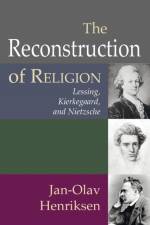
The Reconstruction of Religion explores the thoughts of three influential philosophers--G. E. Lessing, Soren Kierkegaard, and Friedrich Nietzsche--looking in particular at their influential approaches to the relationship between religion and modernity.In a period of a little more than one hundred years, Lessing, Kierkegaard, and Nietzsche each developed a different theory of religion. Rejecting the possibility of maintaining religious faith on the old foundation of church tradition, these thinkers formulated new ways of understanding religion in response to the challenges of modernity. Though the conclusions of each system are different, there remain important elements in common between them, such as the importance of ""religious subjectivity."" Jan-Olav Henriksen compares and contrasts the thought of Lessing, Kierkegaard, and Nietzsche, showing that each of these philosophers still has something important to contribute to understanding religion in our own postmodern era.For anyone interested in the position of religious belief in today's world, these reconstructions of religion are of great value. In addition to their place in the history of ideas, these three philosophical approaches anticipate some of the recent issues relating to religion in postmodernity. Henriksen's perceptive work moves beyond the level of historical analysis to insightful rereadings of Lessing, Kierkegaard, and Nietzsche that help us better understand the place of religion in our pluralistic society.
What is worship? Are the things we do in worship mere ritual, or do they have meaning? Why do we do these things, anyway? Worship is one of our most important acts, and it serves several purposes. In worship, we honor the God who has done so much for us. We communicate to him that we are on his side. We educate our children, leading them into a deeper relationship with Jesus. And we communicate to Satan that we're on God's side, for worship is both an act of solidarity and an act of war.But how best to communicate in worship? Traditional singing is often simply a transition to another part of the service, and for some worshippers, the songs' very familiarity can be deadening.Into this context of familiarity comes contemporary worship with guitars and drums--as well as the new life found in new appreciation for a contemporary understanding of God. New music spawns renewal of our excitement, our appreciation of our relationship with Jesus, and our involvement in his program. We can no longer sit, heads down, as we read old thoughts in old hymnals. He is alive, and so are we.
In ascending to heaven, Jesus Christ gave the church the Great Commission to expand the gospel to all nations. Despite this biblical commission, it is still an unfinished task. As leaders of local churches, pastors play a crucial part in this endeavor. Pastoral leadership principles have varied widely throughout history, yet it is interesting to discover the similarities between pastoral leadership principles practiced by John Chrysostom (AD 347-407) in Antioch and Constantinople, and Won Sang Lee (1937-) in Washington, DC.Despite ministering 1600 years apart, both pastors share the same core values: care for people, Christ-like character, biblical preaching, and world missions. This suggests that continued emphasis on these principles will play a significant role in fulfilling the Great Commission, independent of time and place.
Life After Death takes an in-depth look at the important issues surrounding death. Does it matter what we believe? Why do we avoid talking about it? Can we confidently assume there is life after death? This book presents the Christian view of death and what lies beyond. It doesn't avoid the difficult questions of judgment and the possibility of missing out on all that God has planned for his people. However, for those who are searching for a real relationship with the living God, Life After Death presents a glorious message of hope and certainty. You don't have to go through life with any doubt about the future. On the contrary, if you are willing to accept all that God offers, on his terms, you will be able to look forward to an endless future in which you will experience all that God, in his infinite love and wisdom, has planned for you. You will also find a hope that will transform your goals, values, and understanding of every part of this present life.In every age death has held a perennial fascination for men and women and there is a plethora of ideas about death and especially what lies beyond--every religion has its philosophy on this matter ... How can we know about such things? Is your guess as good as mine? In this age of pluralism can we know the truth? Dick Tripp--in this excellent, helpful, and timely volume--leads us to the Christian's source book--the Bible--for meaningful answers. Answers that underscore once again what a loving, caring God we have who has made every provision that we could ever need to this life and for eternity. --From the foreword by Derek EatonFormer Bishop of Nelson and Assistant Bishop of CairoDick Tripp (MA, Cambridge) is a retired Anglican clergyman who has worked in parish ministry in the Diocese of Christchurch, New Zealand. He is the author of Why Did Jesus Die?: What the Bible Says About the Cross and The Biblical Mandate for Caring for Creation.
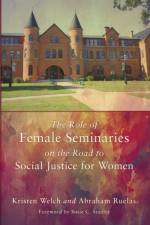
In the United States, female seminaries and their antecedents, the female academies, were crucial first institutions that played a vital role in liberating women from the "home sphere," a locus that was the primary domain of Euro-American women. The female seminaries founded by Native Americans and African Americans had different founding rationales but also played a key role in empowering women. On the whole, the initial intent of these schools was to prepare women for their proper role in American society as wives and mothers. An unintended effect, however, was to prepare women for the first socially accepted profession for women: teaching. Thus equipped, women played a crucial role in the development of American education at all levels while achieving varying degrees of social justice for themselves and other groups through engagement in the reform movements of their times--including women's suffrage, abolition, temperance, and mental health reform. By recapturing the role religion played in shaping education for women, Welch and Ruelas offer a refreshing take on history that draws on several primary texts and details more than one hundred female seminaries and academies opened in the United States.
Through brilliant new interpretations of biblical exiles, Daniel Smith-Christopher shows their experience as the most apt model for the Church as witnesses for the peace and justice of God in a strange land.
Handley C. G. Moule (1841-1920), evangelical Anglican bishop and academic, was one of the foremost New Testament scholars in the Church of England in the late nineteenth and early twentieth centuries. The author of more than sixty books and pamphlets, Moule followed in the English scholar-bishop tradition of Lightfoot and Westcott.A. W. Handley Moule (born 1903) is a great-nephew to Handley C. G. Moule. Educated at Brighton College, he is a historian and a former Scholar of Queens' College, Cambridge. He has read for Holy Orders at Wycliffe Hall, Oxford, and has traveled to Palestine. After teaching for a number of years, he was ordained in 1932 and has had extensive experience in London, in Lancashire and on the Continent. Since 1943, he has served as Rector of Woolhampton, Berkshire. This book has been composed by an experienced pastor and is the product of the last nine years of intermittent literary activity in an English country Parsonage.
Handley C. G. Moule (1841-1920), evangelical Anglican bishop and academic, was one of the foremost New Testament scholars in the Church of England in the late nineteenth and early twentieth centuries. The author of more than sixty books and pamphlets, Moule followed in the English scholar-bishop tradition of Lightfoot and Westcott.
H. C. G. Moule (1841-1920), evangelical Anglican bishop and academic, was one of the foremost New Testament scholars in the Church of England in the late nineteenth and early twentieth centuries. The author of more than sixty books and pamphlets, Moule followed in the English scholar-bishop tradition of Lightfoot and Westcott.
This may be the most honest book ever written about Jesus. As a veteran pastor in the United Church of Christ, Dr. Watson shares his thoughts on the timeless topic of Christology--the doctrine of Christ--with new and creative insights, informative and accessible theology, personal anecdotes, and lively wit. Nothing is off-limits in this no-holds-barred contribution to the Jesus genre. Big Jesus is not another theological ""spin"" on the identity and nature of Jesus of Nazareth, nor is it a sentimental fairytale for those who prefer their Christology to be served up on Sunday mornings with fluffy sheep, little children, and footprints in the sand. This book is for Christian adults with a sense of humor.""Jimmy Watson, being from West Texas, would understand the description of 'hitting someone with a two-by-four in order to get their attention.' Big Jesus is a literary slam against a long-accepted but seldom challenged Christology. In the spirit of George Carlin or Lewis Black, Watson uses satire and acerbic earthiness to kick some props out from under an ancient dogma. You may throw this book against the wall more than once. But pick it up and keep reading. There is something increasingly valuable here.""--Gary West, pastor, Grace Baptist Church, Statesville, NC ""Imagine that you are sitting in a rural Texas truck-stop diner overhearing a couple of guys at the next table talking about Jesus in the colorfully ribald and iconoclastic language of dismissive humor, and down home, mesquite grilled, thick steak, pickup truck driving, frankness. Now imagine that the two guys at the next table are Paul Tillich and Rudolph Bultmann. That's the sort of informed but accessible conversation Jimmy Watson has published in this nakedly honest work about the Jesus that can survive the critical thinking of the modern era . . . the only Jesus that's really worth talking about.""--Roger Ray, pastor, Springfield, MO and author of Progressive Faith and Practice""Watson invites us to accompany him on a wild, entertaining, enlightening, provocative quest for the flesh-and-blood Jesus among the likes of Big Jesus, Badass Jesus, and the Christinator. You've never read Bultmann, Brueggemann, or Borg? No problem. Watson explains the big-name Christologists in down-to-earth language, salting tough spiritual questions with laugh-out-loud humor. An honest guidebook for any fearless twenty-first-century pilgrim searching for a Jesus worth finding.""--Robert B. Pettit, Professor of Sociology, Manchester University, Manchester, UKJimmy R. Watson is a United Church of Christ pastor currently serving in the Indiana-Kentucky Conference. He is the author of Jesus Is Still Speaking through the Gospel of Mark (2011) and several ""Still Speaking"" devotionals for the United Church of Christ. He holds a PhD from Baylor University in the field of Theology and Ethics.
Exploring and Engaging Spirituality for Today's Children: A Holistic Approach answers questions about the most effective ways to help children, pre-teens, and teens develop spiritually. This collection of research gleaned from presentations during the Fourth Triennial Children's Spirituality Conference at Concordia University in 2012 is divided into four major sections: (1) theological and historical foundations, (2) engaging parents and congregations, (3) engaging methodologies, and (4) exploring children at risk, child pornography, social justice, intercultural diversity, and abstinence education. Researchers acknowledge that the home is the foundation for Christian nurture. In Exploring and Engaging Spirituality for Today's Children, both scholars and ministry leaders come together with parents to promote a holistic environment where children are encouraged to love, respect, and obey God. From birth to high school, children's voices resonate throughout these studies as they are invited to share their reflections and experiences. Exploring and Engaging Spirituality for Today's Children is a lively, easy-to-read collection that reflects a broad range of faith traditions and is ideal for all those who are committed to the spiritual development of children.
Abonner på vårt nyhetsbrev og få rabatter og inspirasjon til din neste leseopplevelse.
Ved å abonnere godtar du vår personvernerklæring.