
Norges billigste bøker

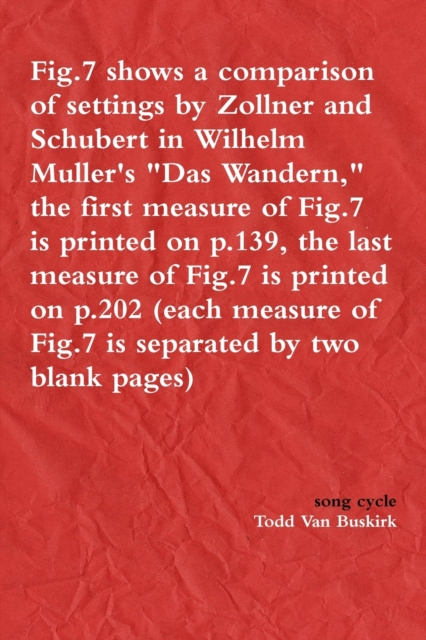
Fig.7 shows a comparison of settings by Zollner and Schubert in Wilhelm Muller's Das Wandern, the first measure of Fig.7 is printed on p.139, the last measure of Fig.7 is printed on p.202 (each measure of Fig.7 is separated by two blank pages)

Om Fig.7 shows a comparison of settings by Zollner and Schubert in Wilhelm Muller's Das Wandern, the first measure of Fig.7 is printed on p.139, the last measure of Fig.7 is printed on p.202 (each measure of Fig.7 is separated by two blank pages)

In a 1793 text called On the Sublime (Vom Erhabenen), Schiller argues that the mathematical sublime ought to be labeled the theoretical sublime. Most contemporary theorists feel uncomfortable about ascribing significance to inaudible relationships to music; we tend to assume that there should be some meaningful relationship between analysis and auditory experience. Now consider that any entity in a music system is a "thought-object." A music object cannot sound or be heard unless it is somehow converted into a thought-object. In order to generate a particular music object usually several thought-objects have to interact and finally undergo a synthesis process. The music domain is made of many different classes whose objects finally influence the performance. As a first approach, our music model distinguishes the following classes: Instrument, Generator, Note and Score. It is important to note that Van Buskirk's music model is object-oriented and not "event-oriented."

Vis mer
  • Språk:
  • Engelsk
  • ISBN:
  • 9781329093799
  • Bindende:
  • Paperback
  • Sider:
  • 360
  • Utgitt:
  • 29. april 2015
  • Dimensjoner:
  • 152x229x20 mm.
  • Vekt:
  • 526 g.
Leveringstid: 2-4 uker
Forventet levering: 6. april 2026

Beskrivelse av Fig.7 shows a comparison of settings by Zollner and Schubert in Wilhelm Muller's Das Wandern, the first measure of Fig.7 is printed on p.139, the last measure of Fig.7 is printed on p.202 (each measure of Fig.7 is separated by two blank pages)

In a 1793 text called On the Sublime (Vom Erhabenen), Schiller argues that the mathematical sublime ought to be labeled the theoretical sublime. Most contemporary theorists feel uncomfortable about ascribing significance to inaudible relationships to music; we tend to assume that there should be some meaningful relationship between analysis and auditory experience. Now consider that any entity in a music system is a "thought-object." A music object cannot sound or be heard unless it is somehow converted into a thought-object. In order to generate a particular music object usually several thought-objects have to interact and finally undergo a synthesis process.

The music domain is made of many different classes whose objects finally influence the performance. As a first approach, our music model distinguishes the following classes: Instrument, Generator, Note and Score. It is important to note that Van Buskirk's music model is object-oriented and not "event-oriented."

Brukervurderinger av Fig.7 shows a comparison of settings by Zollner and Schubert in Wilhelm Muller's Das Wandern, the first measure of Fig.7 is printed on p.139, the last measure of Fig.7 is printed on p.202 (each measure of Fig.7 is separated by two blank pages)


Finn lignende bøker
Boken Fig.7 shows a comparison of settings by Zollner and Schubert in Wilhelm Muller's Das Wandern, the first measure of Fig.7 is printed on p.139, the last measure of Fig.7 is printed on p.202 (each measure of Fig.7 is separated by two blank pages) finnes i følgende kategorier:

Gjør som tusenvis av andre bokelskere

Abonner på vårt nyhetsbrev og få rabatter og inspirasjon til din neste leseopplevelse.