Norges billigste bøker

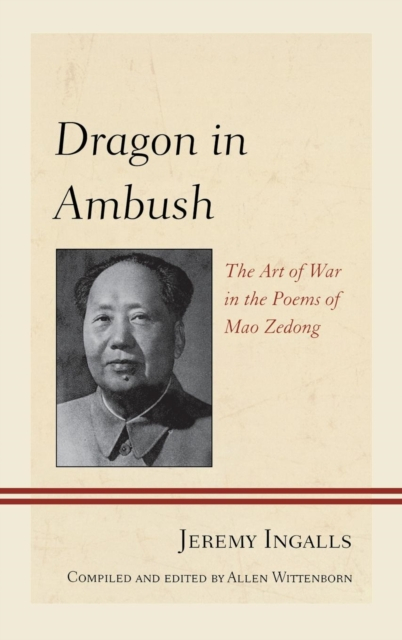
Dragon in Ambush

- The Art of War in the Poems of Mao Zedong

Om Dragon in Ambush

Dragon in Ambush by Jeremy Ingalls is a critique and new translation of the first twenty poems of Mao ZedongΓÇÖs published poetry. This seminal work stands out from previous translations of MaoΓÇÖs poems in seeing them as an expression of his core political beliefs, rather than for their poetic effect. Instead, Dr. Ingalls shows in consummate detail that Mao was careful and deliberate in employing imagery in his poetry to lay out procedures for political supremacy in which the central drive was his will to psychological domination. That is, domination of the minds of others is the unifying theme of MaoΓÇÖs verse-sequence.The crux of Prof. IngallsΓÇÖ work lies in her focus on the symbolism in the poems. The poems are, in MaoΓÇÖs use of them as a means of communication, meaningless on their surface. No image, however seemingly commonplace, is ever employed for merely lyrical or aesthetic description. Every image functions as a factor in an entirely political calculus. According to Dr. Ingalls, ΓÇ£When Mao mentions streams or mountains, suns or moons, clouds or winds or icicles, horses, elephants, snakes, tigers, leopards or bears, specifies kinds of trees or birds or fish, flies, brooms, mats or bridges, these and all his other images have, as their primary function, neither happenstance descriptions nor whimsical metaphor. They all have politically symbolic functions in MaoΓÇÖs algebra of versified political discourse.ΓÇ¥ Furthermore, in her analysis, Prof. Ingalls downplays the significance of Marxism-Leninism in the Thought of Mao Zedong. She shows that throughout his career, Mao regarded Marxism-Leninism as a political convenience, not as a doctrine permanently essential to his master-plan. Just as Mao used the Nationalists of Chiang Kai-shek and StalinΓÇÖs Soviet Union as means to further his own political ambitions, so did he manipulate Marxist-Leninist ideology to hoodwink and attract, at home and abroad, professional revolutionaries to help do his bidding. MaoΓÇÖs aims express, in their worldviews, an entirely Chinese tradition. In his poems MaoΓÇÖs dialectics, his materialism, and his authoritarianism all take their points of reference from within the Chinese cultural order. Dragon in Ambush is a thoroughly unique and revolutionary approach to understanding the Mind of Mao Zedong.

Vis mer
  • Språk:
  • Engelsk
  • ISBN:
  • 9780739177822
  • Bindende:
  • Hardback
  • Sider:
  • 420
  • Utgitt:
  • 16. mai 2013
  • Dimensjoner:
  • 156x236x32 mm.
  • Vekt:
  • 830 g.
  Gratis frakt
Leveringstid: 2-4 uker
Forventet levering: 25. mai 2026

Beskrivelse av Dragon in Ambush

Dragon in Ambush by Jeremy Ingalls is a critique and new translation of the first twenty poems of Mao ZedongΓÇÖs published poetry. This seminal work stands out from previous translations of MaoΓÇÖs poems in seeing them as an expression of his core political beliefs, rather than for their poetic effect. Instead, Dr. Ingalls shows in consummate detail that Mao was careful and deliberate in employing imagery in his poetry to lay out procedures for political supremacy in which the central drive was his will to psychological domination. That is, domination of the minds of others is the unifying theme of MaoΓÇÖs verse-sequence.The crux of Prof. IngallsΓÇÖ work lies in her focus on the symbolism in the poems. The poems are, in MaoΓÇÖs use of them as a means of communication, meaningless on their surface. No image, however seemingly commonplace, is ever employed for merely lyrical or aesthetic description. Every image functions as a factor in an entirely political calculus. According to Dr. Ingalls, ΓÇ£When Mao mentions streams or mountains, suns or moons, clouds or winds or icicles, horses, elephants, snakes, tigers, leopards or bears, specifies kinds of trees or birds or fish, flies, brooms, mats or bridges, these and all his other images have, as their primary function, neither happenstance descriptions nor whimsical metaphor. They all have politically symbolic functions in MaoΓÇÖs algebra of versified political discourse.ΓÇ¥ Furthermore, in her analysis, Prof. Ingalls downplays the significance of Marxism-Leninism in the Thought of Mao Zedong. She shows that throughout his career, Mao regarded Marxism-Leninism as a political convenience, not as a doctrine permanently essential to his master-plan. Just as Mao used the Nationalists of Chiang Kai-shek and StalinΓÇÖs Soviet Union as means to further his own political ambitions, so did he manipulate Marxist-Leninist ideology to hoodwink and attract, at home and abroad, professional revolutionaries to help do his bidding. MaoΓÇÖs aims express, in their worldviews, an entirely Chinese tradition. In his poems MaoΓÇÖs dialectics, his materialism, and his authoritarianism all take their points of reference from within the Chinese cultural order. Dragon in Ambush is a thoroughly unique and revolutionary approach to understanding the Mind of Mao Zedong.

Brukervurderinger av Dragon in Ambush


Finn lignende bøker
Boken Dragon in Ambush finnes i følgende kategorier:

Gjør som tusenvis av andre bokelskere

Abonner på vårt nyhetsbrev og få rabatter og inspirasjon til din neste leseopplevelse.
