




























Gjør som tusenvis av andre bokelskere
Abonner på vårt nyhetsbrev og få rabatter og inspirasjon til din neste leseopplevelse.
Ved å abonnere godtar du vår personvernerklæring.Du kan når som helst melde deg av våre nyhetsbrev.

Das Erleben und Verhalten von Konsumenten wird maßgeblich über die Wahrnehmungs- und Aufmerksamkeitsprozesse eines Individuums bedingt. Um die Neugier der Kunden aufrechtzuerhalten, entwickelt der Handel daher immer wieder neue Konzepte. Dabei gewinnen Pop-Up-Stores zunehmend an Bedeutung. Welchen Einfluss hat die Emotion Neugier auf das Kaufverhalten der Kunden? Wie funktioniert Guerilla-Marketing? Steigt die Bereitschaft zur Weiterempfehlung, wenn Kunden einen Pop-Up-Store besuchen? Inwiefern beeinflusst die Neugier auf einen Pop-Up-Store die Kaufabsicht? Martina Töpfer gibt einen umfassenden Überblick über das innovative Handelsformat Pop-Up-Stores. Sie zeigt, wie Einzelhändler, Projektentwickler und Städte mit solchen Temporary-Stores sowohl die Neugier als auch das Kaufinteresse von Kunden wecken können. Dabei fokussiert sie sich auf den Einfluss von Emotionen auf die Verhaltensabsicht von Individuen. Aus dem Inhalt:- Word of Mouth;- Neugier;- Retail;- Guerilla-Marketing;- Emotionen;- Kaufabsicht
Das Digital Age verändert die Lebenswelt von Konsumenten und jegliche Sektoren der Wirtschaft nachhaltig. So können sich 42 Prozent der Deutschen vorstellen, künftig größtenteils oder sogar ausschließlich online einzukaufen. Der E-Commerce hat immens an Bedeutung gewonnen.Welche Auswirkung das auf das Brand Management von Unternehmen hat, zeigt Alina Orlamünder in dieser Publikation. Wie gestalten Unternehmen eine optimale Digital Brand Experience für die Zielgruppe der Digital Natives? Welche neuen Anforderung stellen diese Kunden überhaupt an ein Unternehmen? Und wie entwickelt man sich zur Love Brand?Nie zuvor waren Interaktion, ein unvergessliches Erlebnis und eine vertiefende Beziehung zwischen Usern und Brand wichtiger. Die Verknüpfung einer überzeugenden Brand Experience mit digitalen Touchpoints ist heutzutage unentbehrlich. Wie das gelingt, zeigt Alina Orlamünder mit ihrem vielseitig einsetzbaren Konzept zum Brand Management in Unternehmen.Aus dem Inhalt:- Kundenverhalten;- Uniqueness;- Branded Interaction;- Nutzerorientierung;- Brand Touchpoints
Infolge des fortschreitenden digitalen Wandels müssen Unternehmen ihre Marketingaktivitäten an die Nutzungsgewohnheiten der Zielgruppe anpassen. Immer mehr Menschen und damit potenzielle Kunden sind auf Social-Media-Plattformen aktiv. Social Media Marketing und Influencer Marketing gewinnen somit zunehmend an Bedeutung. Ist Influencer Marketing ein überschätzter Trend oder ein effizientes Kommunikationsinstrument für die Zukunft? Wie lässt es sich als strategisches Marketinginstrument einbauen? Inwiefern eignet sich Instagram als ein Marketingkanal? Welche strategischen Ansätze ermöglichen ein langfristig erfolgreiches Influencer Marketing auf Instagram?Maschal Haider untersucht die Bedeutung des Influencer Marketings als strategisches Marketinginstrument. Dabei erörtert sie die Chancen und Risiken von Instagram als Marketingkanal und stellt ein Konzept für die erfolgreiche Anwendung von Influencer Marketing auf Instagram vor. Führungskräften und Managern aus dem Bereich Marketing und Kommunikation gibt sie Handlungsempfehlungen für zukünftige Maßnahmen im Influencer Marketing. Aus dem Inhalt:- Social Media Marketing;- Web 2.0;- Kommunikationspolitik;- User Generated Content;- Kaufentscheidungsprozess
If you want to learn how Social Media Marketing can grow your business to heights you never thought possible then keep reading...
If you want to dominate Social Media in 2019 and beyond then keep reading...
If you want to learn how to DOMINATE Social Media in 2019 and beyond then keep reading...
Marketing: A Relationship Perspective is back for a second edition and continues to set a benchmark for achievement in introductory marketing courses across Europe. It is a comprehensive, broad-based, and challenging basic marketing text, which describes and analyzes the basic concepts and strategic role of marketing and its practical application in managerial decision-making. It integrates the 'new' relationship approach into the traditional process of developing effective marketing plans. The book's structure fits to the marketing planning process of a company. Consequently, the book looks at the marketing management process from the perspective of both relational and transactional approach, suggesting that a company should, in any case, pursue an integrative and situational marketing management approach. Svend Hollensen's and Marc Opresnik's holistic approach covers both principles and practices, is drawn in equal measure from research and application, and is an ideal text for students, researchers, and practitioners alike.PowerPoint slides are available for all instructors who adopt this book as a course text.
This book shows how to build and maintain a distinctive and credible employer brand, and develop a set of relevant success metrics to help measure ROI. Starting with the current interest in employer branding, this book looks at the historical roots of brand management and the practical steps to achieve employer brand management success.
This edited book applies to tourism a humanistic management approach entailing a re-discovery of the value of human life and awareness of the ethical side of work. The book develops awareness of the contemporary relevance of the human dignity concept to manage the weaknesses of traditional approaches to tourism and cope with challenges.
This book gathers a selection of contemporary research works dedicated to open internationalization, either seen as a way to analyse expansion in foreign countries, or as a way to investigate the management of geographically dispersed activities.
This book presents issues faced by planners of production and distribution operations in terms of smart manufacturing and sustainability, using efficient quantitative techniques in a variety of decision-making situations.
This book articulates a clear and persuasive argument for the development of compassion in higher education in a global climate of increasing competition, complexity and uncertainty.Drawing upon a range of interdisciplinary, theoretical and professional perspectives, the book addresses the key challenges facing the 21st century university.
The price of a product or a service is a critical element of the marketing mix. Price influences product demand, and the firm's revenue and profits. Prices also signal product quality and value, customer self-image, and the seller's pricing practices. With appropriate balance of theory, applications, and analytics, this book provides business students and practitioners the tools to make profitable pricing decisions under a variety of real-life contexts - current and emerging.Theoretical foundations for pricing decisions come from microeconomics, psychology, and behavioral decision theories. Well-established economic principles, with available data and analytics, help firms customize prices based on customers' willingness to pay, quantity purchased, timing and urgency of purchase, and by bundling their products and services. Pricing and promotional strategies of firms are further informed by the consideration of consumer psychology as well as the decision rules that consumers employ in framing of and responding to prices.As a practical step-by-step guide for firms, the book presents a comprehensive framework for pricing decisions. The framework illustrates how firms' pricing decisions are shaped by customer valuation of the product or service, firm cost, and competition within the category. Additional considerations include: channel arrangements, legal and regulatory limits, public sentiments, and the overriding strategy for the firm. Short cases and numerical examples help illustrate how these factors can be incorporated in firm making decisions.In addition to offering the theoretical foundation and practical guidelines for pricing, there are several distinctive features of the book.Although customer valuation is central to pricing decisions, firms often struggle to reliably estimate value. The book offers a number of analytical approaches for estimating customer valuations of product and service attributes.In addition to the usual cost-based price determination, the book provides guidance for firms in developing pricing policies when costs to serve vary from customer to customer - a feature frequently seen in many services. Additionally, it provides an overview of commercial and government procurement contracts to demonstrate how the client and the vendor use contracts to manage cost-related risks.When firms with fixed capacity face fluctuating demand, firms set prices to balance the demand and capacity to serve. The book presents an overview of dynamic pricing strategies for perishable services, with particular focus on hospitality, airline, and rideshare industries.In keeping with current trends of online shopping, the text highlights the pricing issues related to electronic retailing, including online experiments to estimate price effects, identifying demand dependencies through collaborative filtering, and managing prices under omnichannel shopping by customers.The book concludes with some guidance for firms on how to create a pricing organization within a firm for implementing and monitoring pricing strategies.Pedagogically, the book takes a quantitative approach to pricing decisions and places a special emphasis on the utilization of data and analytics. Nevertheless, sound intuition and judgments remain a prerequisite.
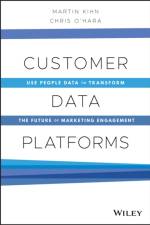
Master the hottest technology around to drive marketing successMarketers are faced with a stark and challenging dilemma: customers demand deep personalization, but they are increasingly leery of offering the type of personal data required to make it happen. As a solution to this problem, Customer Data Platforms have come to the fore, offering companies a way to capture, unify, activate, and analyze customer data. CDPs are the hottest marketing technology around today, but are they worthy of the hype? Customer Data Platforms takes a deep dive into everything CDP so you can learn how to steer your firm toward the future of personalization.Over the years, many of us have built byzantine "stacks" of various marketing and advertising technology in an attempt to deliver the fabled "right person, right message, right time" experience. This can lead to siloed systems, disconnected processes, and legacy technical debt. CDPs offer a way to simplify the stack and deliver a balanced and engaging customer experience. Customer Data Platforms breaks down the fundamentals, including how to:* Understand the problems of managing customer data* Understand what CDPs are and what they do (and don't do)* Organize and harmonize customer data for use in marketing* Build a safe, compliant first-party data asset that your brand can use as fuel* Create a data-driven culture that puts customers at the center of everything you do* Understand how to use AI and machine learning to drive the future of personalization* Orchestrate modern customer journeys that react to customers in real-time* Power analytics with customer data to get closer to true attributionIn this book, you'll discover how to build 1:1 engagement that scales at the speed of today's customers.
Abonner på vårt nyhetsbrev og få rabatter og inspirasjon til din neste leseopplevelse.
Ved å abonnere godtar du vår personvernerklæring.