















Gjør som tusenvis av andre bokelskere
Abonner på vårt nyhetsbrev og få rabatter og inspirasjon til din neste leseopplevelse.
Ved å abonnere godtar du vår personvernerklæring.Du kan når som helst melde deg av våre nyhetsbrev.

Toxic work culture is driving away 1 in 5 employees at an annual cost of US $44.6 billion to American organizations. Yet ironically, toxic leaders often achieve stellar financial profits, continue to get promoted and remain in their leadership roles. In Toxic Leaders and Tough Bosses - Organizational Guardrails to Keep High Performers on Track, employment law attorney Teresa A. Daniel JD, PhD, draws upon numerous studies and interviews to show the real, devastating impact of toxic workplace culture and why leaders must care. This book discusses what signs to look out for in a toxic workplace, factors that promote toxic behavior, types of leaders and how they impact their organization, the role of HR in managing employee wellbeing, and what to look out for in exceptional leaders. With evidence-based strategies for building stronger workplace culture, including tools to help organizations develop better leaders and managers, it makes a compelling case for eradicating toxic leaders as a priority. Toxic Leaders and Tough Bosses is for organizational leaders, mid-level managers, supervisors, HR practitioners and anyone else invested in implementing new, tried and tested ideas to improve their organization's culture to create and sustain its optimum success.
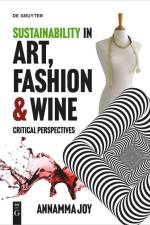
The art, fashion and wine industries are currently at various stages in their efforts to embrace and transition towards sustainability. While sustainability commitments are a necessary condition for progress, they are not sufficient. Instead, there is a need for sweeping transformative change that includes giving serious consideration to indigenous worldviews without recolonizing them. Sustainability in Art, Fashion and Wine includes findings from recent research and contributes to a new understanding of familiar concepts such as sustainability, (de)colonization and corporate responsibility in the art, fashion and wine industries by adopting critical lenses and incorporating them with innovative perspectives on circular business models and digitalization. It endeavors to present remedies for effectively combating climate change and promoting social good. While discussing specific issues such as sub-contracted labor, safe working conditions, living wages, environmental degradation, mismanaged waste, and more, the book argues that recognizing the significant role western colonization has played - and continues to play - in the developing world in our current conception of capitalism is itself unsustainable. To understand the true meaning of sustainability - to fully recognize the looming deadlines we face in combating the climate crisis and instituting sustainability as a new normal - the acceptance of a new conception of capitalism, one antithetical to colonization and exploitation, is required. Contributors to this book address these issues by applying a critical studies approach to their respective chapters, allowing the book to set out what real sustainability could and should look like in the art, fashion and wine industries.
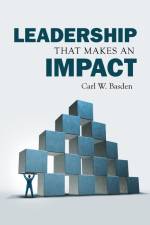
Leadership That Makes an IMPACT presents a practical leadership model that is easy to understand, remember, and apply. The model was developed by the author's personal experiences and his recognition of the key factors that contribute to the making of great leaders, whether in the workplace or at home. The book provides support for the various components of the model and is chock-full of examples, many of them humorous, that underscore the importance of the values presented. The author utilizes a common-sense approach to leadership that is designed to benefit someone stepping into a leadership role for the first time or an experienced leader who is still open to learning.I've had the privilege of knowing Carl for many years. I've worked side by side with him and witnessed his effectiveness. He's the kind of leader we all aspire to be like and would love for our children to emulate. His leadership model doesn't go out of style.--Darrell G. Cooper, Vice President of Security at UnifiWorking with Carl over the years at BellSouth and then ATandT showed me that he lives the IMPACT leadership model regardless of the environment. It is who he is! It has been my honor and pleasure to know Carl as a person, work with and learn from him professionally, and have the privilege of calling him my friend. Thank you for the impact you have had on me personally and professionally, Carl!--Mike Hargrove, PE, Vice President of Network Engineering and Operations at ATandTCarl Basden's passion for developing young talent is unmistakable in this lucid guide to his proven leadership approach. Packed with real-world stories and advice that can be modeled immediately, this book will benefit anyone desiring to become a better leader.--Jeffrey C. Schmidt, PE, Executive Vice President at MasTec Utility Services
I often laugh when I think about leading the next generation, really the current generation! It is difficult! They are different! Honestly, I have to assume I am part of the collective "generation" that we so often refer to as "the hard ones". It wasn't until I had an epiphany about leading the next generation that I realized we are doing it all wrong. They, WE, are looking for something different than the old-school "work-work" balance generations. We are looking for a better balance of life, work, and luxury. As leaders try to dig in and keep things the same, this generation is leaving the workforce and becoming a force to be reckoned with. They are different, they are smart, and they are thinking outside of the box to get what they want. As leaders, we need to embrace them. Embrace their differences. Embrace the difficulties so we can come out on the otherside with them, not against them.Let me show you how to Lead the Next Generation with my top 12 strategies for keeping up with the ever changing workforce. Let me take you into a look at how I did it, became successful, and created a following. Yep, you heard me a following! A following of the @nextgen. We are evolving, and as a leader, you should want to keep up.-Mackenzie Brown, CNMIntroductionAs a leader, you will go through hardship. You will have a vision, and you will see your vision fail; trust me it will fail in some way. But when you dig into the failure, you will see it through to success. This can happen over and over. You will grow something incredible when you keep pushing. Let yourself evolve during the good and the bad, and become the leader that you are meant to be. Stop saying no, say yes! Ask Jesus how you can serve and listen.Let me be clear before we dive in; I am not a leadership guru who writes novels on leadership styles. I will not tell you how to plan, do, study, and act. I will not tell you how to write a budget, or keep a budget. I do not have decades and decades of experience to bring to you and tell you this works and will forever work. I have four college degrees that may seem fancy, but everything I have to offer came from personal experience in the trenches leading a team. What I want to offer you are skills and strategies that I have used in real time. Skills that I have learned, re-learned, and groomed to use appropriately in all situations as a leader. These skills have worked over and over for me, and anyone that has worked alongside me will share with you the magic that happens when the team is led and not managed. I have used this strategy in nursing, but the tools I have gained and groomed can be implemented in any setting with the right mindset. I have taken something completely broken and with the help of an entire team, put it back together better than before.It takes patience, passion, and perseverance for this system to work. I can give you tools to use tomorrow to begin or transform your journey into leadership; to build your team into something magical. I am going to share my top twelve strategies to become a successful leader that generate a following of people that will never let you down.
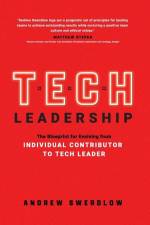
Tech pioneer Andrew Swerdlow helps the next generation move from individual contributors to effective leaders.
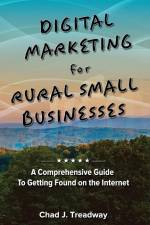
Looking for help growing your rural small business? Discover the tools and techniques to master digital marketing and stake your digital presence today.
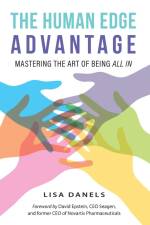
74 gigabytes (GB): This is the average amount of data our brains process each day, a number that is escalating. As the amount of information continues to increase, the business world becomes more complex, and workers at all levels end up feeling exhausted, leaders must find new ways to unify, inspire, and drive their organizations forward.In The Human Edge Advantage, author Lisa Danels guides leaders on the art of being all in-how to create a wondrous space in which co-creation, collaboration, and creativity flourish, and workers create meaningful connections that lead to breakthroughs and results. This exhaustively researched book is divided into four parts:Part I, "Integrating Head, Heart, and Gut": Ground-breaking tools and techniques to help you understand how to open your mind (your power to think), your heart (your power to feel), and your gut (your power of intuition).Part II, "Cultivating Personal Power": Effective approaches to hone your awareness of all that you are, so that you can leverage your full self from moment to moment: in your experiences, interactions, decision-making, and understanding.Part III, "Connecting with Others": Proven methods on how to deepen and expand your relationships, so that your leadership becomes a powerful interaction with the team.Part IV, "Co-Creating Possibilities": Creative guidance on how to use your connections to spark insight, innovation, transformation, and new possibilities.Filled with useful exercises, revelatory case studies, and practical strategies, The Human Edge Advantage is an invaluable tool to help you create meaningful connections and bring everyone all in.
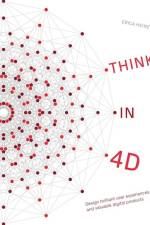
Think in 4D pushes the tech industry to think beyond 2D designs and 3D experiences to 4D impacts. More than 500 illustrations, 40 exercises, and a collection of free templates help any student, professional, or entrepreneur level up.
Apney Sapney kaise sakaar karyen main aap apni wastvik sambhavnao ko kholne ka tarika seektey huy atm khoj aur vyaktigat vikas ki prenadayak yatra par niklenge, aapka utsah badega aur safal honey ki mansikta viksit hogi jo safalta key rasty ko kholti hai. Is guidebook main saflta key mool sidhant, swayan vishshghatya prapt karney key tarike aur appko prabhavi Lakshya nirdharan karney ki kala main marg nirdeshan kartey hain aur sapno ko vastvikta main badlney key liya vyavaharik rannitian Pradhan kartey haina. Anek kahaniyon aur dirghdarshi abhyason key vivran key saath yeh pustak aapko rukavaton ko paar karney aur atmasandeh ko prast praney aur samsayon ko path pathron main badlaney key liya awashyak dharya utpann karney main sahayak hogi.Chahey aap aik utkrasht udyami hon, career key liya prarit peshwar hon ya kisi ko aik santosh purn Jeevan bananey ka irada ho, apney sapney kaise sakaar karey aapko purv ganit manbhrantiyaon avam simayon sey mukt honey, apni suptshaktiyon ko angikaar karney and mahanta ki aur agrasar honey key liya rasta dikhati hai. Apney Jeevan ko uchhtam satr par uthayan, apni sambhanayon ko prakat karey aur saflata marg par dheergakalik uplabdhi aur purnta ki aur badyen.
A book for turbulent times, When Not If is essential reading for anyone preparing to lead through crisis and change. Jeff Martinovich's gripping story of resilience and perseverance is carefully interwoven with actionable lessons from a CEO who journeyed from zero to a billion, only to be reduced back to zero - and a shocking 14-year prison sentence.True, not every reader will experience the trials faced by Jeff. The circumstances of the crisis will differ, but the responses Jeff advocates will bear fruit in most all situations. When Not If gives readers a toolkit of proven practices, behaviors, and actionable takeaways that prepare leaders to survive when the black swan knocks on their front do or.So if you're ready to take your leadership skills to the next level and emerge stronger from any crisis, When Not If is a mandatory guide for you.
This publication features the rules of procedure for the Antarctic Treaty Consultative Meeting (ATCM), the rules of procedure of the Committee for Environmental Protection (CEP) and other valuable texts for delegates to the ATCM and CEP meeting. It also includes a table with information on the status of countries that participate in the Antarctic Treaty system and a list of Antarctic Meetings. This short book is updated every year in English, French, Russian and Spanish.
This book presents the integrating of economics and urban geography to create a framework of cooperation around the idea of urban economic stability. It explores these disciplines through the economic lens and creates a collaborative environment for addressing the global challenges caused by the COVID-19 pandemic and future global shocks. Environmental advocates and proponents of economic growth are increasingly at odds¿having looked at the economic impact of the decline of the environment as well as the environmental loss that occurs with unchecked growth and urbanization. The outbreak of the COVID-19 pandemic changed the global scene. The world shook in its foundations, as a number of countries¿ lockdown affected not only the global economy but also society and the environment. The global community has seen the negative impact of COVID-19 on our economies. There have been steep declines in gross domestic product, job losses have been in the millions, and people have seen their incomes fall. An unplanned shutdown has taken its toll and has been a shock to the economies of the world. Past shocks and how they have impacted urban economies as well as for how long are core to bettering our understanding of present and future urban economic change. The underlying economic factors that make a shock more damaging to certain economies or industries, as well as understanding these vulnerabilities, help entities recover from economic shocks and allow them to better understand how impacts on individual businesses can be implemented. The pandemic revealed the need to adopt a global development approach, taking into consideration four dimensions: global value chains, debt, digitalization, and the environment. Topics related to the causation and lockdown are explored through a number of case studies from around the world.
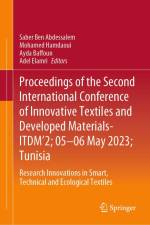
This book includes selected articles from the 2nd International Conference on Innovative Textiles and Developed Materials (ITDM¿2) held in Monastir, Tunisia, on May 5 and 6, 2023. The articles present latest scientific concepts and technological advances in innovative and sustainable textile materials and processes worldwide. The conference promotes exchange of ideas and emerging technologies to foster collaboration between academia and industry.
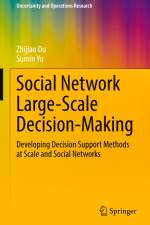
This book focuses on the following three key topics in social network large-scale decision-making: structure-heterogeneous information fusion, clustering analysis with multiple measurement attributes, and consensus building considering trust loss. To address the aggregation and distance measurement of structure-heterogeneous evaluation information, we propose a fusion method based on trust and behavior analysis. Then, two clustering algorithms are put forward, including trust Cop-K-means clustering algorithm and compatibility distance-oriented off-center clustering algorithm. The above clustering algorithms emphasize the similarity of opinions and social relationships as important measurement attributes of clustering. Finally, this book explores the impact of trust loss originating from social relationships on the CRP and develops two consensus-reaching models, namely the improved minimum-cost consensus model that takes into account voluntary trust loss and the punishment-driven consensus-reaching model. Some case studies, a large number of numerical experiments, and comparative analyses are provided in this book to demonstrate the characteristics and advantages of the proposed methods and models. The authors encourage researchers, students, and enterprises engaged in social network analysis, group decision-making, multi-agent collaborative decision-making, and large-scale data processing to pay attention to the proposals presented in this book. After reading this book, the authors expect readers to have a deeper and more comprehensive understanding of social network large-scale decision-making. Inorder to make it more accurate for readers to understand the methods and models presented in this book, the authors strongly recommend that potential readers have a good research foundation in fuzzy soft computing, traditional clustering algorithms, basic mathematics knowledge, and other related preliminaries.
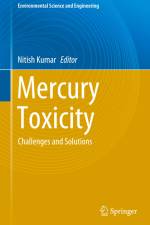
This book presents mercury toxicity with respect to remediation and health issues. It covers sources of mercury contamination, its impact on human health, and prospective remediation by both bioremediation and phytoremediation with the application of recent advanced techniques such as genetic engineering and nanotechnology.Both anthropogenic activities and natural processes cause the release of mercury into different spheres of the environment resulting in severe adverse impacts. Increased anthropogenic discharge of mercury leads to disturbance in its natural biogeochemical cycle, which results in unenviable diseases and hazardous health effects. Mercury pollution is responsible for causing neurobehavioral, kidney, heart, gastrointestinal, liver, and other diseases. Many published works about the impact of mercury on health are also available worldwide; however, there is no complete understanding available on toxicological studies of mercury that covers the broader spectrum of findings ranging from sources of exposure to mercury toxicity to its remediation strategies.This book brings together a diverse group of environmental science, sustainability, and health researchers to address the challenges posed by global mass poisoning caused by mercury contamination. The book also proposes solutions to contamination through multi-disciplinary approaches.The book contains three sections. The first part describes the different sources and distribution of mercury in soil and plant ecosystems. The second part explains the health risks linked to mercury toxicity. The third part addresses sustainable mercury toxicity mitigation strategies and the potential applications of recent technology in providing solutions. This book is a valuable resource to students, academics, researchers, and environmental professionals working in the field of mercury contamination.
This book explores the relationship between pedestrians/cyclists¿ mode and route choice to/from metro/railway stations and the micro-level (street-scale) built environment in a second-tier city in China. More specifically, it investigates how the street-scale built environment influences pedestrians/cyclists¿ mode choice and route choice behavior and examines user preferences for the micro-level built environment around metro stations. The focus on a second-tier city is motivated primarily to expand the set of Chinese cities where the effects of the built environment on pedestrian/cyclist mode and route choice have been studied. Results demonstrate the effects of the street-scale built environment on pedestrian flows. The effects are higher for the main road, which is directly connected with the metro station. The findings of this book are expected to support the design of preferred walking/biking built environments around a metro station. This book appeals to urbanists, planners, engineers, policy makers, and those interested in a wide-ranging overview of slow/green transportation and built environment promotion. These methods not only help to understand the quantitative relationship between built environment design and travel behavior but also support the evaluation and assessment of built environment design in urban planning projects. It reduces the gap in our understanding of the quantitative relationship between the micro-level built environment and pedestrians/cyclists¿ transportation mode and route choice around the metro station. Both stated choice data and revealed choice data were used. An extended set of micro-level built environment attributes was developed. Besides the widely studied transportation-related factors, street-level built environment factors were studied using quantitative methods.
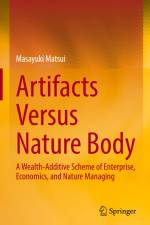
This book proposes a wealth-additive scheme of managing and maximizing (win¿win and sharing) the marginal value (eco-entropy) of artifacts by humanizing the artifacts¿ enterprise and their economics with nature. This type of clockwork would be achieved on a base of the science of nature versus artifacts and the body of science in my Springer books since 2008. My books are advancing factory science, economics, and the science of artifacts and play their role in the sandwich theory and its pair-map microcosm of the 3D-type, toward the development of body science. Then, the wealth-additive goal of the ¿body¿ is not only similar to the marginal profit, GDP, and value in economics, but also means the marginal diversity (eco-entropy) and its wealth of economics versus reliability (sustainability) in the body of the world. The modern world, for example, is faced with deadlocked negotiations over the Sustainable Development Goals (SDGs) bodies at the United Nations. Thus, the forthcoming world of SDGs would be much better and more constructive at transforming traditional bodies of the 3M&I class (human, material, money, and information) as some nano (gene/therblig)-transformation toward eco-entropy(marginal value/diversity) on earth. This semi-visible world is traditionally limited to a molecular size and is too rough at the practical rig-level. Thus, any unsolved and invisible contradictions left behind on earth are subject to SDGs in the practical world. This approach proposes a visible method that could find and solve these contradictions (angles) by transforming the artifact's body, consisting of the 3M&I gene. The pair-map microcosm and its Matsui's M-equation have been designed mainly based on nature and science books on artifacts (in 2016 and 2019). Following these visible methods, our well-being subject might be able to make a breakthrough or make such unsolved contradictions or stalemates subside as any SDGs society of individuals in the near future.Finally, the book will explore and construct a new academic discipline involving 3M&I body science versus cybernetics. And, the study introduces validation cases of convenience stores, self-driving cars, and robotization (individualization) of artificial objects as the realization of the supply¿demand system and the ideal form of artificial and natural bodies. Based on this perspective, the dialogue is conducted according to a creative structure of six parts, twelve chapters, and two appendices.
This book aims at providing cases with inspiring findings for global researchers in capacity allocation and reservation. Capacity allocation mechanisms are introduced in the book, as well as the measures to build models and the ways to achieve supply chain coordination. In addition, it illustrates the capacity reservation contract and quantity flexible contract with comparisons and some numerical studies. The book is divided into 7 chapters. Chapter 1 introduces the background and the latest development of the research. Chapter 2 introduces how to manage downstream competition through capacity allocation in symmetric market, including proportional mechanism and lexicographic mechanism. Demand competition is introduced in Chapter 3 as well as the uniform allocation mechanism and the comparisons among three different mechanisms. In Chapter 4, we give information about demand competition with fixed factor allocation, and the comparison with other allocations. Chapter 5 provides the optimal strategies under fixed allocation with multiple retailers and the impacts of fixed proportions. Chapter 6 illustrates how to achieve supply chain coordination through capacity reservation contract and its comparison with the quantity flexibility contract, and in Chapter 7 we describe outsourcing decisions and order policies in different systems with some numerical studies. We sincerely hope that this book can provide some useful suggestions and inspirations for scholars around the world who have the same interests in this field.
This book presents a methodology for assessing environmental safety in civil aviation. The methodology allows the comparison of different technological processes and evaluates their impact on the environment. At the same time, the medical and demographic indicators for ecologically unfavorable territories are compared with similar indicators in the control (background) territories in the same climatic and geographical zones. This book contains methodological recommendations for the creation of the system for ecology safety in the organizational structures of civil aviation. This book is useful to a wide audience-students of aviation, lecturers, as well as specialists in the field of ecology and those involved in ensuring the necessary ecology requirements at aviation enterprises.
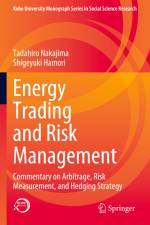
This book introduces empirical methods for analyzing energy markets. Even beginners in econometrics and mathematical finance must be able to learn how to utilize these methodologies and how to interpret the analysis results. This book provides some example analyses of the North American, European, and Asian energy markets. The reader will experience some theories and practices of energy trading and risk management. This book reveals the characteristics of energy markets using quantitative analyses. Examples include unit root, cointegration, long-term equilibrium, stochastic arbitrage simulation, multivariate generalized autoregressive conditional heteroscedasticity (GARCH) models, exponential GARCH (EGARCH) models, optimal hedge ratio, copula, value-at-risk (VaR), expected shortfall, vector autoregressive (VAR) models, vector moving average (VMA) models, connectedness, and frequency decomposition. This book is suitable for people interested in the empirical study of energy markets and energy trade.
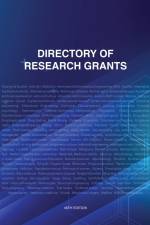
The 46th edition of this invaluable directory highlights over 3,500 current funding programs from thousands of sponsors, including U.S. and foreign foundations, corporations, state and government agencies, and other organizations. Find grants for basic research, equipment acquisition, building construction/renovation, fellowships, and 23 other program types. Government grants include CFDA, NSF, and NIH program numbers. Each record includes grant title, description, requirements, amount, application deadline, contact information (phone, fax, and email), Internet access, sponsor name and address, and samples of awarded grants (when available). Three indexes--subject, program type, and geographic--help you identify the right program quickly.
Harness expert insights from Google, Meta, and TikTok to ace product launch, delight your customers, and accelerate growth with inbound strategies and outbound tacticsKey FeaturesSharpen your product marketing skills to make an impact within your organizationUnlock deeper insights through real-world examples to shape product development and drive exponential growthDiscover product marketing strategies, templates, and frameworks in this one-stop guidePurchase of the print or Kindle book includes a free PDF eBookBook DescriptionIn the ever-evolving product landscape, the significance of building the right product and bringing it effectively to the right market cannot be overstated. With this book, you'll learn how to bridge the gap between your product and the market to meet customer needs effectively.Equipped with a comprehensive understanding of product marketing and its key functions-inbound and outbound strategies-you'll discover how these strategies interweave throughout the product launch process and how to effectively leverage them to bring a product to market.This product marketing book will help you master the inbound strategies, influencing product development by conducting market and customer research, analyzing the competitive landscape, identifying customer segments, and building buyer personas to identify gaps and drive product innovation.Next, you'll get to grips with outbound strategies, the driving force behind product adoption and sustained exponential growth. You'll create and test messaging and positioning, build the go-to-market (GTM) plan, enable your sales team to maximize effectiveness, and ensure a product-market fit throughout the different stages of the buyer journey with impactful collaboration internally and externally for creating value.By the end of this book, you'll have transformed into a product marketing expert enhancing product innovation, driving product adoption, and accelerating growth.What you will learnUnderstand the power of product marketing as you explore inbound and outbound strategiesLeverage customer data to uncover insights and fuel innovationDevelop impactful messaging to capture your audience's attentionDiscover key strategies in customer segmentation and how to build buyer personasExamine each stage of the GTM plan and identify winning strategiesApply the right tactics at each stage of the customer journey to drive product adoptionEnsure internal and external stakeholders buy-in to create valueWho this book is forIf you're a product marketer, product marketing leader, or marketing manager looking to get to grips with product marketing and identify blind spots in your product marketing strategies, primarily in B2B tech, this book is for you. Product managers seeking to develop their product marketing skillset will find this book especially useful. However, basic knowledge of product marketing is all you need to get the most out of this book.Table of ContentsProduct Marketing - an IntroductionInbound Product Marketing: Product InnovationOutbound Product Marketing: Driving Product Adoption & GrowthMarket Research and Competitive Analysis: Strategies to Enhance InnovationCustomer Research: Creating Effective Voice of Customer ProgramsCustomer Segmentation and Buyer PersonasInfluencing the Product RoadmapCompetitive Positioning and Messaging for GrowthGTM Strategies for an Exponential GrowthEnable Your Sales Team & Maximise EffectivenessEnsure Internal Stakeholders Buy-InAnalysts Relations
Communicate with Parents with the help of this indispensable diary.Introducing the Nanny / Educator Diary, the diary and resource book specifically designed to keep the lines of communication open between busy families and Nanny Professionals and Educators - all in one handy book! Ideal for keeping on the kitchen bench! ¿This Diary is an undated log allowing you to record the date as needed. (270 pages including handy reference pages at front)Who is this diary for?Nannies / In Home Care EducatorsFamiliesWhat are the features?Templates for injury, incident and medication reportsSchool and public holidaysMeal, bottle, sleep and nappy details Activities and outings undertakenObservations and reflections on behaviourExpenses log to keep track for tax time or ask for reimbursementInitial box to ensure that the Family has read and understood the content
Research shows that most of what we build creates little or no value for our users and the business. To break away from this harsh reality, you need to adopt a different system, one that combines human judgment with evidence.In this book, Itamar Gilad presents an actionable model to bring evidence-guided development into your organization. Combining tried-and-tested methods with tools created by the author, Evidence-Guided offers a systematic approach-the GIST model (Goals, Ideas, Steps, and Tasks)-to help you create high-impact products. You'll learn how to choose the right outcomes, prioritize ideas, build and learn at a fast pace, and collaborate more effectively with teammates, managers, and stakeholders. The book provides principles, models, tools, and processes, all demonstrated through real-world examples and infused with nuance gained through years of practice.The methods presented in Evidence-Guided can be used by individual contributors, team leads, and managers. They apply to companies of all sizes and life stages. If you're looking to build high-impact products, this book is for you.
Dieses Lehrbuch vermittelt kompaktes Übersichtswissen über relevante Modelle, Konzepte, Bausteine und Prozesse des E-Commerce. Der Autor erläutert und bewertet valide Erkenntnisse aus der Theorie und Empirie basierend auf dem aktuellen Stand der Forschung, und erklärt die wirtschaftlichen Zusammenhänge und Gesetzmäßigkeiten des E-Commerce anschaulich mit Best Practices und fundierten Studien.Die Lerninhalte sind leicht verständlich in didaktisch ausgewogenen Einheiten aufbereitet. Damit werden Studierende befähigt, ökonomische Zusammenhänge und betriebswirtschaftliche Potenziale des E-Commerce zu erkennen, einzuordnen und zu bewerten.In dieser 2., erweiterten Auflage wurden alle Kapitel umfassend überarbeitet und um neue Themen, Entwicklungen, Erkenntnisse und aktuelle Beispiele ergänzt.Zusätzliche Fragen per App: Laden Sie die Springer-Nature-Flashcards-App kostenlos herunter und nutzen Sie exklusives Zusatzmaterial, um Ihr Wissen zu prüfen.Der InhaltBedeutung und Rahmenbedingungen des E-CommerceMarktformen und MarktakteureErlösformen und ErlösgenerierungKaufprozess und KaufverhaltenBetriebstypen und GeschäftsmodelleMarkt- und WettbewerbsstrategienCross-Channel und Omni-ChannelFrequenzgenerierung im E-CommerceTransaktionsprozess im OnlineshopE-Commerce-ControllingDer AutorProf. Dr. Frank Deges lehrt E-Commerce, Internet-Entrepreneurship, Online-Marketing und Controlling an der CBS International Business School in Köln. Zuvor war er in leitenden Funktionen in Unternehmensberatungen, bei einem Internet-Start-up und in der Konsumgüterindustrie tätig und sammelte sowohl in der Praxis als auch in der Lehre vielfältige Erfahrungen in den Bereichen Online-Handel und Online-Marketing.
This book examines the approaches to climate change adaptation in water governance taken by South Korea and Germany. By comparing their political decision-making processes, this book explores the factors behind their differences. Adaptation to the changing climate is critical to human society and water is the principal medium through which climate change will affect us. Due to high levels of industrialization and population density, flood control is a high priority in both countries' adaptation plans. While South Korea has maintained its engineering-oriented flood control policy for river management, Germany has turned its direction from its long-standing technical approach to more nature-based solutions. The evidence of this study indicates that policy change and stability is the result of discourse and institutional interaction, and thus emphasizes the validity of discursive institutionalism. This book will clearly explain why certain policies are adopted for water management and will be an invaluable contribution to the expanding literature on the socio-political aspects of climate change adaptation.
Abonner på vårt nyhetsbrev og få rabatter og inspirasjon til din neste leseopplevelse.
Ved å abonnere godtar du vår personvernerklæring.