




Gjør som tusenvis av andre bokelskere
Abonner på vårt nyhetsbrev og få rabatter og inspirasjon til din neste leseopplevelse.
Ved å abonnere godtar du vår personvernerklæring.Du kan når som helst melde deg av våre nyhetsbrev.

This fresh new approach to African-American theology brings two creative theologians into a lively dialogue between womanist and "Xodus" thought. Karen Baker-Fletcher writes from the perspective of womanism, reflecting the interlocking issues of sex, class, and race, that characterize the experience of African-American women. Garth KASIMU Baker-Fletcher writes from the perspective of what he has termed Xodus theology. With a name that resonates with reference both to the Exodus story, the Cross, and the self-naming identity of Malcolm X, Xodus reflects the perspective of a new generation of Black theology by males who have responded, among other things, to the challenges of womanist theology.
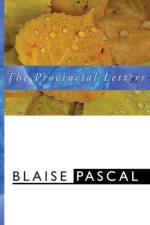
The Provincial letters are a series of eighteen letters written by French philosopher and theologian Blaise Pascal. Written in the midst of the formulary controversy between the Jansenists and the Jesuits, they are a defense of the Jansenist Antoine Arnauld from Port-Royal-des-Champs, a friend of Pascal who in 1656 was condemned by the Faculté de Théologie at the Sorbonne in Paris for views that were claimed to be heretical. The First letter is dated January 23, 1656 and the Eighteenth March 24, 1657. A fragmentary Nineteenth letter is frequently included with the other eighteen. In these letters, Pascal humorously attacked casuistry, a rhetorical method often used by Jesuit theologians, and accused Jesuits of moral laxity. Being quickly forced underground while writing the Provincial Letters, Pascal pretended they were reports from a Parisian to a friend in the provinces, on the moral and theological issues then exciting the intellectual and religious circles in the capital. In the letters, Pascal's tone combines the fervor of a convert with the wit and polish of a man of the world. Their style meant that, quite apart from their religious influence, the Provincial Letters were popular as a literary work. Adding to that popularity was Pascal's use of humor, mockery, and satire in his arguments. The letters also influenced the prose of later French writers like Voltaire and Jean-Jacques Rousseau. Brilliantly written by Pascal, the Provincial Letters would not have been possible without the work of theologians from Port-Royal; indeed, most of the arguments Pascal deployed were already to be found in Arnauld's Théologie morale des Jésuites, something which led the Jesuit Nicolas Caussin to reply to Pascal's perceived libel. Pascal's main source on Jesuit casuistry was Antonio Escobar's Summula casuum conscientiae (1627), several propositions of which would be later condemned by Pope Innocent XI. Paradoxically, the Provincial Letters were both a success and a defeat: a defeat, on the political and theological level, and a success on the moral level. Thus, King Louis XIV ordered that the book be shredded and burnt in 1660. The final letter from Pascal, in 1657, had defied the Pope himself, provoking Alexander VII to condemn the letters. But that didn't stop most of educated France from reading them. Moreover, even Pope Alexander, while publicly opposing them, nonetheless was persuaded by Pascal's arguments. Just a few years later, Alexander condemned "laxity" in the church and ordered a revision of casuistical texts.
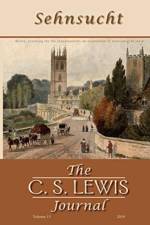
Sehnsucht: The C. S. Lewis Journal, established by the Arizona C. S. Lewis Society in 2007, is the only peer-reviewed journal devoted to the study of C. S. Lewis and his writings published anywhere in the world. It exists to promote literary, theological, historical, biographical, philosophical, bibliographical and cultural interest (broadly defined) in Lewis and his writings. The journal includes articles, review essays, book reviews, film reviews and play reviews, bibliographical material, poetry, interviews, editorials, and announcements of Lewis-related conferences, events and publications. Its readership is aimed at academic scholars from a wide variety of disciplines, as well as learned non-scholars and Lewis enthusiasts. At this time, Sehnsucht is published once a year.
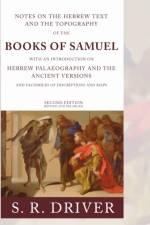
Driver intended this volume to provide insight toward the philology and textual criticism of the Old Testament. He regarded Samuel as an excellent field for training the intermediate Hebrew student in the uses of Hebrew idiom. Driver also regarded the books of Samuel as filled with transcriptional corruption, thus quite appropriate for introduction to the grounds and principles of textual criticism.
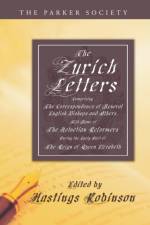
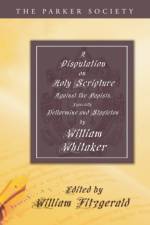
The Parker Society was the London-based Anglican society that printed in fifty-four volumes the works of the leading English Reformers of the sixteenth century. It was formed in 1840 and disbanded in 1855 when its work was completed. Named after Matthew Parker -- the first Elizabethan Archbishop of Canterbury, who was known as a great collector of books -- the stimulus for the foundation of the society was provided by the Tractarian movement, led by John Henry Newman and Edward B. Pusey. Some members of this movement spoke disparagingly of the English Reformation, and so some members of the Church of England felt the need to make available in an attractive form the works of the leaders of that Reformation.
The Parker Society was the London-based Anglican society that printed in fifty-four volumes the works of the leading English Reformers of the sixteenth century. It was formed in 1840 and disbanded in 1855 when its work was completed. Named after Matthew Parker -- the first Elizabethan Archbishop of Canterbury, who was known as a great collector of books -- the stimulus for the foundation of the society was provided by the Tractarian movement, led by John Henry Newman and Edward B. Pusey. Some members of this movement spoke disparagingly of the English Reformation, and so some members of the Church of England felt the need to make available in an attractive form the works of the leaders of that Reformation.
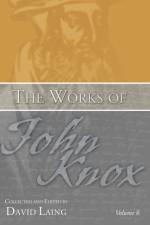
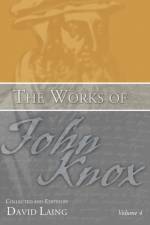
John Knox (1514-1572) was more a reformer of the Scottish Kirk than he was a systematic theologian, as his collected works will attest. Knox had a profound influence upon theological and ecclesiological developments in Scotland both purely by the force of his personality and by the role he played in shaping the Scots Confession and the Book of Common Order. Knox was an ordained priest and served as a tutor prior to his conversion to Protestantism.Volumes One and Two: Knox's famous 'History of the Reformation in Scotland'. Apologetics as much as history, 'History of the Reformation in Scotland' was immediately seized and suppressed when it initially appeared, yet it has remained available in various editions for over 400 years.Volume Three: 'Earliest Writings', 1548-1554Volume Four: 'Writings from Frankfurt and Geneva'. These writings in exile include Knox's famous 'First Blast of the Trumpet against the Monstrous Regiment of Women', his violent diatribe against Mary of Guise.Volume Five: 'On Predestination' and other writings. 'On Predestination, in Answer to the Cavillations by an Anabaptist' is Knox's longest theological work and presents a position of rigid predestinationism.Volume Six: Letters, Prayer, and other shorter writings with a sketch of his life.
John Knox (1514-1572) was more a reformer of the Scottish Kirk than he was a systematic theologian, as his collected works will attest. Knox had a profound influence upon theological and ecclesiological developments in Scotland both purely by the force of his personality and by the role he played in shaping the Scots Confession and the Book of Common Order. Knox was an ordained priest and served as a tutor prior to his conversion to Protestantism.Volumes One and Two: Knox's famous 'History of the Reformation in Scotland'. Apologetics as much as history, 'History of the Reformation in Scotland' was immediately seized and suppressed when it initially appeared, yet it has remained available in various editions for over 400 years.Volume Three: 'Earliest Writings', 1548-1554Volume Four: 'Writings from Frankfurt and Geneva'. These writings in exile include Knox's famous 'First Blast of the Trumpet against the Monstrous Regiment of Women', his violent diatribe against Mary of Guise.Volume Five: 'On Predestination' and other writings. 'On Predestination, in Answer to the Cavillations by an Anabaptist' is Knox's longest theological work and presents a position of rigid predestinationism.Volume Six: Letters, Prayer, and other shorter writings with a sketch of his life.
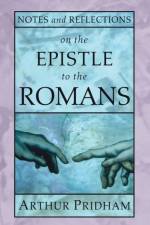
Sound and gracious Charles Spurgeon The study of inspired words is, when soberly pursued, a direct aid to spiritual profit; and a work of this description would be seriously defective, if in its construction this feature were entirely wanting. While, therefore, it holds an entirely subordinate place, there will be found, it is hoped, in the notes to this edition, a sufficient amount of verbal criticism to satisfy the fair demands of educated Christians. But it is better to offend a critic, than to disappoint a hungering soul. My desire is the profit of God's saints. Arthur Pridham
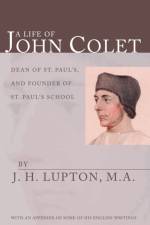
John Colet (1467-1519) was Dean of St. Paul's Cathedral and founder of St. Paul's School, London. Colet lectured at Oxford on St. Paul's Epistles, introducing a new treatment by abandoning the purely textual commentary then common, in favor of a study of the personality of St. Paul and of the text as a whole. In 1498 he met Erasmus at Oxford, with whom he immediately became intimate, arousing in him especially a distrust of the later school men. Colet's lectures on the New Testament continued for five years, until in 1504 he was made Dean of St. Paul's. In London he became the intimate friend and spiritual adviser of Sir Thomas More. In 1509 he began the foundation of the great school with which his name will ever be associated.This biography by noted Oxford reform scholar J.H. Lupton was the standard for one hundred years and remains a classic today.
Abonner på vårt nyhetsbrev og få rabatter og inspirasjon til din neste leseopplevelse.
Ved å abonnere godtar du vår personvernerklæring.