










Gjør som tusenvis av andre bokelskere
Abonner på vårt nyhetsbrev og få rabatter og inspirasjon til din neste leseopplevelse.
Ved å abonnere godtar du vår personvernerklæring.Du kan når som helst melde deg av våre nyhetsbrev.

Who was the real founder of Christianity as it is known today--Jesus or Paul? What, if any, was the connection between them? These and other questions about the two historical figures have occupied biblical scholars and the Christian church for many years up to the present time. This book proposes new ways of framing the questions as well as new approaches to answering them.Neither Jesus nor Paul spoke of a new world religion, separate from Judaism, that would envelop the planet and last for millennia. This study seeks to locate both figures in their respective places in the first century, in Jewish contexts and within the larger Greco-Roman society. The aim is to transcend the language and thought patterns of later generations of theologians in order to hear more clearly the prophetic voices of Jesus and Paul on their terms and in their social locations. By so doing, Shillington lays the groundwork for a more authentic translation of their vision and mission into modern alternatives, including better Jewish-Christian relations.
When the New Testament was read publicly, what effect did the performances have on the audience? In Delivering from Memory, William Shiell argues that these performances shaped early Christian paideia among communities of active, engaged listeners. Using Greco-Roman rhetorical conventions, Shiell's groundbreaking study suggests that lectors delivered from memory without memorizing the text verbatim and audiences listened with their memories in a collaborative process with the performer. The text functioned as a starting place for emotion, paraphrase, correction, and instruction. In the process, the performances trained and shaped the character of the reader and the formation of the audience. The lector's performance functioned as a mirror for the audience to examine themselves as children of God. These conventions shaped the ways lectors performed Jesus. Just as the New Testament reflects many titles for Jesus, so the canonical form of the Gospels offers many ways Jesus was performed in the ancient world. By interpreting through the eyes of performance, we join a conversation that has existed since the formative stages of the Christian movement. By performing with the ancient audience, we shape the character of reader and audience through the emotions, rhetorical figures, and memories in the text. We raise new questions about audiences in the ancient world and interpret stories through the ears of performance.
This unique commentary generates a conversation between the biblical narrative of conquest, related biblical themes, and the American master narrative of Manifest Destiny. Writing in an accessible style and format, Hawk offers an exegesis of the biblical text with special emphasis on the ways the narrative of conquest shaped ancient Israel's identity as a people. A second level of commentary lifts key themes from the text (e.g., the land as divine gift and promise, mass killing, Israel's distinctive attributes, the construction of the Indigenous Other) and sets them within their broader biblical context. A third dimension reflects on corresponding elements in America's narrative of "westward expansion" (e.g. the conviction of America's unique character and destiny, total war and ethnic cleansing, the dehumanization of Native peoples, patriotism and homeland, the idea of the American Dream). As a whole, this book offers Joshua as a biblical resource for reading the American experience, challenging readers to reflect on how conquest shaped America's identity and how it continues to influence American attitudes and actions.
Critical Conversations provides a series of theological engagements with the work of Michael Polanyi, one of the twentieth century's most profound philosophers of science. Polanyi's sustained explorations of the nature of human knowing open a range of questions and themes of profound importance for theology. He insists on the need to recover the categories of faith and belief in accounting for the way we know and points to the importance of tradition and the necessity sometimes of conversion in order to learn the truth of things. These themes are explored along with Polanyi's social and political thought, his anthropology, his hermeneutics, and his conception of truth. Several of the essays set Polanyi alongside the work of other thinkers, particularly Karl Barth, Lesslie Newbigin, Hans-Georg Gadamer, and Rene Girard, and they discuss points of comparison and contrast between the respective figures. While all the essays are appreciative of Polanyi's contribution, they do not shy away from critical analysis--and take further, therefore, the critical appreciation of Polanyi's work.
Drawing from the fields of evolutionary neuroscience, psychology, and theology, Sandra Levy-Achtemeier considers what it might mean for humans, as embodied and spiritual selves, to flourish now, and how such flourishing can contribute to our final flourishing in the time to come. She shows how such holistic flourishing and growth-filled transformation can occur even--and perhaps especially--in times of darkness and struggle. In this engaging work, she makes complex ideas accessible to all who hunger for deeper spiritual growth over the course of their lives. This book is not only highly readable, but it is also a practical guide to the flourishing life, providing resources for embodied practices--from prayer to dance to storytelling--which can enhance our human flourishing now. In short, she lays out a complete picture of human flourishing, from our evolutionary roots to kingdom living in the life to come.
What does the evangelical church in Palestine think about the land, the end times, the Holocaust, peace in the Middle East, loving enemies, Christian Zionism, the State of Israel, and the possibilities of a Palestinian state? For the first time ever, Palestinian evangelicals along with evangelicals from the United States and Europe have converged to explore these and other crucial topics. Although Jews, Muslims, and Christians from a variety of traditions have participated in discussions and work regarding Israel and Palestine, this book presents theological, biblical, and political perspectives and arguments from Palestinian evangelicals who are praying, hoping, and working for a just peace for both Israelis and Palestinians.
Description:At a recent conference entitled Ancient Wisdom--Anglican Futures, theologians from across the denominational spectrum considered the question, "What does it mean to inhabit the 'Great Tradition' authentically?" As an expression of what C. S. Lewis called "Deep Church," Anglicanism offers a test case of Tradition with a capital "T" in late modernity. Of particular interest is the highly dynamic transmission that has preserved a recognizable "Anglican Way" over the centuries. The process has been enlivened through constant negotiation and exchange with surprising convergences that have brought new life and direction. The contributors to this volume show how "profitable and commodious" (as Richard Hooker has said) the Great Tradition can be in nurturing the worship, communal life, and mission of the Church. But it often demonstrates how hard it is to uphold the varied integrities of historic faith in the contemporary marketplace of religion and, especially, among evangelicals who continue to follow the Canterbury Trail.Contributors: Simon Chan, Tony Clark, Dominic Erdozain, Edith Humphrey, D. Stephen Long, George Sumner, and D. H. Williams.Endorsements:"Evangelicals have too long suffered from a willful amnesia. In their passion for the immediacy of God's voice in the pages of Scripture, they have implicitly stopped their ears to the many and various ways God spoke to our fathers (and mothers). The essays in this volume will help us tune our ears to God's voice in the church's history, even as we listen carefully for his voice in our future."--David Neff ,Editor in Chief & Vice PresidentChristianity Today Media Group "Recently there has been an exciting 'ancient-future' resourcement of the larger church. This work explores the contours and nature of that movement, through a veritable cornucopia of essays, from evangelical, to pentecostal and emerging. This intricate mapping announces that the archives of the church are now open to all, whilst at the same time providing a much needed guide to the use of those resources for Christian formation."--Jason ClarkEmergent U.K. CoordinatorPastor, Putney Vineyard Church, London, UK"Much more than just presenting a call for allegiance to the Great Tradition, this collection of essays actually engages the tough question what such allegiance might look like on the ground. We find here a common recognition that this effort inevitably involves what T. S. Eliot called a 'great labour.' Happily, this book itself forms an important contribution of this great labour."--Hans BoersmaJ. I. Packer Professor of TheologyRegent CollegeAbout the Contributor(s):D. H. Williams is Professor of Religion in Patristics and Historical Theology at Baylor University, Waco, Texas. William's recent books include Tradition, Scripture and Interpretation (Baker, 2006).Philip Harrold is Associate Professor of Church History, Trinity School for Ministry, Ambridge, Pennsylvania. Harrold's most recent book is 'A Place Somewhat Apart: The Private Worlds of a Late Nineteenth-Century Public University (Wipf & Stock, 2006).
You Belong to Christ explores the way that the Apostle Paul sought to form the social identity of one of his most important Christ-following communities. It sheds light on the way various social identities function within the Pauline community and provides guidance concerning the social implications of the gospel. Drawing from contemporary social identity theories as well as ancient source material, J. Brian Tucker describes the way 1 Corinthians 1-4 forms social identity in its readers, so that what results is an alternative community with a distinct ethos, in contrast to the Roman Empire and its imperial ideology. This book contends that previous identities are not obliterated "in Christ," but maintain their fundamental significance and serve to further the Pauline mission by means of social integration. Providing a comprehensive survey of Christian identity in Pauline studies as well as an interesting look into the material remains of Roman Corinth, this volume provides a social-scientific reading of 1 Corinthians 1-4, and argues that Paul's strategy was to form salient "in Christ" social identity in those to whom he wrote.
Synopsis:In this work, Houghtby-Haddon takes a new look at an old text, using a theory of the Social Imagination as an exegetical guide. In her exploration of the Bent-Over Woman story in Luke 13:10-17, Houghtby-Haddon uncovers clues suggesting that this story is a key interpretive text for seeing Luke's social vision for his community at work. Exploring mythic, social, communal, and cultural elements beneath the surface of the story, Houghtby-Haddon suggests that the Bent-Over Woman is the embodiment of Jesus' claim in the synagogue in Nazareth that "today, these Scriptures are fulfilled in your hearing" (Luke 4:16-21), and that the woman prefigures the post-Pentecost community that will gather in Jesus' name.The author concludes by taking the theory from the Gospel of Luke to the streets to see how a contemporary neighborhood group might use the Social Imagination model--and the new reading of the story of the Bent-Over Woman--to imagine a twenty-first-century social vision for its own community: a vision that more fully embodies the just community Jesus proclaims in Nazareth.Endorsements:"Houghtby-Haddon combines expertise in biblical studies with theory from the history of religions and cultural anthropology to address a critical issue in the way policy is formed in our current social practices. It encourages leaders at all levels of our society to imagine alternative and creative responses to social issues and structural problems, and to think deeply about the relation between social structure and human well-being. The process she describes is in fact an outline of the creative construction of social formations that can support human well-being. Leaders in all of our political, social, and religious institutions will want to read this book."--Burton L. Mackauthor of Myth and the Christian Nation"This book is a must read for anyone interested in understanding how scriptures can be used to understand contemporary social issues. The author's message will be of interest across disciplines and intellectual boundaries. Readers will be rewarded with new insights on how the social imagination applies to building community."--D. Christopher KayesDean's Research Scholar and Associate Professor of ManagementThe George Washington University"My friend and colleague, Natalie, has brought her many talents and considerable skills together in this remarkable book, unfolding a new metaphor and thus a new vision for congregations and communities seeking to fulfill God's future. With a sincere passion for deeper understanding and an impressive array of technical and conceptual skills, Natalie bridges the millenniums to show us how Luke's Bent-Over Woman can illuminate Christ's mission in practical ways for our own time."--Bishop Mary Ann SwensonLos Angeles Area of the United Methodist ChurchAuthor Biography:Natalie K. Houghtby-Haddon is the Associate Director of the George Washington University Center for Excellence in Public Leadership, and also teaches New Testament for the George Washington University Department of Religion. She is an ordained elder in the United Methodist Church and previously served a number of churches in Southern California.
In The Dead Sea Scrolls for a New Millennium, Phillip R. Callaway presents the most comprehensive survey of the Dead Sea Scrolls since the final publication of the cave 4 fragments. The chapters on editing the Scrolls, on the caves, on the scrolls, and on Khirbet Qumran present the evidence without getting bogged down in older controversies. Callaway discusses the so-called yahad ostracon, as well as a fascinating writing exercise, and the supposed Dead Sea Scroll on stone. Those who desire to know more about the Bible among the Scrolls are offered brief comments on over one hundred readings from Qumran's biblical manuscripts and other biblical texts. In the chapter on the pseudepigrapha and apocrypha, Callaway emphasizes the rich literary production of the mid- to late Second Temple period, with sections on Enoch, Jubilees, the Genesis Apocryphon, a Genesis commentary, the Reworked Pentateuch, targums on Leviticus and Job, the Temple Scroll, the New Jerusalem, an Apocryphon of Joshua, the psalms, various works of wisdom, Tobit, Ben Sira, the Epistle of Jeremiah, and the Greek fragments from cave 7. The chapter on the Community Scrolls deals with the Damascus Document, the Rule of the Community and its appendages, a Hybrid Rule, the Rule of War, the Thanksgiving Hymns, Florilegium, Testimonia, Melchizedek, the pesher commentaries on Habakkuk, Nahum, and Psalm 37, Ordinances, Calendar texts, Some Works of the Law, the Angelic Songs of the Sabbath Sacrifice, and the phylacteries. In terms of the Scrolls and Jewish history, Callaway discusses the text called Praise for Jerusalem and King Jonathan, the Copper Scroll, the documentary texts (which may or may not be from Qumran), the history of the Qumran community, and some similarities to early Christian thought and language. In addition to clarifying discussions of all the works mentioned above, the author hopes that The Dead Sea Scrolls for a New Millennium will help readers understand the Scrolls not as the product of a radical, separatist community, but rather as the literary heritage of many of the greatest Jewish minds that lived in the Second Temple period.
Today the "land of promise" is a spark in the tinder dry atmosphere of Middle Eastern affairs. Events there continue to wield influence among peoples and in places well beyond the region itself. This raises for Christians the acute theological problem of how to relate to the "land of promise" today and in light of the land of the Bible. Our hope is that this volume of essays will contribute to a more informed and theologically coherent response to the "Land of Promise." It is offered here in the name of peace for all peoples in that place and among those who continue to look to her as a place of promise.
The relationship between the church and Israel in Pauline interpretation has long been an area of considerable debate. The traditional view has understood Paul to identify the church with Israel, such that the church is the sole inheritor of Israel's sacred history, privileges, and divine promises. Yet recent developments in Pauline scholarship have called this view into question. The so-called New Perspective and its emphasis upon the decidedly Jewish context of Paul's theologizing, along with an increasing sensitivity to the post-Holocaust context of modern interpreters, have brought about readings that understand Paul to maintain a distinction between God's historical people, Israel, and the newly created multiethnic communities of Christ followers, that is, the church. Nevertheless, there are still scholars who, while embracing the New Perspective, have interpreted Paul as holding that the church is indeed identifiable in some way as Israel. This work explores a spectrum of scholarly views on the subject advanced between 1920 (as per the publication of C. H. Dodd's The Meaning of Paul for Today) and the present. Furthermore, it examines the most relevant Pauline texts upon which these views are founded, in dialogue with various readings of these texts that have been offered. Each view on Paul's understanding of the church vis-a-vis Israel is critically assessed in light of the exegetical findings. Using this approach Zoccali demonstrates that a view holding to both a certain distinction between, as well as an equating of, the church and Israel represents the most plausible interpretation of Paul's understanding.
Synopsis:New Testament Greek Primer has established itself among Greek instructors as a popular and dependable guide to the Greek of the New Testament, appreciated for its accuracy, coverage, and well-designed exercises. Students appreciate easy-to-read explanations, English grammar bridges, user-friendly layout, and copious tables, charts, and indexes. Retaining the basic form and content, the third edition builds on this solid reputation with enhanced discussion, organization, examples, and exercises. The appendix on English grammar aids English-challenged students. Pictures from the author's extensive travel overseas illustrate the ancient Greco-Roman context of the Greek New Testament. Other resources include language lessons elaborating translation and morphology issues, convenient vocabulary reviews anticipating vocabulary exams, an answer key, and indexes of vocabulary, principal parts, paradigms, and subjects. The method is deductive and the goal focused on grammar and exegesis. An early emphasis on the noun system transitions to the principal parts of the verb, followed by moods, infinitives, and participles. Two lessons on the MI-verb system conclude the work. Examples and exercises are taken directly from the Greek New Testament.Endorsements:"Gerald Stevens' New Testament Greek Primer is a superb textbook for guiding students along the journey of learning Koine Greek grammar . . . Incorporation into the text of material often relegated to a separate workbook enhances the value and usefulness of the Primer, a feature appreciated by my students. With the inclusion of supplementary material in the form of photographs and discussions of archaeological artifacts, Stevens facilitates the employment of the best practices for Koine Greek language instruction, demonstrating how the language 'lived' outside the New Testament text."--Richard Warren JohnsonEast Texas Baptist University"In this latest edition, Stevens advances his work still further in providing a solid foundation for anyone seeking to learn Koine Greek. Clearly written and accessible at every point, the text teaches itself. A masterful text by a master teacher!"--Robert A. BryantPresbyterian College"In this third edition, Gerald Stevens has produced a beginning Koine Greek Grammar that continues to be stellar with regard to both content and being user friendly. The copious tables, charts, listings, graphs, and photos make this one of the premier New Testament Greek grammars in terms of usefulness for both students and instructors. The organization is easy to follow and works through the various elements of Greek grammar in a manner that students can grasp and at a pace that they can handle."--Bill WarrenNew Orleans Baptist Theological SeminaryAuthor Biography:Gerald L. Stevens is Professor of New Testament and Greek at New Orleans Baptist Theological Seminary.
Since the time of Jerome, scholars have tried to explain why John the Baptist asks Jesus if he is ""the one who is to come"" (Matt 11:2-6; Luke 7:18-23) after he had apparently identified him as ""the lamb of God"" (John 1:29-34). The puzzling question is part of one of the longest fragments of traditional material in the New Testament dealing with the Baptist and Jesus. The present study critically examines the Lukan version of this double tradition normally attributed to Q, which includes John's question as well as Jesus' testimony about the Baptist (7:24-28) and his reproach of the religious leaders (7:29-35). Martinez investigates the narrative elements of the passage and shows how Luke 7:18-35 is part of a literary pattern within a section whose main goal is to clarify the identity of Jesus. The study argues that the tradition in Matthew 11:2-19 and Luke 7:18-35 deserves to be interpreted differently in the Gospel of Luke and explains how Luke integrates John's apparent ignorance of Jesus as well as Jesus' indictment of the religious leaders into his literary scheme. Finally, Martinez shows how Luke puts this tradition about John and Jesus at the service of his theocentric and christological perspectives and offers an alternative explanation to the prevailing interpretation of John's question.
A Land Like Your Own explores the ways the Bible has reused previous traditions and has subsequently been reused by both Jews and Christians. The ten essays included cover a broad range of topics in the Hebrew Bible, the New Testament, and subsequent traditions, but they all highlight the many ways in which the traditions associated with Israel have impacted communities. A Land Like Your Own will interest anyone involved in biblical studies (students and scholars alike) through its wide-ranging array of topics, highlighting how interconnected the many biblical studies subdisciplines truly are.
Revelation is a book that many Christians find confusing due to the foreign nature of its apocalyptic imagery. It is a book that has prompted endless discussions about the "end times" with theological divisions forming around epicenters such as the rapture and the millennium. In this book, award winning author Gordon Fee attempts to excavate the layers of symbolic imagery and provide an exposition of Revelation that is clear, easy to follow, convincing, and engaging. Fee shows us how John's message confronts the world with the Revelation of Jesus Christ so that Christians might see themselves as caught up in the drama of God's triumph over sin, evil, and death. Fee draws us into the world of John and invites us to see the world through John's eyes as the morbid realities of this world have the joyous realities of heaven cast over them. In this latest installment in the New Covenant Commentary Series we see one of North America's best evangelical exegetes at his very best.
"". . . from expected death comes unexpected new life!""The Gospel of Matthew does not shy away from the realities of struggle, suffering, doubt, and death. Yet, from the first names in the genealogy to the last words spoken by Jesus, the Gospel testifies to the promise that from expected death comes unexpected new life. Through the actions of Tamar, Rahab, Ruth, and Bathsheba, we experience the expectation of death and the promise of unexpected new life. In the birth story of Jesus, Joseph suspects Mary of committing adultery. It is this dilemma that is the focus of the narrative. If he reveals her pregnancy, she could be killed. If he conceals her pregnancy, he will be going against the law of the Lord. What is a righteous man to do? In Joseph's dilemma, this experience of expected death, the Gospel of Matthew proclaims the promise of unexpected new life.The promise of unexpected new life is a theme that continues throughout Matthew's Gospel in the life and ministry of Jesus. The call of his disciples is a call from death to new life. The teaching of Jesus focuses on the experience of death and the promise of new life. In both healing and curing, Jesus brings unexpected new life to those who face death. But it is the death and resurrection of Jesus that is the climax of unexpected new life in the Gospel of Matthew. Even as Jesus experiences a most horrific and humiliating death in the crucifixion, death and the grave do not have the final say. In bearing witness to Jesus' resurrection, the Gospel of Matthew proclaims the magnificent promise of unexpected new life.Matthew J. Marohl invites you in these pages to read the Gospel of Matthew in a new way, from a fresh perspective. Integrating insights from the study of Mediterranean anthropology, Marohl makes the cultural world of the Gospel come alive, so that as you read Matthew again (or perhaps for the first time) you will certainly experience the powerful promise that from expected death comes unexpected new life!
This book explores Deuteronomy's understanding of exile. While Deuteronomy speaks of a potential historical experience in the nation's future, ""exile"" is also a dynamic theological concept. In short, exile represents the death of Israel. In losing her land, Israel apparently also loses her identity, history, and covenant relationship with Yahweh. Restoration from exile, then, is a resurrection from death to life. Since exile is a recurring theme in Deuteronomy, the theology of the book must be considered in light of its vision of exile and restoration. The thesis of the following study consists of three major aspects: (1) the theological construct that exile constitutes the death of Israel; (2) the pervasiveness of the theme of exile in Deuteronomy; and (3) the significance of the theme of exile for understanding and developing the theology of the book. While the theological connection between exile and death is not new, this study attempts to ground this association in the vocabulary of the text. This, in turn, will open up a more nuanced reading of the entire book in which the persistent presence and influence of the theme of exile on Deuteronomy's overt message, underlying theology, and structure will be recognized.A major catalyst for this work is a network of debates among Evangelicals in New Testament theology, including covenant nomism and the New Perspective on Paul. For some, Jesus' preaching of the kingdom and the forgiveness of sins is tied up with the nation's expectations of the return from exile, which is fulfilled in his death and resurrection. Proponents of this position (e.g., N. T. Wright) often turn to Deuteronomy for support. In some ways, the present work implicitly enters this discussion by providing Old Testament theological background en route to evaluating implications being drawn.
Studying the New Testament requires a determination to encounter this collection of writings on its own terms. This classic introduction by Charles B. Puskas, revised with C. Michael Robbins, provides helpful guidance. Since the publication of the first edition, which was in print for twenty years, a host of new and diverse cultural, historical, social-scientific, socio-rhetorical, narrative, textual, and contextual studies has been examined. Attentive also to the positive reviews of the first edition, the authors retain the original tripartite arrangement on 1) the world of the New Testament, 2) interpreting the New Testament, and 3) Jesus and early Christianity. This volume supplies readers with pertinent primary and secondary material. The new edition carries on a genuine effort to be nonsectarian, and although it is more of a critical introduction than a general survey, it is recommended to midlevel college and seminary students and to anyone who wants to be better informed about the New Testament.
This volume invites readers to walk in Israelite sandals, that is, to take a journey of the imagination, and to immerse themselves in the identity, values, and institutions of first-century CE Israelites with the help of contemporary social-scientific studies and theories. What emerges is that the Israelites did not practice a religion. Rather, they were an ethnos, or as this book describes it, an ethnic identity, who lived out a particular way of life and culture the customs of the fathers. It is to belong to a people who obtained their collective identity, honor, and sense of worth from their socialization and membership in Israel and from the social convention of loyalty to their rich cultural tradition. It was to belong to a "world," or having a perspective on the world with its own quality of "knowledge," which, among other things, preferred collectivism over individualism, and orthopraxy over orthodoxy.
Synopsis:A group of authors led by Shaphan, King Josiah's secretary, wrote some three hundred chapters of Scripture--one-third of the Hebrew Bible. For the first time ever, we can learn the names of those who composed Joshua, Isaiah, Psalms, Proverbs, Job, Songs, Daniel, and half the Minor Prophets. (Probabilities throughout the book strongly support these findings.) Moreover, those authors together constitute Dtr, the long-sought editors of Deuteronomy through Second Kings. One of the most important discoveries of The Shaphan Group is that Huldah the prophetess signed many chapters of Hebrew Scripture. Judged from her use of coded writing, Huldah was arguably the most accomplished writer among the group's fifteen authors. She was joined by the Priestly Source and Second Isaiah (both of whom are named), as well as others--unrecognized until now--who risked their lives to shape the Hebrew Bible. The Shaphan Group offers students of whatever age, not only a book full of discoveries, but also a new way to approach Holy Scripture.Endorsement:"In The Shaphan Group, his third book on the subject, Kavanagh offers up another provocative exploration of coding within the Tanakh. There is much here that will inform new understandings of biblical texts and confound conventional scholars. Reading Kavanagh is always an exciting and illuminating experience."-Jeff LevinInstitute for Studies of Religion, Baylor UniversityEditor of Divine Love: Perspectives from the World's Religious TraditionsAuthor Biography:Twenty-four years ago, Preston Kavanagh retired from an executive position in a large company in order to seek the identities of those who wrote the Hebrew Bible. The Shaphan Group discusses what he found, as do his two prior books--Secrets of the Jewish Exile (2005) and The Exilic Code (Pickwick Publications, 2009). He and his wife, Lois, live quietly in Maryland.
Ephesians speaks to our deepest questions about God: the redemptive plan of God written from ages past now revealed; the work of Christ complete and effective now and for eternity; the power of the Holy Spirit to change lives and build a community. The clear message of God's unfathomable grace establishes the believer's hope and undergirds the call for faithful living. Down through the centuries, the clarion call to unity that permeates Ephesians has inspired and challenged the faithful to live out the promises found in Christ. This short letter speaks to the twenty-first century's longing for friendship and wholeness.
Jesus of Nazareth and Paul of Tarsus represent two of the most influential figures of history because of the expansion of later Christianity. But Christianity's historical development includes a checkered and troubling past of abusive power that also impugns both Jesus and Paul. European colonialism carried the ""gospel"" to the world, claiming Jesus and Paul as architects of its oppressive empire building. Modern churches in America quote Jesus and Paul to inspire, inform, and justify a host of cultural values that often include the subordination of women and marginalization of others who differ in beliefs, values, and lifestyles. Talbott analyzes how Jesus and Paul responded to the systems of oppressive power in their day, and how each in turn used power to form their respective communities. The conclusions are based on the most recent scholarly approaches to Jesus and Paul and will enable modern readers to judge for themselves how Jesus and Paul envisioned the use of power among their communities.
Never before has the problem of evil been a more urgent subject for our reflection. The Yahwist confronts the issue through a sequence of stories on the progressive deterioration of the divine-human relationship in Genesis 2-11. In Genesis 4 he narrates the initial slaughter of one human being by another, and strikingly, it is described as fratricidal. Onslaught Against Innocence: Cain, Abel, and the Yahwist provides a close reading of J's story by using literary criticism and psychological criticism. It shows that the biblical author has more than an ""archaeological"" design. His characters--including God, Adam, Eve, Cain, and Abel, plus minor characters--are paradigmatic. They allow J to proceed with a fine analytical feel for the nature of evil as performed by ""homo"" as ""homini lupus."" No imaginative ""mimesis"" of evil has ever been recounted with such an economy of means and such depth of psychological insight.
This translation of the Gospel of Thomas represents a departure from the usual literal English of previous publications. It aims at providing a reader-friendly translation of the original Coptic language in contemporary idiomatic English, while remaining true to the complexities of the Coptic. The commentary seeks to clarify each saying as it likely would have been understood in the historical context of the Coptic language during the period of Thomas's popularity in Egypt. The sayings in Thomas in this period are no longer sayings of the Jewish man Jesus of Nazareth, but they have become sayings of a revelation bearer, the living Jesus, who announces a radical faith for a new age of the church. The historical matrix that best serves to inform the text is found in a continuation, albeit in a radical direction, of the traditional faiths represented in the earliest Christian literature.
In most areas of this Epistle, B. Ward Powers has come to share the interpretation of Paul's meaning held by the Early Church Fathers; although he explains and expounds those views. This is particularly the case in relation to chapters 12 through 14 where, in keeping with the Early Church Fathers, the Reformers, most Scripture expositors until recent times, and many present-day exegetes, Powers expounds the interpretation that tongues refers to human languages spoken on earth. The one major area where Powers parts company with the Fathers of the first Christian centuries is in relation to matters of sex and marriage, divorce and remarriage, and attitudes to women generally. Here Powers explains that Paul is more affirming of sex, marriage and remarriage, and women than many early writers (and some modern writers) have understood him to be. We need at times to take considerable care, he writes, to understand the meaning of what Paul says to the Corinthians, and in coming to terms with how this teaching is to apply to us in today's world. But when we have arrived at our understanding of these things, then there is no question: this is the Word of God to us, and we must take it very seriously indeed. We cannot just dismiss it offhandedly and simply say, 'Well, that is just Paul's opinion, and we can take it or leave it.' Not at all: Paul has explained clearly that what he writes comes with the inspiration and authority of the Holy Spirit of God.
Comprising a rich variety of quotations from some of the greatest thinkers in the Christian tradition, this new anthology will encourage a more sensitive and compassionate regard for the animal creation. Suitable for use by groups or individuals, Compassion for Animals will become a valuable resource for discussion and worship--whether in church, in school, or in the home.Andrew Linzey has been described as ""the greatest living writer on theology and animals"" by Bishop John Austin Baker. He is the director of the Oxford Centre for Animal Ethics and a member of the Faculty of Theology at the University of Oxford. He has written or edited more than twenty books, including Animal Theology, Creatures of the Same God, and Why Animal Suffering Matters. He is also the author of Animal Rites: Liturgies of Animal Care and the coeditor of Animals and Christianity: A Book of Readings, both published by Wipf and Stock.
Description:Previously unpublished, the forty sermons collected here were preached by Austin Farrer during his twenty-five years as chaplain of Trinity College, Oxford (1935-60). Most of them were short biblical addresses given during Evensong, and they are offered here for Farrer devotees, and for a new generation of readers to savor. Endorsements:""Austin Farrer''s many-sided gifts may be said to have been distilled in his preaching . . . Here are the learning, the imagination, the whimsical humor, the originality, the eloquence, blended with a profound spirituality, which made him so exceptional a character."" The Times Literary Supplement""The freshness of his approach and the simplicity of his profound understanding make his sermons a delight to read and a stimulation to further thought."" Church of England NewspaperAbout the Contributor(s):Austin Farrer (1904-1968) was ordained an Anglican priest at Oxford where he served as chaplain and fellow of several colleges. He was warden of Keble College from 1960 until his death. Both a noted theologian and New Testament scholar, Farrer was a member of ""the Oxford Christians,"" conversing frequently with C. S. Lewis, J. R. R. Tolkien, Dorothy Sayers, and T. S. Eliot.Charles Conti is a Lecturer in Philosophy at the University of Sussex.Leslie Houlden is Professor of Theology at King''s College, London.
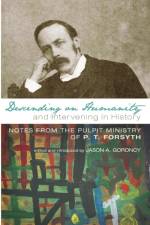
Description:This collection of forty-eight sermons, most of which have not been previously published, discloses the integration of vocation and imagination in the work of one of the greatest of Free Church theologians, P. T. Forsyth. At a time of fragmentation, when theological study has become too much removed from the task of the preacher, Forsyth''s work can remind us of the invigorating power of Christian doctrine interpreted and expounded in situations of pastoral and political exigency. Its capacity for the renewal of the church is evident again from this rich and timely anthology, compiled and introduced by Jason Goroncy.
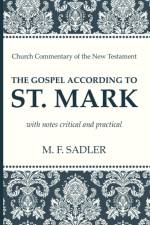
M.F. Sadler was an Anglican priest. He served as rector of Honiton, England, and wrote several other commentaries, including volumes on each of the four Gospels. SADLER, MICHAEL FERREBEE (1819-1895), theologian, eldest son of Michael Thomas Sadler [q. v.], was born at Leeds in 1819. Educated at Sherborne school, he entered St. John's College, Cambridge, after a short interval of business life. He was elected Tyrwhitt's Hebrew scholar in 1846, and graduated B.A. 1847. He was vicar of Bridgwater from 1857 to 1864 (during which time he was appointed to the prebend of Combe, 13th in Wells Cathedral), and of St. Paul's, Bedford, from 1864 to 1869; he was rector of Honiton from 1869 till his death. In 1869 he received an offer of the bishopric of Montreal, carrying with it the dignity of metropolitan of Canada, but refused it on medical advice. He was a voluminous writer on theological subjects, and a strong high churchman. His works, which had a large circulation, did much to popularise the tractarian doctrines.
Abonner på vårt nyhetsbrev og få rabatter og inspirasjon til din neste leseopplevelse.
Ved å abonnere godtar du vår personvernerklæring.