











Gjør som tusenvis av andre bokelskere
Abonner på vårt nyhetsbrev og få rabatter og inspirasjon til din neste leseopplevelse.
Ved å abonnere godtar du vår personvernerklæring.Du kan når som helst melde deg av våre nyhetsbrev.

HOW WOULD YOU ANSWER THESE QUESTIONS? Which is the more crucial problem in most marriages: lack of money--or lack of communication? At what age do children copy adult attitudes and beliefs? Are friends and co-workers entitled to a different standard of courtesy than mate or children? Should children be forced to do household chores? At what age should the facts of life be taught? Your score may very well indidicate the Happiness Quotient of your spouse and children! No Is The Time To Love contains the answers, and many more, to help you attain deep, lasting fulfillment in your home--and in your life. It is a book telling what real love is and what it will do--sharing help in a positive Christian way.
The results of our rapidly expanded historical and archaeological knowledge have here been brought to bear on the Book of Acts to stunning effect. Outstanding as Jackson and Lake was in its day, this volume on the Graeco-Roman setting of Acts holds out the promise of equaling if not surpassing that great achievement. Paul Barnett, Bishop of North Sydney, Australia This well-written volume offers a remarkable, up-to-date collection of relevant new data to assist in scenario formation for a considerate reading of the Book of Acts . The largely Australian and British team of authors must be congratulated for preparing this very useful data set. There are authoritative descriptions of travel, of food supply, of domestic and political religion, of urban elites, and of the Eastern Mediterranean provinces and their leadership. Such information about the realm of the Graeco-Roman world will enable the interpreter of Acts to bring these data to bear in the process of interpretation.... Of great use to ancient historians, classicists, and biblical scholars, yet written and presented in such a way that it will be fascinating to intelligent nonprofessionals as well. Bruce J. Malina, Creighton University
John W. de Gruchy entangles the complex story of the South African church, reviewing its history of past divisions. present positions on social issues and reflecting on the church's significance for the future.
Books in the series present specialised research into all aspects of New Testament textual and historical culture, taking a range of approaches. This is widely recognised as the most authoritative and prestigious forum for serious scholarly publication in the area, and series books are highly regarded by biblical scholars the world over. General Editors: Edward Adams, King's College London
How can a letter written over 1900 years ago to a Christian group in a small town of Asia Minor mean anything to us? But if Colossians is a word from a God who does not change, and is therefore relevant to His people in every age, how are we to understand and interpret Paul's thought and expression today? Dr. Ralph Martin tackles this problem by asking what the apostle meant when he set out to instruct, correct and exhort the original readers of the epistle. From this inquiry he deduces certain principles of belief and conduct which may still be applied even though our situation differs in external details from that in which the Colossian Christians found themselves. The underlying intellectual and religious question is the same--what is man's relation to the cosmos and the powers that rule it? The predominant theme of the book, as of the epistle, is the glory and Lordship of the risen Christ, in whom Christian believers have come to fullness of life. Professor Martin examines the Colossian heresy, and shows that life in Christ brings complete liberation from mental and spiritual bondage to those merely human mystical notions that had only an appearance of wisdom. From doctrine he moves on, with Paul, to the therefore of everyday Christian conduct, in the context of family relationships, prayer, and the Church's mission in today's world. So far from being out-of-date or irrelevant, the Epistle to the Colossians might well have been written (as indeed in one sense it was!), for our modern space-age. It shows the person of Jesus Christ as the answer to humanity's questioning about the cosmos of which we form such a frighteningly insignificant part. Above all it sets out the Jesus of history as the Lord of glory, the Master of time and space, and shows the essential continuity between the two. It is Professor Martin's first aim to make the background and the message of the Epistle clear in its original setting, and then to show its particular relevance to the present day.
Even as America's prison system is expanding at an unprecedented rate, Lee Griffith makes a startling proposal in this book: abolish prisons. To make his case, Griffith thoroughly examines prisons from the perspectives of sociology, theology, history, and biblical exegesis. Bolstered with extensive documentation as well as lively anecdotal evidence, this compelling, radical book is bound to stir up serious discussion.
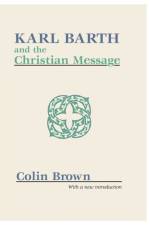
Colin Brown attempts to get inside Barth's mind: to see the main issues as he sees them, to try to bring into critical focus Barth's approach to the Christian message and to find out what can be learned from it. The Book is divided into four main sections. The first traces the course of Barth's life, outlines briefly his main writings, and sees how and why Barth has come to believe what he believes and think in the way he does. The second deals with the question of revelation, the third with his natural theology, the fourth with Barth's Christological approach to doctrine.
Amid the welter of writing on biblical prophecy, this important work by Kuyper challenges the thoughtful Christian to profoundest reverence for the message of the book of the Revelation.
In his book Donald Bloesch points the way towards much needed reforms within Protestantism, showing how Catholic thinking in this area can be of aid to Protestants. He sounds the call for sacramental and spiritual renewal within the church today, and gives a fresh interpretation of the sacraments of baptism and the Lord's Supper. He also discusses such rites as confession and confirmation, as well as spiritual healing and other charismatic gifts. The book concludes with a call to Christian unity based upon the Gospel of free grace declared in Holy Scripture. The Reform of the Church is both evangelical and ecumenical, and can be recommended to anyone who is earnestly seeking the renewal of the church in our time.
Preachers with a working knowledge of New Testament Greek will appreciate the insights and thorough explanations found in this volume. The expositions are based on Eadie's precise exegesis of Greek words and phrases. The expositions deal with all exegetical problems and carefully trace the development of Paul's themes. Important digressions on theological truths distinctive to each epistle are also present. Viewpoints that differ from the author's are summarized and assessed objectively. According to The New Shcaff-Herzog Encyclopedia of Religious Knowledge, the work of John Eadie are marked by candor and clearness as well as by an evangelical unction not common in works of the kind.
Preachers with a working knowledge of New Testament Greek will appreciate the insights and thorough explanations found in this volume. The expositions are based on Eadie's precise exegesis of Greek words and phrases. The expositions deal with all exegetical problems and carefully trace the development of Paul's themes. Important digressions on theological truths distinctive to each epistle are also present. Viewpoints that differ from the author's are summarized and assessed objectively. According to The New Shcaff-Herzog Encyclopedia of Religious Knowledge, the work of John Eadie are marked by candor and clearness as well as by an evangelical unction not common in works of the kind.
What have Baptists to do with Lutherans of Holiness groups? Pietists with premillennialists? Pentecostals with restorationists? The self-consciously Reformed with Black religionists? Or fundamentalists with Adventists or Mennonites? Despite the apparent diversity of these groups, each has in some way been identified with American evangelicalism. Just how appropriate is such identification? How do these various traditions see themselves in relation to one another and the larger phenomenon known as evangelicalism? The editors of this volume have sought answers to these questions by inviting twelve expert interpreters of these traditions to compare each tradition's self-understanding with its understanding of evangelicalism. The result is a fascinating collection of essays - of interest to general readers as well as students and scholars - which make a significant contribution to the ongoing efforts to define and understand American evangelicalism.
Eleven lectures on the role of the letter and the Spirit and the centrality of Christ set against the historical background of the Reformation of the Anabaptists and the Calvinists.
This long-standing series provides the guild of religion scholars a venue for publishing aimed primarily at colleagues. It includes scholarly monographs, revised dissertations, Festschriften, conference papers, and translations of ancient and medieval documents. Works cover the sub-disciplines of biblical studies, history of Christianity, history of religion, theology, and ethics. Festschriften for Karl Barth, Donald W. Dayton, James Luther Mays, Margaret R. Miles, and Walter Wink are among the seventy-five volumes that have been published. Contributors include: C. K. Barrett, Francois Bovon, Paul S. Chung, Marie-Helene Davies, Frederick Herzog, Ben F. Meyer, Pamela Ann Moeller, Rudolf Pesch, D. Z. Phillips, Rudolf Schnackenburgm Eduard Schweizer, John Vissers
This long-standing series provides the guild of religion scholars a venue for publishing aimed primarily at colleagues. It includes scholarly monographs, revised dissertations, Festschriften, conference papers, and translations of ancient and medieval documents. Works cover the sub-disciplines of biblical studies, history of Christianity, history of religion, theology, and ethics. Festschriften for Karl Barth, Donald W. Dayton, James Luther Mays, Margaret R. Miles, and Walter Wink are among the seventy-five volumes that have been published. Contributors include: C. K. Barrett, Francois Bovon, Paul S. Chung, Marie-Helene Davies, Frederick Herzog, Ben F. Meyer, Pamela Ann Moeller, Rudolf Pesch, D. Z. Phillips, Rudolf Schnackenburgm Eduard Schweizer, John Vissers
This omnibus contains in their entirety The Divine Self-Emptying, The Holy Father, The Living Christ, Christian Perfection, The Taste of Death and the Life of Grace, The Soul of Prayer, This Life and the Next.
The leaders in England of two schools of mythology, based mainly in the one case on Aryan linguistics and in the other on anthropology, have recently published their revised, and probably final, conclusions. The time, therefore, seems oportune for a statement of the principles of a third School, which, for present purposes, I may style the Aryo-Semitic. Its members, whilst paying every respect to the system of Aryan philology, and fully recognizing the vast results that have sprung from the scientific application of Aryan linguistics, are nevertheless of opinion that the Aryanists have been unable to explain Hellenic mythology and Hellenic archaic history as a whole, because they have almost wholly ignored or denied the existence of that great mass of Semitic influence, which the Aryo-Semitic School hold is to be found throughout the length and breadth of Hellas. This latter School, moreover, is in entire sympathy with the researches of anthropology in general, and of folklore in particular.
Abonner på vårt nyhetsbrev og få rabatter og inspirasjon til din neste leseopplevelse.
Ved å abonnere godtar du vår personvernerklæring.