









Gjør som tusenvis av andre bokelskere
Abonner på vårt nyhetsbrev og få rabatter og inspirasjon til din neste leseopplevelse.
Ved å abonnere godtar du vår personvernerklæring.Du kan når som helst melde deg av våre nyhetsbrev.

When Jesus overturned the carts of the merchants in the temple, he was just the latest in a long line of people who decried the activities that took place there. To understand his actions better, one must go back in history to the eighth century BCE, to the first two prophets to criticize the temple cult: Amos and Isaiah. Their criticism of all worship activities came as a result of the people setting wrong priorities in their lives. What happens in the temple should extend into regular everyday activities in the home, in the market, in business dealings, at work, and at the city gate. Amos and Isaiah present similar oracles that address the prioritization of worship over real life. This book looks closely at their oracles, comparing and contrasting them, and analyzes what they were trying to teach the people.
Lamentations is a book that has never had a place of honor at the table of Christian spirituality. This is an unfortunate state of affairs because its challenging poetry has much to offer. This volume explores the how the biblical book of Lamentations may be engaged afresh so that it can function as Holy Scripture for the ekklesia. Four main chapters consider issues in hermeneutics, exegesis, the use of Lamentations in worship, and pastoral reflections. These chapters have been supplemented by seventeen reception history studies written by an international team of Jewish and Christian scholars. These studies introduce a wide range of interpretations and uses of the book of Lamentations from throughout the history of Judaism and Christianity. They include examinations of the use of Lamentations in Isaiah 40-55, the Targum, Rashi, and contemporary Jewish thought, the Patristic period, Calvin, Jewish and Christian worship, music, Rembrandt, and psychological and feminist interpretation. Appendices include new English translations of LXX Lamentations and Targum Lamentations.
The Old Testament is an ancient collection of theological reflections of life with God that the church has claimed as authoritative Scripture. Whereas most introductory books march from Genesis to Malachi, this book engages four important leadership roles across the breadth of the Old Testament canon: king, prophet, priest, and sage. Despite the obvious differences between the societies of ancient Israel and modern America, lessons can be learned from our ancestors in the faith. This engaging volume is intended for people who want to know more about the Old Testament, whether in personal study, church groups, college classrooms, or seminary courses. The book may be used profitably in concert with Theological Themes of the Old Testament: Creation, Covenant, Cultus, and Character (Cascade Books, 2010).
Remain in Your Calling explores the way the Apostle Paul negotiates and transforms existing social identities of the Corinthian Christ-followers in order to extend his gentile mission. Building on the findings of Tucker's first monograph, You Belong to Christ: Paul and the Formation of Social Identity in 1 Corinthians 1-4, this work expands the focus to the rest of 1 Corinthians. The study addresses the way Paul forms Christ-movement identity and the kind of identity that emerges from his kinship formation. It examines the way previous Jewish and gentile social identities continue but are also transformed "in Christ." It then provides case studies from 1 Corinthians that show the way social-scientific criticism and ancient source material provide insights concerning Paul's formational goals. The first looks at the way Roman water practices and patronage influence baptismal practices in Corinth. The next uncovers the challenges associated with the transformation of the Roman household when it functions as sacred space within the ekklesia. The final study investigates the way Paul uses apocalyptic discourse to recontextualize the Corinthians' identity in order to remind them that God, rather than the Roman Empire, is in control of history.
The Gospel of Judas: On a Night with Judas Iscariot presents a fresh translation of the Gospel of Judas, with introduction, commentary, and notes. Originally published with considerable international fanfare in 2006, the Gospel of Judas has prompted a vibrant discussion among scholars and other interested readers about the meaning of the text and the place of Judas Iscariot in the story of Jesus and the history of the church. Meyer, a member of the original research team assembled by the National Geographic Society to edit, translate, and publish the Gospel of Judas and the remaining texts in what is now called Codex Tchacos, here offers an up-to-date and thoroughly accessible translation of the Gospel of Judas, expanded with new fragments of the text and informed by the latest scholarship. He adds reminiscences of the work on the Coptic text when it first was coming to light in 2005 and 2006. This book also includes reflections on the extensive literature, beyond the Gospel of Judas, on the figure of Judas Iscariot, with suggestions for a literary interpretation of Judas--an interpretation that may have a dramatic impact upon our understanding of the role of Judas Iscariot in the story of Jesus's passion.
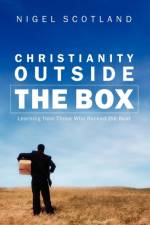
A major aspect of the history of Christian missions is the way groups who have jumped the ecclesiastical ship have renewed and recalled their parent bodies back to biblical roots and a biblical vision. This book examines fourteen such vibrant Christian movements which operated outside the box. Each chapter ends with a practical section highlighting those factors that made the particular group successful. They were all missional movements that pursued a Christian vision and developed structures to facilitate it. In contrast, the traditional organizations from which they emerged tended to do mission from an established, given structure. Here are seriously committed movements that offer a dynamic challenge to our contemporary churches.
Did the Jesus of St. Luke's Gospel come to heal the brokenhearted (4:18)? Did Mark's Jesus call his disciples to prayer and fasting (9:29), and did he cry from the cross, ""My God, my God, why have you persecuted me?"" (15:34). Did St. Paul write to the Romans that God works all things together for good for those who love him (8:28)? Did the author of Hebrews declare that Jesus died apart from God (2:9)?These statements are found in the manuscript tradition of the New Testament, but are not included in our standard printed editions or translations. Peter Rodgers argues that these and other textual variations should be reconsidered. After reviewing ten important verses using the traditional areas of text-critical inquiry (manuscript evidence, internal criteria such as style, and transcriptional probabilities), Rodgers turns our attention to important but neglected narrative features indicated by quotations, allusions, and echoes of the Old Testament. These references to the story told in the Scriptures of Israel shed new light on the passages considered, offering fresh material and greater perspective for making judgments about the original text.
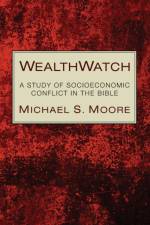
The purpose of this book is to help postmodern Westerners understand what the Bible has to say about wealth and possessions, basing itself on the presumption that (a) nobody can understand themselves apart from some recognition of their spiritual roots, and (b) that these roots sink deeper into the pages of the Bible than most Westerners realize. Focusing upon that part of the Bible most widely recognized to be its ideological core--that which is called Torah by some, Pentateuch by others--it interprets this ""great text"" against other ""great texts"" in its literary-historical environment, including (a) some epic poems from Mesopotamia, (b) some Jewish texts from Syria-Palestine, and (c) some Nazarene parables from the Greek New Testament.
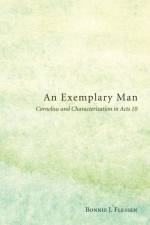
While most scholars focus on the character of Cornelius as a model Gentile, Bonnie Flessen argues that Cornelius is also a model male figure for Luke's audience. When analyzed closely, the characterization of Cornelius reveals a multifaceted rhetorical strategy regarding both gender and empire. This strategy lifts up a rather surprising portrait of an exemplary man who represents the Roman Empire and yet nevertheless manifests the virtues of submission, piety, and generosity.Flessen also proposes a hermeneutic of masculinity as a means to exegete Acts and other New Testament texts. This critical lens provides interpreters with a way of thinking about gender when female characters are absent or sparse. Although constructs of gender are embedded in texts, interpreters can use recent scholarship on masculinity along with extrabiblical evidence as tools to excavate the contours of the male figure in antiquity.
B. J. Oropeza offers the most thorough examination in recent times on the subject of apostasy in the New Testament. The study examines each book of the New Testament with a fourfold approach that identifies the emerging Christian community in danger, the nature of apostasy that threatens the congregations, and the consequences of defection. Oropeza then compares the various perspectives of the communities in Christ in order to determine the ways in which they perceived apostasy and whether defectors could be restored. In this final book of a three-volume set titled Apostasy in the New Testament Communities, Oropeza focuses on the Christ communities found in the General Epistles and Revelation.
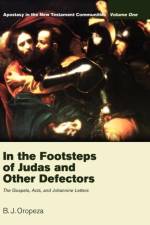
In this three-volume set, Apostasy in the New Testament Communities, B. J. Oropeza offers the most thorough examination in recent times on the subject of apostasy in the New Testament. The study examines each book of the New Testament and identifies the emerging Christian community in danger, the nature of apostasy that threatens the congregations, and the consequences of defection. Oropeza compares the various perspectives of the New Testament communities on the subject of apostasy to arrive at the idea that the earliest followers of Christ did not all believe and teach alike on the issue. The first volume, In the Footsteps of Judas and Other Defectors, focuses on the Christ-communities of the Gospels, Acts, and Johannine Letters.
Does the Apostle Paul have any use for the person of Jesus presented in the Gospels? Critical scholarship thinks not, but this book argues that Paul not only mentions more than seventy specific details of the historical Jesus, but he also commends the character of Jesus and echoes His teachings repeatedly in his letters and sermons-in full agreement with the Gospel accounts. Stout examines Paul's intriguing description of the ""Man Christ Jesus"" (1 Tim 2:5) and suggests that this title fulfills the OT expectation of God appearing in human history as a man. In his incarnated humanity, the Man Christ Jesus accomplished salvation in the historical events of his life and death, and in his resurrected humanity, he appeared to Paul on the Damascus Road-rooting Paul's Christology deeply in human experience.Furthermore, Stout shows how Paul rests his concept of salvation on a neglected aspect of his doctrine-that the entire church is associated with the historical events of the life, death and resurrection of Jesus, an association which also unites his church with one another in fellowship and service. This book, then, demonstrates that Paul's gospel rests upon Jesus as a man of history who brings salvation into human history in his life, death, and exaltation as the ""Man Christ Jesus.""
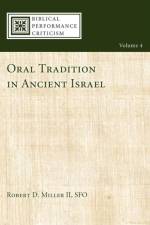
Providing a comprehensive study of "oral tradition" in Israel, this volume unpacks the nature of oral tradition, the form it would have taken in ancient Israel, and the remains of it in the narrative books of the Hebrew Bible. The author presents cases of oral/written interaction that provide the best ethnographic analogies for ancient Israel and insights from these suggest a model of transmission in oral-written societies valid for ancient Israel. Miller reconstructs what ancient Israelite oral literature would have been and considers criteria for identifying orally derived material in the narrative books of the Old Testament, marking several passages as highly probable oral derivations. Using ethnographic data and ancient Near Eastern examples, he proposes performance settings for this material. The epilogue treats the contentious topic of historicity and shows that orally derived texts are not more historically reliable than other texts in the Bible.
Synopsis:This book offers a rigorous analysis of the theme of "the cross" in the Johannine literature. After reviewing previous scholarship on the issue, Morgan-Wynne examines evidence that prima facie suggests that the evangelist, while maintaining the role of Jesus as revealer of the Father in his incarnate ministry, also saw something decisive for the salvation of human beings happening in the cross. Having established this, the work looks at John's understanding of sin and his concept of the purpose shared by the Father and Jesus, before reflecting on themes associated with the meaning of the cross. Of special importance is John 12, which connects the cross to the judgment of the world, the ejection of Satan, and the drawing of all to Jesus. The author examines what John considers to have been objectively achieved at the cross. A further section examines the meaning of the death of Jesus in the Epistle of 1 John, seen as the work of someone different from the evangelist but belonging to the same Johannine circle. The similarities and differences between Letter and Gospel are explored.Endorsements:"After a comprehensive survey of recent scholarship on the significance of the death of Jesus in the Gospel and First Letter of John the author gives us his own carefully and clearly argued interpretation of it as a saving and not merely a revelatory event. This confirmation of the traditional type of understanding of John's theology over against views that weaken the significance of the cross in it is warmly to be welcomed, especially by students looking for an up-to-date discussion of the problems."-I. Howard MarshallProfessor Emeritus of New TestamentUniversity of Aberdeen"The Cross in the Johannine Writings provides a thorough, up-to-date evaluation of a discussion that has vexed Johannine scholars for a century. Morgan-Wynne carefully surveys contributors (helpfully including vast continental scholarship in detail), provides an assessment, and then gives careful attention to one of John's most nuanced themes. This is now the most current and important voice that every Johannine scholar will want to hear."-Gary M. BurgeProfessor of New TestamentWheaton College & Graduate School"A Gospel is the story of Jesus, climaxing in his crucifixion and resurrection. John's telling of that story moves steadily to the same climax, but in motifs and images which are distinctive, even unique among the New Testament Gospels. To appreciate how John's treatment of the cross sheds new light on the gospel being proclaimed adds so much to Christian understanding of the cross. John Morgan-Wynne's valuable study brings this point home with force and effect."-James D. G. DunnEmeritus Lightfoot Professor of DivinityDurham UniversityAuthor Biography:John Morgan-Wynne (PhD in Durham) was Tutor in New Testament at Regent's Park College, Oxford, and taught Greek in the University for over twenty years. He served as Principal of Bristol Baptist College for six years and then became minister of Ilkley Baptist Church, West Yorkshire, before retiring. He is the author of Holy Spirit and Christian Experience in Christian Literature ca 90AD to 200AD.
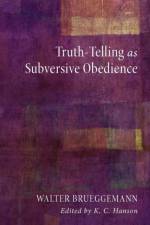
""Those who serve as truth-tellers in the church, like those who listen to the truth-telling in the church, are a mix of yearning and fearfulness, of receptiveness and collusion. In the end, the work of truth-telling is not to offer a new package of certitudes that displaces old certitudes. This truth to be uttered and acted, rather, is the enactment and conveyance of this Person who is truth, so that truth comes as bodily fidelity that stays reliably present to the pain of the world.""--from the Preface
This book, as a comprehensive analysis of the fate of Saul's heirs, shows that David, like other ancient Near Eastern usurpers, perpetrated heinous injustices against the vanquished house of Saul. It evaluates the relationships between David and Saul's heirs, using the criterion of justice, which is a cardinal directive principle for living in YHWH's covenant community as is enunciated in the Deuteronomic Code. Tushima focuses on the story of David and its interconnections with the fate of the Saulides to determine the factors that lay behind the latter's tragedies, inquiring into whether these tragedies were due to continuing divine retribution, pure happenstance, or Davidic orchestration. In his close reading of these texts, Tushima argues that David was, for the most part, unjust and calculating in his dealings with the Saulides. Thematic and motific threads arising from this narrative critical study (such as the impact of human conduct on the environment, the tension between election and the character of God's servants, the dynamics of sacred space and sacred typonyms, the Judahite [Davidic] kingship, the monarchy, marriage, and Zion theology) are considered within their contexts in Israel's traditions for their biblical-theological and redemptive-historical import.
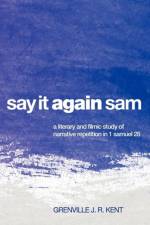
Synopsis:In recent decades, biblical scholars have often drawn from the wells of literary theory when seeking to better understand the art of biblical narrative. This innovative work adds to these insights by applying film theory to the analysis of story in the Hebrew Bible. Kent argues that film theory helps us to attain much greater clarity in our appreciation of the functions of narrative repetition.This book offers a synchronic exegesis of Saul's night visit to the witch of En-Dor (1 Sam 28:3-25), focussing on the web of repetitions of visual elements, of symbols, of sounds, of entire scenes, and of keywords. Kent shows how an artistry of repetition and non-repetition helps to build characterization, plot, and structure, as well as prophetic fulfilments, foreshadowing, and inter-textual warnings. Anyone interested in biblical narrative and the Hebrew Bible will find here new questions and techniques, and a wider repertoire of tools offering fresh understandings.Endorsements:"[T]his book is an important contribution to Old Testament studies. As an Old Testament scholar with an interest in narrative, and also a film maker, Grenville Kent is well qualified to explore the interface between these disciplines and to show the fruitfulness of bringing them together."--David FirthSeries Editor, Tyndale Old Testament Commentaries"Drawing from the author's professional and academic expertise, this work offers a rigorous understanding of narrative film studies within Biblical Studies and related theological disciplines. With more and more publications seeking to make use of some form of film appreciation as part of their narrative reflection on theology, this contribution is timely and important and will form an important text for narrative critical studies of both Old and New Testament."--Revd Dr. Peter Phillips St. John's College, University of DurhamAuthor Biography:Grenville J.R. Kent is Lecturer in Old Testament and Arts at Wesley Institute in Sydney. He is co-editor of Reclaiming the Old Testament for Christian Preaching (IVP, 2010).
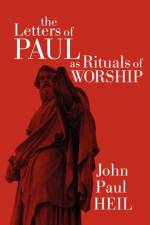
Synopsis:This book focuses on worship in the letters of Paul in an effort to shed some light upon this key theme and bring the various dimensions of its significance into the foreground of Pauline studies. Each of the thirteen New Testament letters attributed to Paul are treated exclusively from the aspect of worship, as understood in its most comprehensive sense in the biblical tradition, with the liturgical and the ethical facets of worship held in dynamic interrelationship. The result is a fresh way of reading and listening to the letters of Paul for a deeper appreciation of their original purpose and message.Endorsements:"When Heil calls the thirteen letters of Paul 'rituals of worship,' he means that each is written as a script to be performed for a community gathered for worship over which Paul presides through the letter, thereby evoking and sharing in the prayer of his audience. Heil also explores how the language of the letters uses imagery from temple worship metaphorically, to interpret Christian life itself as worship. Heil manages to provide a fresh, pastoral reading of the Pauline corpus as a whole."--Dennis Hamm, SJDepartment of TheologyCreighton University"This book offers a unique and much needed narrative on the way St. Paul understands liturgy from the inside and how he invites others to do the same. The major factor in Heil's interpretation of the Pauline corpus is that he restores them to the context in which they were first received--as proclaimed in a liturgical assembly--and in which believers hear them today. This respects the letters not as literary output but as proclamations about the mystery of God as proclaimed in the liturgical and sacramental settings they were intended for. Highly recommended. Christian 'spirituality' at its best."--Kevin W. IrwinDean of the School of Theology and Religious StudiesThe Catholic University of America"The connection between communal worship and the NT is a fascinating topic. Understanding 'worship' comprehensively, Prof. Heil is the first to focus on all the letters attributed to Paul. Prof. Heil appreciates the uniqueness of each letter but notes they all begin with a prayer-greeting for divine grace, include ritualistic and liturgical language, and refer to both the ethical and liturgical worship of the audience. His book is insightful, instructive, and, as always, excellent scholarship."--Robert F. O'Toole, SJ, SSDGregorian University FoundationAuthor Biography:John Paul Heil is Professor of New Testament at The Catholic University of America in Washington, DC. He is the author of Ephesians: Empowerment to Walk in Love for the Unity of All in Christ (2007).
Against the Tide, Towards the Kingdom is the story of the Urban Vision community in New Zealand. This book recounts the story of a group of young Christian adults who over the last fifteen years have relocated to the colorful ends of their city to share life with those who are struggling, homeless, sick, poor, neglected, or otherwise marginalized. The community has grown over time to seven neighborhoods where on any given day you may find "Urban Visionites" growing vegetables amidst the concrete, teaching English to refugees, offering alternative education programs to out of school teenagers, fostering children, doing church with the homeless, offering friendship to the mentally ill, roasting fair trade coffee, running kids clubs, moms groups, tenant meetings or just sharing yet another cup of tea with their neighbors. In fact sharing is a good summary of the whole shape of this exciting movement. They share homes, food, money, vehicles, jobs, prayers, dreams, conversations, fun, tears, pain, hope, healing, transformation . . . they share the whole of life with each other and with their neighbors. They live the gospel, this good news of Jesus.
The Wedding of the Lamb does not fit into any of the traditional categories of interpretation for the book of Revelation. The author uses historical sources to combine New Testament interpretation with the history of the Roman/early Christian period to present an interpretation that is meant to approximate the way the early Christians would have understood the text. Far from a doomsday message, the message of Revelation is one of hope for a Church in the midst of persecution. The result is an interpretation which, unlike the proliferation of fictionalized accounts of the "end-times," recognizes that most of the images in the book of Revelation are references to events in the history of the Church.
Synopsis:Is Second Corinthians, one of Paul's most personal and passionate letters, better understood as a text or a performance? Using an audience-oriented method, Timothy Milinovich examines the letter as orally performed correspondence, from the view of the authorial (i.e., intended or ideal) audience. What results is an original structural analysis of 2 Corinthians 1:1--6:2, denoting twenty chiastic units and three larger macrochiastic arguments. This arrangement is intended to show what the authorial audience heard, offering a new way of understanding how Paul's letter would have been received--not based on modern thematically determined paragraphs, but on oral patterns consonant with the cultural context of the author and audience. In particular, Milinovich offers insight on the audience response to the climactic exhortation to reconciliation with the apostle in 5:16--6:2. He determines that the structure of the unit is the key to its theological and rhetorical message, which is just as much concerned with the community's relationship with Paul as with God. That is, if they are to fully receive the salvation that God intends for them, the community must be reconciled with their apostle now, at the hearing of this letter.Endorsements:"This detailed analysis of a key section of 2 Corinthians perceptively demonstrates how an audience-oriented close listening to the text not only contributes to an ongoing trend to view this Pauline letter as a unified composition, but provides a model that can be profitably applied to other problematic parts of the New Testament. Its theme of renewal and reconciliation is as relevant for us today as it was for Paul and the Corinthians."--John Paul HeilProfessor of New TestamentThe Catholic University of America"In this new study of 2 Corinthians, Milinovich offers a close reading of the first six chapters of the letter that uncovers a series of intricate chiasms, which knit these chapters together. If this reading is correct, it provides us with a new way to read 2 Corinthians and with fresh evidence for the literary integrity of this letter."--Frank J. MateraThe Andrews-Kelly-Ryan Professor of Biblical StudiesThe Catholic University of AmericaAuthor Biography:Timothy Milinovich is Assistant Professor in the Department of Religious Studies and the Pastoral Institute at the University of the Incarnate Word in San Antonio, Texas.
Biblical scholars often read the Bible with their own interpretive interests in mind, without associating the Bible with the concerns of laypeople. This largely undermines the contributions laypeople can offer from reading the Bible in their own contexts and from their own life experiences. Moreover, such exclusively scholarly reading conceals the role of biblical texts in dealing with current social problems, such as HIV/AIDS-related stigmatization. Hence, the lack of lay participation in the process of Bible reading makes the Bible less visible in various common life situations.In this volume Elia Shabani Mligo draws on his fieldwork among people living with HIV/AIDS (PLWHA) in Tanzania, selects stigmatization as his perspective, and chooses participant-centered contextual Bible study as his method to argue that the reading of texts from the Gospel of John by PLWHA (given their lived experiences of stigmatization) empowers them to reject stigmatization as unjust. Mligo's study shows that Christian PLWHA reject stigmatization because it does not comply with the attitude of Jesus toward stigmatized groups in his own time. The theology emerging from the readings by stigmatized PLWHA, through their evaluation of Jesus' attitudes and acts toward stigmatized people in the texts, challenges churches in their obligatory mission as disciples of Jesus. Churches are challenged to reconsider healing, hospitality and caring, prophetic voices against stigmatization, and the way they teach about HIV and AIDS in relation to sexuality.Churches must revisit their practices toward stigmatized groups and listen to their voices. Mligo argues that participant-centered Bible-study methods similar to the one used in this book (whereby stigmatized people are the primary interlocutors in the process) can be useful tools in listening to the voices of stigmatized groups.
What may happen when Christians take doctrine seriously? One possible answer is that the shape of churchly life "on the ground" can be significantly altered. This pioneering study is both an account of the doctrine of the person of Christ as it has been expounded by the theologians of historic English and Welsh Nonconformity, and an attempt to show that while many Nonconformists held classical orthodox views of the doctrine between 1600 and 2000, others advocated alternative understandings of Christ's person; hence the evolution of the ecclesial landscape as we have come to know it. The traditions here under review are those of Old Dissent: the Congregationalists, Baptists, Presbyterians and their Unitarian heirs; and the Calvinistic and Arminian Methodist bodies that owe their origin to the Evangelical Revival of the eighteenth century.
Description:How does one explain the New Testament texts that seem to announce the imminent arrival of the long-awaited Day of the Lord?In this study, Dale Allison presents a comprehensive analysis of the first-century beliefs about the period of suffering and tribulation which was to precede the general resurrection of the dead. Although such beliefs were not uncommon, they heave received little attention from New Testament scholars. Dr. Allison argues that they provided the conceptual tools that allowed New Testament writers to make sense of the death and resurrection of Jesus, without abandoning altogether Jesus'' own messianic expectations and belief in some imminent radical change. Dr. Allison shows that the realized eschatology of the Gospels is not, as is so often thought, the product of Jesus'' own teaching and preaching. Rather, it stems from the reflection of the earliest Christian communities on the death of Jesus, in the light of his belief in a imminent End.Dr. Allison offers a stimulating and detailed account of the teaching of Jesus and of the New Testament records of the passion and resurrection of Jesus. He concludes his study with an important discussion of the way this process of reflection has continued throughout Christian history and indeed how it continues to influence Christian thinking today.
About the Contributor(s):James Morison (1816-1893) was Principal and Professor in the Theological Hall of the Evangelical Union Church, Glasgow.
Moved by God to Act offers a fresh description of Christian moral action as a moment of connection between divine and human agency. Through an ecumenical consideration of a variety of resources, this book gives an accessible description of the work of God's grace not only in individual Christian agency but also within the dynamics of Christian community. Moved by God to Act brings the contemporary theological ethics of community into dialogue with the pneumatology of Thomas Aquinas. The ethic emerging from this dialogue lifts up the centrality of God's grace in Christian community while at the same time offering a detailed articulation of the human being as naturally and beautifully drawn into cooperation with God's grace in the ethical life. The book concludes by showing how Aquinas stands in substantial harmony with the contemporary authors discussed, offering a proper description of God's agency in individual Christian human agency and the dynamics of the "body" of the Christian community to which the contemporary discourse so rightly points. Moved by God to Act is an attempt to speak to the work of God in the life and day-to-day action of Christians and Christian communities as moved to act by the Holy Spirit.
Street Signs is an engaging missiological inquiry into the cultural and theological meaning of the city. Through the lens of Seattle's Rainier Valley, one of the most ethnically and socioeonomically diverse communities in the US, this work constructs an urban, missional, and contextual theology that is shaped by the local realities of urban neighborhoods but relevant to cities everywhere. Focused on the themes of incarnation, confrontation, and imagination, Street Signs explores the contours of missional theology in urban contexts marked by physical density, social diversity, and economic disparity. In addition to examining contextualization and cultural theory, Street Signs also utilizes creative research methods like urban exegesis, cultural semiotics, and theology of the built environment. For the urban ministry practitioner or the theologian in the city, this work aims to engage thoughtful Christians with missiological and theological reflections on place, neighbor, and community.
This book is a vital resource for intervention programs, educators, social workers, counselors, psychotherapists, pastoral counselors, and survivors of intimate violence and their families. It gives the reader access to the inner emotions and psychological mechanisms of survivors of intimate violence in collective cultures that work to hold them captive in violent relationships. The author integrates the psychological developmental theories of Heinz Kohut and Erik Erikson with social, cultural, and religious aspects to demonstrate the collusive power of what she calls the orienting system (psychosocial and religious cultural force) in the formation of a female sense of self, to investigate the peculiar range of responses of females to intimate violence. Using theoretical and empirical research, the author claims that the demeanor and functionality of the female survivor of intimate violence is an adaptation that enables her to retain her socially prescribed roles, which she appropriates as a social identity and sense of self. A surprising aspect of this work is the transformative power of religion, also resourced in the orienting system, in transforming the psychic hold of survivors to cathected self-objects, to self-images that approximate a self in healthy relationship with God. Consequently the energies and investment released can be redirected to cohere in self-identities that can optimize drive, thrive and relationality.
Abonner på vårt nyhetsbrev og få rabatter og inspirasjon til din neste leseopplevelse.
Ved å abonnere godtar du vår personvernerklæring.