











Gjør som tusenvis av andre bokelskere
Abonner på vårt nyhetsbrev og få rabatter og inspirasjon til din neste leseopplevelse.
Ved å abonnere godtar du vår personvernerklæring.Du kan når som helst melde deg av våre nyhetsbrev.

Endorsements:"This book is a study of the Holocaust as problem in ethical theory. How could a whole society participate in an ethic of mass torture and genocide for over a decade without opposition from responsible political, legal, medical, or religious leaders? How does a society create and adopt its ethical norms? This is a study in narrative ethics at its best, yet the author''s purpose is to discover how a people redefined evil to the degree that they committed heinous atrocities that were reprehensible under normal circumstances."--Guy Greenfield, Southwestern Journal of Theology"Peter Haas gives us a good overall description of the Holocaust, the way the Nazis and their myriad collaborators treated the Jews. The book . . . is well formulated and well written. It makes a good one-volume introduction to the Holocaust."--Frederick K. Wentz, Lutheran Quarterly"Peter Haas urges us to recognize ourselves in the perpetrators of the Holocaust. . . . In the course of setting forth his position, the author offers a concise and wonderfully accessible account of the formation of German political culture from Bismarck through Hitler. . . . Morality After Auschwitz is a serious book that should provoke long thoughts, and perhaps useful disputes, about the power of ethics to shape political cultures."--First Things
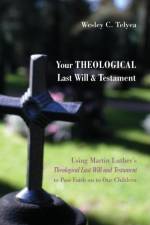
Description:Have you ever wondered what the church will look like a generation or two from now? Do you worry that the church you grew up in might someday die? Would you like to see your faith legacy passed on to a new generation of Christians? Using Martin Luther''s Smalcald Articles Wesley Telyea explores how Christians today can use Luther''s insights found in his own theological last will and testament to write their own, and pass the faith to the next generation of disciples. For Lutherans this book will bring to life an often neglected, but highly valuable, confessional document. For non-Lutherans this book will open up a new way of thinking for how to make disciples.
Description:Narrow escapes, hilarious predicaments, and grim disasters are all part of the rich and varied experiences of a young tugboat captain on the Columbia River during the era between the grand old sternwheelers and the multi-thousand horsepower tugboats of today. The author had captured the excitement of this episode in his life and presented it in and informal manner that will appeal to a wide audience.
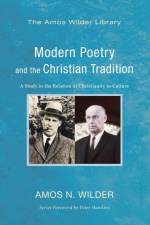
Description:In Modern Poetry and the Christian Tradition, Wildler examines this movement in poetry in relation to the direction in which our culture is moving. He interprets the significance of modern poetry and shows its relation to the ""traditional."" He gives attention to the representative poets of our time (including Dylan Thomas, Gerard Manley Hopkins, Allen Tate, W. H. Auden, Wallace Stevens, T. S. Eliot and others); he notes the wider implications of their work and assesses from them the impulses and trends of our age.As a poet of considerable ability, as a student of literary criticism for many years, and as a teacher, Wilder is in a position to know and understand his subject. The result is a book of permanent value to all concerned with the deeper meanings of civilization and Christianity.
About the Contributor(s):Amos N. Wilder (1895-1993), New Testament scholar, poet, literary critic, and clergyman, received all earned degrees from Yale. His teaching career included posts at Andover Newton Theological School, Chicago Theological Seminary and the University of Chicago, and Harvard Divinity School. Special honors included the Golden Rose of the New England Poetry Club (1943) and the Bross Prize (1952). Wilder also received the Croix de guerre for service in World War I. He was the brother of playwright and novelist Thornton Wilder.
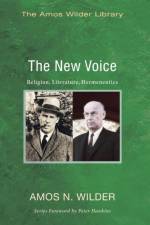
Description:In The New Voice, Amos Wilder carries forward and combines two areas of activity represented in his earlier, groundbreaking publications. One of these is that of the theological critic, concerned with modern literature as it illuminates the quests of our age and the vicissitudes of our religious tradition, as found in his Modern Poetry and the Christian Tradition and Theology and Modern Literature. The other area is that of biblical scholarship, especially in its recent concern with hermeneutics and the modes of language, as represented by his volume on early Christian rhetoric, The Language of the Gospel.Wilder seeks in the present book to deepen and correct the approach of the theological critic by urging that rhetorical criteria should receive primary attention and that language should be explored in new ways. Wilder therefore examines certain aspects of biblical genre and style as ways of illuminating modern rhetoric and its underlying assumptions. It is a main theme of the work that the disorders and travail of our time should be construed in a positive light, and that the most significant writing of the period not only illuminates contemporary reality but fashions a language in which the abiding legacies and archetypes of the past can again be brought to speech.Writers specially discussed in the book range from Musil, Proust, Eliot, and Gide to Sartre, Perse, Beckett, Lowell, David Jones, and the exponents of open verse. The work of many others is brought into relation with the task defined by Pound as naming things accurately and by Stevens as ""making the bread of faithful speech.""
About the Contributor(s):Ray Anderson (1925-2009) was Senior Professor of Theology and Ministry at Fuller Theological Seminary and served on the faculty of the School of Theology since 1976. He is the author of more than twenty books, including Spiritual Caregiving as Secular Sacrament, The Soul of Ministry, Self-Care, Living the Spiritually Balanced Life, and Dancing with Wolves While Feeding the Sheep: The Musings of a Maverick Theologian.
Description:Most people probably have a copy of the Bible in their homes, some hold one in their hands each week at church-and perhaps even attend a Bible study- but not everyone sees or appreciates the great beauty and intricate composition of the Bible,"" writes author Drake Williams. ""The Bible, as a great work of art, deserves to be considered in unity.""Combining first-rate scholarship with easy-to-understand language, Making Sense of the Bible examines the Bible as a literary work of art and reveals ten key threads that form the thematic tapestry spanning Old and New Testaments. With this book, the Bible will no longer be a jumble of unrelated books, promises, and exhortations, but a collective, cohesive, and more meaningful masterpiece to any reader who wishes to explore its full breadth and depth.
About the Contributor(s):Andrew Taylor-Troutman is the author of Take My Hand: A Theological Memoir about his first-year of ordained ministry at New Dublin Presbyterian Church in the mountains of southwestern Virginia. The author received his bachelor of arts from Lenoir-Rhyne University and holds graduate degrees from Union Presbyterian Seminary and the University of Virginia Charlottesville.
Description:LoveVolume , Number 2, June 2012Edited by David Matzko McCarthy and Joshua P. HochschildLove: A Thomistic AnalysisDiane Fritz CatesMovements of Love: A Thomistic Perspective on Eros and AgapeWilliam C. Mattison IIILove and Poverty: Dorothy Day''s Twofold DiakoniaMargaret R. PfeilWhat''s Love Got to Do With It?Situating a Theological Virtue in the Practice of MedicineBrian E. VolckAdoption and the Goods of BirthHolly Taylor CoolmanNatural Law and the Language of LoveCharles Pinchas and David Matzko McCarthyReview Essay: Love and Recent Developments in Moral TheologyBernard V. Brady
Description:What does it mean to be both a Christian and a therapist?Between Jerusalem and Athens offers a compelling answer to this question. It shows students and practitioners who struggle with this issue how they can authentically integrate faith and practice by considering the central, life-shaping theme of biblical Christian ethics: the Reign of God.Part 1 proposes that a distinct cultural ethic based on the central theme of the Reign of God be the context of therapy. Part 2 explores how the church can be a community of ethical reflection and healing. Part 3 discusses the therapist''s character and a model for developing character that reflects the Reign of God.
Description:The first year for any missionary is filled with adventure and trials. Assimilating to a new culture requires more than any book can offer. This is the story of a young woman who stepped out of her college years directly into the mission field. She was vastly unprepared in language, experience, and spiritual discipline, but she encountered the Lord in a way she never could while growing up in America. The transition from an American college campus to the sandy streets of a developing country was not easy physically or emotionally. The excitement of adventure soon waned in the face of homesickness and culture shock. Through it all, she found that the practices she had been taught for years in church and student ministry were vital for survival and that there is no hope, no strength, and no joy that can sustain you outside of what is found in Christ.
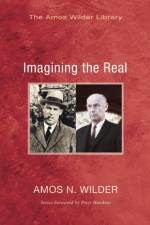
Description:The graphic artist Margaret Rigg met Amos Wilder through The Society for Arts, Religion and Contemporary Culture (ARC), of which Wilder, together with such figures as Joseph Campbell and Paul Tillich, was a founder in the early 1960s. In 1978 Rigg published Imagining the Real, a limited edition (350 copies with designs) as an expression of ""homage"" to Wilder with a special emphasis on his poetry. This unusual publication includes an extensive interview between Rigg and Wilder covering his upbringing and its influence on his life as a writer and poet; an original essay by Wilder on themes suggested by the interview (""A Comment . . .""); six poems by Wilder selected to depict shifting sensibilities over his six-decades-long career as a practicing poet; and a lively self-annotated overview of his life and career (""Wilderiana: Dates and Places""). The volume concludes with poems dedicated to Wilder by Stanley Romaine Hopper and Arnold Kenseth. Long known only to students of Amos Wilder and his family, the republication of Imagining the Real makes available to a broader public an unusual window on the story of Amos Wilder, poet.
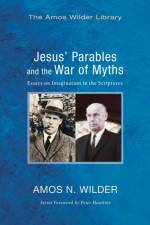
Description:Amos Wilder is widely known as a pioneer of an indigenously North American approach to biblical interpretation which takes language to be an expression not only of psychological but also of sociological and concrete reality. Recording the history of his interest in eschatological language, Wilder further advances the literary and rhetorical criticism of Scripture, especially by alerting interpreters to the deeper modes of language and communication often overlooked.The essays in this volume, recaptured and edited to clarify their relatedness, are presented in two groups. The first group includes essays that situate the parables of Jesus within the broader context of the biblical narrative. The second is a series of essays dealing with the problem of adequately interpreting the ""kingdom language"" of Jesus. The book includes an essay in which Wilder chronicles and advances his long interest in the task of doing justice to the imaginative dimension of biblical language. Wilder develops a contemporary hermeneutic that combines the full range of historical-critical methods with approaches generated by various modern disciplines which attempt to do full justice to the interrelationship of language and reality. The preface by James Breech offers an exposition of the main features of Wilder''s hermeneutic, together with a discussion of Wilder''s understanding of parabolic narrative and Jesus'' symbolics.
Description:Amos Wilder, a distinguished New Testament scholar and poet, was only a youth when he volunteered to serve as an ambulance driver with the American Field Service during World War I and then became a corporal in the Army''s 17th Field Artillery of the 2nd Division. His journals and letters home (including correspondence with his younger brother, Thornton Wilder) form the basis of this book of reminiscences about his experiences, one of the few wartime memoirs that eloquently articulates and interprets the common soldier''s point of view.As an ambulance driver, Wilder traveled from the western front to the mountains of Macedonia, where his memoir sheds light on the many nations, races, and religions involved in the conflict in that turbulent region. After the United States entered the war, Wilder, now the soldier, participated in the decisive 1918 actions at Belleau Wood, Soissons, and the closing Argonne drive. His journals provide a brilliant panorama of the activities and people behind the lines, an often arresting portrayal very different from the scenes of death in the trenches that others have described. Throughout, Wilder explores in a fresh and provocative way larger questions about the enduring meaning of a shattering event in world history remembered by himself and others as an encounter with ""Armageddon.""
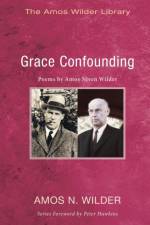
Description:Thirty-one poems, the great majority written and published in the 1950s and 1960s in such magazines and journals as The Christian Century and Christianity and Crisis, as well as a selections from two of his earlier collections. His important poem, ""A Hard Death,"" the last Wilder work to appear in Poetry (1965), is also found here. The volume''s foreword, addressed to alert Christians and congregations, is an important and forthright statement of the poet''s artistic world view. ""Old words do not reach cross the new gulfs,"" Wilder writes, adding, ""Does not the New Testament itself promise new tongues, new names, new songs?"" In recognizing a faith that ""the ancient covenant mortised in the foundations of the world still holds,"" readers of Amos Wilder''s poetry encounter a distinguished student of the New Testament who wrestled with fresh idiom and metaphor in his search to make the scripture of the past ""speak to us anew.""
Description:Thornton Wilder, three-time winner of the Pulitzer Prize, remains to many people an enigma. Malcolm Cowley indicated that ""in point of intelligent criticism, Wilder is the most neglected author of a brilliant generation,"" and the Times Literary Supplement once observed that ""Thornton Wilder has successfully resisted any kind of classification as a novelist or playwright.""In this revealing, incisive study, Amos Wilder, Thornton''s older brother, seeks to situate his brother''s vision and art. Much criticism, dominated my modernist canons, has not known what to do with Thornton Wilder and finds suspect his wide popularity and what is seen as his traditionalist or ""mid-brow"" outlook informed by ""Puritan"" antecedents and rearing. The present essay, however, documents Wilder''s full initiation into the ""modern"" experience, only insisting that he absorbed its iconoclasms into a deeper and more universal humanism.Critical circles, in their view of the American Writer in our day, commonly neglect and disparage those legacies, cultural and religious, which shaped Wilder''s outlook. Therefore, the central section of this essay is devoted to biographical detail, illustrating those creative factors and faiths that undergird American society and its promise. Many readers will be aided in their understanding of Wilder by this book''s description of the special circumstances of his education, formative influences, and family life.Thornton Wilder and His Public offers rare, intimately informed, and helpful illumination on the life and art of one of America''s greatest literary figures.
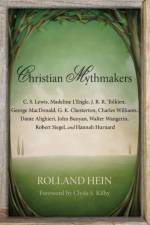
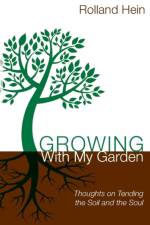
About the Contributor(s):Rolland Hein, professor emeritus from Wheaton College, also graduated from Wheaton in 1954. Having recieved a BD degree from Grace Theological Seminary and a PhD from Purdue University, he taught English at Bethel College, St. Paul, until 1970. His writings include George MacDonald: Victorian Mythmaker and Christian Mythmakers. He currently conducts a class in myth at the Wade Center on Saturday mornings. He and his wife, Dorothy, live near St. Charles, Illinois.
About the Contributor(s):Rolland Hein, professor emeritus from Wheaton College, also graduated from Wheaton in 1954. Having recieved a BD degree from Grace Theological Seminary and a PhD from Purdue University, he taught English at Bethel College, St. Paul, until 1970. His writings include George MacDonald: Victorian Mythmaker and Christian Mythmakers. He currently conducts a class in myth at the Wade Center on Saturday mornings. He and his wife, Dorothy, live near St. Charles, Illinois.
Endorsements:"For almost forty years Charlotte von Kirschbaum was Barth''s closest companion and coworker. Barth himself spoke of her ''immeasurable contribution to the formation and development'' of his theological work. The author of this book is not willing to let Charlotte von Kirschbaum be one of the forgotten women of history."--Keith Crim, translator
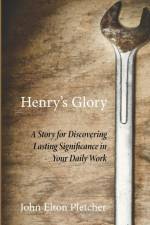
About the Contributor(s):John Elton Pletcher (DMin, Denver Seminary) serves as Lead Pastor at Manor Church in Lancaster, Pennsylvania. He also teaches as adjunct faculty for Eastern University and Evangelical Seminary.
Description:""If it ain''t broke, don''t fix it.""But it''s no secret that the Christian church is ""broke,"" and does need fixing. Despite great effort, things are going badly for us. We''ve tried trendy and tech-savvy, entrepreneurial and coffee-house gritty. They''re not helping. Our problem is deeper than that. Our problem is our instincts--instincts informed by our story. There was a time when the Christian church was a powerfully transformative presence in society. It can be again--but it will require radical rethinking of the story that informs our instincts. And it''s time! It''s been five hundred years since the Reformation, our last major update. Today is a pivotal moment in history. With our worldview upended by quantum physics, history is demanding we renew the Christian story for our times. Rethinking Our Story reframes the elements of the Christian narrative for the new era. It explores ""quantum"" ways of thinking about God, human nature, Jesus, salvation, and the afterlife. The future of the church and the health of our society depend on our willingness to rethink, retell, and live out a better story. We will either update our instincts and contribute to the earth''s well-being--or disappear into oblivion.
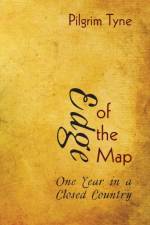
About the Contributor(s):Pilgrim Tyne is a student and teacher of writing. At the time of this publication, he and his family continue to serve as missionaries to the least reached.
About the Contributor(s):Hans W. Frei (1922-1988) was one of the most important American theologians of his generation. He spent the majority of his career teaching at Yale Divinity School, where he authored The Identity of Jesus Christ and The Eclipse of Biblical Narrative, numerous essays, and a vast collection of unpublished works, which have since been published posthumously: Types of Christian Theology, Theology and Narrative, and the forthcoming Reading Faithfully: Writings from the Archives.
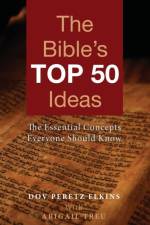
Description:All the important moral ideas of the modern world are based on the key biblical verses analyzed in this collection.What generally happens when someone picks up a copy of the Bible?Often it is put down within seconds because readers see endless verses which turn them off.Finally, here is an accessible book about the Bible that focuses on its great moral principles:--Human beings are created in the image of God.--""Love your neighbor as yourself.""--""You shall not stand idly by the blood of your neighbor.""--""You shall love the Lord your God with all your heart and with all your soul and with all your might.""--""Justice, justice shall you pursue.""Dov Peretz Elkins believes that if a reader understands fifty verses of the five thousand in the Bible (only 1 percent), he or she will begin to grasp the essence of the Bible.This remarkable explanation of the Bible shows readers how it can serve as a light that illuminates a path through the confusion and problems in their personal and communal lives. The result is a life that is better and more serious--a life with meaning, purpose, and direction.The Bible''s Top 50 Ideas:--Presents the Bible''s essential ideas in readable, engaging fashion.--Focuses on the contemporary value of the Bible.--Uses commentaries and explanations from sources that are modern as well as ancient, Christian as well as Jewish, and popular as well as scholarly.Elkins not only simplifies the Bible but also demonstrates how its fundamental ideas and concepts have inspired four thousand years of civilization to follow its teachings. The result is a moral, legal, and literary foundation that remains the basis of all democratic and principled societies to this day.
About the Contributor(s):L. Gail Irwin (MDiv) is an ordained minister and freelance writer who has served in the United Church of Christ and the Presbyterian Church (USA). In 2010, she was a Louisville Institute Pastoral Study Project Grant recipient. She lives in rural Wisconsin and blogs at http://freelancepastor.wordpress.com.
About the Contributor(s):Jonathan Huggins is Research Associate in Systematic Theology and Ecclesiology at Stellenbosch University. He is also Chaplain at Berry College and a priest in the Anglican Church in North America. Dr. Huggins lives with his wife and three children in Rome, Georgia.
About the Contributor(s):Joe R. Jones is Professor Emeritus of Theology and Ethics at Christian Theological Seminary, in Indianapolis, and now living in retirement in his hometown of Oklahoma City. He is the author of the still widely used A Grammar of Christian Faith: Systematic Explorations in Christian Life and Doctrine (2002) and On Being the Church of Jesus Christ in Tumultuous Times (2005).
Description:Can your ultimate desire ever be fulfilled? Everywhere you look, every time you listen, with each click and tap, there''s something you desire. How do you know if what you desire will satisfy, or if you are seeing a ""desire mirage""? The global village presents countless ways to connect to all kinds of information. We think we can scarcely live without these connections. Do we realize, however, that these connections often block or slow down connections to God, self, and others? Divided Desire is a journey along the road of desire--a road everyone travels. Along the journey, Kenny Damara explores why we desire what we desire in the global village today.What role does God have in fulfilling the ultimate desire of the heart? And how should we respond?
Abonner på vårt nyhetsbrev og få rabatter og inspirasjon til din neste leseopplevelse.
Ved å abonnere godtar du vår personvernerklæring.