











Gjør som tusenvis av andre bokelskere
Abonner på vårt nyhetsbrev og få rabatter og inspirasjon til din neste leseopplevelse.
Ved å abonnere godtar du vår personvernerklæring.Du kan når som helst melde deg av våre nyhetsbrev.

The wonders and mysteries of sacramental life are celebrated in this distinctive collection of essays by eight acclaimed Catholic writers. In Signatures of Grace, Murray Bodo, OFM, Andre Dubus, Mary Gordon, Patricia Hampl, Ron Hansen, Paula Huston, Paul Mariani, and Katherine Vaz share the personal experiences that have deepened the significance of the sacraments in their spiritual and everyday lives.In ""Baptism,"" Katherine Vaz, a novelist and lifelong swimmer, blends images of water, creation, and rebirth to evoke the eternal readiness of the soul to receive grace. Discussing Penance. Patricia Hampl recalls her earliest confessions, when tallying up a decent number of disobediences was a challenge. Writing from a wheelchair and knowing he would never walk again, Andre Dubus, who died in 1999, learned to embrace life's simplest pleasures as gifts: a breeze wafting through his window on a fine June day; a conversation with a friend; preparing a meal for his daughters.These and other essays weave the evolution of the sacraments through the centuries with each author's unique personal history. Inspiring and deeply felt, Signatures of Grace is an invitation to revisit, or discover for the first time, the profound mysteries at the heart of Catholic life.
American Presbyterians have a remarkable heritage of foreign mission work. While today the mission and ministry of the Presbyterian Church and all of mainline Protestantism is in a time of reformation and deep change, it is vital to remember this heritage of world mission. The Presbyterian Mission Enterprise tells this story by highlighting significant mission leaders through the ages. Our story includes Francis Makemie, a colonial-era missionary pastor and church planter who gathered with colleagues to form the first Presbytery in 1706. Tough, old-school Presbyterians like Ashbel Green insisted on a distinctive Presbyterian mission effort, and Presbyterians were among those who heard the call exemplified by William Carey to take the gospel to the whole world. This vision beckoned Walter Lowrie into leadership, and Presbyterians joined the great missionary movement. Robert Speer was a driving force behind this growing movement, negotiating a moderate path through bitter conflicts. After the traumas of World War II, John Coventry Smith worked to reconfigure and redirect the mission enterprise. Now, in an era marked by fragmentation and realignment, leaders like Clifton Kirkpatrick and Hunter Farrell work to continue the Presbyterian mission enterprise as a vital piece of the way forward. Our heritage guides our future.""Mark''s careful outline of the long heritage of Presbyterian missions ends with a challenge for us as mission co-workers--and indeed for all Presbyterians: how to make real--to embody--mission as partnership in our daily work and worship. With the explosion of short-term mission trips and decentralized mission leadership, we all need to reflect more deeply on what ''communities of mission practice'' means as our Presbyterian theology of mission, with Christ at the center.""--Eric L. Hinderliter, PC (USA) mission coworker, Klaipeda, Lithuania""The adage goes something like this: ''You can best see where you are going, if you look back at where you have been.'' The Presbyterian Mission Enterprise by Englund-Krieger provides an excellent narrative of some of the saints who have led the way in Presbyterian missions over the centuries. Today''s mission work can only be strengthened by meeting these people and hearing their stories as we work with global partners to create new narratives.""--Debra L. Hough, Director of Christian Education, Derry Presbyterian Church, Hershey, PA""The Presbyterian Mission Enterprise takes us back to the beginning of US Presbyterian mission, holding up critical themes, leaders, and controversies that have shaped the ways in which Presbyterians have been sent out into the world to share the gospel of Jesus Christ. But more than raw history, Englund-Krieger shares his passion that the rich history of US Presbyterian mission can help instruct and lead us into a faithful and effective mission for the future.""--J. Mark Wright, PC (USA) mission coworker, Tegucigalpa, HondurasMark J. Englund-Krieger is Executive Presbyter of the Presbytery of Carlisle, Presbyterian Church (USA). He is the author of The Presbyterian Pendulum (Wipf & Stock, 2010).
Does Christianity have anything useful or credible to say to the twenty-first century, or is it just a relic of a past era, doomed eventually to die a long and painful death, perhaps to be replaced by the new atheism or another religion? In an original contribution to such debates, The Revelation Worldview is a bold attempt to construct a biblically based Christian worldview that makes sense to postmodern people. It also seeks to make the book of Revelation, one of the most strange and difficult books in the Bible, relevant to issues facing people in the twenty-first century. Jon K. Newton wrestles with the complex notion of worldview, tells the story of the changing Western worldview from its ancient and medieval beginnings through the modern era and into the unpredictable world of postmodernism, and compares the worldview found in Revelation with other worldviews of its day. He then uses Revelation as a source for identifying some basic Christian answers to questions such as: What is real? How do we know anything? How can religious knowledge claims be justified? How can we understand the concept of the human person? How can we make sense of history? And how should we respond to pluralism?""Newton offers useful ways to understand how our worldview influences our understanding of the book of Revelation, and more importantly, how Revelation can modify our worldview. The argument is thoughtful and challenging. Where do we stand? How does our worldview influence our thinking about life, God, the Bible, and in particular the Apocalypse? And alternately, how can the Apocalypse affect our worldview? As you read this work, I hope that your response goes even further; not just ''serious consideration,'' but a willingness to allow the perspective of the remarkable book of Revelation to mold your worldview and to enhance the way you live.""--Barry Chant, founding President, Tabor College, Adelaide, Australia""This is an ambitious book. We might term it a ''metagesis'' of the book of Revelation--an attempt to explore the foundational presuppositions of John''s Apocalypse in critical dialogue with the crumbling metanarratives of Western worldviews. Jon Newton concedes the near impossibility of this task within one book, but argues that nothing less than such attempts will equip Christians to live faithfully in contemporary society. With disarming honesty about his own assumptions, he plunges us into a maelstrom of competing worldviews in both the biblical text and our contexts, and finds a hopeful way forward. This book is a passionate example of pentecostal biblical scholarship at its best.""--Keith Dyer, Whitley College, University of Divinity, Melbourne, AustraliaJon K. Newton is Head of Biblical Studies and Head of Research at Harvest Bible College, Australia. He is the author of Revelation Reclaimed (2009) and editor of New Frontiers (2013), and his articles have been widely published in academic journals such as Australian Biblical Review, Journal of Pentecostal Theology, Colloquium, and Heythrop Journal. He and his wife live in Melbourne, Australia, and co-pastor Oasis Church.
Here at last is the synthesis of the diverse research on the letters of the early Christians--the primary medium for primitive Christian business, theology, and teaching. With unusual clarity, William G. Doty discusses both the cultural setting of the letters and the literary aspects of the epistles of the early Christians to offer further clues to these people and their times. Singling out Paul's letters, Doty analyzes their formal and structural features and examines their importance as the norm for the early church. Other New Testament letters, which disclose the development of a long series of writings in that form, are also explored.
His birthday was once celebrated as a national holiday and his portrait once adorned the walls of almost every classroom in the United States. He was a victorious Revolutionary War general, a crucial influence in the creation of the Constitution, and the first President of the United States.Today, unfortunately, many only know America's first hero and the ""Father of His Country"" as a slaveholder with wooden teeth or as the somber-looking man on the one-dollar bill. To many, he remains a distant, mysterious, and unapproachable figure from a day long gone.The truth about George Washington, however, is much different. He was America's most successful, venerated, and indispensable founding father. So who was this man? What made him such a singularly successful leader? What lessons can be learned from his life?Confidence and Character: The Religious Life of George Washington examines religion's impact on the private and public man. Too often ignored, underemphasized, suppressed, or distorted, Washington's religious faith fundamentally inspired and nurtured his worldview, vocational performance, and leadership. This is the Washington we need to get to know and learn from, even today.
Our world is inundated with war, poverty, disease, economic crises, terrorism, unemployment, fatherlessness, addictions, divorce, abortion, sex trafficking, racism, depression and anxiety, information and stimulation overload, and the list goes on and on. Where do people find relief? How do people find true peace and hope? Do they find it? Do they even find it in church, or do they endlessly and hopelessly search? Truth Therapy is a devotional strategy for spiritual formation and discipleship that employs scripture, basic Christian truths, the names of God, and faith affirmations blended with cognitive-behavioral theory. It is an intentional approach that tackles many of the maladies of our day that impede believers from growing and overcoming in Christ, such as stress, worry, fear, depression, and anxiety. The fundamental premises of Truth Therapy are that lies bind us, but the truth sets us free. The lies we believe are the primary weapons used to defeat us, while the truth we believe can be the key to setting us free. Truth Therapy provides a framework for identifying and evaluating the lies we believe and replacing those lies with the truth found in the word of God for every area of our life. Truth Therapy can be used in multiple settings, such as personal devotions, group devotions, small group study, discipleship, counseling, and in intercession.""Truth Therapy is a helpful antidote to one-sided ideas about healing. In practical and theologically sound ways, Bellini shows how God's truth brings broad-scale healing if soundly understood and applied. The book helpfully blends pastoral insights, psychological perspectives, theology, Scripture, and biblically-informed common sense. It can help bring healing so people may enjoy the fullness of the Spirit and be part of God's healing work in our diseased world.""--Howard A. Snyder, author of The Problem of Wineskins""For those searching for a spirituality for life in the real world, Bellini offers both a biblical theology and a dynamic program for personal holistic spiritual growth. With insights drawn from pastoral experience, biblical knowledge, and scholarly studies, Truth Therapy encompasses not only the spiritual but also physical, mental, emotional, and practical aspects of human experience. Crisp, clear, and direct, this book is accessible and relevant to both Christian laypersons and professionals.""--Wendy Deichmann, editor with Carolyne De Swarte of Gender and the Social GospelPeter J. Bellini is a mission theologian and renewal specialist, serving as Assistant Professor in the Practice of Global Christianity and Intercultural Studies at United Theological Seminary in Dayton, OH. He is an ordained elder in the United Methodist Church and has served as a pastor and an evangelist in urban ministry for over twenty-five years. He is the author of Participation: Epistemology and Mission Theology.
Why did Jesus die? What does it mean that Jesus died for our sins? Christian theology has been wrestling with these questions for centuries, and theologians have proposed lots of different answers and explanations in the form of theories of atonement. But most of these theories fall short when confronted by a contemporary, postmodern worldview. Many of these models come out of orthodox (rather than Free Church) traditions, so they also lack the distinctive elements that characterize Brethren ways of understanding God and the world. The Church of the Brethren is well known for its acts of service and discipleship in the nonviolent model of Jesus, but it has not produced much constructive theology. Cooperative Salvation attempts to remedy this situation by proposing a constructive Brethren model of atonement. It analyzes the diverse atonement models proposed throughout the Christian tradition, noting where they prove inadequate. To address the shortcomings of other models, this work draws on important claims of historical Anabaptist and Brethren theology while also incorporating ideas from feminist, liberation, and process theology in order to construct an understanding of atonement that contributes a contemporary Brethren voice to the centuries-long discussion of atonement.
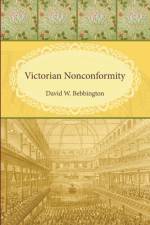
Description:The Nonconformists of England and Wales, the Protestants outside the Church of England, were particularly numerous in the Victorian years. From being a small minority in the eighteenth century, they had increased to represent nearly half the worshipping nation by the middle years of the nineteenth century. These Methodists, Congregationalists, Baptists, Quakers, Unitarians, and others helped shape society and made their mark in politics. This book explains the main characteristics of each denomination and examines the circumstances that enabled them to grow. It evaluates the main academic hypothesis about their role and points to signs of their subsequent decline in the twentieth century. Here is a succinct account of an important dimension of the Christian past in Britain.Endorsements:"No one can understand the Victorians who does not appreciate the impact of a dynamic Christian counter-culture in their midst--Protestant Dissent. Nonconformity gave the age its pre-eminent preacher, C.H. Spurgeon, its most famous missionary, David Livingstone, one of the most respected women in all of British history, the prison reformer Elizabeth Fry, recreational institutions such as the YMCA and Aston Villa football club, highly successful businesses such as Thomas Cook''s tours and Cadbury''s chocolate, and much more. David Bebbington is the greatest authority on Victorian Nonconformity working today and this book is the best introduction to this subject that has ever been written. There is no better place to start learning about the Free Churches in nineteenth-century Britain than with this learned, lucid, and accessible volume."Timothy Larsen, McManis Professor of Christian Thought, Wheaton College"It is a very good thing to see this new edition of David Bebbington''s detailed, informative, and clearly outlined primer on the Nonconformist churches during the period when their national influence was at its height. The booklet is carefully detailed, unusually informative, and skilfully outlined. Its success in explaining who the Nonconformists were, how they differed from the Church of England (and among themselves), and why their fortunes rose and fell makes this an ideal beginning point for further study, both historical and theological."Mark A. Noll, McAnaney Professor of History, University of Notre Dame"This welcome reprint and light revision of Professor Bebbington''s work reminds us that communities often caricatured as narrow and hypocritical were attempting to ''create a Christian counter-culture'' which gave meaning to the lives of many ordinary people and influenced society at large. Combining critical analysis with engaging vignettes of individuals, this is an attractive, lucid and authoritative introduction to Victorian Nonconformity."Henry D. Rack, Honorary Fellow and former Bishop Fraser Senior Lecturer in Ecclesiastical History, University of ManchesterAbout the Contributor(s):David Bebbington has served since 1976 at the University of Stirling, where he is Professor of History. His books include Evangelicalism in Modern Britain: A History from the 1730s to the 1980s (1989), The Mind of Gladstone: Religion, Homer and Politics (2004) and The Dominance of Evangelicalism: The Age of Spurgeon and Moody (2005).
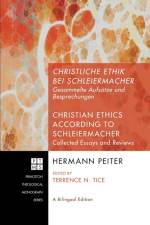
Description:No one is so intimately acquainted with Schleiermacher''s Christian Ethics material or with the 1821-1822 first edition of his companion volume, Christian Faith, than Hermann Peiter. The present volume is a collection of Peiter''s nineteen essays and thirty reviews. Extensive English summaries are offered for all this material, and an English version for four of the essays. Professor Peiter''s summary of this volume reads as follows:""This book treats of praxis in the Christian life and of Christian responsibility for the world we have in common. The following, however, forms a background for these considerations. Schleiermacher reminds his Christian brethren, who often deck themselves out with alien, borrowed plumes from morals and metaphysics, of their actual theme, that of religion, which he also designates as a kind or mode of faith. Like Luther, he also turns against both the practical misconception that considers faith itself to be a good work and the theoretical misconception that faith is a product of thinking, a theory. Whether a practitioner thinks to give thanks for one''s own work or whether a theoretician hopes to find final fulfillment and justification in one''s range of metaphysical ideas amounts to the same thing. Faith is the courage to be (Paul Tillich). For Schleiermacher, to want to have speculation (thus, metaphysics) and praxis without religion is the nonsalutary intention of Prometheus, who faintheartedly stole what he could have expected to possess in restful security. If taken seriously, the ''gods''-to use that pagan expression for once-are that nature to which a human being belongs. Each human being is their possession. When one steals what the gods have, one steals oneself, can thank oneself for a robbery. For a gift that is stolen, one cannot possibly be thankful. Only a pure gift awakens true joy. A human being has the chance to receive the gift that one is or is not (in case it is stolen) not from a thief but from religion. Thanks to one''s birth, both physical and spiritual, one gains oneself and has oneself. To steal means to take away, to depreciate. In contrast, whoever has oneself from elsewhere is no longer extracted from oneself or from the one to whom one belongs."" Endorsements:""This remarkable volume is a most welcome contribution to a conversation about life and faith that has been going on in the academy and in the church for two centuries, to a considerable extent due to Schleiermacher. Christian Ethics according to Schleiermacher distills great insights from Hermann Peiter''s lifetime of work on this towering figure in the history of theology. Terrence Tice deserves our thanks for being midwife to the birth of this volume, offering exact summaries and providing English translations side-by-side with the German.""--James M. Brandt, author of All Things New: Reform of Church and Society in Schleiermacher''s Christian Ethics""This highly engaging, timely contribution introduces Hermann Peiter''s magisterial work on Schleiermacher''s Christian ethics. In essays luminously summarized or translated by the noted Schleiermacher scholar Terrence N. Tice, Peiter here insightfully explores Schleiermacher''s thesis that Christian teaching regarding faith (Glaubenslehre) and life (Sittenlehre) are expressive of communion with God in Christ, experienced in community.""--Allen G. Jorgenson, author of Awe and Expectation: On Being Stewards of the Gospel""As a combined discipline regarding faith-doctrine and ethics, Schleiermacher''s theology of Christian piety has tended not to be studied with adequately systematic care. Thus, the father of modern theology''s positions have been chiefly understood in terms of faith, but ignored in terms of action in every part of life. Peiter''s thoroughgoing studies on Schleiermacher''s theology aptly correlate faith and action with constant references to situations of contemporary life.""--John S. Park, author of Theological Ethics of Friedrich
The respected American theologian Robert Jenson here, in brief compass, presents his uncluttered understanding of the Christian message in a form ideal for beginning students, laypeople, and clergy. Professor Jenson sees the heart of the gospel as the unconditional promise of the ultimate triumph of the love of Jesus of Nazareth. This gospel is based on the story of Jesus and is worked out in the lives of men and of nations as the promise it brings moves towards fulfillment.Story and Promise--we dare to call it a ""one-volume dogmatics""--leaves no element of the Christian faith untouched: the classical doctrines concerning God, Christ, the Holy Spirit, man, the church; the clearly radical implications of these doctrines for personal and social transformation; the focus of Christian vision on the future as the time when God comes and man becomes what God intends. This book clarifies the traditional problems of faith, and also raises the revolutionary issues marking the end of this century. It is a thoughtful and satisfying piece of systematic theology in a time of shattered understandings of the faith.Robert W. Jenson has been a student of Barthian theology for many years, and his doctoral dissertation at the University of Heidelberg earned Barth's approval as an interpretation of his writings. Dr. Jenson attended Luther College in Iowa and the Lutheran Theological Seminary in St. Paul, MN, before studying at Heidelberg, where he was awarded his Doctorate of Theology, summa cum laude. After completing graduate work at the University of Basel, he taught theology for many years at St. Olaf College in Northfield, MN, the Lutheran Theological Seminary in Gettysburg, PA, and Oxford University. Dr. Jenson currently serves as Senior Scholar for Research at the Center of Theological Inquiry, Princeton, NJ. Dr. Jenson's most recent works included his two-volume Systematic Theology.
The contents of this book emerge from the Catholic Worker House of Hospitality in New York City and the Saint Thomas Project in New Orleans. Two years of working with people on the margins of society confronted Marc Ellis with a truth and challenge: to delve deeper into his own life and the life of the world so as to begin the movement toward a new society. Since that time, in his travels through Latin America, the Middle East, and Asia, Ellis has been exposed to the global dimensions of the situations he experienced in New York's Lower East Side and in New Orleans. This book is an attempt to work through the questions posed to Ellis over his years among the poor and through his contact with the global issues of justice and peace.For some, fidelity is a question answered before asked; for the pious through dogma and eternal truth, for the cynic through denial and derision. For Ellis, fidelity is neither assumed nor negated. Rather, it is a struggle through which we search out our own humanity. As human beings born with an unfinished consciousness and into a specific historical context, the struggle to be faithful begins with the historical hour in which we live. This is our burden, but it is also an opportunity to become what we are called to be.Marc H. Ellis is University Professor of Jewish Studies, Professor of History, and Director of the Center for Jewish Studies at Baylor University. He is the author of several books, including A Year at the Catholic Worker, Toward a Jewish Theology of Liberation: The Uprising and the Future, and Beyond Innocence and Redemption: Confronting the Holocaust and Israeli Power.
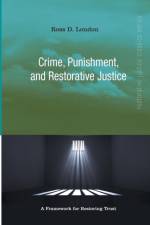
Can restorative justice be applied to a full range of offenses? Ross London answers with an unequivocal ""Yes.""London proposes that, by focusing on the restoration of personal and social trust, restoration may become acknowledged as the overarching goal of all criminal justice policies and practices. While supporting the use of restorative justice as a non-punitive alternative for appropriate cases, London argues that deserved punishment for serious offenses--far from contradicting the goal of restoration--may be instrumental for the emotional recovery of crime victims, the security of communities, and for the successful reintegration of offenders. Moreover, this approach responsibly minimizes resort to punishment by maximizing all of the many other means of restoring trust.Drawing on his experience as a judge, prosecutor, and public defender, London offers a pragmatic vision of restorative justice that integrates its core values with real-world applications for even the most serious violent crimes.""London provides a comprehensive analysis and application of his argument, exploring its socio-biological basis and how it addresses the needs of victims, offenders, and society as a whole. He discusses the role of apology, forgiveness, restitution, rehabilitation, victim-offender dialogues and punishment within this framework. By identifying restoration of trust as the overarching goal of justice, we might be able to provide a realistic and comprehensive theory of sentencing, for all levels of crime.""-- Howard Zehr, Professor of Restorative Justice at Eastern Mennonite UniversityRoss D. London, Ph.D., is a former municipal court judge and, during a twenty-five year career as a criminal law practitioner, has served as a Public Defender, Prosecutor, and Juvenile Court Referee. He presently serves as Professor of Justice Studies at Berkeley College. In addition to his academic writings, Dr. London is also the co-author of In That Moment, a one-act play that explores the struggles of an African American police officer involved in a fatal shooting.
If you've ever been uncomfortable or confused by the conventional wisdom of traditional religious beliefs, read this book. In Of Tribes and Tribulations, Rabbi Roseman addresses twelve of the most common issues raised by religious seekers. Using his own search for clarity, he leads the reader through a mature thought process that can help seekers move toward answers to their spiritual questions, or in his words, ""tribulations.""""Of Tribes and Tribulations"" is Kenneth D. Roseman's capstone work reflecting a fifty year career as college dean, congregational rabbi, scholar, and writer. With an 'introduction' that reveals a remarkable childhood and education, its twelve chapters are filled with honesty, humor, humanity, and wisdom. The author grapples with every major Jewish religious and historical issue from the changing perspectives of a rabbi, shaped by but transcending his Classical Reform upbringing. Each page reflects Roseman's 'religious humanism,' his thoughtful spiritual curiosity, and his constant quest to understand the covenant between God and the Jewish people.""--Lewis M. Barth, former Dean, Hebrew Union College-Jewish Institute of Religion, Los Angeles, CA""In these delightful essays, Ken Roseman takes us on a personal and intellectual journey through the most vexing questions of our time. Part apologetic, part memoir, part call to action, Of Tribes and Tribulations is filled with wisdom, honesty, and tenderness. It is a thoughtful, moving exploration of the meaning and value of Jewishness in the 21st century.""--Peter N. Moore, Associate Professor of History, Texas A&M University-Corpus Christi, Corpus Christi, TXRabbi Kenneth D. Roseman, PhD, has retired after fifty-three years of congregational and academic rabbinical service in the cities of Cincinnati, New York, Madison, Dallas, and Corpus Christi. He is the author of prize-winning books on Jewish history for adolescents and adults.
While the question ""Is faith reasonable?"" has continually occupied philosophers and theologians, little attention has been paid to what faith itself is. The Act of Faith remedies this neglect by looking at what it means for a person of Christian faith to believe.Eric Springsted contrasts modern views of faith with the Christian tradition running from Augustine through Aquinas and Calvin. In reviewing such thinkers as Locke and Hume, Springsted discovers that behind modern discussions of the reasonableness of faith lie key assumptions about the human self, including the views that the good is a matter of choice and that we can exercise objective, uninvolved reason. According to Springsted, however, the church has not viewed faith in this way. His survey of the Augustinian tradition shows that the self our most esteemed Christian thinkers had in mind when talking about faith was a ""moral self""--one defined by character and self-involvement. Christian faith is at root a participation in the good, and reasoning within faith is reasoning within the life of God.Drawing on contemporary philosophers and theologians like John Henry Newman and Simone Weil, Springsted builds a fresh understanding of faith for today. He shows how the ""inner act"" of faith is ultimately a radical willingness to be open to God, and he argues that the faithful self is one that develops within a community that shapes its members through the morally formative activities of interaction, teaching, and sacramental practice.""The Act of Faith is a book characterized by the arresting range and quality of its argument. . . . Springsted provides a mature inquiry into epistemological and metaphysical questions, writing with an enviable clarity of expression. His book should prove accessible to a relatively wide audience of intelligent believers, and it may also illuminate those chary of the inner resources of faith commitment.""--David Burrell, C.S.C, University of Notre Dame""We have suffered too long from theological amnesia. Eric Springsted helps us recover the treasures of the past for our use today in seeking to be faithful. A masterful and profound study.""--Diogenes Allen, Princeton Theological SeminaryEric O. Springsted has taught at Illinois College and Princeton Theological Seminary. He is an independent scholar and lecturer in philosophy
Is it possible that American Christians hold to two distinct sets of beliefs and values without knowing the difference? One is a Christian set, which is openly affirmed every Sunday; the other is an American set, which is more hidden within the forms of our popular entertainment culture. Through mediums like Westerns, country music, and detective novels, John Nelson explains how we internalize our American values without even knowing it.This book is largely intended for preachers who, of all people, should realize how American Christians internalize both sets of values without understanding the contradictions. The purpose of this book is to help preachers and congregations alike recognize the differences in order to account for them in preaching as well as in the church''s life in community.""John Nelson brings first-rate theological scholarship to bear on American popular culture, unpacking operative belief systems in a way that is bound to stimulate the imagination of the working preacher.""--John McClure, Vanderbilt Divinity School""Nelson is able to see into our lives in ways that illuminate our preaching and our life in religious communities.""--Don Mackenzie, UCC Pastor, SeattleJohn Wiley Nelson is retired and living in Cape Cod. He was formerly Assistant Professor of Systematic Theology at Pittsburgh Theological Seminary (1969-79) and Pastor of First Presbyterian Church of Trenton, New Jersey (1979-98). He is a graduate of the University of Chicago (PhD, 1971). He is a singer-songwriter with eight albums of original music.
The phenomenon of Asian women doing theology is recent. Christian women in Asia increasingly insist that unless their distinctive voices as Asians and as women are heard, the emerging theologies cannot be liberating, relevant, or complete.Bringing together writings of women from the Philippines, India, Taiwan, Hong Kong, Malaysia, Korea, and Singapore, We Dare to Dream first reworks some basic theological themes of Christology, ecclesiology, and the Holy Spirit from an Asian feminist perspective. Part II explores the realities of the Asian context through issues of peace, politics, sexuality, and culture. Part Ill presents and explicates what doing theology as Asian women means.These writings are vital to theology throughout the world today. Not only do their authors take their own history and context seriously, but they relate their experience to the experience of women throughout the world, forging common bonds and venturing toward a world of justice and reciprocity. As the editors state, ""Unless our thoughts as women are known and our voices heard, the work toward rearticulating Christian theology in Asia will remain truncated. God''s face will be only half seen and God''s voice only half heard.""""One of the most important developments in feminist theology is its increasing globalization by Third World women. We Dare to Dream is an exciting example of this contextualization of feminist thought by Asian Christian women.""--Rosemary Radford Ruether""Two pioneering women in the development of Asian women''s theology have collaborated to bring us a much-needed collection on how Asian women do theology in their own contexts.""--Letty M. RussellVirginia Fabella, a Maryknoll sister from the Philippines, is Academic Dean of the Sister Formation Institute in Manila, and Asia Coordinator for the Ecumenical Association of Third World Theologians (EATWOT). She is coeditor of With Passion and Compassion; Doing Theology in a Divided World; and Irruption of the Third World.Sun Ai Lee Park is an ordained minister of the Disciples of Christ from Korea. She is editor of the journal In God''s Image.
How would Jesus have us act in today''s world? Living Like Jesus explores eleven basic yet profound ideals that spell the difference between nominal Christianity and the incredible power of the authentic gospel. Ronald Sider challenges us to reexamine our commitment and return to the basics of faith, exploring the impact this will have on our relationships--with God, others, the church, our society, and our world.""Ron Sider''s own genuineness lends credibility to this comprehensive assessment of a summons to genuine Christianity for today. Here''s a practical handbook for the fulfilling yet disciplined lifestyle we can all learn.""--Jack W. Hayford, senior pastor, The Church on the Way""This is Sider''s Mere Christianity. . . . Compelling.""--Christianity Today""I am using Living Like Jesus with elders and key laypeople as a solid, practical resource for biblical teaching and living. I highly recommend it.""--Roberta Hestenes, senior pastor, Solana Beach Presbyterian Church""Living Like Jesus bores in on and illuminates the core, what''s crucial, in the well-lived-out Christian passage in today''s world.""--J. McDonald Williams, chairman, Trammell Crow Company""The author has provided an outline of what it means to be a Christian today--the sort of wallet-size gem that the reader may carry . . . as an aid to prayer.""--Cross PointRonald J. Sider (PhD, Yale) is Senior Distinguished Professor of Theology, Holistic Ministry & Public Policy at Palmer Theological Seminary, and President Emeritus of Evangelicals for Social Action. He is the author of over thirty books including Rich Christians in an Age of Hunger (1977), The Scandal of the Evangelical Conscience (2005), Christ and Violence (reprinted 2001), Saving Souls, Serving Society (2005), and I Am Not a Social Activist (2008).
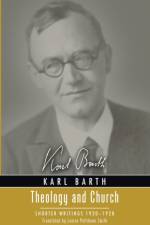
Karl Barth (1886-1968), the Swiss Reformed professor and pastor, was once described by Pope Pius XII as the most important theologian since Thomas Aquinas. As principal author of The Barmen Declaration, he was the intellectual leader of the German Confessing Church--the Protestant group that resisted the Third Reich. Barth''s teaching career spanned nearly five decades. Removed from his post at Bonn by the Nazis in late 1934, Barth moved to Basel where he taught until 1962. Among Barth''s many books, sermons, and essays are The Epistle to the Romans, Humanity of God, Evangelical Theology, and Church Dogmatics.
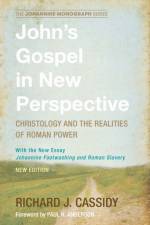
The conflict between Christianity and Roman Imperial theology manifested at very early stages in Christian history. Richard Cassidy argues that ignoring or downplaying such political-theological implications because of some supposedly manifest separation between spiritual belief and politics is both shortsighted and unbiblical. In this fascinating and original reading of the Gospel of John, it becomes clear that Christology is not merely theological theorizing, but a matter of immense political import.The conflict between Christianity and Roman Imperial theology manifested at very early stages in Christian history. Richard Cassidy argues that ignoring or downplaying such political-theological implications because of some supposedly manifest separation between spiritual belief and politics is both shortsighted and unbiblical. In this fascinating and original reading of the Gospel of John, it becomes clear that Christology is not merely theological theorizing, but a matter of immense political import.END:""Succeeds in demonstrating a scarcely-noticed major concern of the Fourth Gospel: to provide guidance to Christians of the time in facing hostile Roman authorities. Cassidy interprets the work as a whole as well as selected passages on this basis, greatly enhancing the realism and depth of the story. Special praise is due to his lucid writing on so intricate a subject . . . His presentation is no less balanced for being original.""--David Daube, University of California, Berkeley""This valuable study of the Gospel of John offers a new approach to the setting and purpose of the book. Cassidy relies on the Gospel itself to argue that it supports Christians facing persecution and possible martyrdom in a Roman imperial campaign against [them] at the end of the first century . . . [His] picture supplements and rounds the others out, shedding fresh light on old texts."" --Robert M. Grant, University of Chicago""This startling thesis . . . illuminates an aspect of John virtually overlooked by Johannine scholars and [yet] not incompatible with [its] traditionally recognized purposes . . . With particular sensitivity to the Roman context, Cassidy solidly demonstrates the correlation between particular Johannine themes and elements of the text, and key terms and practices of the Roman authorities of the approximate time period . . . Cassidy''s insights . . . call for elaboration by those concerned with the sociopolitical background of the Fourth Gospel."" --Susan F. Mathews, University of Scranton""Well-known for his studies on the relationship of Luke-Acts and the Roman Empire, Cassidy here continues this line of research [examining] the Fourth Gospel as it consciously reflects knowledge of the Roman Empire, the cult of the Emperor, and the persecutions waged against the Christians. In this endeavor he utilizes John''s particular Christological titles and the implicit or explicit indications of persecution. In this way, Cassidy illustrates a neglected aspect of the Fourth Gospel, and brings it more into relationship with the Apocalypse."" --Giuseppe Segalla, Seminario Vescovile, Padua, ItalyRichard J. Cassidy serves as Professor of Sacred Scripture at Sacred Heart Major Seminary in Detroit, Michigan. His most recent books are Paul in Chains: Roman Imprisonment and the Letters of Paul and Four Times Peter: Portrayals of Peter in the Four Gospels and at Philippi. He is currently completing a commentary on St. Paul''s Letter to the Philippians.
This cycle of poems travels the path of the Gospel of Mark, rereading and retelling the story, flashing back and anticipating, reading from unusual vantage points, flowing with the author''s perspective and rowing against it. Crossing the genres of poetry and biblical interpretation, the poems themselves become a way to experience the Gospel of Mark.""Terse, teasing, quixotic, discomfiting, needling away at mind and imagination, Cynthia Kittredge''s poems mirror the qualities of Mark''s Gospel. Reading them singly, or as a whole sequence, invites the reader into disconcerting perplexity and opaqueness, yet offers the prospect of cleansed seeing, surprising angles of vision, renewed and more risky faith.""--Nicola Slee, author of Praying Like a Woman""Buy this book! You will keep these poems close at hand, returning to them again and again. Read the whole Gospel of Mark--aloud--without distraction of devices and duties. Do it again. Then read some of these poems--again undistracted by devices--and in some other quiet time read more, or the same ones, again. Kittredge will lead you into immersion in the Gospel, into probing, puzzling, questioning, fresh encounters, flashes of new insight. . . . Working through the Gospel with the provocation of these poems will be a continuing process: revealing and unveiling.""--Richard Horsley, author of Hearing the Whole StoryCynthia Briggs Kittredge is Dean, President, and Professor of New Testament at Seminary of the Southwest. She is the author of Community and Authority and Conversations with Scripture: The Gospel of John. She is coeditor of the Fortress Commentary on the New Testament.
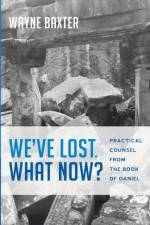
Is the church of the twenty-first century supposed to regain its former glory, or is it too late? Are the people of God in exile yet again? Have we lost our cultural footing and are now in desperate need to find a new way for the present millennium? Daniel was born into a nation of God-fearers, where the Scriptures were embraced and biblical values espoused. But that all changed with the Babylonian exile. Daniel's God, his values, and his faith had become irrelevant and even despised in his society. With the erosion of Christendom, Daniel's story has become the church's story! We've Lost. What Now? offers a clear, insightful, and relevant exposition of Daniel in order to empower believers to minister more effectively than ever before from the social and cultural margins the church now inhabits.
Endorsements:""Tears are a little-known subject spiritually to most people, and Maggie Ross is very helpful in giving us both a historical grounding and a contemporary personal relevance for it.""--Tilden Edwards, Shalem Institute for Spiritual Formation""Maggie Ross has written a lovely, intelligent, and costly book: costly in that it is evident that it cost her a great deal to write it, and costly in that the conscientious reader cannot but be challenged by it.""--Alan Jones, Dean of Grace Cathedral, San Francisco""This is the only major work on tears today. A fountain in the desert, this book fills a genuine need--which is more than most books can claim.""--David Steindl-Rast, OSB""Maggie Ross skillfully examines the gift and way of tears in relation to the evolution of Christian thought and spiritual theology. Her thesis that ''tears release us from the prison of power and control into the vast love and infinite possibility of God'' is truly ecumenical.""--William H. Frey II, author of Crying: The Mystery of Tears
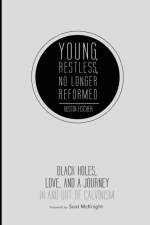
Description:Does it really matter? Does it matter if we have free will? Does it matter if Calvinism is true? And does what you think about it matter? No and yes.No, it doesn''t matter because God is who he is and does what he does regardless of what we think of him, just as the solar system keeps spinning around the sun even if we''re convinced it spins around the earth. Our opinions about God will not change God, but they can change us. And so yes, it does matter because the conversations about free will and Calvinism confront us with perhaps the only question that really matters: who is God?This is a book about that question--a book about the Bible, black holes, love, sovereignty, hell, Romans 9, Jonathan Edwards, John Piper, C. S. Lewis, Karl Barth, and a little girl in a red coat. You''ve heard arguments, but here''s a story--Austin Fischer''s story, and his journey in and out of Calvinism on a trip to the center of the universe.
Endorsements:Christian leaders help other Christians see and understand everything in their lives in spiritual terms.""Scott Cormode is a pioneer in understanding church leadership with the theological disciplines of the faith. Making Spiritual Sense captures in a marvelous way the distinctive character of church leadership as the Christian leader is defined as theological interpreter.""-Lovett H. Weems Jr., Distinguished Professor of Church Leadership at Wesley Theological Seminary in Washington, DC, and author of Take the Next Step: Leading Lasting Change in the Church""Those who know Scott Cormode well and have long respected his teaching and leadership in church and academy have eagerly anticipated the publication of his first in-depth study of leadership. At last our hopes have been rewarded--and generously so. This book demonstrates a rare breadth of scholarly knowledge and possesses the humility and confidence that characterizes the best leadership today. It invites those who lead to remember that the best leaders give people the tools to think for themselves, a fact that any leader neglects at the greatest of peril.""-Michael Jinkins, Dean and Professor of Pastoral Theology, Austin Presbyterian Theological Seminary, Austin, TX""This is a profoundly important book. Finally someone has taken seriously the need to deeply integrate social science perspectives in relation to a Christian understanding of leadership. Cormode creatively integrates key theoretical insights within a theological framework in helping Christian leaders understand how to lead by making spiritual sense. Extensive use of narrative stories brings his argument to life and provides accessible ways for readers to further develop their own repertoire of meaning for leading through sense making.""-Craig Van Gelder, Professor of Congregational Mission, Luther Seminary, Saint Paul, MNAbout the Contributor(s):Scott Cormide is the Hugh De Pree Associate Professor of Leadership Development at Fuller Theological Seminary and the De Pree Leadership Center. He is an ordained Presbyterian minister and the founder of both the Academy of Religious Leadership and the Journal of Religious Leadership.
This unique phrase-by-phrase exposition reads the Lord''s Prayer as Jesus'' description of God. Our heavenly Father is the perfect parent beyond our dreams who loves, provides, forgives, and ultimately protects. Finding our parent, we discover who we really are and enter a kingdom without boundaries. The Prayer of Jesus is not a somber duty; it is the essence of the gospel''s happy news. ""If laughter is forbidden in heaven,"" said Martin Luther, ""I don''t want to go there.""""If you have read all of Thomas Merton, C. S. Lewis, and Frederick Buechner, you are spiritually ready to read Kent Gramm''s meditation on the Lord''s Prayer. If you have not read Merton, Lewis, and Buechner, you will come to those writers and many more much more spiritually endowed for having read one of the Christendom''s most unique books: The Prayer of Jesus by Kent Gramm. This promises to become a universally beloved book.""--David Madden, author of The Last Bizarre TaleKent Gramm teaches at Gettysburg College and is the author of Psalms for Skeptics, November, Somebody''s Darling, Gettysburg, and the novel Clare.
About the Contributor(s):M. David Litwa (PhD) is currently an instructor in Greek at the University of Virginia. He is author of We Are Being Transformed: Deification in Paul''s Soteriology (de Gruyter, 2012) and Iesus Deus: The Depiction of Jesus as a Mediterranean God (Fortress, forthcoming).
Description:If you find books such as Richard Dawkins'' The God Delusion compelling but your faith heritage is also important to you, this book shows how you can affirm both. Taking a cue from Marcus Borg''s contention that "scriptural literalism" is for many people a major impediment to authentic spirituality, Carl Jech describes how all religion can and should be much more explicit about its symbolic, metaphorical, and artistic nature. With a particular focus on mortality and the relationship of humans to eternity, the book affirms a postmodern understanding of "God" as ultimate eternal Mystery and of spirituality as an artistic, (w)holistic, visionary, and creative process of becoming at home in the universe as it really is with all its joys and sorrows. Religion as Art Form is a must-read for those who think of themselves as spiritual but not religious.Endorsements:"If you''re looking for a way to make sense of your life and your world, but you don''t get much (or any) satisfaction from slick, glib, outdated, unworkable, arrogant, or cocksure religious ''answers,'' this is your book. If you''re looking for trustworthy answers that don''t demean, insult, or ridicule, this book is a good place to start. . . . By the time you finish this book, you''ll find there are no supernatural, sacred cows left in the corral. What you will find is a new way of thinking about language and life."--Michael Luther Sherer, editor emeritus of the MetroLutheran"Critical issues central to the purpose of religion are woven in an intricate tapestry that utilizes every conceivable strand of expressive art available to elucidate the topics addressed. The style of writing itself is reflective of an art form, as ideas flood each page in a stream of consciousness, expressive of the dynamic, progressive posture that permeates each page. Readers seeking an alternative approach for expressing and experiencing their spirituality will find this book scintillating and stimulating."--Robert H. Albers, Distinguished Visiting Professor of Pastoral Theology, United Theological Seminary of the Twin Cities"Separating God from the sterile options between theism and atheism and seeing God as a verb to be lived, not a noun to be believed, are the themes of this book. Religion as Art Form is both groundbreaking and riveting."--John Shelby Spong, author of The Fourth GospelAbout the Contributor(s):Carl L. Jech (ThM, Harvard) is Instructor in Humanities at DeAnza College in Silicon Valley. He has served as parish pastor and college chaplain in Michigan, Wisconsin, and California, and has taught at other colleges in the San Francisco Bay Area.
Abonner på vårt nyhetsbrev og få rabatter og inspirasjon til din neste leseopplevelse.
Ved å abonnere godtar du vår personvernerklæring.