












Gjør som tusenvis av andre bokelskere
Abonner på vårt nyhetsbrev og få rabatter og inspirasjon til din neste leseopplevelse.
Ved å abonnere godtar du vår personvernerklæring.Du kan når som helst melde deg av våre nyhetsbrev.

Jesus never intended the church to become an institution; he intended it to be a people of power, transforming the world.Power is the capacity, ability, and the willingness to act. Most people and systems use power to dominate and control, but others have used it relationally to liberate, transform, and even save.Built around a biblical exploration of shalom, Building a People of Power explains how local churches can use power to transform their communities and their cities. Detailed power strategies are presented enabling churches to build productive relationships, to address the primary issues of people they serve, and to develop strong leaders, faithful organizations, and redeemed neighborhoods that live out shalom.Dr. Robert C. Lithicum has been rebuilding poor urban communities since 1955. He has pastored churches in Chicago, Milwaukee, and Detroit where he helped form nine community organizations, people-businesses, and housing efforts. From 1985 to 1995, Dr. Lithicum headed the urban work of World Vision where he guided third world organizers who coordinated slum dwellers to build multiple organizations and businesses, and over six thousand homes. Since 1996, he has been the president of Partners in Urban Transformation. He is the author of fourteen books, including Transforming Power, and Empowering the Poor.
Journal for the Evangelical Study of the Old Testament (JESOT) is a peer-reviewed journal devoted to the academic and evangelical study of the Old Testament. The journal seeks to fill a need in academia by providing a venue for high-level scholarship on the Old Testament from an evangelical standpoint. The journal is not affiliated with any particular academic institution, and with an international editorial board, open access format, and multi-language submissions, JESOT cultivates and promotes Old Testament scholarship in the evangelical global community. The journal differs from many evangelical journals in that it seeks to publish current academic research in the areas of ancient Near Eastern backgrounds, Dead Sea Scrolls, Rabbinics, Linguistics, Septuagint, Research Methodology, Literary Analysis, Exegesis, Text Criticism, and Theology as they pertain only to the Old Testament. JESOT also includes up-to-date book reviews on various academic studies of the Old Testament.
This book charts a course through the equally inadequate options of despair and optimism to a responsible understanding and practice of Christian hope.""A wonderful theological meditation on hope--a virtue so necessary for ethical commitment and change! This book is a gift to all who struggle to create and maintain hope in the face of suffering, disappointment, and social injustice. Ellen Ott Marshall names honestly the many sources of human pain. Yet she weaves an eloquent Christian response from contemporary and traditional theologies and her own experience, lifting up hopeful practices of compassion, resistance, and conversion that support the common good.""--Lisa Cahill, J. Donald Monan Professor, Boston College""This study of hope glows with wisdom and compassion. Through conversation and metaphor, public events and personal experience, Ellen Ott Marshall leads us into the intricate structure of hope. Simultaneously fragile and strong, hope guides us as we navigate the great contrarieties of human existence--peril and promise, goodness and cruelty, beauty and tragedy. Not incidental to the brilliance of this book is Marshall''s distinctive redefinition of hope in terms of a relational understanding of God''s continuous interaction with history. This book is an impressive contribution to theological ethics.""--Mariorie Hewitt Suchocki, author of Divinity and Diversity: A Christian Affirmation of Religious PluralismEllen Ott Marshall is Associate Professor of Christian Ethics and Conflict Transformation at Candler School of Theology, Emory University.
Dietrich Bonhoeffer is a celebrated and enigmatic figure in theology. Though he is known for advocating a concrete and worldly Christianity, Justin Mandela Roberts argues that his theology is in continuity with a participatory ontology, especially as seen in the ressourcement movement and Radical Orthodoxy. While critical of such ""metaphysical speculation,"" Bonhoeffer displays similar inclinations that situate Truth, Goodness, and Beauty as transcendental aspects of divine being. His theology affirms the pervasive ""rhetoric"" of doxology, details the economy of reciprocal gift-giving, and celebrates the sacramentality of creation. Sacred Rhetoric contributes to the ongoing discussion of metaphysics, and also serves as a supplement to the debate between Karl Barth and Erich Przywara.""Justin Roberts'' Sacred Rhetoric offers a reading of one of the twentieth century''s more enigmatic theologians, Dietrich Bonhoeffer, within the context of contemporary retrievals of the metaphysics of participation and the gift. This is an imaginative interpretation of Bonhoeffer''s work for our own time.""--Simon Oliver, Associate Professor of Philosophical Theology, University of Nottingham""In this important and beautifully written contribution to Bonhoeffer studies and modern theology, Roberts demonstrates that Bonhoeffer can and should be read in continuity with the participatory theological tradition from patristic to medieval and modern theology. Bonhoeffer''s life and work thus appear in fresh perspective, as representing the ''doxological modality'' of the Christian life that engages the world out of union with God; a sacramental, sacred rhetoric that is most clearly expressed as worship.""--Jens Zimmermann, Author, Professor of Humanities and Canada Research Chair in Interpretation, Religion, and Culture, Trinity Western UniversityJustin Mandela Roberts is a graduate of Regent College (Vancouver, British Columbia) and a PhD Student at McMaster Divinity College (Hamilton, Ontario). He is also the author of Behold Our God: Contemplative Theology for the Soul.
Although a large majority of believers agree that they should share their faith, most report that they, in fact, do not. That''s not really all that surprising given today''s pluralistic cultural setting. But maybe this same culture''s longing for transcendence, community, and a place to call home points to a backstory that makes sense of it all. If such a narrative exists, it deserves a hearing, and those who know and live this story have both the responsibility and privilege of sharing its message of hope.The narrative of the Bible tells just such a story where God''s purpose from the beginning has been to dwell--or tabernacle--in the midst of the people he has created. This book traces the theme of God''s tabernacling presence across Scripture, reading the story afresh through a missional lens in order to gain insights for mission and gospel witness. The hope is that readers will awaken wide-eyed to the wonder of God''s tabernacling presence in our midst, that we will live in such a way that others recognize this reality, and that we will boldly and joyfully share the good news of Jesus under the direction and power of his indwelling Spirit.""Susan Booth''s work on the presence of God is penned with the scholar''s mind, but the reader will also sense her missional conviction that the Scripture and theology must bring us to a gospel response worthy of our God and fit for our critical times. Read this carefully, prayerfully, thoughtfully, and join the conversation.""--Alvin L. Reid, Professor of Evangelism and Student Ministry, Bailey Smith Chair of Evangelism, Southeastern Baptist Theological Seminary""Booth offers us a theological underpinning for gospel witness in an increasingly post-Christian culture. The book employs the mission of God as an interpretive key, relates the fact of God''s presence to the task of evangelism, contextualizes it for the West in general and Canada in specific, and does so in an eminently readable way. Highly recommended.""--Bruce Riley Ashford, Provost, Professor of Theology, Southeastern Baptist Theological Seminary""Booth masterfully addresses humanity''s age-old question: How can I personally experience a God who, if he exists, seems so far away? Combining a razor-sharp scholarly mind with a compassionate heart for evangelism, Booth provides a brilliant analysis of God''s unrelenting effort to dwell among his people, and a pragmatic approach to what this could look like in an increasingly secular nation like Canada.""--Richard Blackaby, Author; President, Blackaby Ministries International""Booth convincingly and coherently traces her theme from the opening chapters of Genesis to the closing chapters of Revelation, and demonstrates how fruitful a systematically missional hermeneutic of the whole Bible can be. Again and again, I found myself exclaiming, ''Why did I not see that more clearly before?''"" --Christopher J. H. Wright, Langham Partnership""[This] is an outstanding work that connects one of the most central themes of Biblical theology--the Presence of God--to the very heart of the church''s mission. Biblically based and engaging.""--Daniel Hays, Professor of Biblical Studies, Ouachita Baptist UniversitySusan Maxwell Booth (PhD, Southeastern Baptist Theological Seminary) serves as the Professor of Evangelism and Missions at the Canadian Southern Baptist Seminary & College in Cochrane, Alberta, Canada. Susan and her husband Steve are under appointment with the International Mission Board of the Southern Baptist Convention. They served in Budapest, Hungary, for seven years before transferring to Canada in 2000.
Rivals the major systematic theologies of this century. --Baptist History and Heritage Journal, July 1996 One of the characteristics of Garrett's system that needs especially to be noted is its balanced, judicious, and nearly invariably objective presentation of materials. While holding true to the teachings of his own Baptist faith, Garrett so carefully and judiciously presents alternatives . . . that teachers and students from other confessional and denominational positions will find his work instructive. --Consensus, 1997 If one is searching for an extensive exposition of the biblical foundations and historical developments of the various loci of systematic theology, there is no more complete presentation in a relatively short work than this . . . Pastors will especially find this feature to be a real help in teaching theology . . . [It is] an indispensable contribution to the task of systematic theology. --Journal of the Evangelical Theological Society, September 1999 Many students and pastors will find all they need here, and will in addition be helped to relate their knowledge to recent developments in the theological world. --The Churchman: A Journal of Anglican Theology, 1991 A gold mine of helpful material. --The Christian Century, May 29-June 5, 1991 No book that I know is more loaded with biblical and theological facts than this one. The prodigious research that must have gone into the preparation of this volume is truly mind-boggling. --Faith and Mission, Fall 1991 Garrett has provided a massive and scholarly systematic theology from a thoroughly conservative and comprehensive viewpoint. The work is well documented in both biblical and historical scholarship and will prove to be a classic. --William Hendrickson, Southern Baptist Theological Seminary One of the most comprehensive, concise books of its type available; it should receive wide use in the classroom and in the study. --Robert H. Culpepper, Southern Baptist Theological Seminary
Rivals the major systematic theologies of this century. --Baptist History and Heritage Journal, July 1996 One of the characteristics of Garrett's system that needs especially to be noted is its balanced, judicious, and nearly invariably objective presentation of materials. While holding true to the teachings of his own Baptist faith, Garrett so carefully and judiciously presents alternatives . . . that teachers and students from other confessional and denominational positions will find his work instructive. --Consensus, 1997 If one is searching for an extensive exposition of the biblical foundations and historical developments of the various loci of systematic theology, there is no more complete presentation in a relatively short work than this . . . Pastors will especially find this feature to be a real help in teaching theology . . . [It is] an indispensable contribution to the task of systematic theology. --Journal of the Evangelical Theological Society, September 1999 Many students and pastors will find all they need here, and will in addition be helped to relate their knowledge to recent developments in the theological world. --The Churchman: A Journal of Anglican Theology, 1991 A gold mine of helpful material. --The Christian Century, May 29-June 5, 1991 No book that I know is more loaded with biblical and theological facts than this one. The prodigious research that must have gone into the preparation of this volume is truly mind-boggling. --Faith and Mission, Fall 1991 Garrett has provided a massive and scholarly systematic theology from a thoroughly conservative and comprehensive viewpoint. The work is well documented in both biblical and historical scholarship and will prove to be a classic. --William Hendrickson, Southern Baptist Theological Seminary One of the most comprehensive, concise books of its type available; it should receive wide use in the classroom and in the study. --Robert H. Culpepper, Southern Baptist Theological Seminary
Description:An Alaskan Gold Mine: The Story of No. 9 Above is a notable and tragic story of the discovery of Alaska gold in 1898. The mine had so many implications for leaders and institutions of the Evangelical Covenant Church, a tangled and contested case of ownership extending over two decades that went to the Supreme Court of the United States on four occasions. Visiting Alaska three times doing meticulous research into legal proceedings and conducting oral interviews, Carlson succeeded in crafting a compelling narrative of gold, grief, and greed. An Alaskan Gold Mine: The Story of No. 9 Above remains a classic case study of the Alaska gold rush as a whole, as well as the particular context of issues and personalities unique to the bonanza claim staked by a Covenant missionary on Anvil Creek above the boomtown Nome.About the Contributor(s):Leland H. Carlson (1908-1995) was born in Rockford, Illinois, and educated at Beloit College (BA), Chicago Theological Seminary (BD), and the University of Chicago (PhD). He began his teaching career at North Park College (1932-1942), before joining the history department at Northwestern University, where he won several awards for teaching European and British history. From 1955 to 1959 Carlson was president of Rockford College, then returning once again to teaching and the academic life at the Claremont Graduate School and Southern California School of Theology. In 1970 he was chosen the first Colin Rhys Lovell Professor of English History at the University of Southern California, retiring in 1973. From 1984 until his death, Carlson was a research scholar at the Henry E. Huntingdon Library in San Marino, California.
What makes the difference between those who aspire to lead and those who actually do it? What does anyone need to know about themselves and others, in order to be ready to lead? How might society benefit from persons who give time and energy to learn the skills of leadership readiness?This book offers a lifelong resource for persons committed to improving their own personal effectiveness as a key step toward leading--in whatever the context, at whatever level. The concepts and terms in this book become tools that strengthen self-awareness, self-management, social awareness, and relationship management. Exercises at the end of each chapter stimulate real-life learning, as one practices specific skills that create confidence in being ""ready to lead.""
It has been some time since Catholic and liberal Protestant theologians stopped writing seriously on bibliology. Meanwhile, conservative evangelical theologians guard against the introduction of new ideas. In an effort to make headway through this gridlock, Carlos Bovell has commissioned a roundtable discussion on the prospect of whether the inspiration of Scripture might extend beyond authors and texts, and if so, what this might entail for the authority of Scripture. Taken together, the essays in this volume make an invaluable contribution to contemporary literature on the inspiration and authority of the Bible.
Description:John Chrysostom, the golden mouth, the greatest preacher in the early church and a key figure during the transition from the ancient to the Byzantine and medieval worlds, is known as a vehement critic of the Jews. In this study, Robert Wilken presents a new interpretation of John's homilies against the Jews, setting them in the context of the pluralistic society of fourth-century Antioch and against the tradition of ancient rhetoric.In reading John's homilies, Wilken argues, we must not impose on them the anti-Jewish attitudes of medieval times, when Christianity was the dominant force in the West and Judaism was a minority religion. In John's time, Christianity was only one, and by no means the most self-assured, of the cultural forces in Antioch. It had to compete with an established Jewish community and with the classical pagan tradition that underlay education and public life. In 363, the Roman emperor Julian, who had apostatized Christianity to embrace the traditional pagan religion, attempted to rebuild the Jewish Temple in Jerusalem. He terrified the Christians, who saw in the Temple's ruins proof of the truth of their religion. Wilken examines John's sermons against this atmosphere of intense religious rivalry and lively polemic between Christians, Jews, and pagans. His book calls not only for a fresh look at John Chrysostom but also for a reconsideration of the continued importance of Judaism in late antique society and in the history of Christianity. Its conclusions will be of interest to historians and theologians, and to participants in the present-day Jewish-Christian dialogue.
Christians believe that the logos is the source of all life, yet Christian worship remains unashamedly human-centric. The world of creation, and animals in particular, is almost invisible in our worship. The churches do not have the liturgical means of celebrating the life of animals, giving thanks for their companionship, praying for the relief of their suffering, or marking their death.This unique book provides a variety of liturgies that are animal-friendly and animal-inclusive. They include services in celebration of animal companionship, services for animal welfare, healing liturgies, new eucharistic prayers ""for thewhole creation,"" and animal burial services. Underlying all these new forms is a serious theological purpose: to help us to draw deeper into the mystery of God''s work in creation and to affirm other sentient beings as co-creatures with us.""The commentary, thoughts, and prayers on this issue of animal care are a very necessary provision to help clergy and ministers understand and appreciate the theme of Christian responsibility for creation.""--The Most Reverend Alwyn Rice Jones, Archbishop of Wales"" . . . of an exceptionally high standard both in language and content.""--Bishop John BakerAndrew Linzey is Director of the Oxford Centre for Animal Ethics and a member of the Faculty of Theology in the University of Oxford.
This sesquicentennial project of Presbyterian College tells the stories of thirteen individuals, chosen from among its graduates, faculty and benefactors, whose still voices represent in unique ways the history and influence of the college over the past 150 years. Each chapter presents a biography, a sermon, address, letter or report, followed by a commentary showing how this still voice spoke to the issues of the time and why it still should be heard. The themes remind us of the college''s continuing mission to provide the Church with strong and visionary leaders. The book concludes with useful lists of Presbyterian College''s students, scholars, supporters and societies down through the years."The editors have creatively combined biographical essays with addresses, letters, reports, and sermons to present the history of its ministry to both English and French Protestants, showing how its leaders, graduates, and supporters shaped Christianity and culture in and beyond Canada."--Phyllis Airhart, Professor of the History of Christianity, Emmanuel College, University of Toronto"This book inspires! As an archivist, the concept of presenting the 150th anniversary history of Presbyterian College, Montreal, by way of well-chosen key ''voices'' influenced by that institution is most effective, and makes for a compelling and Spirit-filled read." --Kim Arnold, Archivist, The Presbyterian Church in Canada"What a wonderful way to celebrate an anniversary! The various lives chronicled here are testament to the vitality and witness of Presbyterian College, Montreal, and the changes in the Presbyterian Church in Canada, particularly the place of women within the church. The mix of biography and sources . . . brings these individuals and their times to life." --Stuart MacDonald, Professor of Church and Society, Knox College"The publication of a sesquicentennial study of Montreal''s Presbyterian College should excite anyone who wants to learn about our Canadian Presbyterian heritage. The recovery of the stories of many who provided leadership in the past is encouraging for our future." --Don MacLeod, Research Professor of Church History, Tyndale University College and Seminary"This creatively edited book offers unusually effective insights for the Presbyterian College in Montreal''s 150-year history. Each chapter features something written by a significant figure connected to the college, but also interpreted in context by a contemporary author. The result is an excellent account of the college, while illuminating much wider domains in Canada and beyond."--Mark A. Noll, Francis A. McAnaney Professor of History, University of Notre DameJ.S.S. Armour, minister emeritus, The Church of St. Andrew and St. Paul, MontrealJudith Kashul, editor and member, The Church of St. Andrew and St. Paul, MontrealWilliam Klempa, principal emeritus, The Presbyterian College Montreal Lucille Marr, adjunct professor of Church History and course lecturer, Faculty of Religious Studies, McGill University, Montreal and chaplain at The Presbyterian College, MontrealDaniel Shute, librarian, The Presbyterian College, Montreal
Jesus made claims about redemptive community throughout his ministry when he called people to extravagant grace. Even in the midst of the oppression of his day, Jesus preached and taught that redemptive community was possible if his followers would simply stop hoarding, hiding, and excluding. What a prophetic word for today in the midst of modern day oppression and fears of scarcity! In this edited volume, in honor of religious education scholars Jack Seymour and Margaret Ann Crain, eight of their PhD advisees--each scholars in their own right--join Seymour and Crain to lay out their vision of redemptive community. Rooted in their own scholarship, each contributor proposes ways in which Jesus'' vision of redemptive community can become reality in churches and congregations, and in our larger world. In addition to essays by Jack Seymour and Margaret Ann Crain, scholars contributing to this volume include Dori Grinenko Baker, Reginald Blount, Evelyn L. Parker, Mai-Anh Le Tran, Leah Gunning Francis, Carmichael Crutchfield, Debora B.A. Junker, and Denise Janssen. The foreword by Mary Elizabeth Moore and afterword by Seymour and Crain set the volume in the larger context of the church and academy."Educating for Redemptive Community is a treasure of cutting edge scholarship on the ability of education within faith communities to address the world''s most pressing issues. . . . There could not be a more fitting description of a faithful response to the needs of a world in crisis, nor for the deep and abiding values that flow through Crain''s and Seymour''s years of individual and collaborative work. This volume leads readers into an illuminating exploration of both." --Lucinda Huffaker, Executive Secretary, Religious Education Association, Director of Supervised Ministries, Yale Divinity School"The fabric of faith that has been woven in the lives of Crain and Seymour is visible in the themes of these contributors--how belief transforms individuals and communities for living together with a public face of faith. These essays reveal a patchwork quilt of hope and challenge for all who seek to live in response to God''s call."--Elizabeth F. Caldwell, Professor Emerita, McCormick Theological Seminary Adjunct Professor, Vanderbilt University Divinity School"In this collection of essays, these scholar-practitioners of religious education . . . reflect upon what it means to educate for redemptive community. . . . This book is a testimony to their commitment to religious education and theological education." --Virginia Lee, Associate Professor of Christian Education & Director of Deacon Studies, Garrett-Evangelical Theological Seminary"This book is a guiding light for all people committed to working for the common good. . . . Crain and Seymour''s diversity of background, denomination, ethnicity, and nationality offer a dialogical approach to tackling issues that threaten the future of life on earth. . . . Crain and Seymour continue to make significant contributions to both the content and the processes that foster faithful and redemptive ways of living."--Linda J. Vogel, Professor Emerita, Garrett-Evangelical Theological SeminaryDenise Janssen is Assistant Professor of Christian Education at the Samuel DeWitt Proctor School of Theology at Virginia Union University. She is the author of Fostering Faith: Teaching and Learning in the Christian Church (2014) and Reclaimed: Faith in an Emerging Generation (2015).
Agnes Sanford was arguably the most original and spiritually fruitful theologians of the twentieth century. Among her achievements were the discovery and development of the inner healing ministry, the development of a theology of the light of God (missing in Western theology), and the first ever theology of ""nature prayers""--as in stilling storms. She and her husband developed a school to teach ministers and lay leaders healing and deliverance prayer, and the gifts of the Spirit a decade before the charismatic renewal made such things acceptable in mainline churches. In spite of these achievements, she is largely ignored and unrecognized today.This work examines her career and shows why her theology, though deeply biblical, was unacceptable to ""orthodox"" critics. Sanford was part of a group who worked from the 1900s through the 1960s to make healing and deliverance prayer as normal in church. They had to confront the erroneous established theology of cessationism, which affirmed that the healing ministry of the church was past. ""The important role played by Agnes Sanford in the history of healing ministry is one that needs telling, and De Arteaga is well placed to tell it. . . . Anyone interested in the history of Sanford or who wants to understand how to encourage healing ministry in the life of the church will find this book a very rewarding read."" --Justyn Terry, Dean, President and Professor of Systematic Theology, Trinity School for Ministry, Ambridge, PA""This inspiring book shows how one dedicated person can, by persistence, change the mindset of an entire group of people. From healing prayer being the activity of a small group, it has now become ordinary, especially in family members praying for one another.""--Francis and Judith MacNutt, Founders of Christian Healing Ministries, Inc.""De Arteaga''s perspective on the move of God in healing for the denominations is never overshadowed by the rise of Pentecostalism in non-denominational churches alongside the Charismatic Movement. . . . De Arteaga brings honor to a great lady in Sanford.""--The Rev. Dr. Jack Sheffield, co-founder of Deep River Ministries, Director of the North American branch of the Order of St. Luke""Agnes Sanford--a name still recognized as a twentieth century pioneer & practitioner--evoked and still evokes much controversy. . . . I welcome this book as one which both promotes and encourages reflection and ministry.""--Sean E. Larkin, Archbishop, The United Anglican Church Province II""De Arteaga is a remarkable scholar. . . . [O]ne need not agree with every aspect of his historical theological approach to explain the importance of Agnes Sanford, but his big picture view makes this book a ''must-read.''""--Dr. Gottfried Sommer, church historian, pastor, guest lecturer for historical theology and apologetics, GermanyRev. William De Arteaga is both an Anglican priest and historian. His articles, blog posts, and books, especially Quenching the Spirit (1996) and Forgotten Power (2002) have long attracted attention among Pentecostal and charismatic audiences. He pastored two Hispanic congregations, and has been the chaplain the Order of St. Luke in Georgia for over a decade. He and his wife, Carolyn, have ministered healing, inner healing, and deliverance together for over three decades.
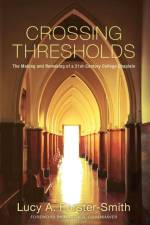
With candor, passion, and deep love for her work, Lucy Forster-Smith takes us across the threshold as a chaplain on a college campus. This vocational narrative braids the story of her faith journey that began on a porch when she was a four-year-old, was shaken by a sexual assault as a seminarian, and through healing and grace brought her to claim a call to ministry with students. With delightful humor and an infectious love for her work, Forster-Smith invites the reader into her world. Crossing Thresholds is a theological narrative, weaving together the story of faith in the context of the professional life of a college chaplain. Lighting on the power of spiritual awakening at a college, once named as the number one institution of higher education that ""ignored God on a regular basis,"" Forster-Smith jars loose the assumptions about the avowedly secular campus. Her journey of healing and grace illuminates and guides to cross the threshold of the campus''s soul. ""Lucy Forster-Smith served for two decades as an exemplary college chaplain at Macalester, and she captures in this book the many rewards, challenges, and complexities of that work. Anyone who wants a window into the spiritual life on a modern college campus would benefit from reading Lucy''s memoir.""--Brian Rosenberg, author of Little Dorrit''s Shadows""Crossing Thresholds is an invitation to that place of authenticity where self, role, and meaning meet. Only rarely are we gifted by such access to the inside experience of a professional role--whatever the profession--in a manner that transcends artifice. Not only chaplains, but all who care about living faithfully in a complex world, will savor this intelligent, informing, story-filled, and evocative book that reminds us how much is at stake for self and world in the conversation between generations.""--Sharon Daloz Parks, author of Big Questions, Worthy Dreams""Lucy Forster-Smith blends spiritual memoir with deep theological reflection to provide an engaging and in-depth look at life as a college chaplain. Lucy captures a ''day in the life'' by stepping outside of the designated sacred space and into the quotidian rhythms of a campus community. . . . Lucy Forster-Smith makes a compelling case for the power of mere presence. Wherever and whenever people are present with open hearts and open hands, hope and healing abide!""--Jonathan Walton, author of Watch This!""In these pages, Lucy Forster-Smith shares her personal stories of wonder, vocation, and brutal pain, elemental in the spiritual life that created the influential religious leader she is today. Through vivid and instructive anecdotes, the book also introduces the readers to the complex landscape of today''s college campuses where pluralism, secularism, and politics intersect with religious traditions and spiritual seeking. Colleges and universities are training grounds for future citizens, so we can be glad that Forster-Smith is in the trenches, helping young students to find their deepest personal callings and inspiring values that will create more just communities in the future.""--Paul Raushenbush, religion editor of The Huffington PostLucy A. Forster-Smith is the Sedgwick Chaplain to the University and Senior Minister in the Memorial Church at Harvard University. From 1994 to early 2014 she served as the Chaplain of Macalester College, St. Paul, Minnesota. Her recent book, College & University Chaplaincy in the 21st Century: A Multifaith Look at the Practice of Ministry on Campuses across America (2013), has launched broad discussion on the vocation of chaplains in higher education.
Description:The story of Adam is the story of Israel writ smallIn this text-centered interpretation of Genesis 1-3, Seth Postell contends that the opening chapters of the Bible, when interpreted as a strategic literary introduction to the Torah and to the Tanakh, intentionally foreshadows Israel''s failure to keep the Sinai Covenant and their exile from the Promised Land, in order to point the reader to a future work of God, whereby a king will come in ""the last days"" to fulfill Adam''s original mandate to conquer the land (Gen 1:28). Thus Genesis 1-3, the Torah, and the Hebrew Bible as a whole have an eschatological trajectory.Postell highlights numerous intentional links between the story of Adam and the story of Israel and, in the process, explains numerous otherwise perplexing features of the Eden story.Endorsements:""Dr. Postell has written a brilliant treatise arguing that Genesis 1-3 serves as the literary introduction to the Pentateuch, and, indeed, the entire Tanakh. He is clearly conversant with all the relevant literature and he makes a persuasive case. This is a work that needs to be read carefully and taken seriously.""--David M. Howard Jr.Professor of Old TestamentBethel University""In a stimulating study of the first three chapters of Genesis, Dr. Postell has argued convincingly that they were written as fitting prelude to and portent of the ensuing narrative. Instead of looking to presumed parallel or contrasting ancient creation accounts for its meaning, this study confirms that the opening narratives of the Pentateuch exhibit language and themes coherent with the entire narrative that follows. The persuasive argument expressed here points to the necessity of further studies of similar approach to the Hebrew Bible.""--Robert ColeAssociate Professor of Old Testament and Semitic LanguagesSoutheastern Baptist Theological Seminary""To anyone who suspects that there is a divine order behind the compilation of the Hebrew Scriptures, this excellent work by Seth Postell will confirm that suspicion. Not only has he carefully described the methodology used in evangelical canonical research of the text, he has built upon the existing evidence to further substantiate the approach. Fresh new insights are always pleasing to the theological senses! Research professors and students alike will be strengthened in their devotion to the sacred text and spurred on to answer the research questions that naturally arise from this work.""--Gregory HaggProfessor of Bible Exposition/DirectorThe Feinberg Center for Messianic Jewish StudiesTalbot School of TheologyAbout the Contributor(s):Seth D. Postell, formerly Assistant Professor of Old Testament at the Charles L. Feinberg Center for Messianic Jewish Studies (in partnership with Talbot School of Theology), is currently Lecturer in Biblical Studies at Israel College of the Bible in Netanya, Israel.
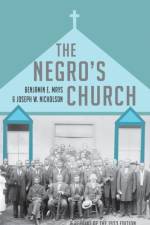
Benjamin E. Mays (1894-1984) was President and Professor Emeritus of Morehouse College.
Spirituality is aligning our innermost being with the Way of the Cosmos. It''s our effort to get our total beings right, ultimately right, or at least as right as we can at this time in our lives given everything we know. For those trying to live lives deeply influenced by Jesus of Nazareth, a spirituality based on active nonviolence is in harmony with his life and teachings. It is both a guide and support in times of stress, turmoil, terrorism, fear, and uncertainty.In this book, a compilation of much of his decades-long work on nonviolence, Vanderhaar explains how a spirituality of nonviolence provides methods and guidance in everyday activities such as speech, leadership, and dealing with difficult people or even those who might be seen as enemies. He outlines how this spirituality helps us to understand both our gifts and our shortcomings and to deal with the challenges of life in the twenty-first century. Understanding nonviolence can guide peacemakers to a practical spirituality based on the nonviolent Christ, our guide and inspiration.""Dr. Vanderhaar''s unmatched love for peace and nonviolence is beautifully expressed in this book. It is a book that everyone needs to read so that we may become the change we wish to see in this world."" --Arun Gandhi, Founder/President, M.K. Gandhi Institute for Nonviolence, Memphis, TN""I cannot exaggerate my enthusiasm for Dr. Gerard Vanderhaar''s posthumous book providing ''a practical spirituality for peacemakers.'' As followers of Jesus, we are called to wage peace on every level of life--from the personal to the international. Dr. Vanderhaar will inspire you to do it and show you the way."" --Bishop Thomas J. Gumbleton, Pax Christi USA Ambassador of PeaceDr. Gerard A Vanderhaar (1931-2005), author of six books on nonviolence as well as numerous articles and other publications. He was Professor Emeritus of Religion and Peace Studies at Christian Brothers University in Memphis, TN, where he taught for twenty-eight years.
Open the pages of Do What You Have the POWER to Do and you will meet, face to face and heart to heart, six New Testament women. You may have heard their stories before: the woman who anointed Jesus, the bent-over woman in the synagogue, the insistent Canaanite woman, the woman with the hemorrhage, the woman found in adultery, and the Samaritan woman at the well. After completing this study, you will feel as if you know them. Their empowering stories will become yours.""Do What You Have the POWER to Do is an excellent Bible study of six New Testament women and their experience with Jesus. With unusual sensitivity, Helen Pearson weaves biblical scholarship, social concern, and the reflective heart into a powerful understanding of what these women offer spiritual pilgrims today. This will be a transforming book for men and women.""--Luther E. Smith, Jr., PhD, author of Howard Thurman: The Mystic as ProphetHelen Bruch Pearson is a retreat, workshop, and seminar leader; guest teacher and preacher; and designer and leader of worship and liturgical events. Emerita Professor of Theology, Candler School of Theology of Emory University, Atlanta, Georgia, Pearson is an ordained minister in the United Church of Christ. Along with many articles and curriculum studies, she is also the author of Mother Roots: The Female Ancestors of Jesus.
This paper is the result of ethnographic research carried out by the Managing Chaplain at Haverigg Prison. It is the first work of its type since the reorganization of the Prison Service in 2013 under the heading ''Fair and Sustainable.'' Essentially, it is a case study of the role of the Managing Chaplain at Haverigg, with an evaluation of the changed role of the Prison Chaplain, with particular attention to the chaplain''s role as a Christian leader. Much of the content is concerned with perception, both historic and contemporary. The main body of the work identifies relevant background information alongside other models of leadership. It traces the history of the development and perception of the Prison Chaplain, and constructs an understanding of the leadership style currently employed. Issues arising include mission (as it applies in this context), the tension between pluralism and the uniqueness of Christ, the implicit suggestion of syncretism, and the use of religion as an intervention. The conclusion includes recommendations for maintaining the integrity of Christian witness whilst fully respecting all faiths.""Glynn Jones gives a fascinating insight into prison life. A highly readable and well written study on modern day faith.""--GP Taylor, New York Times bestselling author, broadcaster, and screenwriter""Engaging from the outset, this case study allows fascinating insight into the perceptions and role of the modern day Chaplain. Drawing from a wealth of sources, a well researched comprehensive chronology, and background history, the reader is afforded context. The delicate balance fulfilling Prison Service requirement and facilitating all faiths, without compromising personal and/or religious integrity is thought provoking . . . Highly recommended.""--Rebecca A. Flux ""[In] meetings across the country before the grade of Managing Chaplain was introduced, multi-faith groups of chaplains were encouraged to reflect theologically on the implications of this change, and on what their faith tradition understood about leadership. To read Glynn''s exploration is to recognize someone who has wrestled--personally and professionally--with these issues from a Christian point of view, and will, I hope, inspire others to do so from within their faith traditions.""--The Venerable Mike Kavanagh, Head of Chaplaincy and Faith Services/Chaplain General, LondonReverend Glynn Jones is the Managing Chaplain of Haverigg Prison. He has been full-time with the Prison Service of England and Wales since 1977, serving in nine establishments of varying security, age, and gender categories.
This work, originally published as one volume in the Peter Lang series, Issues in Systematic Theology, is now available in two volumes. In the first volume, Gary Deddo shows how Barth grasped the nature of relations as intrinsic to the being and act of the Triune God and to God''s relations to us and our relationship to God in Christ. Deddo then completes his comprehensive survey showing how Barth saw the reality of the divine relationships analogically pertains, by grace, to humanity and its creaturely relationships. Barth''s doctrine of God, Christology, and theological anthropology are all intrinsically onto-relational (to borrow a term coined by Thomas F. Torrance).In the second volume, Deddo shows how Barth''s relational theology is intrinsically ethical. As a case study Deddo explicates Barth''s ethical teaching on the relationship between parents and children found in section 54 of his chapter on Freedom in Fellowship in CD, III/4. He further demonstrates the relevance and fruitfulness of Barth''s theology of relations for critically engaging other theological and non-theological views of the family and for shedding ethical light on a wide range of contemporary issues facing families, especially in the North American context.Karl Barth is known for his insight into the inseparability of act and being in God. What is less recognized is that Barth''s theological understanding of dynamic, covenantal relationship is also essential to his doctrine of the Triune God, his Christology and theological anthropology. God is revealed in Jesus Christ to be one in act, being and relation. Humanity is revealed in Jesus Christ to be essentially a unity of act, being and relation. The failure to see the ethical implications of Barth''s theology can be traced in large part to the failure to gasp how Barth''s understanding of God''s being and act is also essentially relational. Deddo''s work corrects this oversight and opens up the door to better comprehension of Barth''s trinitarian doctrine of God, his Christology, anthropology and ethics.""Gary Deddo has provided us with a meticulous analysis on Barth''s theological understanding of human personhood. The ethical implications of this are clearly set forth with reference to the crucible of the family. His work deserves attention both for its valuable exposition of one of the lesser known aspects of Barth''s work and for its positive contribution in developing a critical theology of the family.""--David A. S. Fergusson, Professor of Divinity and Principal of New College, University of Edinburgh""Gary Deddo succeeds in a marvelous way of demonstrating Karl Barth''s relevance as a practical theologian. Those who are familiar with Barth''s relational theological anthropology will be impressed with the way in which this book traces out the contours of the intra-divine character of personal being-in-relation as the objective grounds for human parent-child relations. No one who sets out to determine biblical and theological assumptions for the ethical concerns for quality of life for persons in families can afford to ignore this book.Critical interaction with contemporary theological and psychosocial approaches to issues such as parenting, gender, child-rearing, childlessness, adoption, church and family, makes this a valuable theological resource for educators, counselors, and pastors. This book will be required reading for my own students in Theology of the Family classes. I wish that I could require it for all pastors and those who intend to do serious theological reflection on critical issues in family life ministry.""--Ray S. Anderson, (1925-2009), Former Senior Professor of Theology and Ministry Fuller Theological Seminary, Pasadena, CaliforniaGary W. Deddo (PhD, University of Aberdeen, Scotland) is currently President and Professor of Theology of Grace Communion Seminary, Glendora, CA. He serves as Executive Board Member of the Thomas F. Torrance Theological Fellowship and was its foun
This work, originally published as one volume in the Peter Lang series, Issues in Systematic Theology, is now available in two volumes. In the first volume, Gary Deddo shows how Barth grasped the nature of relations as intrinsic to the being and act of the Triune God and to God''s relations to us and our relationship to God in Christ. Deddo then completes his comprehensive survey showing how Barth saw the reality of the divine relationships analogically pertains, by grace, to humanity and its creaturely relationships. Barth''s doctrine of God, Christology, and theological anthropology are all intrinsically onto-relational (to borrow a term coined by Thomas F. Torrance).In the second volume, Deddo shows how Barth''s relational theology is intrinsically ethical. As a case study Deddo explicates Barth''s ethical teaching on the relationship between parents and children found in section 54 of his chapter on Freedom in Fellowship in CD, III/4. He further demonstrates the relevance and fruitfulness of Barth''s theology of relations for critically engaging other theological and non-theological views of the family and for shedding ethical light on a wide range of contemporary issues facing families, especially in the North American context.Karl Barth is known for his insight into the inseparability of act and being in God. What is less recognized is that Barth''s theological understanding of dynamic, covenantal relationship is also essential to his doctrine of the Triune God, his Christology and theological anthropology. God is revealed in Jesus Christ to be one in act, being and relation. Humanity is revealed in Jesus Christ to be essentially a unity of act, being and relation. The failure to see the ethical implications of Barth''s theology can be traced in large part to the failure to gasp how Barth''s understanding of God''s being and act is also essentially relational. Deddo''s work corrects this oversight and opens up the door to better comprehension of Barth''s trinitarian doctrine of God, his Christology, anthropology and ethics.""Gary Deddo has provided us with a meticulous analysis on Barth''s theological understanding of human personhood. The ethical implications of this are clearly set forth with reference to the crucible of the family. His work deserves attention both for its valuable exposition of one of the lesser known aspects of Barth''s work and for its positive contribution in developing a critical theology of the family.""--David A. S. Fergusson, Professor of Divinity and Principal of New College, University of Edinburgh""Gary Deddo succeeds in a marvelous way of demonstrating Karl Barth''s relevance as a practical theologian. Those who are familiar with Barth''s relational theological anthropology will be impressed with the way in which this book traces out the contours of the intra-divine character of personal being-in-relation as the objective grounds for human parent-child relations. No one who sets out to determine biblical and theological assumptions for the ethical concerns for quality of life for persons in families can afford to ignore this book.Critical interaction with contemporary theological and psychosocial approaches to issues such as parenting, gender, child-rearing, childlessness, adoption, church and family, makes this a valuable theological resource for educators, counselors, and pastors. This book will be required reading for my own students in Theology of the Family classes. I wish that I could require it for all pastors and those who intend to do serious theological reflection on critical issues in family life ministry.""--Ray S. Anderson, (1925-2009), Former Senior Professor of Theology and Ministry Fuller Theological Seminary, Pasadena, CaliforniaGary W. Deddo (PhD, University of Aberdeen, Scotland) is currently President and Professor of Theology of Grace Communion Seminary, Glendora, CA. He serves as Executive Board Member of the Thomas F. Torrance Theological Fellowship and was its foun
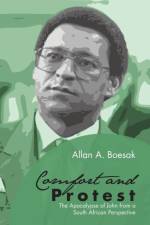
By the time Comfort and Protest was completed, South Africa was in a declared state of emergency. Within the context of the ongoing struggle in his country, Allan Boesak has written a powerful and urgent commentary on the Book of Revelation. He provides scriptural and historical interpretations, emphasizing that the drama which unfolds in the Apocalypse is played out in history whenever a political ruler claims the allegiance that belongs to God alone. Amid persecution and temptations to despair, Boesak provides a message of hope. He sees that, in the Apocalypse, ""John longs passionately for another day, another world. He feels it so keenly that he writes: ""That day has come. The church shares this longing, for the tent of God to be among the people. This is what the church has lived and died for, worked and struggled for: justice and humanity and peace and fullness of life.""""Comfort and Protest was conceived in 1980 as a series of Bible studies for my local church. It was the year of the student uprising in Cape Town, following on Soweto, 1976. The school boycotts left hundreds dead, many wounds that would never heal, and questions about faith and God to which I had no answer.... I turned to the words of John of Patmos, and for the first time I began to understand. The power of his testimony forever changed my life."" -From the Preface by Allan A. Boesak""Allan Boesak''s reflections on the Book of Revelation are as relevant and powerful in the 21st century as when they written in the midst of South African apartheid."" -- Curtiss Paul DeYoung, executive director of the Community Renewal Society, Chicago""Comfort and Protest logically embraces the life of Allan Boesak as a radical activist for societal change who fueled his faith to endure cruel hardship, suffering love, and blind hope, all of which came from the serious study of biblical narratives.""-- J. Alfred Smith Sr., Professor Emeritus, American Baptist Seminary of the WestAllan A. Boesak received his PhD in Theology from the Protestant Theological University (Netherlands) in 1976, the same year of the Soweto Uprisings which marks his entry into public life in South Africa. As President of the World Alliance of Reformed Churches he called for the formation of the United Democratic Front to advance the anti-apartheid movement in 1983. He has written 17 books and has received numerous awards, including the Martin Luther King Jr. Peace Award. He now holds the Desmond Tutu Chair for Peace, Global Justice and Reconciliation Studies at Christian Theological Seminary in Indianapolis.
It is hardly noteworthy in contemporary discourse when the phrase, ""We''ll just have to agree to disagree"" actually means, ""We plan never to speak to each other again."" For members of Episcopal and other Anglican churches, however, the Anglican tradition''s identity as a via media demands forthright engagement with difficult topics by Christians committed to remaining in prayerful relationship with each other. In the spring of 2013, Duke Divinity School''s Anglican Episcopal House of Studies began a series of ""fierce conversations"" designed to expose seminary students to the profound and painful reality of ecclesial divisions in North American Anglicanism (revolving around issues of human sexuality, scriptural authority and interpretive practices, and church leadership) while cultivating skills for leading congregations to worship, pray, and serve in ways that contribute over time to the full, visible reconciliation of Episcopalians and other Anglicans in North America. This book presents this year of conversations as a way of inviting congregations to take up the challenge and joy of ""fierce conversations"" in their own common life.Isaac Arten was a member of Duke Divinity School''s Anglican Episcopal House of Studies from 2012-2015. He received a Master of Divinity degree in May, 2015, and will begin doctoral studies in historical theology in the fall of 2015. William Glass was a member of Duke Divinity School''s Anglican Episcopal House of Studies from 2011-2014. He received a Master of Divinity degree in May, 2014. A Deacon in the Anglican continuum, he is a PhD student in Systematic Theology at Southern Methodist University in Dallas, TX.
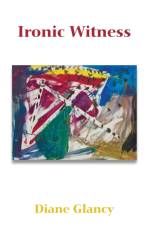
A minister's wife finds herself in hell. The story of Lazarus and the rich man in Luke 16:19-31 gives a chilling insight into the afterlife. It is a story that is not often addressed because it makes clear the separation of people upon death. Frank Winscott, a retired minister, works at comparing translations of the Bible. Eugena has ignored her husband's work and his sermons all her life. Instead, she finds meaning in her potter's shed, where she makes different forms of ziggurats that she places in her kiln, a little symbol of hell. Though Eugena rejects Frank's insistence that there is a heaven and hell, she finds that she has worked with the shape of both and never knew it. In the end, she realizes that heaven and hell are in the shape of ziggurats, one rising and the other sinking. Her beloved ziggurats become the ironic witness of what her husband preached. Meanwhile, Frank and Eugena struggle to make sense of their lives after the death of their addict son, Daniel. When he is killed in a car accident, Frank and Eugena argue over whether Daniel's death was truly an accident, or whether his car may have been pushed off the road. The novel begins, ""Another letter from the afterlife, you might say. But this one starts before the afterlife and continues into it."" When Eugena dies, she travels through hell to find her son, Daniel. Frank sends the last chapter from heaven. The novel was influenced by Dante's The Divine Comedy and begins with an epigraph from The Inferno, ""What I was living, that I am dead.""
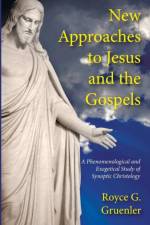
The approaches of contemporary New Testament scholarship to Jesus and the Gospels have been, in Royce Gordon Gruenler's view, inadequate. Instead, he offers some imaginative and well-articulated reflections on several new and promising approaches. These ""have meant a great deal to me over the past few years,"" he writes, ""since in fact I had a change of personal commitment from a former liberalism which had run dry, to the rediscovery of the vitality of my earlier evangelical heritage."" This change was precipitated by ""the investigation of the data"" that this provocative volume details.Gruenler employs a phenomenology of persons, borrowed from Wittgenstein, to highlight the fundamental claims of Jesus. Though limiting himself to the core of sayings accepted by radical critics as authentic, the author concludes that Jesus' concept of himself is so incredible on any human level that it becomes academic to insist on separating his implicit from his explicit christological claims. The use of redaction criticism to distinguish the two, therefore, is misguided.Marshaled in support are Lewis, who urges attentiveness and obedience to the story; Ramsey, who points to the ""logically odd"" supernaturalism of the Gospels; Polanyi, the tacit dimension of trust; Marcel, Jesus' creative fidelity; Tolkien, the spell of the story; and Van Til, the importance of presuppositions in Gospel research.
Abonner på vårt nyhetsbrev og få rabatter og inspirasjon til din neste leseopplevelse.
Ved å abonnere godtar du vår personvernerklæring.