














Gjør som tusenvis av andre bokelskere
Abonner på vårt nyhetsbrev og få rabatter og inspirasjon til din neste leseopplevelse.
Ved å abonnere godtar du vår personvernerklæring.Du kan når som helst melde deg av våre nyhetsbrev.

Although the object of centuries of study, only relatively recently has Genesis 1-11 been analyzed with attention to its literary unity and theological purpose. With the latter twentieth century's increased attention to synchronic approaches, many scholars began to consider Genesis 1-11 from the perspective of a literary unity in its final form and, therefore, to consider matters of intent and theological content. Yet, in spite of these treatments, there have been virtually no attempts to view the entire section of Genesis 1-11 as a literary and theological unity presenting a coherent message.This book begins to fill this void by seeking to identify the message of these chapters through utilization of a literary-theological approach. The study focuses on literary features, including the broader issues of surface and deep structure, while other topics of special concern include rhetoric as the art of composition for the purpose of communication and persuasion, and the use of speech as an important indicator of key issues in Hebrew narrative.
It seems that nearly everyone is talking about missional change for congregations. As a result, many church leaders are attempting to drive that kind of change for the ministries they lead. Some succeed. But many others hit a wall of considerable frustration as they find that congregations resist the very change that is so needed. The reasons for this resistance are many, and they are explored in this volume. What is required to move a church from resistance to readiness? Some resistance is deeply rooted in spiritual patterns. But there are other reasons as well, and they center on trust--personal trust in the leaders who offer missional change. For this work, the authors have done extensive primary and secondary research to identify patterns and behaviors that invite missional leadership. More than that, they've lived this out in their own ministries as pastors of traditional congregations. This book thus offers compelling first-person stories and congregational case studies alongside more generalized findings.Leading Missional Change was written to support pastors and other church leaders who experience resistance, to share wisdom and experience that may lead to readiness, and to give hope and encouragement toward a re-energizing of your own congregation.
""Worship the Lord.""Too many churches assume that those in their pews and those who pass through their doors know what worship is and why the Lord commands it. The purpose of this booklet, then, is to educate and acquaint members of Reformed churches but most of all those who inquire within their walls, with a basic knowledge of what Reformed churches mean when they say, ""Worship the Lord."" In knowing what to expect, the worshippers' response of praise and thanksgiving will be more active, joyful, and meaningful.
Jesus and Menachem places Jesus (Jeshua) in the historical context of the Roman occupation of Judea Second Temple period The fictional character of Menachem is introduced to deepen and clarify the relationship between Jesus, the Pharisees, the Sadducees, the Zealots, and Rome. In a1949 review in Commentary magazine, this book is compared favorably to The Nazarene by Sholem Asch. Menachem fights the Romans at the side of the Zealot Ben-Necher, killing them as he murmurs ""thou shalt not kill."" He loves Jesus, but does not believe in him as Jesus would have him believe. He is not a Pharisee, and yet cannot be against the Pharisees. When Pontius Pilate offers the Jews a choice between Barabbas the ""robber"" and Jesus the ""negator of God,"" he refuses to choose, for Barabbas is not a robber but a Zealot, and Jesus not a negator of God but perhaps a Messiah. Van Praag has painted Palestine with a simplicity, containing nothing unnecessary or barbarous, with a palpable mellowness which can be touched, inhaled, heard on every page.
Strengthening families of different varieties and ending abuse in the myriad of forms through which it surfaces is God's way of bringing peace and safety to Christian homes across the world. We challenge congregations, their leaders, and the men, women, and youth who faithfully support them to consider their personal role in bringing this vision--inspired by the Scriptures--into reality. Together our voices can be strong. We are united in our belief that every home should be a safe home, every home a shelter from the storms of life, every home a place where we are supported, treated with respect and dignity, and every home a place where men and women are encouraged to be all they can be. It is a tall order. It is a dream to guide our personal conduct and to measure our congregational and community life. We are far from reaching this goal--but toward it we strive.
Bold Girls Speak inspires girls to go boldly where God calls. This collection of Old and New Testament short stories follows smart, problem-solving girls who persevere and thrive with God's help in difficult circumstances. Most are unnamed and overlooked, living in a foreign culture, but the small ones can make a big difference. A few of the main characters are well known and named, but most are found in tucked-away verses in the shadows of the powerful. The girls live in historical and social-cultural settings authentic to the Bible, and they increase the reader's curiosity about biblical times and places. Each story is accompanied by age-appropriate commentary and discussion questions appropriate for classes, mother-daughter groups, home-schoolers, and Christian schools, as well as those reading for enjoyment.
This semi-autobiographical novel is set in a small, rural Alabama community during the height of World War II. At that time, the modern Civil Rights Movement was scarcely in its infancy. The main characters are two ten-year-old sons of sharecroppers--one black and one white. Amid the difficulties, deprivations, and disadvantages resulting from living on the bottom rungs of the economic ladder, they share a friendship that carries them through tough times and enriches their lives with joy. A terrible sequence of events threatens that friendship and rocks their world.
In modern times the relationship between the church and academy has been strained and tension-filled. Mainstream church culture has often been skeptical of Bible scholars, depicting them as self-serving intellectuals trying to out-think God by devising new and controversial interpretations. Just as well, academics have often leveled harsh critiques against church culture, painting pastors and laity as anti-intellectual pseudo-spiritualists. Entering the Fray argues that, in spite of the wide gap between the academic and ecclesiastical worlds, the modern church should be aware of the key discussions taking place among biblical scholars. To be sure, the average churchgoer has not been tuned in to scholarly conversations concerning matters such as the Messianic Secret, Q, the Historical Jesus, the pistis Christou debate, and related topics. In fact, they may have purposefully tuned out! Some, however, are simply unaware that any such dialogue has taken place, and beyond the internet, may not have the first clue as to how to explore the details. This primer seeks to function as that ""first clue"" by helping congregants, pastors, and students of the Bible enter into the fray of scholarly discussions that, over the last few hundred years, have shaped both the academy and church.
Sehnsucht: The C. S. Lewis Journal, established by the Arizona C. S. Lewis Society in 2007, is the only peer-reviewed journal devoted to the study of C. S. Lewis and his writings published anywhere in the world. It exists to promote literary, theological, historical, biographical, philosophical, bibliographical and cultural interest (broadly defined) in Lewis and his writings. The journal includes articles, review essays, book reviews, film reviews and play reviews, bibliographical material, poetry, interviews, editorials, and announcements of Lewis-related conferences, events and publications. Its readership is aimed at academic scholars from a wide variety of disciplines, as well as learned non-scholars and Lewis enthusiasts. At this time, Sehnsucht is published once a year.
What if the story of Jesus was meant not just to be told but retold, molded, and shaped into something new, something present by the Evangelist to face each new crisis? The Evangelists were not recording a historical report, but writing to effect a change in their community. Mark was faced with the imminent destruction of his tiny community--a community leaderless without Paul and Peter and who witnessed the destruction of the Temple; now, another messianic figure was claiming the worship rightly due to Jesus. The author of the Gospel of Mark takes his stylus in hand and begins to rewrite the story of Jesus--to unwrite the present, rewrite the past, to change the future. Joel L. Watts moves the Gospel of Mark to just after the destruction of the Temple, sets it within Roman educational models, and begins to read the ancient work afresh. Watts builds upon the historical criticisms of the past, but brings out a new way of reading the ancient stories of Jesus, and attempts to establish the literary sources of the Evangelist.
The author of Ephesians shows an interest in the Isaianic new exodus (INE) in facilitating his focus on the present triumph of the people of God. The recipients required both insight and confidence, especially in regard to the certainty of their salvation, its mysterious nature, Jewish-Gentile relations, and their former manner of life. In the face of these challenges the author maintains that victory is secured through God's choice of them and the working of his redemptive program--which inevitably leads to triumphal blessings. As with the exodus-era Hebrews, the readers participate in paschal redemption, now embodied in Christ, along with his resurrection and ascension as the triumphant new exodus warrior over principalities and powers. In addition, and as predicted by OT writers, Gentile proselytes share the blessings of the new exodus, but now on equal footing and access as Jewish Christians--creating a new eschatological temple. Triumphant Christ distributes gifts, facilitates Spirit-endowed living, and enables Christian warfare that mirrors Yahweh and his servant. The recipients of the epistle appear to be called to view INE triumph as above, below, now and not yet, while not discarding current applications on earth.
In 1938 the Reverend Henry H. Riggs wrote ""Shall We Try Unbeaten Paths in Working for Moslems?"" He encouraged the church to help Muslim converts remain inside Islam so that they might not lose their cultural identity. These ideas were soundly denounced by leading missionary scholars of the time: Samuel Zwemer, J. Christy Wilson, and Hendrik Kraemer. In the 1980s Riggs's suggestions bubbled up to the surface with new life in Bangladesh, but the proponents of these views--known as the insider movements (IM)--maintained a low profile. The church did not know what was taking place in Bangladesh until the 1990s when anonymous authors published papers with made-up locations reporting hundreds of thousands of new believers.Today, proponents of IM support their observations of what God is doing among Muslims with eight biblical passages. If the biblical support is real, it behooves you to support missionaries who advocate for IM; but if the biblical evidence is absent, you will have a difficult decision to make. The purpose of this book is help clarify the insider movements' claims and paradigm by simply examining the Scriptures.
Created in Delight challenges the church to take seriously the relationship of human beings with the earth and their fellow creatures. It challenges communities of faith to construct youth and young adult ministry through an ecological hermeneutic. Van Meter includes narratives from his youth work and teaching as well as ecological theology and an exploration of contemporary ecological concerns. He challenges youth and young adult ministers to seek their own formation through practicing hope in resistance to despair as they engage ecological questions in partnership with young people. The book concludes by asserting that cultivating curiosity, compassion, resilience, wisdom and other virtues is essential for the continuing health of young people and faith communities.
All over Canada, from coast to coast, there is new life in the Christian church. In spite of declining numbers, every Christian tradition has stories to tell of new ministries, fledgling Christian communities, and fresh expressions of church springing up, sometimes in unlikely places. Here, seventeen authors with experience in areas such as church revitalization, innovative ministry, evangelism, and church planting, reflect on what they are seeing and how the lessons they have learned can guide us into ways of health and vitality. They tell us about immigrant churches and indigenous ministries, about youth research and environmental concerns, about churches in the city and churches in the country, about leadership and spirituality. Scattered throughout the book are ten exciting stories of new ministries and new churches, from different traditions and different parts of the country, all seeking to engage their communities with the Gospel.Does the church in Canada have a future? The answer these authors give is a resounding yes--green shoots can grow out of dry ground--if we are prepared to rise to the challenge and follow where the Spirit of God leads. This book is timely, comprehensive, challenging, and deeply encouraging.
The Greeks and Romans often exposed their babies, especially if the child was of the wrong gender, malformed or from the wrong father--or, more simply, when a child was not needed. It was lawful, but Jewish and then Christian teachers did everything to prevent the practice among their own groups. Most of the arguments used by Christians were borrowed from their Jewish predecessors. The unique value of every human being and God's commandments were emphasized in both religions. Above all, they considered a newborn child a person who was created and protected by her or his Creator.The book presents the most important texts, often dealing simultaneously with exposure and abortion. The texts are interesting, sometimes shocking. A world without Christian ethics could be very hard for a small child. The book helps every modern reader to take care that our societies treat gentler human lives in their earliest phases.
For the first time, the Gospel material unique to both Matthew and Luke is brought together into one volume--in both Greek and English. For more than a century, New Testament scholars have asserted that Matthew and Luke drew on sources in addition to Q and Mark during the composition of their Gospels. For convenience, the non-paralleled material in Matthew has traditionally been labeled "M," and the non-paralleled material in Luke has traditionally been labeled "L." We learn only from Matthew, for example, particular stories like Joseph and Mary's escape to Egypt and the Great Commission; from Luke stories like the Prodigal Son and Jesus' appearance on the Emmaus road. Studying the material unique to each Gospel in isolation from their narrative contexts will allow students and scholars alike to engage these stories on their own. In this book, the individual special pericopae from Matthew and Luke are collected and arranged in Greek and English in the order in which they appear in the Greek New Testament. An introductory essay is provided to introduce readers to the Synoptic Problem, the notions of M and L and where they come from, what the parameters are for selection, and the critical debate, so that readers know how the selections were made and what is being asserted by their inclusion. This book will be a wonderful teaching tool for seminary and university professors, and will facilitate student engagement with distinctive Matthean and Lukan stories. It will also be a valuable resource for New Testament scholars doing research on this special material, since having it all in one place will no longer require them to search for the distinctive passages among the larger Gospel narratives.
Poems of Devotion is a collection of the finest recent poems in the devotional mode, which the editor examines in detail in the introductory essay. The seventy-seven poets collected here demonstrate the ongoing vitality of poetry as a spiritual practice, in the long tradition of poets, psalmists, and mystics from the East and West. This is an anthology that will prove deeply rewarding in the classroom, at home, or in the library of your religious institution.
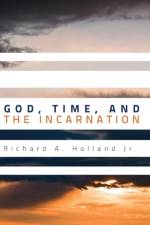
The dominant view among Christian theologians and philosophers is that God is timeless--that he exists outside of time in an ""atemporal"" eternity. In God, Time, and the Incarnation, Richard Holland offers a critical evaluation of this traditional view in light of the most central doctrine of Christianity: the Incarnation of Christ.Holland reviews the history of this controversy, highlighting the various theological problems for which atemporal models have been offered as a solution. He asserts the central importance of the Incarnation for Christian theology and evaluates several atemporal models in light of this doctrine. Finally, he suggests that the traditional atemporal view is not compatible with a robust and orthodox view of the Incarnation. This book rejects the traditional atemporal view of God's relationship to time and argues, based on the Incarnation, that God experiences temporal sequence in his existence.
The American Board of Commissioners for Foreign Missions (ABCFM) was the country's first creator of overseas Christian missions. Founded in 1810 and supported by a coalition of Calvinist denominations, the ABCFM established the first American missions in India, China, Africa, Oceania, the Middle East, and many other places. It was America's largest missionary organization in the nineteenth century, and its influence was immense. Its missionaries established the first Western schools and hospitals in many parts of the world, and they successfully promoted women's rights and other ideals from the Enlightenment. They also transformed oral languages such as Zulu, Hawaiian, and Cherokee into written form, and they preserved many elements of premodern cultures (albeit not always intentionally). The contributors to this book provide valuable insights on the work of the ABCFM (which exists today under a different name). Some of the contributors profile the lives of notable ABCFM missionaries, others focus on ideological shifts within the Board, and still others chronicle the Board's role in historic events, including the Opium Wars, the colonization of Hawai'i, and the Armenian Genocide. From reading this book, people will come to understand why the ABCFM is widely viewed as America's most historically significant missionary organization.
River of God is an introduction to world missions aimed at undergraduate students. However, the readers will soon discover that the book is rich in its content far beyond the editors' original plan. It serves as a reader for people with various levels of missiological interest and competence and deals with cutting-edge issues in missions. This book introduces a new paradigm, Kingdom Missiology, which builds on shalom in the Old Testament and as Jesus applied to the Kingdom of God in the New Testament.The first half of the book looks at Kingdom Missiology from the biblical, historical, and cultural dimensions. The second half of the book describes helpful strategies in the implementation of this paradigm. The importance of urban ministry is woven throughout the book.
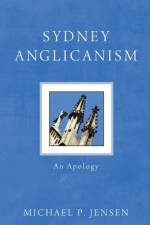
Sydney's evangelical Anglicans have been the focus of a great deal of controversy and criticism in the Anglican world. Their blend of conservatism towards doctrine and radicalism towards the institutional church has made them something of an enigma to other Anglicans. But what makes them really tick? Michael Jensen provides a unique insider's view into the convictional world of Sydney Anglicanism. He responds to a number of the common misunderstandings about Sydney Anglicanism and challenges Sydney Anglicans to see themselves as making a positive contribution to the wider church and to the city they inhabit.
Accosted by hatred and living out a dismal existence in Dirt Place, we humans have tried and failed to find the source of love. Many philosophies of love have proved powerless in satisfying our need for this pure and true thing. One after another, the world's religions fail to illuminate its reality and beauty. All the while, the overwhelming presence of evil has forced love into the shadows of elusiveness. But through the barrage of attempts to explain love's source, it is the Christian God alone who has brought meaning, value, and eternal significance to this oft-misunderstood virtue. It is the Christian God alone whose divine and perfect love was revealed in all its splendor in the cross of Jesus Christ. In Leaving Dirt Place, Jonah Haddad explores a multitude of philosophies and religions whose flawed accounts of love must ultimately yield to the truth of Christianity. This thoughtful and challenging apologetic presents a clear case for the true God of love.
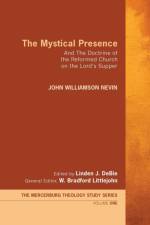
The Mystical Presence (1846), John Williamson Nevin's magnum opus, was an attempt to combat the sectarianism and subjectivism of nineteenth-century American religion by recovering the robust sacramental and incarnational theology of the Protestant Reformation, enriched with the categories of German idealism. In it, he makes the historical case for the spiritual real presence as the authentic Reformed doctrine of the Eucharist, and explains the theological and philosophical context that render the doctrine intelligible. The 1850 article ""The Doctrine of the Reformed Church on the Lord's Supper"" represents his response to his arch critic, Charles Hodge of Princeton Seminary, providing what is still considered a definitive historical treatment of Reformed eucharistic theology. Both texts demonstrate Nevin's immense erudition and theological creativity, contributing to our understanding not only of Reformed theology, but also of the unique milieu of nineteenth-century American religion. The present critical edition carefully preserves the original text, while providing extensive introductions, annotations, and bibliography to orient the modern reader and facilitate further scholarship. The Mercersburg Theology Study Series is an attempt to make available for the first time--in attractive, readable, and scholarly modern editions--the key writings of the nineteenth-century movement known as the Mercersburg Theology. An ambitious multi-year project, this aims to make an important contribution to the academic community and to the broader reading public, who may at last be properly introduced to this unique blend of American and European, Reformed and Catholic theology.
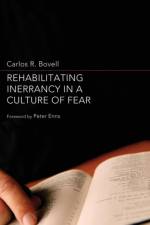
The notion that the Bible is inerrant in everything it teaches is something those with conservative upbringings are conditioned to take for granted. However, after being exposed to scholarship in biblical studies and other disciplines, some draw the unexpected conclusion that inerrancy as a doctrine is in dire need of serious revamping. Unfortunately, inerrantist politics and culture are making the constructive, restorative process impossible to intitiate. In Rehabilitating Inerrancy in a Culture of Fear, Carlos Bovell offers a synoptic overview of the issues to be addressed if inerrancy is to survive as a viable bibliological option.
A commitment to historical-grammatical hermeneutics often has been confused with a commitment to literal language. Time, in our modern conception, has been construed as a measurement of temporal units, and the numbers assigned to them, as merely counting those units. However, a study is needed to explore whether this is the Genesis author's use of time, and whether numerical values utilized suggest something other than tracking simple measurements. This book attempts to offer an answer to this question by analyzing the ancient Near Eastern and literary context of the Book of Genesis in terms of its use of temporal language in determining its value within the narrative. It is the contention of this book that both of these concepts have been misunderstood to such an extent that these misperceptions often obstruct interpreters from understanding the sociological and theological intent of the author to convey a theology of God, man, creation, and chaos that addresses concerns of both the ancient and the modern reader.
In 1976, a twenty-three year old German girl, named Anneliese Michel, died following months of exorcism sessions. Despite the fact that she had been medically diagnosed with epilepsy and manic depressive psychosis, two priests conducted numerous exorcism sessions and ignored her mental, medical, and physical condition. Doctors would later state that her cause of death was starvation and dehydration. Unfortunately, Ms. Michel's tragic death due to misdiagnosed demonic possession and negligently applied exorcism was neither the first nor the last of such negligence to occur. Complete familiarity with the spiritual elements of demonical possession and attack is the sole focus of most demonologists, exorcists, and clerical members of Christianity. Few clerics have a sufficient understanding of psychiatric conditions that may mimic the symptoms of demonic possession. The result has been catastrophic for many innocent people over the centuries. The overlooking or ignoring of a person's medical and psychiatric condition is the primary culprit behind misdiagnosed possession and botched exorcisms resulting in death or serious bodily injury.Father John Duffey, a New American Catholic priest, exposes the truth behind the young girl's death and renders a standardized approach to properly investigating suspected demoniacal possession, determining the existence of possession, and in the safe execution of exorcism/deliverance acceptable to virtually all denominations of the Christian faith. This book brings psychology, medicine, faith, legality, and safety together for the first time in order to enhance evaluation accuracy, demonic expulsion, wellbeing for the afflicted, and safety for all involved parties.
The book you hold in your hands says that our churches and our nation are in desperate need of biblical awakening and revival. It begins with the churches. In stark opposition to the quest to give our utmost for God's glory, as a whole, the modern evangelical movement has settled for a compromised form of Christianity. The book exposes the roots of this compromise, analyzes keys areas of church life where we have abandoned the biblical record, and offers a roadmap for revival and reformation.
This book presents a dynamic picture of Jesus and relates this picture to Jesus' fundamental and underlying relationship with his Father through the Holy Spirit. The concrete expression of that relationship in Jesus' life, ministry, death, and resurrection is presented in a unified manner, avoiding the pitfall of majoring on only one of these aspects. This holistic and dynamic picture of Jesus in intimate fellowship with his Father through the Spirit gives the readers a valuable glimpse into the mystery of the Trinity and invites them to reflect on what it means to follow Jesus as individuals and as communities in the context of the twenty-first century with its many challenges.
The stories of transgender people reach back to the beginnings of recorded history. At this particular point in time the psychiatric, medical, and secular worlds are beginning to appreciate the authenticity of Lesbian, Gay, Transgender, Bisexual, and Queer people. Sadly, many Christian churches and denominations continue to oppress and vilify the LGTBQ community. This is the story of a transgender man who has been an ordained elder in The United Methodist Church since 1984 and has quietly served his congregations for twenty-eight years before sharing his story and spiritual journey with his congregation, denomination, and the world. This is the story of a Transgender man, a Christian, an ordained minister, a loving husband and father--a human being. It is his challenge to his denomination and to all Christians and spiritual seekers to consider the truth of gender identity and sexual orientation as God given gifts, to be celebrated and embraced among all other gifts.
Abonner på vårt nyhetsbrev og få rabatter og inspirasjon til din neste leseopplevelse.
Ved å abonnere godtar du vår personvernerklæring.