











Gjør som tusenvis av andre bokelskere
Abonner på vårt nyhetsbrev og få rabatter og inspirasjon til din neste leseopplevelse.
Ved å abonnere godtar du vår personvernerklæring.Du kan når som helst melde deg av våre nyhetsbrev.

""The heart is the most influential and dynamic of all human images. This is due to its origins in our formational womb experience for over nine months. In the Bible, the word/image is found close to a thousand times. The purpose of this book is to explore the deep significance of biblical heart language/images. It will also point out important avenues of practical application in teaching, healing, and personal transformation. To make the book as effective as possible, we have placed practical exercises and suggestions for application throughout the book.""-- Joseph Grassi""This is an excellent resource for counselors, retreat directors, teachers, and all who recognize the centrality of the imagination in human conversion.""-- Kathleen Fisher, author of The Inner Rainbow""Psychologically sound, spiritually helpful, and biblically rich, this book can aid us to renew our 'heart covenant' with the Lord.""-- Robert J. Wicks, Director of the Graduate Program in Pastoral Counseling, Neumann CollegeDr. Joseph Grassi is a professor of religion at Santa Clara University. His numerous published books include the popular Changing the World Within: The Dynamics of Personal and Spiritual Growth (Paulist Press).
The first book to tell you how to confront the New AgeThe threat is growing. So not only do we need to understand the New Age, we need to stem the tide of this growing religious movement. Here's the first book that tells how.You'll find all you need to know for:- Witnessing to New Age adherents- Identifying New Age influences in business seminars- Exposing New Age curriculum in our public schools- Discerning New Age influences in pop psychology, biofeedback therapy, visualization, and New Age musicThis book takes you a step beyond other books with its practical advice and sound suggestions.
Erhard S. Gerstenberger is Professor Emeritus at the University of Marburg. He is the author of numerous books, including Theologies in the Old Testament, Yahweh the Patriarch, and commentaries on Leviticus and the Psalms.
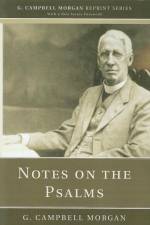
Here is a book about the Psalms which are the devotional center of the Bible, adored by not only the people of Israel but by New Testament believers generally. The Psalms are grouped into five books, each of which has a central theme. These divisions are preceded by an outline and analysis of the Psalms as to content and purpose. While each of the Psalms are analyzed in turn, they are also examined as they relate to their grouping. It is this synthetic approach which will make it particularly valuable to all students of the Bible. To facilitate the study of the Psalms, the complete text of each Psalm has been printed preceding its own analysis. Dr. Morgan has long been recognized as one of the great Bible expositors of modern times, and this book deserves a worthy place alongside his other works.
G. Campbell Morgan (1863-1945) was a leading Bible expositor in England and the United States. Despite a lack of substantial formal training, Morgan was a prolific writer and teacher. Ordained into the Congregational ministry, he was the pastor of Westminster Chapel, London (1904-17 and 1933-45). Morgan also conducted two very successful teaching tours in the United States, including work with D.L. Moody's ministry.
The ""Prince of Bible Expositors"" presents the stirring events of Jeremiah's career in this volume--one of the most oustanding works on this subject ever published. In these chapters, the character of this ""prophet of strength and tears"" is analyzed and appraised and his dealings with the people are carefully pursued and portrayed, while his ""prophetic utterances which constituted the word of Jehovah to a decadent age"" are interpreted in a masterly manner. This unabridged edition embraces the penetrating analysis and warm devotional spirit which characterizes all of Dr. Morgan's writing. The world has seen but one G. Campbell Morgan, whose messages are as popular, effective, and inspiring today in printed form as they were when preached from the pulpit. What the artist portrays with his brush, G. Campbell Morgan reveals with his pen, a pen that never rested from its labors in the cause of Christ.G. Campbell Morgan (1863-1945) was a leading Bible expositor in England and the United States. Despite a lack of substantial formal training, Morgan was a prolific writer and teacher. Ordained into the Congregational ministry, he was the pastor of Westminster Chapel, London (1904-17 and 1933-45). Morgan also conducted two very successful teaching tours in the United States, including work with D. L. Moody's ministry.
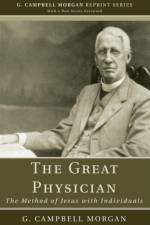
""Or Lord referred to his work as that of the Physician . . . Healing all manner of disease applies to the spiritual as well as the mental and physical . . . our business is of bringing the sin-sick face to face with the One Healer. To do this demands some knowledge of His Methods and these are most radiantly revealed in the records of His early ministry.""--From the Foreword
G. Campbell Morgan (1863-1945) was a leading Bible expositor in England and the United States. Despite a lack of substantial formal training, Morgan was a prolific writer and teacher. Ordained into the Congregational ministry, he was the pastor of Westminster Chapel, London (1904-17 and 1933-45). Morgan also conducted two very successful teaching tours in the United States, including work with D.L. Moody's ministry.
Walking with Faith addresses a long-standing need to develop the faith-related dimensions of Christian moral life and explore their implications. It responds to Vatican II's exhortation that theological studies be renewed through a lively contact with the mystery of Christ and the history of salvation. Accordingly, this book examines the relationship between faith and moral life in the Scriptures and acknowledges the normative quality of the biblical texts. It reviews the long experience of the Church, paying special attention to history, worship, and intellectual currents. These dimensions of Christian life show the relationship between faith and moral life at any given time and allow the actions of one generation to have effects that extend far into the future. Walking with Faith promotes an understanding of contemporary pastoral and theological issues and encourages a deep and informed approach to Christian life.
Myth is not a remote subject, restricted to the limited intellect of "pre-logical" man. The question "What is man?" is an ancient one. It is also a recent one, still unanswered in the impasse of our sciences. Wherever and whenever human beings are alive, there are creators of myth among them. Kees Bolle singles out one group as having the most significant "say" in the formation of myths: the mystics, who epitomize the common urge for a simplicity beyond the whirlpool of personal existences. And, surprisingly, the author finds that the study of humor provides a great deal of insight into the study of religious traditions.
Mitch Finley earned a B.A. in Religious Studies from Santa Clara University and an M.A. in Theology from Marquette University. He is the author of more than 30 books on Catholic topics. Mitch has been happily married to counselor, teacher, and author Kathy Finley since 1974. They live in Spokane, Washington, and together they have three grown sons. Visit their website: www.mitchandkathyfinley.com.
A comprehensive account of the major theological themes in the late sixteenth and early seventeenth century Puritanism of England and New England as seen through the concept "covenant of grace." The covenant of grace, von Rohr argues, enabled Puritanism to affirm both a continuation of Calvinistic predestinationism and an emergent voluntaristic pietism, pastorally both the absolute and conditional promises of God. An extensive array of primary source material is used in substantiating the author's thesis.
Traditional Protestant theology has long answered the question, ""What is the true church?"" by pointing to the visible church--its location, nature, and structure. The recent increase of interest in missions, however, has raised the issues of the church's role and identity--its mission in the world.It is no longer enough to use orthodoxy as the criterion for the genuineness of the church, identifying the body of Christ by organization or clerical structure, perfection in lifestyle, or ecstatic experience of the Holy Spirit. Rather, says Norman Kraus, the mark of the true church is its authenticity--its ability to remain true to its original prototype in character and purpose.Thus, the church's mission is to be the authentic community of witness to the world. The Christian community affirms each individual as a person in Christ, and its objective for the world is the same as for itself: it calls the world to peace in Christ. The church in mission, then, must be a sign to the world of the kingdom of God. As an authentic community, it is a healing community, characterized and organized around its mission of reconciling witness rather than creeds, various practices, or preaching. Following Christ as its model, its message is salvation and reconciliation.
""When we are called to minister to the dying and/or bereaved, many of us who count ourselves as servants of God too easily prejudge the matter and rush in with words and a trite formula. Words have become our trade, jargon our bane, and verbiage our downfall. ""Bert Walsh knows this all too well. Only in the last of five chapters does he get around to the things which we are to say in the presence of crisis. But those are words we have long ago learned from reading the New Testament or heard time and again from well-meaning consolers. What is crucial is that which comes before those words are spoken and surrounds them."" --from the Foreword by G. Clarke Chapman Jr.Believing that death and bereavement present pastors and believers with the most extreme challenges to faith, Bert Walsh carefully examines the potential for new discoveries, greater personal growth, and maturity in faith offered to those who minister to the dying and bereaved. With his uncommon insight and measured, simple, purposeful style, the author helps those who minister to the grieving to develop a new sensitivity to both spoken and unspoken needs. He expertly demonstrates that there is a time for words of solace and consolation; there is also a time for silence, a time for touching, a time to share tears. Periods of silence no longer need to be awkward or uncomfortable. Rather, they can become productive moments of quiet reflection and prayer.
Ephemeral differences notwithstanding, both literature and the Bible are stirred by a common passion for words, all of which are on an equal footing in staging an at once intimate and ultimate passion of the word. Of language and its quest for truth of which each and every word of a dictionary is entrusted, so long as no word per se can lord it over all the other words. Keepers of the word, words cannot keep a secret, bound as they are both to reveal and conceal it at one and the same time. Except for a parrot, language has no mother tongue: it inherits only that which it can translate: the everlasting into the ephemeral, the temporal into the eternal, speaking into writing - into that which happens once and for all. Language is iconic and iconoclastic. It is propitious to God and would-be gods and, conversely, it is equally allergic to idols. Hence the title of this book, borrowed from a line of W.H. Auden's Christmas Oratorio. No sooner is God worshipped than God is turned into an idol.Biblical or not, religious or secular, literature is iconoclastic. ¿Promethean iconoclasm quarrels with God. Ironically less theistic, the paradox of Abrahamic iconoclasm lies in laying bare the duplicity, not so much of God, as of all human all too human conceptions of a God which, falling short of God, becomes an idol that can only be rebuked even by God if not by Abraham, the father of faith. No wonder, Western literature has dealt with the death of God rather than with the living God: its task has consisted in wording a world shaped and left to go adrift by Christian tradition itself gone irrelevant and locked up in a mother tongue no one speaks instead of time and again unleashing and worlding the Word.
In search of a way to worship that is relevant today and into the twenty-first century, Moeller proposes an approach based on the "great commandment" to love God and one's neighbor as oneself. With special attention to the time, space, sounds, sights, touches, and symbols that form the context of every worship service, she argues for a collaborative approach to the worship service in which the participants are involved from preparation to celebration. Illustrating this highly evocative, thoroughly feminist theology of worship is a sample service that pays particular attention to how the process and design of worship impact the experience of the worshipers.
""This is a deeply moving tale of the American we often read about but seldom run into: the independent spirit who speaks truth to power, no matter the consequences. Dave Dellinger, the oldest of the Conspiracy Eight, turns out to be the most obstinate. This book tells us why.""-- Studs Terkel""Before reading this book, I knew and greatly admired Dave Dellinger. Or so I thought. After reading his remarkable story, my admiration changed to something more like awe. There can be few people in the world who have crafted their lives into something truly inspiring.-- Noam Chomsky""Dave Dellinger's life is as American as apple pie wildly seasoned--the life of an active, endlessly inventive peacemaker--resisting, determined, positive. It's an exciting personal story lived in the heart of historical events. An American tradition infrequently mined, deep and continuous.""-- Grace Paley""A powerful, sensitive, and deeply compassionate reflection from one of the most important and bravest nonviolent revolutionaries of the twentieth century.""--Martin Sheen
In Peter Maurin: Prophet in the Twentieth Century, Marc H. Ellis traces Maurin's life from his early years--as peasant, brother, and Catholic activist--through his meeting with Dorothy Day. Ellis' Chronicle focuses on the consequences of that meeting: the founding of the Catholic Worker movement and newspaper, the founding of hospitality, the farming communes. Peter Maurin: Prophet in the Twentieth Century is the first biography to really examine Maurin's thought. A commitment to non-violent reform and to a life of poverty were chief tenets of Maurin's philosophy; it was Maurin's notion that farmers and scholars would labor and learn together in the ideal world. Ellis discusses these and other ideas of Maurin, their development and their particular importance today.
The Reverend Richard McSorley, S.J. (1914 - 2002), was professor of peace studies at Georgetown University and writer of eight books on pacifism and social justice. As a Jesuit priest ordained in 1946, he completed his studies for his Ph.D. at Ottawa University. In 1970, he co-founded St. Francis Catholic Worker in Washington, D.C. He served as a board member of the National Interreligious Board for Conscientious Objectors for 15 years and was a National Council member of Pax Christi, U.S.A. from 1983 to 1989. He has written five other books and is a nationally recognized newspaper columnist.
In The Time's Discipline. Philip Berrigan and Elizabeth McAlister offer us a chronicle of their community in Baltimore. They show us that for their nonviolent community, resistance to the nuclear arms race is not merely a political endeavor, but most profoundly a spiritual endeavor, rooted in fidelity to the Gospel. Thus the reporting of Jonah House's first fifteen years is formed around the Beatitudes, eight points of blessing at the outset of Matthew's presentation of the Sermon on the Mount.Invariably for Phil & Liz and those who have been part of their work at Jonah house and related endeavors, that spirituality is not abstract, but rooted in community and resistance and thus very much of this world and in service to its highest good. Understanding that we live in a nuclear empire, they present us in these pages, their ""experiment in truth"" in its midst. ""The integrity of the witness of the Jonah House community is their ability to embrace the joys and challenges of both expressions of resistance: community and direct action. They are bound together as parts of a mutual whole. The Time's Discipline illustrates that our hardest work is not necessarily doing time or crossing the line, but creating a common life together."" Barb Kass, Anathoth Community Farm
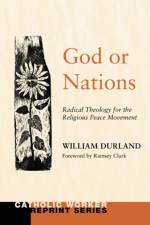
The difficulty in realizing that a truth beyond culture exists is perhaps the greatest single barrier to the life of love. Our culture is permeated by violence, militarism, materialism, patriotism to nation right or wrong, the supremancy of force, racism, sexism. Most people, seeking approval of their peers, never see how destructive these false values are. Here you are challenged to be dissatisfied with this cultural reality; to resist custom, habit, tradition, mores, social environment, even heredity; to act on your own conscience, to reform reality, to return good for evil, to love your enemy, to serve the oppressed.William Durland is an author, lawyer, and theologian, and former member of the Virginia State Legislature. William has practiced in the areas of International, Constitutional, and Military law with an emphasis on human rights and civil liberties for more than 40 years. Durland also has had a long history in education, teaching in the areas of Philosophy, History, and Government, at Purdue University, Villanova University, the University of Notre Dame, and in the Colorado Community College system. He also taught peace and justice courses at Pendle Hill Quaker Study and Contemplation Center from 1985-1988
This collection of articles and talks are some ""personal favorites"" of the late Gordon C. Zahn, a founder of the U.S. Catholic peace movement, and fondly known as the ""dean of American Catholic pacifists."" The theme of these essays is imbedded in the title of the book: All Christians have a vocation of peace, a call to serve the cause of peace and to obey the obligation to oppose war and any support or participation in war. The first set of essays will challenge the reader to consider the role of conscience and the moral responsibility it holds for the Christian. The second set of essays presciently addresses issues that have become known as the ""consistent ethic of life."" The third set offers the examples of individuals or groups whom Zahn knew who lived out their vocation of peace. In this book, you will discover Gordon Zahn's continuing legacy: to help you discover your own vocation to peace!""In a world that, sadly, has come to accept as normal every form of violence against human beings - from abortion to war - Gordon Zahn's steadfast faith and wisdom remind us not to ""succumb to the delusion that it is somehow possible to overcome evil by adding to it."" -- Michael W. Hovey, Co-director with Gordon Zahn at the Pax Christi Center on Conscience and War, Cambridge, Mass.Gordon C. Zahn is the definitive biographer of Franz Jaegerstaetter and author of numberous books and articles on issues of peace and justice.
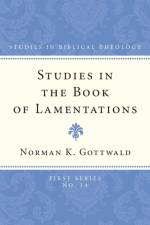
When published, this work on the Book of Lamentations opened a new wave of studies on that much neglected biblical book. After a fresh translation, followed by acute analyses of the acrostic form and literary genres, the author develops the two-fold theology of ""doom"" and ""hope"" that reverberates through the five laments composed during the exile to cope with the fall of Jerusalem. Created for public performance, the poems artfully alternate the voices of the poet and the community, personified by turns as a forlorn widow (Fair Zion) and as an afflicted man (Jacob/Israel). The book attributes the catastrophe in part to the moral and social failures of Judah's leadership, but it also finds the enormity of the suffering beyond moral or theological explanation.
Why Does Marriage Today Seem To Be Such a Far Cry From Paradise?Let's face it. Our culture's version of marriage is not as God designed it to be. With a lot more emphasis on individualism and consumerism, today's married couples tend to lose sight of God's original purpose for marriage--a call for his people to take Jesus' message to the heart of everyday life. Marriage Made in Eden provides a radical alternative to today's view of marriage, giving a glimpse into the historical and cultural aspects that have shaped marriage in America. With this insightful analysis you'll learn how marriage has come to be in the state we now find it and about God's model and purpose for a sacred Christian union.
This volume is a collection of six essays that Dr. Kim published in various journals over the past several years. They represent the early period of Dr. Kim's theological journey into Christian faith as a Korean Christian or, more broadly, an East Asian Christian. These essays deal primarily with religio-cultural themes related to my existential situation.- from the PrefaceThis book provides for Christian theology what has long been needed: a sustained and original analysis of the relationship between the Taoist and Christian traditions. An important study.David Tracy, Andrew Thomas Greeley and Grace McNichols Greeley Distinguished Service Professor of Catholic Studies and Professor of Theology and the Philosophy of Religion, University of Chicago Divinity SchoolHeup Young Kim is Professor of Systematic Theology at Kangnam University, Korea, and former Dean of the College of Humanities and Liberal Arts and the Graduate School of Theology. He received his BSE degree from Seoul National University, M.Div. and Th.M. from Princeton Theological Seminary, and Ph.D. from Graduate Theological Union. Awarded as the 2009 Alum of the Year by the Graduate Theological Union, he is a co-moderator of the Congress of Asian Theologians and a founding member of the International Society for Science and Religion. Professor Kim has published numerous works in the areas of interfaith dialogue, theology of religions, Asian theology, and theology and science, including Wang Yang-ming and Karl Barth: A Confucian-Christian Dialogue (1996).
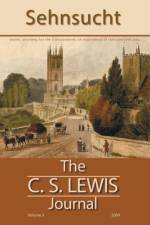
Sehnsucht: The C. S. Lewis Journal, established by the Arizona C. S. Lewis Society in 2007, is the only peer-reviewed journal devoted to the study of C. S. Lewis and his writings published anywhere in the world. It exists to promote literary, theological, historical, biographical, philosophical, bibliographical and cultural interest (broadly defined) in Lewis and his writings. The journal includes articles, review essays, book reviews, film reviews and play reviews, bibliographical material, poetry, interviews, editorials, and announcements of Lewis-related conferences, events and publications. Its readership is aimed at academic scholars from a wide variety of disciplines, as well as learned non-scholars and Lewis enthusiasts. At this time, Sehnsucht is published once a year.Grayson Carter is Associate Professor of Church History at Fuller Theological Seminary, where he has taught since 2002. Since its inception, Carter has served as General Editor of Sehnsucht: The C. S. Lewis Journal, the only peer-reviewed journal devoted to the study of C.S. Lewis and his writings published anywhere in the world.
Recent controversies have rocked evangelicalism on the question:Is gender-inclusive language for human beings faithful and helpful in Bible translation, or does it distort and obscure God's Word? Distorting Scripture? moves beyond sensationalism to the meaty core of an ongoing debate.""A fascinating, illuminating, informative, balanced, accurate discussion by a scholar who is a conservative evangelical in doctrine and a complementarian/traditionalist in gender roles.""Alan Johnson, Professor of New Testament and Christian Ethics, Wheaton College""Mark Strauss has put us in his debt by cutting through the rhetoric and placing the issue of gender-neutral translation where it belongs--in the areas of translational theory and of accuracy in bringing Greek and Hebrew into contemporary and readable English, not in the context of pro- or anti-feminist agendas.""Gordon D. Fee, Professor of New Testament, Regent College""Mark Strauss rightly discusses the debate over inclusive language in the larger context of debates over traditional language and translation theory that have always been a part of the history of Bible translation. And as a self-designated complementarian, he resoundingly rejects the notion that inclusive language in Bible translation is part of a feminist plot to rewrite Scriptures. I strongly recommend this book to anyone interested in the current debate and in the future of the English Bible.""John R. Kohlenberger III, coeditor, The NIV Exhaustive Concordance""I have read Distorting Scripture? with enjoyment and fascination. Dr. Strauss demonstrates conclusively how gender-inclusive versions of the Bible (as opposed to feminist versions) are motivated by the need to translate as accurately as possible into the language that people actually speak.""I. Howard Marshall, Professor of New Testament Exegesis, University of Aberdeen""The clamor against recent evangelical attempts to be gender accurate in translation has brought terrific confusion and needless pain to the church. Mark Strauss takes the reader sure-footedly through the dispute, making clear what is and is not at stake. His work is like defrosting fog from a windshield so one can see where one should be going."" Darrell L. Bock, Research Professor of New Testament Studies, Dallas Theological seminary""Distorting Scripture? presents a strong case for the validity of biblically faithful inclusive-language versions of Scripture.""Gretchen Gaebelein Hull, author of Equal to ServeMark L. Strauss is Professor of New Testament at Bethel Theological Seminary--West Campus, San Diego, California. He is the author of The Davidic Messiah in Luke-Acts: The Promise and Its Fulfillment in Lukan Christology.
This study traces the development of the story of Paul's martyrdom from the New Testament period until approximately the reign of Pope Gregory the Great. H. W. Tajra reviews the historical and juridical context of the Apostle's martyrdom and analyzes the literary traditions and legends which came to envelop the historical core of the martyrdom tale.
Abonner på vårt nyhetsbrev og få rabatter og inspirasjon til din neste leseopplevelse.
Ved å abonnere godtar du vår personvernerklæring.