









Gjør som tusenvis av andre bokelskere
Abonner på vårt nyhetsbrev og få rabatter og inspirasjon til din neste leseopplevelse.
Ved å abonnere godtar du vår personvernerklæring.Du kan når som helst melde deg av våre nyhetsbrev.

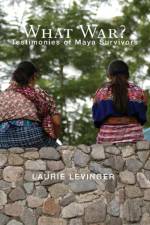
In 2004, Laurie Levinger left her home in Vermont for Guatemala, where she planned to teach English to Maya university students. But on the first dayof class, Levinger became the student instead of the teacher when a young man named Fernando introduced himself by saying, ""My father was killedwhen I was four months old. I am a survivor of the Guatemala civil war.""Shocked, Levinger''s first thought was, ""What war?""Beginning in 1960, fighting between the Guatemalan military and guerrilla fighters raged across this Central American country. By 1980, this violence--which began with a CIA-backed coup and efforts by the United Fruit Company to protect its financial interests--turned into the massacre of Maya people in every corner of Guatemala. By the time peace accords were signedin 1996, over two hundred thousand Maya people had been murdered, ""disappeared,""or forced into exile by their own government.Levinger''s students had been young children when these atrocities were committed. Many lost their parents. Many had relatives who ""disappeared.""All had suffered the loss of their culture, their family ties, their sense of safety, their personal identities.As a clinical social worker, Levinger believes in the importance of bearing witness, of speaking the unspeakable out loud. After her initial trip, shereturned to Guatemala, this time with a tape recorder and a mission: to record the testimonies of her students, to document their enduring love for their Maya culture, and to honor their unflagging search for truth.In What War? Levinger brings us stories, told in the spare and eloquent language of truth-tellers, reminding us all that the true cost of war is borne by the survivors. And so is the hope for peace.""I only once or twice experienced any one speaking as openly about The Violence, la violencia, asdo these young people. Their candor is extraordinaryand gives me hope.""--Staughton Lynd, author, historian,peace activistLaurie Levinger is a retired psychotherapist who lives and writes in Vermont.
Contributors: Philip Yuen-Sang Leung Mathias Mundadan Gerald J. Pillay Lamin Sanneh Andrew F. Walls""Enlarging the Story is an eye-opening collection of essays by first-rate scholars, who, all in their different ways, remind us that a very great deal of Christian history happened outside Europe and North America. This challenging book is essential reading for anyone interested in tracing the global development of Christianity through the centuries.""--Philip Jenkins, author, The Next ChristendomWilbert R. Shenk is Senior Professor of Mission History and Contemporary Culture, School of Intercultural Studies at Fuller Theological Seminary in Pasadena, California. Among Shenk''s recent publications are: North American Foreign Missions, 1810-1914: Theology, Theory, and Policy (2004), By Faith They Went Out: Mennonite Missions, 1850-1999 (2000), and Changing Frontiers of Mission (1999). He was a consulting editor of the Dictionary of Mission Theology: Evangelical Foundations (2007).
""Should Christians be concerned with faith and evangelism and not politcal affairs?"" In answering this question, American Crossroads provides a thought-provoking look at what it means to submit to the governing authorities of the United States of America. Just as God called for Christians to submit to the Roman government that forced its will upon the people (Rom 13:1), so too is God calling for us to submit to the existing form of government in the United States, a government that lives and thrives upon the will and involvement of people. Today, by submitting to the government, Christian citizens are led to influence the American political process that depends upon the involvement of all citizens for its well-being and survival.""Government was God''s idea, not ours. But in today''s sociopolitical climate, foundational truths are routinely challenged and those who hold to a biblical worldview are either intimidated by demands to leave the public square or are voluntarily absenting themselves from the discussion. American Crossroads helps followers of Christ understand God''s idea for government, motivating them to be active stewards of the government entrusted to their care.""-Jeremy DysPresident and General Counsel The Family Policy Council of West VirginiaJesse Wisnewski is currently a graduate student at Gordon-Conwell Theological Seminary.
""What may I hope for?"" Immanuel Kant''s third question, both speculative and practical, speaks to the heart of the problem of human destiny. Such a question can hardly help but call for careful scrutiny by Catholic philosophers. It confronts Catholic philosophy as inevitably and as poignantly as it does any other comprehensive humanistic thinking. It is especially urgent at present, as humanity seems to be destining itself to a suicidal end in a worldwide nuclear holocaust. Owens takes the notion of human destiny taught as a revealed truth by the Catholic Church and considers it thematically as an object of the philosophy of religion. He examines the philosophical problems that arise, first in Aristotle, then in Aquinas, and finally in the contemporary world.Reverend Joseph Owens, CSsR (1908-2005), was a Canadian Roman Catholic priest and a scholar in medieval philosophy. Owens received his PhD in 1951 from the Pontifical Institute of Mediaeval Studies and remained at the Institute as a teacher and distinguished researcher for the rest of his career. He authored nine books and almost 150 academic papers. Among his many publications are A History of Ancient Western Philosophy, The Doctrine of Being in Aristotelian Metaphysics, and St. Thomas Aquinas on the Existence of God.
The Witness of the Spirit is a clear and comprehensive treatment of the teaching of the Word of God concerning the inner witness of the Spirit of God. The book opens with an account of Calvin''s and Luther''s contribution to this important theme, followed by a survey of the theological reflection upon this subject from the days of the early Church Fathers to the present time. Dr. Ramm shows that the work of the Holy Spirit is not a single subject to be discussed in isolation from the total area of Christian theology; therefore, he helpfully relates it to the doctrine of the Trinity, of revelation, redemption, and the Scripture; and to Christian fellowship and the spiritual life. Dr. Ramm''s book is an invaluable and much needed contribution to a phase of the Spirit''s ministry, an aspect long neglected in evangelical thought.""Bernard Ramm has already distinguished himself by his writings in the area of conservative apologetics and theology. This latest volume from his pen is marked by the same qualities of relevance, forthrightness, and insight by which his writings have come to be so widely known. The Witness of the Spirit was written because of the author''s conviction that the doctrine of the testimonium has been sorely neglected in current discussions of revelation and authority. His book is an invaluable study and is sure to stimulate a fresh interest in a most timely and basic topic. When it comes to writing a book that is a must in the area it treats we can say of this volume that Ramm has done it again.""-Dr. Boyd Hunt in Christianity TodayBernard Ramm, professor of Systematic Theology and Apologetics, California Baptist Theological Seminary.
""Religion is much too great and permanent an element in human experience to be swept out of sight,"" writes Bishop Newbigin. ""I want to ask what must be the religion of a Christian who accepts the process of secularization and lives fully in the kine of world into which God has led us.""His answer involves relating the universal fact of secularization to the biblical picture of the nature and destiny of man. It involves, too, some criticism of recent Christian responses to secularization - but the whole tone of this book is positive. The emphasis is on knowing God, being God''s people, and living of God in the midst of the secular.The late Lesslie Newbigin was one of the twentieth century''s most influential Christian thinkers. A founding bishop of the Church in South India, he later served as an associate general secretary of the World Council of Churches, before being called back to southern India as Bishop in Madras in 1965.
The biblical injunction not to steal is often used to defend the notion of inviolable private property and the right to accumulate great wealth. The author demonstrates that this is a misuse of the biblical text and that, on the contrary, the commandment''s purpose was to guarantee everyone''s right to basic necessities of life.""This book purports to be the exposition of a single commandment. It is that. But beyond that, it is a programmatic statement about how the Bible speaks about wealth, power, community, and responsibility. Without engaging in ideological extremity, the author shows how serious social criticism can illuminate scripture and rescue us from distortions of the text because of our own economic commitments. The outcome of the study is to show how the prohibition of stealing is not a defense of private property (as commonly read) but a warning against property management that diminishes community: that is, the text turns against our preferred reading. ""It takes no great sensitivity to see that this subject and this treatment of it have urgency for us, even though the author makes no special effort at relevance. As Gnuse observes, ''The Israelite ethos was formed in the crucible of slavery of Egypt and of conflict in Canaan.'' Our interpretive task is to see how this text continues to have social energy in a matrix of affluence and greed. ""The book is enhanced by a full bibliography and a brief extension of Old Testament trajectories into church tradition."" Walter Brueggemann, Eden Theological Seminary ""You Shall Not Steal is a thorough and discerning analysis of the decalogue commandment against stealing. Gnuse shows its radical character in the ancient Near Eastern world, traces its implications in later biblical literature and thought, and has sound observations about the continuing import of this commandment on the contemporary scene."" Walter Harrelson, The Divinity School, Vanderbilt University ""This book raises the central issue of biblical justice for all Christians. For the western mind justice is perceived as incompatible with compassion. But biblical justice overturns this notion; it is both fairness and compassion. Gnuse''s efforts to develop the biblical understanding of justice are bound to prove fruitful for all concerned Christians."" Patrick D. Sheedy, JD, Director of Social Action, Social Welfare Department, Minnesota Catholic ConferenceRobert Gnuse is the James C. Carter, SJ/Bank One Distinguished Professor of the Humanities in the Religious Studies Department at Loyola University New Orleans. He is the author of 12 books and approximately 80 articles in the field of biblical studies.
John H. Leith''s classic examination of what it means to become a member of the church. This study was designed for junior high communicant classes, but is also an excellent resource for church officer training and new member classes--for adults and young people alike.Leith confronts the choices and questions that arise for young people, or anyone for that matter, trying to understand their place in the priesthood of all believers. He enlightens readers to the meaning of the church while he explores the vows taken by those entering the communing fellowship of the church, the nature and faith of the church, and the worship and work of the church.John H. Leith (1919-2002) was the Mary Elizabeth Pemberton Professor of Theology at Union Theological Seminary in Virginia, where he served the church as a theologian and teacher from 1959 until his retirement in 1990. Of his many books are Assembly at Westminster: Reformed Theology in the Making, An Introduction to the Reformed Tradition: A Way of Being the Christian Community, and John Calvin''s Doctrine of the Christian Life.
""If I could, I surely would stand on the rock where Moses stood."" --from the Spiritual ""Elijah Rock"" Taking its theme from the pastoral letter of the Black Catholic bishops of the United States, which spoke of the challenge of being ""authentically Black and truly Catholic,"" To Stand on the Rock invites us ""to linger awhile in the garden of our imagination and try to see with the eyes of faith and art how the old ones . . . took a twisted version of Christianity and re-twisted it into a culture of liberation, transcendence, creativity and wholeness.""Father Brown begins by recalling the religion and identity of those Africans who were brought to these shores in bondage: the original source in the quest for what it means to be ""authentically Black."" He then explores the style of Christianity they forged through the sufferings of slavery, which found expression in the Spirituals. Brown then reflects on the struggle of Black Catholics to claim their own style of faith and spirituality and to assert their distinctive gifts to the church universal.""If I could, I surely would Stand on the Rock where Moses stood."" from the Spiritual, Elijah Rock Taking its theme from the pastoral letter of the Black Catholic bishops of the United States which spoke of the challenge of being ""authentically Black and truly Catholic"" To Stand on the Rock invites us ""to linger awhile in the garden of our imagination and try to see with the eyes of faith and art how the old ones . . . took a twisted version of Christianity and re-twisted it into a culture of liberation, transcendence, creativity and wholeness:'' Father Brown begins by recalling the religion and identity of those Africans who were brought to these shores in bondage: the original source in the quest for what it means to be ""authentically Black."" He then explores the style of Christianity they forged through the sufferings of slavery, which found expression in the Spirituals. Brown then reflects on the struggle of Black Catholics to claim their own style of faith and spirituality and to assert their distinctive gifts to the church universal. ""Father Brown has written a fundamental work on African American culture and Catholicism that everyone who shares in our heritage and/or Faith should read . . . Engaging and informative!"" Most Reverend Wilton D. Gregory, SLD, Bishop of Belleville, Illinois ""A cultural kaleidoscope which refracts the dark hues of pain along with the brilliant colors of semi-triumphs that have been part of our struggle to be authentically Catholic and truly Black."" Giles Conwill, Morehouse College ""Father Joseph Brown writes as priest, poet, prophet, and praise singer. He offers us all a reflection and a song: a reflection on the Black Catholic community and a song for those who would be both Black and Catholic."" Cyprian Davis, OSBJoseph A. Brown, SJ, is Director of Black American Studies at Southern Illinois University in Carbondale. He has served as Director of the Institute for Black Catholic Studies at Xavier University in New Orleans. He is author of a volume of poetry as well as A Retreat with Thea Bowman and Bede Abram.
What are the purposes and priorities that really govern a theological school? What are realistic expectations of theological education? What would be the ideal theological school, and what is theological about it? Theologian David Kelsey addresses these questions and other concerns regarding theological schooling, and offers suggestions on how to analyze and reconceive ""theological schooling"" in productive ways.""Kelsey''s study offers both the best and fullest analysis to date of the major interpretations of theological education and an original proposal that argues that God is what theological education is all about. It deserves to be the major reference work for discussion of theological education.""--Edward Farley, Professor of Theology, The Divinity School, Vanderbilt University, Nashville""This book provides a new map to see theological education, and Kelsey charts the territory that we all know in powerful and surprising new ways.""--Rebecca Chopp, Associate Professor of Theology, Emory University, Atlanta""This may well be the best book yet on theological education. It is must reading for all persons in the theological schools and in the churches who care about the future of religious leadership in America.""--Joseph C. Hough Jr., Dean, The Divinity School, Vanderbilt University, NashvilleDavid H. Kelsey is professor of theology at Yale Divinity School, New Haven, Connecticut.
Gifts from the Poor asks a question. It is a fundamental question that each person must ask him or herself, ""will you live by fear, or by faith?""Drawing on his experience as a missionary in EI Salvador, John Loya reflects on his encounters with the people of that country and presents these reflections as gifts from the poor. These gifts are lessons in what it means to choose faith over fear. He tells us many stories of persons and events, and then he turns to scripture with a sensitivity that reaches to the heart of each story. The result is a collection of gems in the great tradition of spiritual writing, but with radical implications for our daily lives. From the midst of strife-torn EI Salvador, Loya''s message is not one of strident anger, but of compassion and love. He calls us to love in fait, not a sentimental love, but a true love that acts and is prepared to sacrifice. Whether we live in the Third World or the world of privilege, we all face the same choice: ""Will we live by fear, or by faith?"" Which will you choose?Rev. John F. Loya is a priest of the Catholic Diocese of Cleveland and is currently the Spiritual Director of Borromeo Seminary.  He and his brother Rev. Joseph A. Loya, OSA, are co-authors of Jesus'' Love Stories: Scriptural Insights into the Spirituality of Christian Loving.
Adrio Konig is among those theologians in South Africa who are attempting to break away from a traditional fundamentalist approach to the Bible typical of an older Dutch generation raised on the Neo-Calvinism of Abraham Kuyper. This younger generation of Reformed theologians from South Africa wants to make use of a far wider theological spectrum than merely the Netherlands. This book, focusing on the doctrine of God, is an excellent example of contemporary theological thinking by an outstanding member of this generation.Konig strongly asserts that his book is unlike most doctrines of God in that it is not about ""God-in-himself"" as is most scholastic and classical Protestant theology, but rather about God in certain relationships: ""While God does exist over and above his relationships and his actions and is thus more and greater than his deeds and relationships . . . it is only through his deeds and relationships that we know God."" Konig goes on to explore specifically four relationships--God to the gods, God to man, God to history, and God to the future.""A thorough study of this book,"" say Hendrikus Berkhof in his Foreword, ""will not only be illuminating the many students of theology, but will also help preachers and teachers in the church to open new perspectives for faith and action.""Adrio Konig is Professor Emeritus of Systematic Theology at the University of South Africa.
""The Barth-Harnack exchange is remarkably relevant to contemporary contestations of the proper method of Christian theology and its relation to the historical and social-scientific study of religion. The reissue of this translation, together with the expert analysis and assessment of H. Martin Rumscheidt, is a welcome event.""--David Fergusson, Professor of Divinity and Principal of New College, University of Edinburgh
Elder Wisdom invites us to a refreshing new vision of aging in the company of one hundred creative elders who share their insights and experiences about getting older. These mentors invite us to reflect on their lives so that we can reflect on our lives with pertinent questions about how we are eldering. They don''t promise us an ""ageless body"" or a ""timeless mind,"" but rather practical wisdom on how we can grow inwardly and reach out during later life in exciting and rewarding new ways.Over a two-year period, Eugene Bianchi interviewed more than one hundred older people for this book. Their ages range from the midsixties to centenarians. They range from well-known people such as Jimmy Carter, Maggie Kuhn, E. G. Marshall, Tillie Olsen, Desmond Tutu, Martin Marty, and June Singer to an electrician, a teacher, a homemaker, an entrepreneur, an artist, and a bookstore owner. The selection is at once diverse and universal. The book''s gift is its power to draw us into lives that are similar to our own, so that we can apply its elder wisdom to ourselves.Topics covered include learning from work and life''s turning points, empowering your elder self, expanding, reaching out, cherishing your family, cultivating friendships, encountering mortality, developing a personal spirituality, and sharing gifts of wisdom.Elder Wisdom is not just for the still-active elder. It is a pathfinder that will help all of us move toward elderhood in creative and promising ways.""Eugene Bianchi has long been an advance scout in the unexplored region of spiritual growth in later life. He''s now opened up new territory, and we can all be grateful for his guidance.""--Harry R. Moody, Director of Academic Affairs, AARPEugene C. Bianchi is a Professor of Religion Emeritus at Emory University. In addition to his many books and articles, he has written two novels. He has also served in leadership roles in educational and religious organizations.
A revision of the author's inaugural dissertation, Faculty of Evangelical Theology, University of T'ubingen, 1973.
In this authoritative and passionately argued book, Robert Beckford explores the future of Black British Pentecostalism in a society where the notion of White supremacy--even in faith--is all too evident.Drawing on Black, womanist, and post-colonial theologies of liberation, he urges the Black Church to regain its traditional prophetic role as part of its ministry. He suggests that the Caribbean''s first liberation theology, Rastafari, has much to offer all Christians concerned with speaking prophetically into social and political life in Britain.Reflecting on aspects of Rastafari, Black Pentecostalism and the meaning of Jesus in the world today, he develops a new model for a Black political faith--a Dread Pentecostal theology.Dr. Robert Beckford is an educator, author, and award-winning broadcaster. An educator for most of his life, he first taught adult literacy at Bournville College in Birmingham in the early 1990s and progressed to become the first-ever tutor in Black Theology at Queens College, Birmingham (1992-1998), where he taught trainee priests and ministers for the Anglican and Methodist churches.
This book derives from the Messenger Lectures at Cornell. In it Daube provides a synoptic view of nonviolent civil disobedience in the Ancient World. His learning lets him draw freely on Greek and Roman sources--theological, legal historical, literary, dramatic, and popular. From these he shows that there is hardly a variety of civil disobedience known today which is not anticipated in some form or another by the ancients. Is this book more than an entertaining exercise of scholarship? Professor Daube writes, ""To speak through historical figures is sometimes wiser than to declare in one''s own name. The word ''person'' originally means a mask . . . Civil disobedience can at all times profitably avail itself of persons.""David Daube (1909-1999) was Regius Professor of Civil Law at Oxford University, and later Professor of Law at the University of California at Berkeley School of Law.
St. Catherine of Bologna, much venerated in her own city, has been little known outside of her native region but interest in her is now increasing. The outline of her life is clear and her own work, The Seven Spiritual Weapons, tells a good deal about her inner experiences and early years in the cloister. The introduction to this translation situates her life in the history of Ferrara and Bologna and studies how the external history of the community impinged on Catherine''s own religious experience and how it was interwoven with her successful struggle against depression.
When we think of happiness, we have to admit that our idea is at times worldly and self-centered. Jesus in His Sermon on the Mount showed us that true happiness will elude us, however, if we follow that kind of thinking. And, in the form of a series of promises and challenges, which we have come to know as the Beatitudes, He told us how to find perfect happiness--both here and in the hereafter. In a world that is capable of the best and the worst, we all have reason to be concerned about the very possibility of ever finding happiness in our lifetimes. The good news of the Gospel message is that we can. Even more, it teaches a way based not on rules and obligations so much as one founded on love, a way that depends upon and leads to the blessings of God Himself. These pages have been written in the conviction that every seeker should make the Sermon on the Mount the primary source of what will and will not make her happy. In His approach to the question, Jesus insists from the outset that we face up to the inevitable trials of life: poverty, tears, hunger and thirst, and shows us how we can find God--the source and object of our joy--in the midst of them.Servais Pinckaers, OP, is Professor of Moral Theology at the University of Fribourg in Switzerland. The author of a dozen major works in French in the area of moral theology and spirituality, he is best known in the English-speaking world for his work titled The Sources of Christian Ethics.
St. Winefride, beheaded by a lustful suitor, was brought back to life by the power of prayer. On the site where her blood was spilled, a spring of healing water erupted and became the focus of a miracle-working cult which gained influence throughout the Middle Ages and the early modern period. Two Mediæval Lives of Saint Winefride brings together two twelfth-century accounts of her life, miracles and relics, with a study of British well-cults and her significance in mediæval and early modern Britain.Fr. Hugh Feiss is a Benedictine monk, scholar and gifted Latin translator. His latest book, Essential Monastic Wisdom, was chosen as one of the top ten Catholic books by the organization, Church 2000. He is a member of the Monastery of the Ascension, Jerome, Idaho.
""This book, comprising a sweeping range of well-documented articles on Pentecostal theology, hermeneutics, missiology, and the social sciences, provides for the student of Pentecostals a window on contemporary Pentecostal scholarship that discloses vigorous engagement with critical issues. The editors have provided a resource that promises to stimulate further research and reflection.""William Menzies, Chancellor, Asia Pacific Theological Seminary, Baguio City, Philippines. Excerpts from Respondents Jose Miguez Bonino on Changing Paradigms: ""An updating of Pentecostal thinking on a whole spectrum of theological disciplines: systematics, missiology, biblical studies, history, and praxis . . . a wealth of information and reflection."" Vinay Samuel on Global Culture: ""Global Pentecostalism can bring a new impetus to the movement for Christian unity . . . it has much to contribute to the shaping of a new 21st century definition for Christian unity."" Harvey Cox on A Postmodern World: ""There was a time when Pentecostals warned themselves and anyone else who would listen not to become entangled with and dependent on the ''things of the world.'' Pentecostals were suspicious of the passing fads of stylish clothing, the latest hairdo, and glitzy new consumer products. They were also, as it turns out rightly, suspicious that the powerful new mass media could be a seductive lure, tricking people into the empty values of the consumer market culture. Perhaps it is time for a rebirth of that ethic of simplicity, that suspicion for ''the things for the world'' for which the early Pentecostals were so famous.""
""The greatest event in twentieth-century church history was the Second Vatican Council. The greatest achievement, which this event has made possible, is the liberation theology and praxis of Latin America. In this event and in this achievement freedom has won a great victory. ""The consequences of this victory have been almost as important for Protestants as for Catholics. Indeed they have included the destruction of the great wall that separated these two communities for so long. For a while this seemed to render Catholic thought highly dependent upon the last two centuries of Protestant theological development. But the actual result is that the great initiatives of the global Christian movement are now in the hands of Catholics. In so far as there is a center for the theology of the Protestant/Orthodox World Council of Churches, that center is constituted by the primarily Catholic theology of liberation. ""Sadly, however, we must recognize that while liberation theology advances in the Third World, First World churches are drawing back from their supportive interest. This is equally true of Catholics and Protestants, of Germans sand North Americans. Churches in the First World are attending to increasing demands of their more conservative constituencies and seem less and less able to adopt positions that transcend economic and national interests, It seems all too likely that in the eighties a politicized Third World Christianity will confront a First World church concerned for other-worldly salvation and peace of mind and whose political dimension is exhausted by its nostalgia for an older morality and its sanctification of existing structures of power . . . ""Brown''s book makes evident how natural it is for North American theologians to share in the themes of liberation theology. Karl Barth astutely observed that when the. United States produced its own theology, this should be a theology of freedom. To Set at Liberty is just such a theology of freedom . . . ""One of the most important lessons the Latin Americans have to teach us is that improved understanding by itself will not go far to produce those changes in United States policy, our church life, or personal life-styles which must occur before our national role ceases to block the movement of political liberation in Latin America And elsewhere. The message of liberation theology is that doctrines developed outside the matrix of practice are likely to have too little effect upon practice. Process theology must learn this lesson too. But meanwhile we can be grateful that Brown has done much to pave the way to partnership between one strand of North American theology and the great movement of Latin American theology."" from the Foreword by John B. Cobb, Jr.Delwin Brown (1935-2009) was Dean Emeritus of the Pacific School of Religion. He also served as Harvey H. Pontoff Professor of Christian Theology at Iliff School of Theology and taught at Arizona State University. His previous work has appeared in such journals as Religious Studies, Process Studies, Journal of the American Academy of Religion, and Evangelische Kommentare.
""An outstanding contribution to the subjects of intra- and interpersonal relations is the work done by J. Knox Chamblin, Paul and the Self. The author has studied every Pauline passage relating to the self and arranged his findings so as to enrich our understanding of a holistic personal maturity as well as a holistic corporate maturity. The serious Bible student should have this book.""--J. Grant Howard, author of The Trauma of Transparency (1997)
Anthony Tyrrell Hanson was Professor of Theology at the University of Hull, and former senior editor of the Journal for the Study of the New Testament.
The New Testament Interpretation of Scripture is an important and challenging contribution to New Testament scholarship. As a contrast to form criticism, it presents a fresh, in-depth study of Scripture interpretation within the tradition of Judaism.Professor Hanson''s analytical study of Paul''s use of the Scriptures on the question of his meaning in 1 Corinthians 2:6-16 concludes that these verses constitute the strongest possible assurance that the advent of Christ had been predestined by God and that his death and resurrection were the means of self-revelation and redemption for those who chose to enter the fellowship of the Christian church. His examination of these verses further leads to the conclusion that assumptions of gnosticism as their inspiration are erroneous. And in the logion in John 1:51, he perceives that it is the church that is indicated as the place where God is to be encountered and worshiped.He surveys and elaborates on current studies on the scriptural sources for the doctrine of the ""descent into Hades"" to reveal that the doctrine was partly based on a messianic interpretation of the 16th, 68th, 88th, and 89th Psalms, as well as on a typological interpretation of the book of Jonah.The New Testament Interpretation of Scripture is a thoughtful, erudite work, persuasively and lucidly argued by one of Britain''s most respected New Testament scholars.Anthony Tyrrell Hanson was Professor of Theology at the University of Hull, and former senior editor of the Journal for the Study of the New Testament.
Twenty-five doctoral students from around the world recently set out to forge a new path toward a theology of mission. As they blazed a new trail, they discovered the footprints of God--evidence that God was their trial guide.Charles Van Engen led this group of mission practitioners, pastors, teachers, and mission executives as they set out to discover answers to important questions, such as ""What is theology of mission?"" and ""What is missiology?""The team used a new approach to answer these questions, employing narrative to integrate personal story, community stories, cultural stories, and biblical stories. Each writer brings his or her own unique context to bear on these important questions through personal story and by highlighting the work of a major missiologist who has impacted their life and work. By drawing from personal stories, the authors show how human factors affect missiology.All of the chapters are set within a unique theological framework created by Charles Van Engen that focuses on mission of the way, mission in the way, and mission on the way. This framework reveals that mission must be ""of the way"" (Christ-centered), ""in the way"" (happening among the peoples and cultures of the world), and ""on the way"" (moving forward over time through God''s people as they anticipate Christ''s present and coming kingdom).If you are concerned about connecting the Bible, theology, and ministry with the complexity and variety of contexts facing Christians today, then you will want to join this journey to discover the footprints of God. As Van Engen says, you will be encouraged to ""think theologically about mission, and missiologically about theology.""""The genius of this book is that it uses biography and narratives of personal pilgrimage to shape and inform our missiology. . . . This puts flesh on the bones of theory and encourages an integrative process of missiological reflection.""-- from the foreword by Gerald H. AndersonCharles Van Engen earned his PhD in missiology from Free University in Amsterdam. He is currently F. Glasser Professor of biblical theology at Fuller Theological Seminary and is author of several books, including Mission on the Way, and co-editor of God So Loves the City.Nancy Thomas served with the Friends Church in Boliva for eighteen years, where her work revolved around church planting, leadership training, and encouraging Bolivian writers. She has published several volumes of poetry and writes regularly for magazines and devotional booklets. Robert Gallagher was formerly a Pentecostal executive pastor in Australia and theological educator in Papua New Guinea and the Solomon Islands. He currently serves as Associate Professor in the Intercultural Studies Department at Wheaton College, Illinois.
In a world where armed conflict, repression, and authoritarian rule are too frequent, human rights and peace-building present key concepts and agendas for the global and local struggle for peace and development.But are these agendas congruent? Do they support each other? Many organizations, states, and individuals have experienced how priorities of one agenda create friction with the other. For instance, are justice and reconciliation incompatible goals? If not, do they lead to counteracting initiatives? How can local and international actors develop support to societies that search a way out of violence and repression without violating universal moral standards, in an imperfect and resource-scarce situation?This study departs from the view that both human rights and peace-building are agendas with specific and unique contributions. In order to deal with overlapping claims that the two agendas sometimes formulate, in both conflict and post-conflict situations, this study suggests specific approaches in order to create synergy effects of agenda cooperation.""This is an excellent book that reaches beyond intellectual niceties that are often removed from the real-life social and economic concerns of the victims of violence and abuse in different parts of the world. It draws on five case studies (Colombia, Democratic Republic of the Congo, Guatemala, Palestine, and Timor-Leste), where the lives of people are torn apart by lasting oppression, greed, slaughter, and generational defeat. It ponders realistic solutions to what are often perceived as insurmountable problems, which require nations to tackle the major dilemmas facing post-conflict societies. Goran Gunner and Kjell-Ake-Nordquist remind us that sustainable stability requires this dilemma--likely and unlikely--to be resolved.""-Charles Villa-VicencioSenior Research FellowInstitute for Justice and Reconciliation in Cape Town, South Africa""This book skillfully demonstrates that there is no lasting peace without respect of human rights. Peace and justice have to be pursued as simultaneously as possible. In fact, peace development and human rights are indivisible. The sooner the world realizes this, the safer it will be.""-Jan EliassonFormer President of the United Nations General AssemblyMinister for Foreign Affairs, SwedenGoran Gunner is Associate Professor in Mission Studies, Uppsala University, and Researcher at Church of Sweden Research Unit, Uppsala. Dr Gunner is also Senior Lecturer at Stockholm School of Theology, Stockholm, Sweden.Kjell-Ake Nordquist is Associate Professor in Peace and Conflict Research, Uppsala University, and Visiting Professor and Head of Research Program on Human Rights and Peace-Building, Stockholm School of Theology, Stockholm, Sweden.
Abonner på vårt nyhetsbrev og få rabatter og inspirasjon til din neste leseopplevelse.
Ved å abonnere godtar du vår personvernerklæring.