
Gjør som tusenvis av andre bokelskere
Abonner på vårt nyhetsbrev og få rabatter og inspirasjon til din neste leseopplevelse.
Ved å abonnere godtar du vår personvernerklæring.Du kan når som helst melde deg av våre nyhetsbrev.

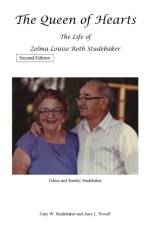
Zelma Studebaker was a writer, teacher and mother of eight children. She was a Christian woman who worked for peace and justice as a participant in humanitarian service projects. In August of 1963 she participated in our nation's historic March on Washington for Jobs and Freedom. Her son, Ted Studebaker, was an agriculturalist with Vietnam Christian Service and is a celebrated, nonviolent peace martyr. After Zelma and Stanley raised their children on an Ohio farm, she then went on to earn her university degree at the age of 61. She taught elementary students in the public school system for 19 years. Shortly thereafter she and Stanley celebrated 65 years of marriage.Zelma Studebaker was a compassionate and driven woman who saw the power of written correspondence through letter writing, poems and short stories. She impacted numerous lives far and wide through her writing and simply being open and available for shared dialogue. Zelma's life influenced and prompted her children to express thankfulness and support in letter writing as well as biographies and other projects that connect people and celebrate family life and humanity.Gary W. Studebaker is a son of Zelma and Stanley Studebaker. He was a volunteer agriculturalist in Laos and a special education teacher. He is a writer of family biographies and other publications. Gary and his wife Susan are the parents of a daughter.Amy L. Powell is a granddaughter of Zelma and Stanley Studebaker. She had a career in business and was an elementary school teacher. Amy and her husband John are the parents of three children.
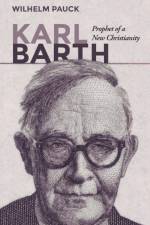
In the 1930s, Karl Barth was unquestionably the most discussed personality in the theological world of that time. This book was the first of its kind to be published in America, giving an adequate story of Barth's life, a complete outline of his teaching, and a careful estimate of the so-called ""Barthian Movement.""Dr. Pauck, of the Chicago Theological Seminary, was born and educated in Germany, and had studied under Barth. By training, personal relationship with Barth and his followers, and by a knowledge of practically everything that has been written by or about Barth, Dr. Pauck was preeminently fitted to write this book. Moreover, his American professorship allowed him to be more cognizant of the American mind, enabling him to explain Barth and his message to a puzzled, sometimes skeptical, American audience.The author pictures Barth in his early days as a minister of a Reformed Church in Geneva. Fresh from a seminary training in liberal theology, he finds that he is not assured of that authority with which he feels he has to speak of God to his people. He therefore attempts to retrieve the old Christian belief in a revelation of the divine. Opposing the orthodox dogma of supernaturalism as well as the modernist emphasis on the psychological approach to religion, he develops a theology of ""divine realism.""The challenging theology of Barthianism is presented historically, practically, and without prejudice. It not only confronts every minister, conservative or liberal, with the persistent question, ""What do I think about Barth?"" but also with the more personal question, ""What do I now do in light of Barth's prophetic message?""Wilhelm Pauck (1901-81) studied with Harnack and Troeltsch at the University of Berlin and became the first foreign student at the University of Chicago in 1925. He joined the faculty in 1926 and was made full professor of Church History in 1931. After twenty-seven years at the University of Chicago, he taught at Union Theological Seminary in New York. After retirement in 1967, he taught at Vanderbilt University and Stanford University. His books include From Luther to Tillich: The Reformers and Their Heirs and Paul Tillich: His Life and Thought, the latter of which was co-authored with his wife, Marion Pauck, who was former assistant editor of religious books at the Oxford University Press.
The culture of this country has become so far secularized that there is a danger that its Christian origin may be forgotten. This provocative series of lectures (the Edward Alleyn Lectures of 1944) indicates how the present crisis in our culture must be faced in the light of those origins in order that the continuity of the Christian tradition may be maintained. The lecturers are all authorities in their respective spheres: philosophy is dealt with by Professor H. A. Hodges and education by Christopher Dawson; Miss Dorothy L. Sayers contributes a lecture on Christian aesthetics; Maurice B. Reckitt, the editor of Christendom, discusses industrial problems; and the introductory and closing lectures are by Canon Demant, the editor.
""Al Staggs knows about words and puts them to fresh and suggestive use. He knows about brutality that shows its ugly face in too many places. And he knows about phoniness that supports evil by its default. With his words he conducts guerilla warfare, leaving us unsettled, seeing more clearly than we might wish, inviting us to decide anew. No easy slumbers here!""--Walter Brueggeman""Al Staggs writes his poetry with the passion of a prophet. Like Amos of old, he recognizes that divine worship is nothing but human justice being offered to God and that human justice is nothing but divine worship being acted out. His words call religious spokesperson and political leaders who lace their rhetoric with religious phrases alike to acknowledge both their idolatry and their hypocrisy. Read him and weep for what your country has become and for what Christianity is no more."" --John Shelby SpongAl Staggs holds a B.A. from Hardin-Simmons University, an M.R.E. from Southwest Baptist Theological Seminary, a Th.M. from Harvard Divinity School, and a Doctor of Ministry degree from Austin Presbyterian Theological Seminary. In the spring of 1983 he was honored as a Charles E. Merrill Fellow at Harvard with major emphasis in applied theology under the direction of Harvey Cox. After serving as a pastor for 24 years, Al became a full-time performing artist. His repertoire of seven programs includes characterizations of Dietrich Bonhoeffer, Clarence Jordan, and Oscar Romero. He has been writing and publishing poetry related to the themes of peace and justice throughout his careers as pastor and performer.
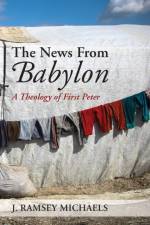
First published as Word Biblical Themes: 1 Peter (Word Publishing, 1989), this volume explores Peter's effort to build a sense of identity and responsibility among the Christians to whom he wrote, scattered through several Roman provinces in Asia Minor. Their past is a biblical past, he tells them, rooted in the history of the Jews as the people of God. Consequently, they are called to live as strangers in a strange land, never fully at home in Roman society. Their present journey is a journey in the footsteps of Jesus, in paths of servanthood, and undeserved suffering. Their future is the completion of this journey to heaven, wrapped in a hope of victory over death and the devil and issuing at last in ""joy unspeakable and full of glory"" when their Lord Jesus Christ is revealed. Because these distant Gentile Christians are not personally known to Peter in Rome (which he calls ""Babylon,"" reminding them that he is as much a stranger as they are), he deals in the great universals of Christian experience: faith, baptism, and doing good; love, suffering and the hope of salvation. These universals make 1 Peter a letter for twentieth (or twenty-first) century American Christians no less than for his first century readers. The concluding chapter, ""The Message of 1 Peter Today,"" begins to explore certain parallels between Peter's readers in the Roman Empire and Christians in America, where we, no less than they in the provinces and Peter himself in ""Babylon"" are not fully at home either. This is even more the case now than it was in 1989 when the book first appeared, so that we need to listen ever more closely to ""The News from Babylon"" that 1 Peter sent so long ago. To this end a postscript has been added, addressing candidly the difficulties of being Christian in America in a new millennium.J. Ramsey Michaels, now living in Portsmouth, New Hampshire, is Professor Emeritus of Religious Studies at Missouri State University in Springfield. He is the author of a major commentary on First Peter in the Word Biblical Commentary series (1988) and a much shorter one in the one-volume Mercer Commentary on the Bible (1994). He has also written commentaries on Revelation, on Hebrews, and most notably the Gospel of John in the New International Commentary on the New Testament (2010). In a different vein, he recently published Passing by the Dragon: The Biblical Tales of Flannery O'Connor (Wipf & Stock, 2013), marking a crossover into American literary criticism.
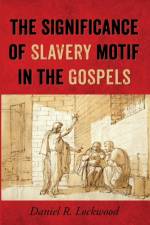
In the New Testament, figures drawn from common experience often communicate deep theological truth, depicting the vital relationship of the believer to Jesus Christ. However, there is one figure used throughout Scripture to describe the relationship of peoples to their Lord which for the most part is either minimized or ignored: the figure of master and slave. -From the Introduction Daniel R. Lockwood was president of Multnomah Bible College and Biblical Seminary. Under his guidance, the University blossomed into an accredited institution bursting with new programs, new buildings, and new teaching sites beyond its Portland campus.
In this remarkable book about religion and politics today, Commonweal writer Michael Gallagher asks the question, How does one adhere to an essentially simple faith in a complex society that lacks moral leadership not only in its government, but also in its religious institutions? Laws of Heaven answers by exploring the lives of twelve extraordinary men and women whose controversial beliefs have led them to challenge their church and government as well as to frequently place their lives on the line. Here you will meet some of contemporary America's bravest and most unusual citizens: Marietta Jaegar, whose young daughter was brutally murdered by a serial killer, and who has become a dedicated anti-death penalty and peace activist; Charlie Liteky, who, relinquishing the Medal of Honor and the pension that accompanies it, fasted regularly in order to protest U.S. support of the Contras in Nicaragua; Elizabeth McAlister, who, like her husband, Philip Berrigan, repeatedly took part in acts of civil disobedience to protest American reliance on nuclear weapons; William P. Ford, a Wall Street attorney whose life was turned upside down when his sister was killed in El Salvador. Laws of Heaven is a challenging and provocative contribution to our understanding of the world in which we live. The lives of its twelve subjects force us to confront our own values and to ask how far we would be willing to go for what we believe in. EXTRAORDINARY PRAISE FOR LAWS OF HEAVEN""Michael Gallagher is the rare writer who can write about saintliness without sounding sanctimonious, about religion without losing the interest of the nonbeliever, about humanity in the deepest sense as one who practices it."" --John Simon""Michael Gallagher's Laws of Heaven is a compassionate look at men and women who are willing to accept martyrdom for their beliefs. Its effect is to make the reader examine with diligence his own beliefs in these last years of our twentieth century."" --Horton Foote""Being an atheist, I do not share the religious faith of these embodiments of the life force, but I greatly admire their witnessing--and I wish this book were in every school library in the country. Everybody is talking about the need for moral guidance in America. Well, here it is."" --Nat HentoffMichael Gallagher is a former Jesuit seminarian and an ex-paratrooper who spent many years working within the Catholic Church as the film critic for the U.S. Catholic Conference. He has written extensively about religion, literature, and film for such periodicals as Commonweal, Newsday, Sports Illustrated, The National Catholic Reporter, and the Cleveland Plain Dealer. He now teaches and works at John Carroll University in Cleveland, where he lives with his family.
Pastors of smaller membership churches have a huge calling. They are responsible for changing the world! Rather than look at the small number of members in their congregations as a limitation, pastors should view their congregations as an elite force, able to impact their communities for the Kingdom of God.Small Church, Excellent Ministry is a handbook designed for pastors serving in smaller membership churches. This book will help you to conduct your ministry with excellence. Written by practitioners and professors, the information provided in this book is on the vanguard of pastoral ministry and is useful for training pastors to be leaders of their churches.""In Small Church, Excellent Ministry, Jeffrey Farmer gathers a team of pastor-scholars who provide biblical and practical guidance for those who serve in smaller membership churches. The resultant book will be a blessing for those pastors and a much-needed resource for the church.""--Adam Harwood, Associate Professor, New Orleans Baptist Theological SeminaryJeffrey C. Farmer is the Associate Director of the Caskey Center for Church Excellence and Associate Professor of Evangelism and Church Ministry. A native of Atlanta, Georgia, he has served in different ministry positions in Georgia, North Carolina, Tennessee, and Louisiana.
Pastors of smaller membership churches have a huge calling. They are responsible for changing the world! Rather than look at the small number of members in their congregations as a limitation, pastors should view their congregations as an elite force, able to impact their communities for the Kingdom of God.Small Church, Excellent Ministry is a handbook designed for pastors serving in smaller membership churches. This book will help you to conduct your ministry with excellence. Written by practitioners and professors, the information provided in this book is on the vanguard of pastoral ministry and is useful for training pastors to be leaders of their churches.""In Small Church, Excellent Ministry, Jeffrey Farmer gathers a team of pastor-scholars who provide biblical and practical guidance for those who serve in smaller membership churches. The resultant book will be a blessing for those pastors and a much-needed resource for the church.""--Adam Harwood, Associate Professor, New Orleans Baptist Theological SeminaryJeffrey C. Farmer is the Associate Director of the Caskey Center for Church Excellence and Associate Professor of Evangelism and Church Ministry. A native of Atlanta, Georgia, he has served in different ministry positions in Georgia, North Carolina, Tennessee, and Louisiana.
For centuries the New Testament book of Hebrews has been interpreted as though it had been written for Jewish Christians in danger of lapsing back into legalism and religious ceremony. This view is now being challenged by current scholarship. Rather than attacking the Old Testament and Judaism, the author of Hebrews praises the person and work of Jesus through a series of comparisons on which he bases exhortations and warnings to the present people of God. Hebrews urges God''s people to learn from past mistakes and failures, and to take up the challenge in difficult times to live faithfully in the new relationship to God through Jesus, God''s Son.In The Second Chance for God''s People: Messages from Hebrews, Quaker pastor and professor Timothy W. Seid encourages today''s church to respond to the challenge of Hebrews: first individually by progressing in spiritual and moral maturity, and second collectively by being God''s faithful people in the world. In the light of ancient Greek language and rhetoric after having extensively researched Hebrews, Seid interprets the text of Hebrews section by section in an accessible and nontechnical way while also illustrating and applying the meaning of the text for the contemporary church.Honoring the attention the author of Hebrews gives to hearing and responding to the word of God speaking through prophets, a Son, and still through the Spirit, Timothy Seid offers an exposition of this early Christian sermon in perhaps the most appropriate form -- a series of sermons inviting contemporary hearers to attend to what the Spirit is saying. Combining the fruits of his doctoral work on the rhetorical comparisons in Hebrews and years of preaching experience, Seid offers a a collection that will inspire pastors in their own proclamation and disciples in their appropriation of this rich and challenging text.David A. deSilva, author of Perseverance in Gratitude: A Socio-Rhetorical Commentary on the Epistle ""To the Hebrews"" (2000) and An Introduction to the New Testament: Contexts, Methods and Ministry Formation (2004).""In The Second Chance for God''s People, Tim Seid . . . has worked his way through the book of Hebrews and the book of Hebrews has worked its way through him . . . He offers the fruit of critical analysis and commentary in terms . . . easily understood together with illustrations from popular culture and everyday life as well as practical applications."" Cynthia Long Westfall, author of Discourse Analysis of the Letter to the Hebrews""[This Hebrews] commentary combines explanation of the book''s details with a winsome style and generous use of rich illustrations. The modern church is in great need of Hebrews'' relevant messages, and Seid''s readable commentary should make those messages both accessible and . . . applicable.""George H. Guthrie, Union University, Jackson, Tennessee""Timothy Seid has combined the scholar''s insights with the pastor''s concern . . . The result is a . . . valuable resource for lay readers and church study groups. By . . . clarifying his exegetical insights with illustrations from movies, literature, and his own experience, he shows that Hebrews is a word that is ''living and active.''""James W. Thompson, author of The Beginnings of Christian Philosophy: The Epistle to the Hebrews Tim Seid is Associate Dean and Assistant Professor of New Testament Studies at Earlham School of Religion in Richmond, Indiana. He is also a pastoral minister at Salem Friends Meeting in Liberty, Indiana.
This book will deepen your regard for the church''s task of didache, the act of teaching Christians. The chapters explore what the writers believe are several key biblical texts and themes for teaching, select doctrines of the church that inform teaching as a ministry, and features of teaching in the Lutheran tradition and its current practice. We authors address these matters with deep commitment to our shared Lutheran tradition, yet also with profound respect for what the Holy Spirit has done across the centuries in other orthodox traditions of the Great Church. Welcome to our conversation, a conversation the church has shared--though not without dispute--for centuries (from Chapter 1). A team of seven authors bring together in this book insights and approaches to the task of all who teach in the service of the Christian church. The authors trace the calling to Christian teaching from its Biblical roots and explore real-life situations in the lives of teachers with wisdom and sensitivity. Drawing on Scripture and using the fundamental theological tools of the Lutheran tradition, these master teachers bring readers with them into the middle of the work and the joy of conveying the faith through teaching. The clearly written essays make the book accessible to all readers with anecdotes and analyses that clarify what it means to be a teacher in the Lord''s service. Although it is written out of the Lutheran experience of teaching, the book''s insights will aid all Christian teachers.Robert KolbMission Professor of Systematic TheologyDirector of the Institute for Mission StudiesConcordia SeminaryThis thoughtful biblically and theologically grounded book will be edifying to many readers. It locates the central challenge of Christian education not in technique or educational theory, as important as they might be, but in the spiritual and theological formation of the Christian teacher. At the same time, it pays serious attention to the worldly context in which Christian teaching must take place.Robert BenneDirector, Center for Religion and SocietyRoanoke CollegeA Teacher of the Church provides insights and revelations into Lutheran teaching ministry not found in any other resource. It poses questions and critiques of present practices, assesses the impact that societal pressures have on our concepts of ministry, and serves to connect our actions with a firm biblical understanding of the role of the teacher. It should serve to stimulate thought and discussion among teaching veterans, newcomers in teaching ministry, congregational education boards and pastoral leadership.Mark BlankeDCE Program DirectorAssociate Professor of EducationConcordia University-NebraskaRuss Moulds teaches psychology, education, and theology at Concordia University in Seward, Nebraska. Dr. Moulds is the op/ed editor for Issues in Christian Education and editor of the online site, www.theteachingministry.com.
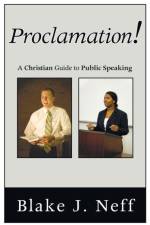
At long last here is a textbook for the basic public speaking course--one that integrates a Christian worldview with up-to-date scholarship in the field of communication. Proclamation! covers the standard speech types: informative speech, persuasive speech, and ceremonial speech. In addition, Blake J. Neff recognizes that Christians need to know how to deliver an edifying speech and a personal testimony speech. Neff acknowledges that one of the reasons to study public address at the university level is that God has commanded His people to ""always be prepared to give an account"" (1 Peter 3:15). Proclamation! prepares Christians to speak not only as one to many but also as members of interpersonal or small groups. Christian teachers of public speaking will appreciate the assistance this book offers toward integrating faith with learning. Students will applaud the practical and readable approaches found in Proclamation!Blake J. Neff is Visiting Professor of Communication at Indiana Wesleyan University and Pastor of the Van Buren United Methodist Church. He is the author of A Pastor''s Guide to Interpersonal Communication and coauthor, with Donald Ratcliff, of The Complete Handbook of Religious Education Volunteers. He and Ratcliff also edited Handbook of Family Religious Education. In addition, to preaching, Dr. Neff has taught public speaking for twenty years at a variety of Christian colleges and universities. He and his wife, Nancy, have three adult children. The couple currently resides in Van Buren, Indiana.
Beginning the Good NewsFrancis Moloney provides a narrative critical reading of Mark 1:1-13, Matthew 1-2, Luke 1-2, and John 1:1-18 to illustrate that the readings of the Gospels set up a tension in the reader who learns from the beginning, but still cannot rest satisfied. The Gospels' beginnings promise the reader the great prize of understanding--later.Francis J. Moloney was formerly Foundation Professor of Theology at Australian Catholic University and is Professor Emeritus of the Theology and Religious Studies Department at the Catholic University of America, Washington, D.C. He is also the author of 'Glory Not Dishonor: Reading John 13-21', 'Signs and Shadows: Reading John 5-12', 'Belief in the Word: Reading the Fourth Gospel; John 1-4', and 'A Life of Promise: Poverty, Chastity, Obedience'.
A book for those who know and love Merton...and those ready to discover his gift for speaking to the human spirit.Since his death in Bangkok, Thailand, on December 10, 1968, Thomas Merton's influence in both Christian and non-Christian spiritual traditions has grown unabated.'Meditations With Merton' is a collage of reflections, with Merton as your guide. Centered on selected passages from Merton's writings, Verploegen has written 30 brief meditations on themes such as personal integrity, sanctity, identity, integration, God, labor, solidarity and service, words of God, God's will, and love. Related Scripture passages and an original prayer complete each meditation.Merton was deeply concerned with the underriding spiritual yearning of every human heart....--Nicki VerploegenNicki Verploegen holds a doctorate in spirituality and has been giving retreats and spiritual direction for over twenty years. A Montana rancher's daughter, she has spent time in Japan, Indonesia, Tanzania, and Liberia exploring approaches to contemplative living. She is author of 'Planning and Implementing Retreats: A Parish Handbook' and 'Organic Spirituality: A Sixfold Path for Contemplative Living.' Currently, she resides at St. Joseph Dwelling Place in Vermont.
Liar . . . lies . . . the father of lies.Can you hear Satan's whispers? Which of his lies bind you?Robert Don Hughes writes,I know the voice within me well--I've heard it all my life. . . . It is sometimes patient-sounding, sometimes playful, sometimes naughty, sometimes devious, sometimes abusive--sometimes frightening. It seeks always to give me permission to do evil. It prompts me to harm myself in the name of fun. It taunts me, calling me names that hurt me names that have had power over me since my childhood, names that prompt me to lash out , to act in ways that I would really rather not. And it criticizes me--constantly--a never-ending stream of cynical, personally targeted satire that leaves me angry, defensive, and depressed. Oh, I know the voice well. I hear it daily. Do you?Satan did many things to block the writing of this book. He may be telling you that you don't need to read it. If you've heard Satan's whispers, you need this book learn of his lies and find the power to break the lies that bind you!Robert Don Hughes is professor of missions and evangelism at Clear Creek Baptist Bible College in Pineville, Kentucky. He is the author of fourteen books, as well as numerous articles and plays. Robert served as a missionary in Nigeria and Zambia and worked in close relationship with missions directors in the North East and for the North American Mission Board.
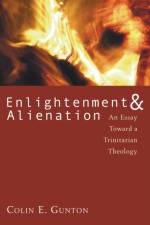
IN THIS CRITIQUE OF THE LEGACY OF THE Enlightenment for Christian theology, Colin Gunton focuses on the concepts of truth, freedom, and faith. He argues that in these areas the emphasis of Enlightenment thought on knowledge which is observable and objective has alienated us from understanding or believing in whatever cannot be seen or scientifically deduced, and cut us off from reality, form ourselves, and form God. But the trinitarian structure of Christian belief contains within itself the resources to overcome this alienation and achieve an integrated perspective. Gunton finds in the doctrine of the Trinity--especially in Jesus Christ, in whom the mysterious and divine joined the physical and observable--a way to give validity both to scientific frames of thought and to religious belief.Absorbing and illuminating. . . . [This book] deals in lucid fashion with the most fundamental issues which haunt us as human beings who are the heirs. . . of that movement which those who first participated in it called 'The Enlightenment'. . . . Colin Gunton gives us grounds for. . . the confidence that there can be enlightenment without the alienation and the skepticism which so easily tumbles into nihilism and despair. For this I am grateful.--Lesslie Newbigin from the forwardColin E. Gunton (1941-2003) was Professor of Christian doctrine at King's College London. He authored twelve books including 'The Christian Faith', 'Christ and Creation', and 'The Triune Creator'. He was also Associate Minister of the United Reformed Church at Brentwood in Essex for 28 years
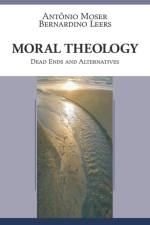
Moral TheologyThis book is a systematic treatment of moral theology from the perspective of liberation theology. It not only surveys the evolution of Catholic moral theology but lays the foundations for a Christian ethic in a world of injustice.In a courageous, balanced, readable way, Moser and Leers examine moral theology--past and present--and explore liberation theology's central ethical principles. They show how moral theology led to dead ends, first by the scholastic morality, and then by the renewed morality of contemporary western Europe. The first, they argued, failed through concentration on the individual as the main subject.To move forward, Moser and Leers propose moving social, political, and community factors to the forefront of moral concern. They find the foundations of this approach first in the covenant of the Old Testament, and in the classic and enduring theme of New Testament spirituality: the following of Christ. They ask, tellingly, how this commitment can be carried out today by asking what sort of society Christ envisaged, and how he faced the powers of his time.A hard-hitting critique form a third world perspective . . . . The authors rightfully challenge the reigning 'idolatries' of power, money, technology, pleasure, and superiority. Pressing beyond Marxism and capitalism, Moser and Leers offer a nuanced and inspiring alternative, shaped around biblically-derived principles of incarnation, praxis, and solidarity. They argue very effectively that although Jesus was no social reformer in the modern sense, his ministry has radical social implications.--Lisa Sowle Cahill, Boston CollegeA powerful attempt to do moral theology from a liberation theology perspective. Moser and Leers integrate the perspective of the poor, contemporary scriptural reflection, and traditional Catholic moral theology in a compelling systematic proposal for a renewed moral theology accessible to all, based on universal participation in, and responsibility for, both church and society, and responsive to the concrete sins besetting our world . . . . Moral Theology is both creatively fresh and in continuity with our moral tradition.--Christine Gudorf, author of Catholic Social Teaching on Liberation ThemesAntonio Moser, a native of Brazil, has lectured for fifteen years in the Franciscan Theological Institute in Petropolis, where he also works with base communities.Bernardino Leers, born in Holland, has worked in Brazil since 1953 where he has taught theology and been engaged in pastoral work among the rural poor.
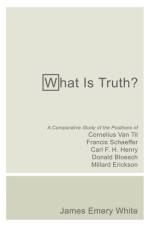
SEARCHING FOR ABSOLUTES IN A POSTMODERN WORLD. In this postmodern age, truth--especially religious or moral truth--is widely criticized and constantly challenged, yet perhaps more important than ever.It was this realization that led James Emery White to examine the concepts of truth as held by five twentieth -century theologians:- Cornelius Van Til - Millard J. Erickson- Francis A. Schaeffer - Donald G. Bloesch- Carl F. H. HenryWhite's study exhibits a comprehensive knowledge of these writers and their background. Its originality lies in the way that the five thinkers are brought together and subjected to minute inspection. As a secondary theme, White shows how their approaches to the question of truth relate to the question of the inspiration and authority of Scripture . . . I am delighted that this important study is now made available to a wider public. --from the Foreword by Colin Brown,Fuller Theological SeminaryJAMES EMERY WHITE is the president of Gordon-Conwell Theological Seminary, with campuses in South Hamilton (Massachusetts), Boston, Charlotte and Jacksonville. He holds M.Div. and Ph.D. degrees in theology, history and biblical studies. He is the author of twelve books, including Embracing the Mysterious God, Serious Times and The Prayer God Longs For.
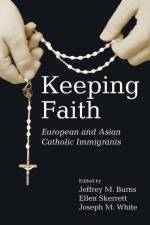
The Catholic Church in the United States has always been an immigrant church, from the earliest arrivals of the Spanish and English, to the influx of Irish, Germans, Italians, and other Europeans in the nineteenth century, to the most recent arrivals from the Philippines and Vietnam. Over two centuries countless laymen and laywomen worked with priests and religious to build and support churches and schools, laying the foundation for the Catholic Church in the United States. The wealth of original documents and photographs in Keeping Faith provides as no other source does a thorough and compelling portrait of these immigrants and their impact on the American Catholic institutions and American Catholic experience.A brilliant collection of primary sources. A goldmine of fascinating information for anyone interested in the history of Catholics in the U.S.--Jay P. Dolan, Professor of History, University of Notre DameSkillful selection and explanation of documents provide readers of Keeping Faith an opportunity to consider the words, review the experiences, and study the artistic expressions of immigrants who have been largely overlooked in American Catholic historiography. This view leads to appreciation for the diverse gifts that immigrants from Europe and Asia offer the church and gratitude to those responsible church leaders who support newcomers.-Dolores Liptak, RSM, Catholic Historical and Archival Consultant, West Hartford, ConnecticutJeffrey M. Burns is archivist at Chancery Archives, the Archdiocese of San Francisco, and is adjunct professor of history at four Bay area universities. Ellen Skerrett, editor of At the Crossroads, is an independent scholar specializing in the history of Irish Catholics in Chicago. Writer and historian Joseph M. White is author of The Diocesan Seminary in the United States and is working on the centennial history of the Holy Name Province of the Order of Friars Minor.
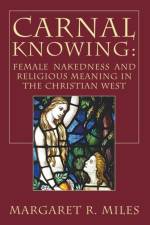
When we look at Michelangelo's David, we see a nakedness that expresses physical prowess, self-knowledge, and spiritual discipline. What do we see when we look at Hans Baldung's Eve, the Serpent, and Death or Master Francke's Martyrdom of Saint Barbara? Why should those naked female images symbolize wantonness and shame? How do ideas about nakedness formed at the dawn of Christianity continue to shape today's sexual values? What must women do to take their bodies back?This revolutionary study by Margaret R. Miles, formerly Bussey Professor of Historical Theology at the Harvard Divinity School and author of the acclaimed Images as Insight, sifts through centuries of Christian writing and religious ritual and, above all, Western art to reveal the origins of our attitudes toward women's bodies and their encoded meanings. Broad enough to encompass fourth-century descriptions of Christian baptism and contemporary theories of representation, Carnal Knowing is a brilliant, startling work of scholarship whose implications extend far beyond the academy to the way we live and see.This fascinating book is a searching analysis of the complex cultural meanings of naked male and female bodies in Christian art and literature and in contemporary society.- Emily Martin, author of The Woman in the BodyMargaret R. Miles was Bussey Professor of Historical Theology at the Harvard University Divinity School. She is the author of Augustine on the Body, Desire and Delight, Image as Insight, and Practicing Christianity.
Abonner på vårt nyhetsbrev og få rabatter og inspirasjon til din neste leseopplevelse.
Ved å abonnere godtar du vår personvernerklæring.