


Gjør som tusenvis av andre bokelskere
Abonner på vårt nyhetsbrev og få rabatter og inspirasjon til din neste leseopplevelse.
Ved å abonnere godtar du vår personvernerklæring.Du kan når som helst melde deg av våre nyhetsbrev.

AIDS. Famine. Ethnic strife. Refugees. Poverty. Debt. Environmental degradation. These form the wounded face of Africa today, the reality confronting the church of Africa. To heal Africa, Spiritan Father Elochukwu Uzukwu argues that the church in Africa must become a credible and effective agent of change by making full use of African resources--natural and sociohistorical--including traditional patterns of social organization. In order to renew itself, the church must remember that it does not exist for itself but for the people--to bear witness in Africa to the risen Lord.Focusing on the Catholic Church in Africa today, A Listening Church proposes a fresh approach to ecclesiology. Following closely on the African Synod of Bishops, Uzukwu proposes the initiation of serious theological discussion on the structure of the Church in Africa that came out of that historic occasion. Simply speaking, the African churches must listen to their people, and the Church in Rome must listen to the churches in Africa.Exciting, very well-written, unpretentious, balanced, creative, and constructive. There is a great deal of wisdom and insight in this book.--Anthony J. Gittins, C.S.Sp.Bishop Francis X. Ford, M. M., Professor of Catholic Missiology, Catholic Theological UnionUzukwu's book comes at just the right moment with just the right approach . . . His challenge to be a 'listening church with large ears' takes the search for the meaning of 'church as family' out of the realm of speculation into the real world of pastoral concern.--Peter J. Henriot, S.J.Directory, Jesuit Centre for Theological Reflection, Lusaka, ZambiaA Listening Church is a creative response to a major theme of the African Synod--The Church as the Family of God.--Aylward Shorter, M.Afr.author of Cross and Flag in Africa: The White Fathers during the Colonial Scramble (1892-1914) (2006)Elochukwu E. Uzukwu is a spiritan priest, liturgist and ecclesiologist, serves as rector and lecturer at the Spiritan International School in Enugu, Nigeria, and is a visiting lecturer at the Catholic Institute of West Africa and the Institute Catholique de Paris. His books include Liturgy: Truly African, Truly Christian and Worship as Body Language: An African Orientation.
With this book I bring to a close the studies begun in The 'Dignity of Man.' Since the present work is a thematic and chronological extension of, if not precisely a sequel to, its predecessor, a common title might have served for both; however, here my subject is the deterioration, or at least the radical mutation, of the idea whose development I earlier tried to trace. More specifically, I am here concerned with the traditional and the emerging concepts of 'truth'--theological, scientific, political, and other--whose collision generated such heat and even such light in the age of Milton. I have tried to describe, at least in broad terms, the meshing of those inherited and newly formulated values which in my judgment gives the period its peculiar poignancy and relevance for the modern world. Between the birth and death of Milton English thought underwent a transformation whose consequences we perhaps do not fully understand even now. Yet in attempting to seek out the origins of this transformation in the early Renaissance and to sketch its progress through the earlier seventeenth century I have sought to indicate the intellectual and emotional pressures which shaped men's conception of 'truth' and of their capacity to attain it, and to suggest some of the consequences for literature. --from the PrefaceHerschel C. Baker (b. 1914) taught at Harvard University. Among his publications are 'The Dignity of Man: Studies in the Persistence of an Idea' and 'The Race of Time: Three Lectures on Renaissance Historiography.'
The tragedy of modern Christian education, the author believes, is that it has been influenced as much by secular philosophies as it has by the gospel. To have a solid basis for an educational program, the church must build upon its own faith--this is the main thrust of her thought.Clearly and concisely, Henderlite lifts up for study some elements of Protestant theology which have been neglected in Christian education. As she examines these beliefs she indicates the effects that would be felt in the church if they were more strongly emphasized.Using the Reformation phrase, justification by faith, as the organizing principle behind her work, the author considers four basic theological problems: the nature of faith, human nature, Christian ehtics, and the meaning of history.Rachel Henderlite was author of many widely-used study books--Exploring the Old Testament, Exploring the New Testament, A Call to Faith, and Paul, Christian and World Traveler.
Each of us will come to at least one crossroads in our lives where decisions must be made that will impact both our past and our future. If we come to that point as wounded and broken-hearted victims of abuse, the hope of a brighter day may be unmet. Joyce Carlin, teacher, counselor, and survivor provides the answers that can heal and strengthen Christian women who may be struggling with feelings of inadequacy and a lack of self worth. This book is an essential tool for emotional healing that contains a gentle and uplifting message confirming who you are in the eyes of an adoring and faithful Father.
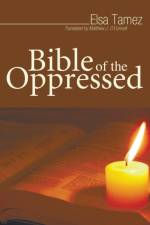
On its surface the book of Ecclesiastes appears to offer a type of wisdom that bears little reference to social or historical issues. But from her own perspective in Central America, Elsa Tamez finds in this ancient book a surprisingly current message. Ecclesiastes reflects a time when utopian hopes have been crushed, when the prospects for change seem remote, and the challenge is how to live faithfully in the present while maintaining some openness to a different future. Because that describes the situation of many people today, especially in the third world, the book of Ecclesiastes bears a message of unusual relevance.Just when we thought that there was 'nothing new under the sun' in Qoheleth studies, Elsa Tamez offers a rereading that speaks hopefully to our present situation. By affirming the joy of life in eating, drinking, and solidarity with a loved one, and by reorienting the world to God's time which has a season for everything, Qoheleth challenges those in his Ptolemaic times who would deny the dignity of life or be paralyzed by its frustrating reality. Like Qoheleth, Tamez's interpretation helps us to 'feel our humanity' and live real life day-to-day with intensity. A must read for every pastor.--Denise Dombkowski Hopkins, Wesley Theological SeminaryElsa Tamez is the author of 'Through Her Eyes' (Wipf & Stock reprint, 2006), 'Bible of the Oppressed' (Wipf & Stock reprint, 2006), 'The Amnesty of Grace' (Wipf & Stock reprint, 2002), and coeditor of 'The Discourse of Human Dignity' (2003).
In ''Being and the Messiah'', Jose Miranda brings his incisive (and controversial) scholarship to the study of The Gospel of St. John.I found ''Being and the Messiah'' exciting reading, and, like ''Marx and the Bible'', full of original, provocative, and highly controversial theses, brilliantly argued. Miranda is a master of polemics, and whether he takes on the whole history of Christendom or the entire establishment of biblical scholars, his wit is always equal to his outrage. Perhaps only an outsider could come to the Bible so fresh. Those who refuse to face this fox reveal themselves rabbits.--Walter WinkProfessor of Biblical InterpretationAuburn Theological SeminaryIn ''Marx and the Bible'', Jose Miranda served notice that he would raise questions and think thoughts that the scholarly world characteristically refuses to raise and is incapable of thinking. Now in ''Being and the Messiah'' he has advanced his program of combining radical social criticism and radical hermeneutical exploration in a way which requires a quite fresh hearing of the Gospel. . . . . . . Miranda will not be pigeonholed by the academy. It is to be strongly hoped that he is taken seriously, for there is in his writing the kind of discernment which may reform and renew Scripture study.--Walter BrueggemannProfessor EmeritusColumbia Theological SeminaryJose P. Miranda is also the author of ''Communism in the Bible'' and ''Racionalidad y Democracia''.
This volume is 'Epworth League Method' revised, rewritten, enlarged, brought down to date. . . . The purpse of the book is not to offer exhaustive discussion of the League's many-sided life. It is meant to be, mainly, suggestive and provocative of independent work. It leaves much to the initiative of the resourceful young people of the Epworth League. Also it is a guide to the sources of ten times as much practical aid as is given within its limited compass. --from the IntroductionDan B. Brummitt (1883-1939) was a Methodist author whose other works include 'John Wesley, Jr.,' 'The Missionary Epworthian,' and 'The Epworth League's History, and Our Pledge.'
The Year's Work in Medievalism: 2004 is based upon but not restricted to the 2004 proceedings of the annual International Conference on Medievalism, organized by the Director of Conferences for Studies in Medievalism, Gwendolyn Morgan, and, for 2004, Christa Canitz of the University of New Brunswick, Fredericton. The essays of the current volume center on the question of individual responsibility in humanizing one's society through the use of medievalism.- Gwendolyn A. Morgan, ""Medievalism and Individual Responsibility""- Karl Fugelso, ""Defining Medievalism in Nineteenth-Century Commedia Illustrations""- Renee Ward, ""Remus Lupin and Community: The Werewolf Tradition in J.K. Rowling's Harry Potter Series.- Nancy M. Thompson, Architectural Restoriation and Stained Glass in 19th-Century Siena: The Place of Light in Giuseppe Partini's Purismo- Barbara Gribling, Nationalism and the Image of the Black Prince- Clare A. Simmons, Small-Scale Humor in the British Medieval Revival- Brian C. Johnsrud, ""The Monsters Do Not Depart"": Re-Unifying Norse, Anglo-Saxon, and Christian in Tolkien's Lord of the Rings- Jaimie Hensley, J.R.R. Tolkien and Walther von der Volgelweide: Faerie and Reality- Peter G. Christensen, From Waste Land to Grail and Back Again Naomi Mitchison's To the Chapel PerilousThe editor of this volume and General Editor of The Year's Work in Medievalism series, Gwendolyn A. Morgan, is Professor of British Literature and Languages at Montana State University-Bozeman.
The meaning of the Greek word 'baptizein' has been so obscured, by the denominational controversies which have sprung up within the last two centuries, that nothing less than a complete historical exhibition of its use, both in pagan and Christian Greek literature, would suffice to place the matter in a clear light. --from the PrefaceT. J. Conant (1802-1891) is also the author of 'Greek Text of the Apocalypse,' a book of Hebrew grammar exercises, and commentaries on Mark and Luke. His career included teaching appointments at Waterville College, Hamilton Theological Institute, and Rochester Theological Seminary.
With the exception of Dr. Montgomery in his Commentary in the International Critical Commentary Series, all my forerunners in the study of Daniel have been handicapped in many respects owing to the lack of an Aramaic grammar which dealt with the historical development of the language. . . . Accordingly a large section of the Introduction is devoted to the grammatical development of Aramaic idioms, so far as these have any bearing on the Aramaic of our text. . . . Again I may remark that though many of the greatest Semitic scholars have edited Daniel, not one of them seems to have had a first hand knowldge of the characteristics of Apocalyptic outside Daniel. . . . In publishing this Commentary my chief claim is, so far as possible, to recover the oldest form of the text, and to interpret that text in conformity with the usages of Jewish Apocalyptic. --from the PrefaceR.H. Charles (1855-1931) was Professor of Biblical Greek at Trinity College, Dublin (1898-1906). He was elected a fellow of the British Academy in 1906, and a fellow of Merton College, Oxford, in 1910. He was also Archdeacon of Westminster. In 1925 he was the first recipient of the British Academy Medal for Biblical Studies. Charles also received honorary degrees from the Universities of Belfast in 1923 and Oxford in 1928. His publications include: ''The Book of Enoch,'' ''The Book of Jubilees,'' ''The Testaments of the Twelve Patriarchs,'' and ''The Apocrypha and Pseudepigrapha of the Old Testament in English'' (2 vols.).
This useful work represents the substance of a course of lectures delivered by the author, as Regius Professor of Divinity at Cambridge, in the Lent and Easter terms of 1825. The second edition makes use of the insights from August Neander's work Antignosticus Geist des Tertullians (The Anti-Gnostic Spirit of Tertullian) and discusses that work at length in the Preface.Contents 1. On Tertullian and His Writings 2. On the External History of the Church 3. On the State of Letters and Philosophy 4. On the Government of the Church 5. On the Doctrine of the Church 6. On the Ceremonies Used in the Church 7. Concerning the Heresies and Divisions Which Troubled the ChurchJohn Kaye (1783-1853) was Bishop of Bristol and Regius Professor of Divinity at the University of Cambridge. Among his publications are: The First Apology of Justin Martyr, Some Account of the Writings and Opinions of Clement of Alexandria, and Some Account of the Council of Nicea.
The Greeks are justly called an artistic people, and the Greek language is the most ancient work of art which they have reared upon a very primitive basis. The student, who approaches the Greek after he has already gone through a considerable preparation by the study of Latin, ought to be impressed with the idea that the structure of this language is one of the most marvelous productions of the intellectual powers acting unconsciously. . . . The attempt, therefore, to connect in a still higher degree the practice of the school with the spirit of science, can here point to numerous precedents; and it is, no doubt, mainly owing to this circumstance that it has met with so favorable a reception. My object has been to produce a consistent system, a careful selection, and a clear and precise exposition, rather than an entirely new system. --from the PrefaceGeorg Curtius (1820-1885) was Professor of Classics at Leipzig University. Among his numerous publications, two others were translated into English: ''Principles of Greek Etymology'' and ''The Greek Verb: Its Structure and Development.''
[T]he primary object in these investigations has been to determine the force and application in Biblical Hebrew of the words discussed and to indicate as precisely as possible in English the ideas ordinarily associated with these terms in the minds of the Scripture writers . . . . --from the PrefaceJames Kennedy is the author of 'An Introduction to Biblical Hebrew' and 'The Book of Daniel from the Christian Standpoint.' He also translated works on Hebrew linguistics and the Old Testament from German and Dutch.
It is infinitely better to commence a study of the prophets with what they themselves have written rather than with the meagre narratives and scattered legends of their deeds and words. In their own writings they have most distinctly and trustworthily laid bare their spirit. Whoever desires to know in their inmost hearts these heroes of divine truth and to admire their genuine greatness, should learn first to understand their words and actions as they themselves have recorded them. It is here that they approach us most closely and confidingly, inviting us most irresistibly to make ourselves acquainted with them. --from the IntroductionOne of the greatest biblical scholars of the nineteenth century, Ewald was a man of amazing learning and deeply held religious and political beliefs, and a formidable opponent of all who disagreed with him. --John W. RogersonGeorg Heinrich von Ewald (1803-1875) was Professor of Old Testament and then Oriental languages at the University of Gottingen. After protesting the repeal of the constitution by King Ernst August, Ewald was dismissed. After visiting England, he was appointed Professor of Philosophy and then Theology at the University of Tubingen before being invited back to Gottingen. He was subsequently removed from his position again when he refused to sign an oath of allegiance to the Prussian king. He published grammatical works on Hebrew, Arabic, and Sanskrit, as well as commentaries and exegetical studies on both Old and New Testament books and biblical theology.
It is infinitely better to commence a study of the prophets with what they themselves have written rather than with the meagre narratives and scattered legends of their deeds and words. In their own writings they have most distinctly and trustworthily laid bare their spirit. Whoever desires to know in their inmost hearts these heroes of divine truth and to admire their genuine greatness, should learn first to understand their words and actions as they themselves have recorded them. It is here that they approach us most closely and confidingly, inviting us most irresistibly to make ourselves acquainted with them. --from the IntroductionOne of the greatest biblical scholars of the nineteenth century, Ewald was a man of amazing learning and deeply held religious and political beliefs, and a formidable opponent of all who disagreed with him. --John W. RogersonGeorg Heinrich von Ewald (1803-1875) was Professor of Old Testament and then Oriental languages at the University of Gottingen. After protesting the repeal of the constitution by King Ernst August, Ewald was dismissed. After visiting England, he was appointed Professor of Philosophy and then Theology at the University of Tubingen before being invited back to Gottingen. He was subsequently removed from his position again when he refused to sign an oath of allegiance to the Prussian king. He published grammatical works on Hebrew, Arabic, and Sanskrit, as well as commentaries and exegetical studies on both Old and New Testament books and biblical theology.
It is infinitely better to commence a study of the prophets with what they themselves have written rather than with the meagre narratives and scattered legends of their deeds and words. In their own writings they have most distinctly and trustworthily laid bare their spirit. Whoever desires to know in their inmost hearts these heroes of divine truth and to admire their genuine greatness, should learn first to understand their words and actions as they themselves have recorded them. It is here that they approach us most closely and confidingly, inviting us most irresistibly to make ourselves acquainted with them. --from the IntroductionOne of the greatest biblical scholars of the nineteenth century, Ewald was a man of amazing learning and deeply held religious and political beliefs, and a formidable opponent of all who disagreed with him. --John W. RogersonGeorg Heinrich von Ewald (1803-1875) was Professor of Old Testament and then Oriental languages at the University of Gottingen. After protesting the repeal of the constitution by King Ernst August, Ewald was dismissed. After visiting England, he was appointed Professor of Philosophy and then Theology at the University of Tubingen before being invited back to Gottingen. He was subsequently removed from his position again when he refused to sign an oath of allegiance to the Prussian king. He published grammatical works on Hebrew, Arabic, and Sanskrit, as well as commentaries and exegetical studies on both Old and New Testament books and biblical theology.
It is infinitely better to commence a study of the prophets with what they themselves have written rather than with the meagre narratives and scattered legends of their deeds and words. In their own writings they have most distinctly and trustworthily laid bare their spirit. Whoever desires to know in their inmost hearts these heroes of divine truth and to admire their genuine greatness, should learn first to understand their words and actions as they themselves have recorded them. It is here that they approach us most closely and confidingly, inviting us most irresistibly to make ourselves acquainted with them. --from the IntroductionOne of the greatest biblical scholars of the nineteenth century, Ewald was a man of amazing learning and deeply held religious and political beliefs, and a formidable opponent of all who disagreed with him. --John W. RogersonGeorg Heinrich von Ewald (1803-1875) was Professor of Old Testament and then Oriental languages at the University of Gottingen. After protesting the repeal of the constitution by King Ernst August, Ewald was dismissed. After visiting England, he was appointed Professor of Philosophy and then Theology at the University of Tubingen before being invited back to Gottingen. He was subsequently removed from his position again when he refused to sign an oath of allegiance to the Prussian king. He published grammatical works on Hebrew, Arabic, and Sanskrit, as well as commentaries and exegetical studies on both Old and New Testament books and biblical theology.
Rufus M. Jones (1863-1948) was a Quaker historian, theologian, and Professor of Philosophy at Haverford College. He was a prolific writer, including such works as ''A Dynamic Faith,'' ''Studies in Mystical Religion,'' ''Spiritual Reformers of the 16th and 17th Centuries.''
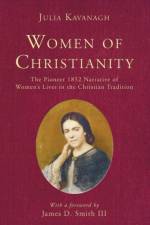
In early 1852, Irish novelist and women of letters Julia Kavanagh (1824-1877) produced her Women of Christianity, Exemplary for Acts of Piety and Charity. It was the first volume of its kind attempting to tell the story of women remarkable for character, intellect, and excellence, who had flourished under the fostering influence of the Christian faith from New Testament to her own. Though subsequent developments in critical historography and feminist theory have transformed the disciplines of women's studies and Church history in recent generations, Kavanagh's pioneer work deserves long overdue attention in both fields. With skill and conviction offering a narrative of women's lives across the ages, she finds her own rightful place within that Christian Tradition.Some of the lives featured in Women of Christianity: - Vibia Peupeta, early North African Christian Martyr - Macrina the Elder, brider of family and monastic community - Teresa of Avila, Carmelite nun and author of The Interior Castle - Elizabeth Fry, English Quaker and pioneer of prison reformJulia Kavanagh has much in common with many women writers today. Although not considered a 'political writer' she was astutely aware of the double standards of her time. Her work bears testimony to the many anomalies and contradictions concerning women's subjectivity and as such she draws on the very core of sexual politics . . . she is concerned with women's experience and works they produced in a world which, for the most part, saw women as adjunctival to male experience. I would argue, nevertheless, that because she is writing about women who previously had each been seen only in relation to more 'historically illustrious men' Kavanagh offers a significant contribution to women's history. - Eileen Fauset, from the Irish Journal of Feminist Studies We can commend Miss Kavanagh for the general ease, propriety and care with which her task has been executed . . . The amount of generous and wholesome effort thus disclosed is sufficient, in variety of scope and in success, to silence the most cynical of misogynists -- unless he be henceforward prepared to accept the imputation of being unjust as well as cynical.Henry Fothergill Chorley, The Athenaeum No. 1265 (January 24, 1852), 104-105.James D. Smith III is Associate Professor of Church History of Bethel Seminary, San Diego, California; a lecturer in Theology & Religious Studies at the University of San Diego; and serves on the pastoral staff of College Avenue Baptist Church. He is on the editorial board of Christian History & Biography magazine.
Though we are not now to worship God in those methods, or by such ordinances as once the old church did; yet to know their methods, and to understand the nature and signification of their ordinances, when compared with the gospel; may even now, when themselves (as to what they once enjoined on others) are dead, minister light to us. And hence the New Testament ministers, as the apostles, made use of Old Testament language, and ceremonial institutions as to their signification, to help the faith of the godly in their preaching of the gospel of Christ. --from the PrefaceJohn Bunyan (1628-1688) was an English minister and the author of Pilgrim's Progress, The Holy War, and Grace Abounding.
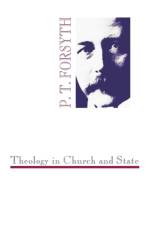
The conviction of this book is twofold. First that the idea of the Church and its supernatural life by a new creation is decaying in several of the Churches that have been most critical about its relation to the State; whereas it is only a high and distinctive idea of the Church that gives us any right or principle regarding that relation. And, second, that a true Church is inseparable from a belief in certain doctrines for which men are ready to die--is, indeed, impossible without such belief; and the decay in the Church idea (as distinct from that of a mere association, sympathetic or religious), is due chiefly to the decay of doctrinal interest and conviction. No theology, no Church. --from the PrefacePeter Taylor Forsyth (1848-1921) preached and pastored for twenty-five years before becoming Principal of Hackney College in London where he taught systematic theology and preaching. Forsyth converted from theological liberalism to classical Christianity in the mid-1880s. The theological transition was, in his own words, from a lover of love to an object of grace. A theologian of the cross, Forsyth is well-known for his publications 'The Work of Christ,' 'Cruciality of the Cross,' and 'The Person and Place of Jesus Christ.'
Paul has poured twelve years of student ministry experience into ""Blueprint of a Student Ministry"". He has been favored to be a part of growing and influential student ministries. His ministry has grown spiritually solid and transformed students to become leaders of the local church. The passionate purpose of this book is to equip future leaders with a blueprint of how to do everyday student ministry effectively. ""Blueprint of a Student Ministry"" is a collection of basic principles and practical applications to student ministry. Every student pastor or minister loves students. Every youth worker wants to make a difference and be a part of the process of life change. So what is the difference between wanting it and making it happen? Practical application of biblically true principles; and that is what ""Blueprint of a Student Ministry"" provides. This book is for anyone considering youth work or desiring to get a better handle on the practical side of everyday student ministry.Paul Hudson is Executive Pastor of Second Baptist Church, Conway, Arkansas.
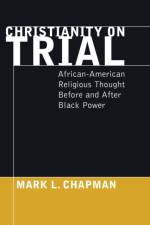
Since slavery times African-American religious thinkers have struggled to answer this question: Is Christianity a source of liberation or a source of oppression? In a study that reviews representative thinkers over the last fifty years, Mark Chapman reviews the variety of ways that African-Americans have addressed this problem and how it has informed their work and lives.Beginning with Benjamin Mays, the leading Negro theologian of the post-World War II period, Chapman explores the critical implications of this question right up to the present day. The pivotal turning point in this period is the emergence of the Black Power movement in the 1960s. Sparked in part by the challenge of the Black Muslims, for whom Christianity was simply the white man''s religion, inherently racist and oppressive, the era of Black Power saw the rise of militant Black theologies as well. After analyzing the work of the Muslim Elijah Muhammad, Chapman turns to the pioneering work of Black theologians Albert Cleage and James H. Cone.Chapman demonstrates the differences but also uncovers surprising lines of continuity between the older Negro theologians and the later Black theologians, particularly in their efforts to uncover the truly liberative potential of Christianity.''Christianity on Trial'' concludes by exploring the recent emergence of womanist theology. As articulated by Delores S. Williams and other African-American women, womanist theology challenges not only the patriarchal aspects of historical Christianity, but the same limitations in previous Black theologies.A welcome addition to the literature on African-American religious thought. I strongly recommend it.-- James H. Cone, Union Theological SeminaryA much-needed and enlightening book! Chapman is not afraid to expose weaknesses and oppressive elements in Christianity. In the process, however, he shows how African American religious thinkers, early and late, have been its most prophetic and productive critics in their continuous search for the God who liberates both women and men.-- Gayraud S. Wilmore, author of ''Black Religion and Black Radicalism''This is a thorough and insightful analysis of the ways in which African-American Christians have ''tested'' their faith. More importantly, it is an affirmation of that faith under the most trying of circumstances.-- James H. Evans, Jr., Colgate Rochester Divinity SchoolMark L. Chapman is Associate Professor of African and African American Studies and Chair of the Department at Fordham University.
Why haven''t we North American biblical scholars done such a systematic study of the words for oppression in the Bible? If the answer is that we who possess the critical skills are not ourselves oppressed or identified with communities of the oppressed, then it becomes imperative that we listen all the more carefully to these voices from the South.-- Walter Wink, Professor Emeritus of Biblical Interpretation, Auburn Theological Seminary, New YorkThis book is a welcome addition to a growing body of evidence that the Bible is a book about social justice for the oppressed of the land and that this indeed is the good news.-- Marie Augusta Neal, SND de Namur, author of A Socio-Theology of Letting GoElsa Tamez''s book attracts our attention, not only for wrestling with a major biblical theme but also for keeping us in continuous contact with the text of the Bible.-- Carroll Stuhlmueller, CP, general editor of The Collegeville Pastoral Dictionary of Biblical TheologyA careful and creative interdisciplinary study in biblical theology, Old Testament, and social ethics. Elsa Tamez''s work has contributed to the church in Latin America and is now available as a readable, important resource for the English-speaking church.-- Jane Cary Peck and Carole Fontaine, Andover Newton Theological SchoolWriting from a perspective of those oppressed by poverty and sexism, Elsa Tamez has brought us a wealth of analysis of the biblical understanding of oppression.-- Letty M. Russell, Professor Emeritus, Yale Divinity SchoolElsa Tamez is the author of ''Through Her Eyes'' (Wipf & Stock reprint, 2006), ''Jesus and Courageous Women'' (2001), and coeditor of ''The Discourse of Human Dignity'' (2003).
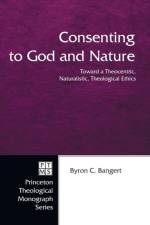
Bangert shows how the work of three major contemporary Protestant thinkers, James M. Gustafson, Sallie McFague, and David Ray Griffin, may be fruitfully appropriated for the articulation of an ethics that is responsive to the Christian tradition while sharing the modern commitment''s appeal to human experience and reason. Each of these three thinkers eschews a priori appeal to the authority of religious tradition, as each takes seriously scientific knowledge of our world. Each accents ways in which current scientific understandings inform, and in some cases are informed by, contemporary appropriations of the language and thought of Christian tradition. Each is also concerned to relate his or her approach to human valuing, life, and action. A critical appraisal of their work shows that none provides a sufficient basis for an intellectually and religiously adequate theological ethics, but that each contributes elements necessary to the articulation of such an ethics within the Protestant Christian tradition as it confronts the religious and intellectual challenges of today''s world.Bangert has done a remarkable job in bringing three important constructive proposals for contemporary theology into respectful dialogue with one another. In addition to presenting the positions of Gustafson, Griffin, and McFague fairly and sympathetically, he makes a convincing case that their respective contributions can only be strengthened and enriched through critical engagement with one another. This book has many virtues to commend it, not least of which are the clarity of analysis and the simple elegance of its prose style. It is a model of rigorous, yet irenic, theological argumentation.Paul E. Capetzauthor of God: A Brief HistoryByron C. Bangert is Research Associate at the Poynter Center for the Study of Ethics and American Institutions at Indiana University, Bloomington. He is also an ordained minister in the Presbyterian Church (U.S.A.), with over 25 years'' experience as a parish minister. His Ph.D. in religious studies is from Indiana University.
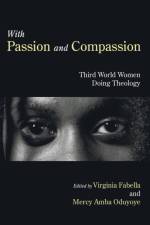
An outstanding collection of original essays, most published here for the first time, With Passion and Compassion provides the outlines of the common struggle of Third World women to forge their own, liberative theology. Protestant and Catholic, these women from Asia, Africa, and Latin America explore the question of what it means to be a Christian, and a woman, in the Third World.The contributors to With Passion and Compassion address traditional theological topics: christology, spirituality, the Bible. But they do so from the perspective that comes out of a struggle to overcome social and economic oppression. Their reflections constitute a powerful statement of faith as well as a challenge to existing structures and thinking, political and patriarchal.The publication of With Passion and Compassion is cause for celebration. The strong voices of Third World Christian women must be heard, loudly and clearly, by First World white feminists and by any who are serious about human liberation in our time.--Beverly W. HarrisonUnion Theological SeminaryA vivid testimony to the 'irruption within the irruption' of Third World feminist theology, arising from within the liberation theologies of Asia, Africa, and Latin America. Only with the voicing of the Third World woman's perspective does it become possible to know what it really means to make a preferential option for the poor. For the poor Third World woman is the poorest of the world's poor.--Rosemary Radford RuetherProfessor EmeritaPacific School of ReligionThroughout the world women have begun to redefine religion and spirituality in light of their everyday experience. Written from Third World Christian women's perspectives these essays are a very significant contribution toward a global feminist theology of liberation--must reading for anyone engaged in church and theology.--Elisabeth Schussler FiorenzaKrister Stendahl Professor of DivinityHarvard Divinity SchoolThis collective work by women from Asia, Africa, and Latin America is a prophetic voice that untangles the webs of multi-layered oppressions and offers a vision of a new human community. Their methodology and context represents a powerful challenge to traditional theologies.--James H. ConeBriggs Distinguished ProfessorUnion Theological SeminaryVirginia Fabella, a Maryknoll sister from the Philippines, is editor of Asia's Struggle for Full Humanity and coeditor of Asian Spirituality.Mercy Amba Oduyoye, a Ghanaian, is the coeditor of One Gospel, Many Cultures (2003) and author of Introducing African Women's Theology.
Purchase of this book includes free trial access to www.million-books.com where you can read more than a million books for free. This is an OCR edition with typos. Excerpt from book: AIDS TO REFLECTION. INTRODUCTORY APHORISMS. APHORISM I. In philosophy equally as in poetry, it is the highest and most useful prerogative of genius to produce the strongest impressions of novelty, while it rescues admitted truths from the neglect caused by the very circumstance of their universal admission. Extremes meet. Truths, of all others the most awful and interesting, are too often considered as so true, that they lose all the power of truth, and lie bed-ridden in the dormitory of the soul, side by side with the most despised and exploded errors. APHORISM II. There is one sure way of giving freshness and importance to the most common-place maxims?that of reflecting on them in direct reference to our own state and conduct, to our own past and future being. APHOEISM III. To restore a common-place truth to its firstuncommon lustre, you need only translate it into action. But to do this, you must have reflected on its truth. APHORISM IV. LEIGHTON AND COLERIDGE. It is the advice of the wise man, Dwell at home, or, with yourself; and though there are very few that do this, yet it is surprising that the greatest part of mankind cannot be prevailed upon, at least to visit themselves sometimes; hut, according to the saying of the wise Solomon, The eyes of the fool are in the ends of the earth. A reflecting mind, says an ancient writer, is the spring and source of every good thing. Omnis boni principium intellectus cogitabundus. It is at once the disgrace and the misery of men, that they live without forethought. Suppose yourself fronting, a mirror. Now what the objects behind you are to their images at the same apparent distance before you, such is reflection to fore-thought. As a man without fore-thought scarcely deserves the name of a man, so f...
Abonner på vårt nyhetsbrev og få rabatter og inspirasjon til din neste leseopplevelse.
Ved å abonnere godtar du vår personvernerklæring.