


Gjør som tusenvis av andre bokelskere
Abonner på vårt nyhetsbrev og få rabatter og inspirasjon til din neste leseopplevelse.
Ved å abonnere godtar du vår personvernerklæring.Du kan når som helst melde deg av våre nyhetsbrev.

This recent edition of Christian Ethics Volume I is a thoroughly revised and updated version of fundamental moral theology. As in the previous editions, the author makes himself an interpreter of the demands of Vatican Council II and its request that moral theology be rooted more fully in Holy Scripture. At the same time account is taken of the new developments in the field of ethics. New issues of actual concern are taken up, such as the deontological and teleological conditions of moral norms, the confrontation between conscience and civil or ecclesiastical law, the communal roots of Christian identity, the requirement of liberty and the ethical compromise. The book addresses itself to all who are interested in the moral teaching of the Christian faith and endeavors to be a helpful instrument to this end.
The aim of the book is to reexamine Baptist theology and practice in the light of the contemporary biblical, theological, ecumenical and missiological context, drawing on historical and contemporary writings and issues. It is not a study in denominationalism but rather seeks to revision historical insights from the believers' church tradition for the sake of Baptists and other Christians in the context of the modernpostmodern context.
Why Teenagers Matter in the Life of the Church""Mark Cannister has given his career to cultivating space for love and commitment between budding youth workers and youth ministry, between academic discourse and the field of youth ministry, and between the young people themselves and the church. This book is the manifestation of those many years of deepening skill and passion. On every page you''ll see a wise teacher, devoted parent, and ferocious advocate for the young.""--ANDREW ROOT, Luther Seminary""Many have sounded the alarm regarding the damage done by parents who choose to spend their time selfishly focusing on pursuits that have come to matter more than raising their children. But is it possible that in our congregations we''ve been selfish as well, isolating teenagers in age-segregated ministries without also integrating them in the full life of the church? Mark Cannister makes it clear that teenagers can, do, and must matter in the life of the church. Pastors, youth workers, parents, and church members who read Teenagers Matter will be challenged to rethink and restructure youth ministry in ways that reflect biblical priorities and promote significant spiritual growth."" --WALT MUELLER, Center for Parent/Youth Understanding""This book gives youth leaders well-conceived, user-friendly counsel for moving beyond ministry that is ''good enough.'' I''m always on the lookout for books that combines biblical faithfulness and theological reflection with in-the-trenches relevance, and Teenagers Matter is just such a book. It''s thorough, thoughtful, challenging, and practical."" --DUFFY ROBBINS, Eastern University""Reading this book was a profound and unexpected pleasure. Mark Cannister effortlessly connects the dots on behalf of comprehensive youth ministry. At last, here is a book that articulates why and how God''s people can step up into a faithfulness that will make a difference for every kid in our communities.""--DAVE RAHN, senior vice president, Youth for Christ/USA; director, Huntington University''s MA in Youth Ministry LeadershipMark Cannister serves as professor and chair of the department of biblical studies and Christian ministries at Gordon College. He has served as president of the Society of Professors in Christian Education, senior editor of the Journal of Youth Ministry, and is the executive administrator of the Association of Youth Ministry Educators. Mark has also served in a variety of leadership capacities at Grace Chapel in Lexington, Massachusetts.
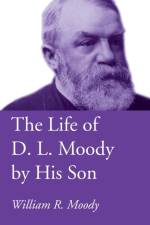
""The preparation of my Father''s biography has been undertaken as a sacred trust. Early in the spring of 1894 he was asked by an old friend for permission to issue a biography with his approval. This my Father declined to do, and, on that occasion, expressed the wish that I should assume the task when his life-work was ended. In reply to my objection that such an undertaking demanded a literary experience that I did not possess, he said: ''I don''t care anything about that. What I want is that you should correct inaccuracies and misstatements that it would be difficult to straighten out during my life. You are the one to do this. All my friends will unite on you and give you their assistance. There are many who think they know me better than any one else, and would feel themselves best able to interpret my life. IF you do not do this work there will be many inaccurate and conflicting ''Lives.''""--From the IntroductionWilliam R. Moody (1900-1985) was bishop of the Episcopal Diocese of Lexington from 1945 to 1970.
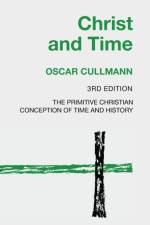
""The object of the present work is to determine what is central in the Christian proclamation. We are tempted to represent as the ''kernel'' or ''essence'' of this proclamation that which appeals to us personally, and to consider as external and dispensable ''framework'' that which is strange to us. It is due to the richness of the Christian message that the question as to the central element from which all the other features are to be explained arises at all, and the endeavor to determine this central element must be designated the one great task of New Testament scholarship, and perhaps of all Christian theology.""--From the ForewordDr. Oscar Cullmann (1902-1999) was born in Strasbourg--then in Germany--where he studied classical philology and theology. From then on, he held a variety of teaching positions involving history and theology. He is best known for his extensive work in the ecumenical movement and can be partially credited for establishing a dialogue between the Lutheran and Roman Catholic traditions.
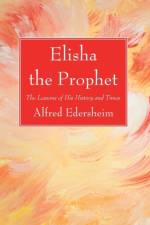
""This book, which now appears in a revised form, does not lay claim to be either a Critical or a Historical Commentary, but is intended to follow the Scriptural account of the Life and Work of the Prophet Elisha with the view of pointing out their moral, and learning their lessons, as applicable to all times, and especially to our own. This will explain the absence of exegetical notes, and of all discussion of the points which have been raised, more particularly in connection with this portion of the Old Testament.""--From the PrefaceAlfred Edersheim (1825-1889) was a Jewish convert to Christianity and a biblical scholar known especially for his book The Life and Times of Jesus the Messiah (1883).
Leadership is a subject that has gained impressive visibility in the past two decades. The number of books, monographs and articles, as well as seminars, devoted to the development of one''s leadership skills has been almost exponential growth.This study is an attempt to forge a full-orbed theology of Christian leadership grounded in the teaching of Scripture. What emerges from tracing the theme of leadership through the biblical record is a servanthood pattern, one that is wholly distinct from prevailing secular models. Our exposition begins with the biblical language of the servant, the term of choice for those great leaders used of God to further his saving purposes in the world. Eleven Old Testament and five New Testament leaders are profiled. The portrait of Jesus Christ focuses on three motifs that governed his training of the twelve for kingdom ministry. The Pauline letters are mined for those convictions that governed Paul''s practice of leadership, both of his mission team and of the faith communities that emerged from that mission. The treatment of each leader, from Joseph to Paul, begins with a series of preliminary questions and concludes with a mini-profile that correlates the biblical data with these questions. The final chapter offers a summary profile of the servant leader, one whose character, motives and agenda align with the divine purposes.Though designed as a textbook for upper level college and seminary courses on leadership, the book''s readable format is ideal for churches and parachurch organizations in their leadership training programs. The author''s prayer is that this work will serve as a catalyst to call God''s people back to Scripture and thereby raise up a whole new generation of authentic servant-leaders.Don N. Howell Jr. has taught New Testament in the Seminary and School of Missions of Columbia International University in Columbia, South Carolina since 1995. Before that, Don and his wife, Melissa, served fifteen years with OMF International in church planting and theological education in Japan. Howell''s earlier book, Servants of the Servant: A Biblical Theology of Leadership (Wipf & Stock, 2003) traces the theme of servant leadership through the biblical record. Dr. Howell has taught in many cross-cultural settings, including East Asia, Eastern and Western Europe, China, and Micronesia.
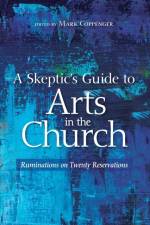
Evangelical discourse on the role of arts in the church can be radioactive, and the twenty-one contributors to this book walk right into the ""hot zone"" to pick up on twenty contentious questions. The volume is a series of written dialogues, each one keyed to a cranky question, one that a skeptic might raise (hence the title). Herein, the gainsayers are taken seriously and given their voice. They even find support in some of the contributors' comments. But apologists for greater use of arts and artists in the church have their say, and things can get edgy. Topics range from the biblically august (the Second Commandment; the regulative principle; Great Commission priorities) to the prudential (expense; ""bohemian"" influence; weaker brothers) to the programmatic (Christmas festivities; committee makeup). Some of the parties to the discussion are church staffers (pastors and ministers of music); some are professors; several are doctoral students; one is a college student; another, a gallery owner; yet another, a denominational ethicist; and there's a Canadian and a Korean in the mix. The collection of speakers and opinions is illuminating and bracing, and the fruit of their thinking makes for great reading and discussion.""Bring together a select group of faith-based, post-graduate, arts-worship practitioners and mentors. Let the agenda be framed by questions about theology, culture, artistic practice, and the worshipping church and let this group fire away at them freely and frankly. You'll soon realize that you are not going to get a neatly packaged set of one-time, all-time answers, and that Christ-centered artistic practice is less a closed, artsy formulation than a vigorous exercise in skilled discernment, experiment, and steady growth. Read it and grow with them.""--Harold Best, Dean Emeritus, Wheaton College Conservatory of Music""This book deals with the objections to the use of art in the church by actually talking them through, with twenty-two pastors, artists, and laypeople joining in. All sides are taken seriously, and a consensus emerges about how churches can use the arts for effective ministry and God's glory. The stimulating conversations demonstrate why classic thinkers believed that dialogue--thrashing out issues by talking about them--is the best way of coming to understanding.""--Gene Edward Veith, Professor Emeritus, Patrick Henry CollegeMark Coppenger is Professor of Christian Philosophy and Ethics at Southern Baptist Theological Seminary in Louisville. He is the author of Moral Apologetics (2011).
Beginning with the desires of our hearts and ending with the priesthood of all believers, this series of meditations traces a path through some central concerns of the Reformation. Along this path, the authors, all faculty at Wycliffe College, engage with biblical passages which were important at that time and remain just as vital today in working out what it means to be a Christian, what it means to be the people of God. It seems appropriate, given the central place Scripture had for the reformers, that we should follow their lead in looking to the Bible in the context of the life of the church. While some church communities enthusiastically proclaim their Reformation roots, others look askance at particular reformers and seek to distance themselves from the whole of the Reformation. Yet the Reformation is not an era we in the West can simply ignore; it is bred in our bones, runs through our veins, and shapes our life together in myriad ways. These meditations are not simply historical explorations or an exercise in documenting past events. Rather, the authors grapple with questions which we continue to struggle with today--questions of faith and grace, sin and salvation, work and worship. These meditations will provoke discussion and broaden our theological understanding while guiding us into a deeper understanding of the faith.""This anthology of sermons draws us into the heart of the Reformation. The reader can hear the voices of the Wycliffe Faculty as they eloquently and elegantly address the salient thoughts of the Reformers. Ranging from diverse themes, such as the Law/Gospel dichotomy, idolatry, grace, the priesthood of believers, the primacy of Scripture, and the absence of God, they bring the Word itself nearer to us all. A faithful compendium and an engaging read.""--Andrew Stirling, Senior Minister, Timothy Eaton Memorial Church, Toronto""The Word Is Near You brings the Protestant Reformation's unique emphasis on Scripture out of history's archives and close to home. By rediscovering the Reformation with all its strengths and weaknesses, we who are its children will better understand ourselves and what God is saying now. This fresh, insightful, multifaceted read will assist us in listening with greater discernment to God's voice and in speaking God's word with increased clarity in the church and society today.""--Paul Louis Metzger, Professor of Theology & Culture, Multnomah University & SeminaryPeter M.B. Robinson is the Professor of Proclamation, Worship, and Ministry at Wycliffe College.
Evangelical discourse on the role of arts in the church can be radioactive, and the twenty-one contributors to this book walk right into the ""hot zone"" to pick up on twenty contentious questions. The volume is a series of written dialogues, each one keyed to a cranky question, one that a skeptic might raise (hence the title). Herein, the gainsayers are taken seriously and given their voice. They even find support in some of the contributors' comments. But apologists for greater use of arts and artists in the church have their say, and things can get edgy. Topics range from the biblically august (the Second Commandment; the regulative principle; Great Commission priorities) to the prudential (expense; ""bohemian"" influence; weaker brothers) to the programmatic (Christmas festivities; committee makeup). Some of the parties to the discussion are church staffers (pastors and ministers of music); some are professors; several are doctoral students; one is a college student; another, a gallery owner; yet another, a denominational ethicist; and there's a Canadian and a Korean in the mix. The collection of speakers and opinions is illuminating and bracing, and the fruit of their thinking makes for great reading and discussion.""Bring together a select group of faith-based, post-graduate, arts-worship practitioners and mentors. Let the agenda be framed by questions about theology, culture, artistic practice, and the worshipping church and let this group fire away at them freely and frankly. You'll soon realize that you are not going to get a neatly packaged set of one-time, all-time answers, and that Christ-centered artistic practice is less a closed, artsy formulation than a vigorous exercise in skilled discernment, experiment, and steady growth. Read it and grow with them.""--Harold Best, Dean Emeritus, Wheaton College Conservatory of Music""This book deals with the objections to the use of art in the church by actually talking them through, with twenty-two pastors, artists, and laypeople joining in. All sides are taken seriously, and a consensus emerges about how churches can use the arts for effective ministry and God's glory. The stimulating conversations demonstrate why classic thinkers believed that dialogue--thrashing out issues by talking about them--is the best way of coming to understanding.""--Gene Edward Veith, Professor Emeritus, Patrick Henry CollegeMark Coppenger is Professor of Christian Philosophy and Ethics at Southern Baptist Theological Seminary in Louisville. He is the author of Moral Apologetics (2011).
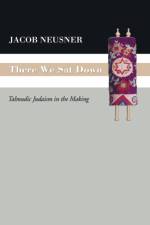
Orthodox Judaism as it has been known through the medieval and modern world covers the period from approximately 100 B.C.E to 640 C.E. It was during this period that the Babylonian Talmud came to prominence through the efforts of the Babylonian rabbinic schools. The Talmud continues to govern the life of traditional Jewry, orthodox and conservative, throughout the world and to provide important guidance for reform Jews as well. Because of the Talmud''s continuing influence, an understanding of this period is crucial to any understanding of present-day Judaism. Dr. Neusner centers his study on three key words applied to rabbinic Judaism: power - the way in which one man caused another to do his will; myth - the stories people told and the beliefs they held to account for and justify the power-relationships they experienced; and function - how things worked. This important book deals with complex materials in a clear, nontechnical manner that will prove useful to those persons who are not familiar with Hebraic studies.Jacob Neusner is Research Professor of Religion and Theology at Bard College and Senior Fellow of the Institute of Advanced Theology at Bard. He has published more than 900 books and unnumbered articles, both scholarly and academic, popular and journalistic, and is the most published humanities scholar in the world. He has been awarded nine honorary degrees, including seven US and European honorary doctorates. He received his A.B. from Harvard College in 1953, his Ph.D. from Columbia University and Union Theological Seminary in 1961, and Rabbinical Ordination and the degree of Master of Hebrew Letters from the Jewish Theological Seminary of America in 1960.Neusner is editor of the ''Encyclopedia of Judaism'' (Brill, 1999. I-III) and its Supplements; Chair of the Editorial Board of ''The Review of Rabbinic Judaism,'' and Editor in Chief of ''The Brill Reference Library of Judaism'', both published by E. J. Brill, Leiden, The Netherlands. He is editor of ''Studies in Judaism'', University Press of America.Neusner resides with his wife in Rhinebeck, New York. They have a daughter, three sons and three daughters-in-law, six granddaughters and two grandsons.
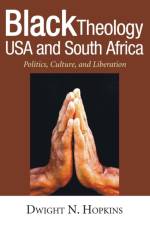
Black theology continually poses a challenge to Christian witness and faith. Through a critical analysis of leading religious thinkers, Dwight N. Hopkins explores the fundamental differences and similarities between black theology in the United States and black theology in South Africa and asks: What is the common denominator between the two? Part I examines the historical, political, cultural, and theological background of contemporary black theology in both countries. Hopkins delves into the distinctive situation of each country, focusing on civil rights, black power, and related political, cultural, and theological themes in the United States, and on civil disobedience, black consciousness, the unity of politics and culture, and political/cultural/theological themes in South Africa. Through interviews with leading black religious scholars, Part II explores these theologies in depth. Contrasting the cultural-theological trend with the political-theological trend in the USA, Hopkins explores the ideas of theologians Albert B. Cleage, James H. Cone, J. Deotis Roberts, William R. Jones, Gayraud S. Wilmore, Charles H. Long, Cecil W. Cone, and Vincent Harding. In Part III Hopkins examines the same two trends - cultural-theological and political-theological - in South Africa. Here the focus is on the impact of black consciousness and Soweto, and the works of Manas Buthelezi, Allan Boesak, Simon S. Maimela, Frank Chikane, Bonganjalo C. Goba, Itumeleng J. Mosala, Takatso A. Mofokeng, and Desmond M. Tutu. Part IV brings black theology USA and black theology South Africa into dialogue. Hopkins locates the common denominator between the tow theologies: that ""they both claim the Christian gospel as the gospel of liberation for black people struggling against racism and for a holistic humanity - physically and spiritually, politically and culturally."" He concludes by looking toward future areas of development and collaboration, arguing that an effective black theology of liberation must integrate politics and culture, insuring that the two are equal and complementary, ""two tributaries within the same current.""""Hopkins'' study is the only book which has dealt with both theologies independently and in relation to each other....It is a first-rate contribution to theology in general and to black theology in particular."" - James H. Cone""Dwight Hopkins carefully maps the terrain between North American and South African Black Theology. This detailed analysis of the cultural and political connections which ignited the explosion of Black theology in both countries is an indispensable guidebook for Black and White coalitions at home or abroad."" - Gayraud WilmoreDwight N. Hopkins teaches at the University of Chicago Divinity School, and is the author of Being Human: race, culture, and religion.
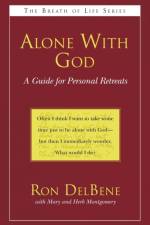
Many of us find it difficult to be alone with God because we are not sure what to do and have no idea what to expect...there is no reason to be afraid of drawing closer to the God who is love.Alone with God was written especially for people who have the desire to spend time alone with God and to be more attentive to God''s presence in their lives but do not have a practical sense of how to begin. Drawing on his background as a spiritual leader and retreat leader, Ron DelBene has a format for personal retreats that is flexible enough to be used in a two-hour block of time or expanded to as many as eight hours. He explains each part of the retreat format in detail, providing a thorough understanding of what is to take place and how best to put it into practice. Twelve retreats explore different themes, such as Seeking Forgiveness, Overcoming Anxiety, Called to Serve, Freedom - all designed to guide participants through their time alone with God.Ron DelBene has been doing spiritual direction and leading programs in the area of spirituality and pastoral care across the country since 1963. He holds a Master''s agree in Theology and a Doctor of Ministry degree in Spirituality and Organizational Systems. He is a poet, artist, author of books and videos and an Episcopal priest. With his wife, Dr. Eleanor McKenzie DelBene, he directs The Hermitage, a non-profit corporation devoted to providing spiritual growth and direction. Ron and Eleanor have two grown children, Paul and Anne. Paul and his spouse, Gayle, have a daughter, Matsue, and a son, Luca. Mary and Herb Montgomery are professional writers who make their home in a suburb of Minneapolis.
In the analysis of contemporary patterns of thought, which comprises Parts II and III of this book, I have had always in mind four main problems. First, the distinguishing of the principal types of attitudes toward the doctrine of the Trinity. Second, the theological ''interest'' or ''motivation'' of these attitudes. . . . Third, the relation of the various restatements to ''classical'' Christian views. . . . Fourth, the value and viability of the recent interpretations in terms of their relevance and meaning for contemprary religious problems and thought. My own constructive suggestions regarding the basis and significance of the trinitarian conception, and the systematic reformulation of the doctrine, are drawn together in Part IV. --from the PrefaceClaude Welch is Dean Emeritus and Professor of Historical Theology at the Graduate Theological Union, Berkeley. He is also the author of In ''Protestant Thought in the Nineteenth Century'' (2 vols.) and ''The Reality of the Church.''
Jacob Neusner is Research Professor of Religion and Theology at Bard College and Senior Fellow of the Institute of Advanced Theology at Bard. He has published more than 900 books and unnumbered articles, both scholarly and academic, popular and journalistic, and is the most published humanities scholar in the world. He has been awarded nine honorary degrees, including seven US and European honorary doctorates. He received his A.B. from Harvard College in 1953, his Ph.D. from Columbia University and Union Theological Seminary in 1961, and Rabbinical Ordination and the degree of Master of Hebrew Letters from the Jewish Theological Seminary of America in 1960.Neusner is editor of the ''Encyclopedia of Judaism'' (Brill, 1999. I-III) and its Supplements; Chair of the Editorial Board of ''The Review of Rabbinic Judaism,'' and Editor in Chief of ''The Brill Reference Library of Judaism'', both published by E. J. Brill, Leiden, The Netherlands. He is editor of ''Studies in Judaism'', University Press of America.Neusner resides with his wife in Rhinebeck, New York. They have a daughter, three sons and three daughters-in-law, six granddaughters and two grandsons.
Jacob Neusner is Research Professor of Religion and Theology at Bard College and Senior Fellow of the Institute of Advanced Theology at Bard. He has published more than 900 books and unnumbered articles, both scholarly and academic, popular and journalistic, and is the most published humanities scholar in the world. He has been awarded nine honorary degrees, including seven US and European honorary doctorates. He received his A.B. from Harvard College in 1953, his Ph.D. from Columbia University and Union Theological Seminary in 1961, and Rabbinical Ordination and the degree of Master of Hebrew Letters from the Jewish Theological Seminary of America in 1960.Neusner is editor of the ''Encyclopedia of Judaism'' (Brill, 1999. I-III) and its Supplements; Chair of the Editorial Board of ''The Review of Rabbinic Judaism,'' and Editor in Chief of ''The Brill Reference Library of Judaism'', both published by E. J. Brill, Leiden, The Netherlands. He is editor of ''Studies in Judaism'', University Press of America.Neusner resides with his wife in Rhinebeck, New York. They have a daughter, three sons and three daughters-in-law, six granddaughters and two grandsons.
Jack Elliott''s A Home for the Homeless is one of the most exciting works in biblical scholarship that I have read in recent years, and the best book on 1 Peter that I have ever read. In my mind he is certainly on the right track in detecting the life-situation addressed in this important epistle. It is consoling to find that amid the plethora of writings on the Bible really worthwhile discoveries can still be made. --Raymond E. Brown author of Recent Discoveries and the Biblical WorldAlready an acknowledged expert on 1 Peter, John Elliott here combines New Testament exegesis and a keen knowledge of the Hellenistic world with the emergent sociological analysis of the New Testament. Elliott has produced a fascinating statement on the broad social setting and religious meaning of an important but often overlooked piece of early Christian literature. It is clearly a significant methodological statement which has ramifications beyond a study of 1 Peter. --John R. Donahue, SJ author of The Gospel in ParableThe power of this book lies in its demonstration of how we move from philology and literary studies to history and sociological reconstruction. Elliott is the first to show that from the meanings of words and their theology we are able to draw insight in the social reality, therefore relevance, of an important religious text from Judeo-Christian antiquity. The book is a methodological model, but also a tour de force of intellect and imagination. --Jacob Neusnerauthor of Rabbinic Literature and the New TestamentAttempts to look through the New Testament texts into the lives of real human communities of the past received a significant boost with the first publication of A Home for the Homeless. Elliott''s work has had a central and provocative role in the debate that has grown and matured during the subsequent decade and which continues vigorously today: What are the appropriate ways of using methods of the social sciences to understand texts from antiquity? --Wayne A. Meeks author of The First Urban ChristiansJohn H. Elliott is Professor Emeritus of New Testament at the University of San Francisco. He is also the author of ''The Elect and the Holy,'' ''What Is Social-Scientific Criticism?,'' and ''1 Peter'' (Anchor Bible).
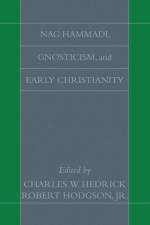
[This] book acquaints the beginner with the topic of gnosticism and early Christianity and presents to the specialist some of the new frontiers their colleagues are exploring. For the beginner there is a concise introduction to gnosticism. It covers the issues of origin, literature, leading ideas, and possible links with early Christianity. Each contributor has prepared a preface to his or her paper that points to its salient features and explains how the essay fits into the overall subject of the book. --from the PrefaceThis important collection of essays comprises the papers of the only major conference on gnosticism to focus exclusively on the relationship between gnosticism and the early church. This book has critical importance as a significant contribution to the pressing task of reconstructing an integrated, holistic, dynamic, socio-theological history of the early church free of anachronism and forced dichotomies. The fine introductory essay of Charles Hedrick makes the volume accessible to the non-specialist. . . . The book can be used both as a general introduction to the issues of gnosticism for the non-specialist and as a study volume for more advanced students and scholars. --David M. Scholer editor of ''Gnosticism in the Early Church''Charles W. Hedrick is Distinguished Professor Emeritus at Missouri State University. Among his many publications are The Apocalypse of Adam, Many Things in Parables: Jesus and His Modern Critics, and When History and Faith Collide: Studying Jesus. He is the co-editor of Gospel of the Savior: A New Ancient Gospel; Nag Hammadi, Gnosticism, and Early Christianity; and Ancient Fiction: The Matrix of Early Christian and Jewish Narrative.Robert Hodgson Jr. is Dean of the American Bible Society Nida Institute for Biblical Scholarship.
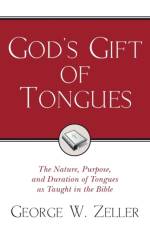
In considering this controversial theme, the author had a fivefold intent:To examine every passage in the New Testament dealing with the gift of tongues.To consider the significance of tongues in the Old Testament. The Apostle Paul indicated that God''s purpose for the gift of tongues could be discovered in the Law (1 Corinthians 14:21-22).To study the gift of tongues from a dispensational point of view, in light of God''s marvelous and yet distinctive programs for both Israel and the Church.To provide a definitive answer to the difficult question, When did tongues cease?To apply the rich truths of this study to the proper functioning and conduct of the local assembly of believers today.George Zeller has served on the staff of the Middletown (Connecticut) Bible Church for more than thirty years. His other books include The Eternal Sonship of Christ co-authored with Dr. Renald Showers. Zeller has written numerous Sunday School lessons, Bible study materials, doctrinal booklets and various papers on a wide range of Biblical topics. These studies are accessible at www.middletownbiblechurch.org.
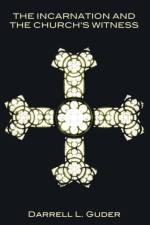
For several years, argues Guder, contemporary Christian churches have often thought of their mission efforts as simply one more program of the church. In addition, outsiders have rightly criticized Christian mission efforts as exercises in cultural imperialism.In this provocative book, Guder argues that the incarnation of God in Jesus provides the foundational model for the practice of Christian missions in the world today. The incarnation is the culmination of God''s activity and presence in the world, says Guder, for in this event God initiates the healing of a broken world.Using literary, historical, and social approaches to scripture, Guder claims the contemporary church should return to an ""incarnational mission"" in which the practice of Christian witness is ""shaped by the life, ministry, suffering, death, and resurrection of Jesus.""Darrell L. Guder is the Henry Winters Luce Professor of Missional and Ecumenical Theology at Princeton Theological Seminary and the author of ''Be My Witness: The Church''s Mission, Message, and Messengers''.
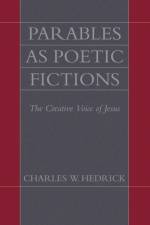
Jesus told parables. Gospel writers give them diverse readings. Modern exegetes give them even more diverse readings. Hedrick chronicles both diversities and then poses a new question. How would those parables, precisely as poetic but realistic stories, have sounded to Jesus'' first hearers ''in the context of Israel''s fictions about itself''? His book emphasizes original audience reaction, and its signal achievement is to have said something new, interesting, and provocative in the very crowded field of parables research. --John Dominic Crossan author of In Parables: The Challenge of the Historical JesusCharles Hedrick''s Parables as Poetic Fictions places the story character of Jesus'' parables at the center of attention. His innovative use of Aristotle''s poetics pioneers the place of sound in the structuring of the parables and provides a way of understanding how the story is organized. This book must be on the shelf of anyone interested in the parables. --Bernard Brandon Scott author of Hear Then the ParableThis is a provocative and insightful study of the parables, which treats them as fictitious stories and employs both literary and historical criticism in reading them. Plot and realism are emphasized, the relationship of the parables to the kingdom of God is marginalized, and the metaphorical or symbolic nature of the parables is played down. An important contribution. --Dan O. Via author of The Parables: Their Literary and Existential DimensionCharles W. Hedrick is Professor Emeritus at Southwest Missouri State University. Among his many publications are ''The Apocalypse of Adam,'' ''Many Things in Parables: Jesus and His Modern Critics,'' and ''When History and Faith Collide: Studying Jesus.'' He is the co-editor of ''Gospel of the Savior: A New Ancient Gospel,'' ''Nag Hammadi, Gnosticism, and Early Christianity,'' and ''Ancient Fiction: The Matrix of Early Christian and Jewish Narrative.''
Via uses the concept of self-deception as a vantage point for understanding something about Paul and Matthew. Employing an existential method in the broad sense, Via asks about the nature of a pervasive phenomenon of human existence with some attention given to psychological aspects. Nevertheless, this study is primarily exegetical and interpretive -- aimed at theological understanding -- rather than intensively methodological. Positing that self-deception is a deformation, Via undertakes to pay attention primarily to the subversion of the self and the recovery of wholeness. Additionally, attention is paid to self-deception as a social phenomenon and some consideration is given to its social causes and implications.Posing provocative questions to the New Testament, Dan O. Via asks how Paul and Matthew understand the near universal human experience of self-deception and shows how each of them, in a different way, proclaims the power of the gospel to break through illusion and bring personal integration to the believer-disciple. . . . Via''s strategy has two benefits for the preacher or interpreter: it formulates the biblical message in terms accessible to [contemporary] readers who might not otherwise be disposed to listen, and it offers a fresh approach to vexed questions about the theological coherence of the New Testament canon. . . . Via''s work out to stimulate lively conversation. --Richard B. Hays author of ''The Moral Vision of the New Testament''Via achieves his extraordinary penetration of these central Christian texts by first honing his analytic tool in the disciplines of philosophy, literary criticism, and psychology. This insightful development of existential interpretation takes New Testament theology and ethics in a promising new direction. --Robert Morgan, Oxford University author of ''Biblical Interpretation''A mature and incisive work dealing with a perennial concern and offering fresh perspectives not only on Paul but also on our own world as well. . . . I found the comparisons of Paul and Matthew both illuminating and insightful. --Calvin Roetzel, Macalester College author of ''Paul: The Man and the Myth''Professor Via proves himself again a valiant wrestler with the truth. . . . This work is subtle and penetrating. --W. D. Davies, Duke University author of ''The Setting of the Sermon on the Mount''Dan O. Via is Professor Emeritus at The Divinity School, Duke University. He is also author of ''The Parables,'' ''The Ethics of Mark''s Gospel,'' and ''What Is New Testament Theology?''
In seeking to develop a hermeneutic for doing ethics on a narrative base, Via here focuses on Mark''s ethics and suggests ways in which they interrelate with other significant motifs in the Gospel: eschatology, revelation, faith, and the messianic secret. Via maintains that the middle of Mark''s plot presents the paradoxical position of the disciple who is placed in the overlapping of the kingdom of God and the age of hardness of heart. Here is a bold attempt to integrate several agendas in interpretation--iterary criticism, biblical studies, constructive theological ethics--so as to draw out the implications of Mark''s narrative for faith and conduct in the real world.Dan O. Via is Professor Emeritus at The Divinity School, Duke University. He is also author of ''The Parables,'' ''Self-Deception and Wholeness in Paul and Matthew,'' and ''What Is New Testament Theology?''
This book is about the past and continuing debate over the causes of United States involvement in the Vietnam War. It brings together readings that best exemplify the widely varying answers that historians, political scientists, social scientists, policymakers, journalists, and novelists have given to the essential question of American involvement: why did the U.S. intervene diplomatically and militarily in Vietnam between 1945 and 1975?"" --from the PrefaceTo Reason Why breaks new ground in covering and analyzing this issue. Kimball has gathered together thirty-eight readings -- including speeches, interviews, and articles -- that best exemplify the conflicting ideas and theories about the U.S. intervention in Vietnam. Among these thirty-eight readings are excerpts from David Halberstam, Daniel Ellsberg, Frances FitzGerald, Henry Kissinger, Lyndon Johnson, and Richard Nixon.Jeffrey Kimball''s book, ''To Reason Why'', was the best reader available when it first appeared. It still is. Kimball''s volume contains a cross-section of documents and readings that bring to clear focus the defining moment of the second half of the twentieth century. The United States still has not come to grips with the Vietnam War, especially its lessons that suggest the limits of power and the dangers of militarism. I used the book two decades ago. It has not lost any of its power to force readers to consider, and reconsider, the origins and nature of the war, its conduct, and its legacies. Indeed, in light of American policy since 9/11, it is a source book for sanity in our dangerous world.""--Geoffrey Smith, Professor of History, Queen''s UniversityKimball''s judicious introduction and headnotes do not prejudice any particular thesis. The care that he has taken to give equal weight to cultural and social forces along with military and strategic factors produces an interpretation much more complex than the simplistic domino theory that persisted for so many years in U.S. government explanations of the war.""--David L. Anderson, in The Journal of Military HistoryThis book specifically addresses the issue of ''why'' the United States became involved, usually the first question students ask. Kimball''s interest in focusing attention on the wide-ranging debate over ''causes'' of the Vietnam War seems particularly appropriate at this time, considering the lack of such debate in popular political discourse.""--Emily S. Rosenberg, in Reviews in American HistoryJeffrey Kimball is a professor at Miami University of Ohio and has taught courses on diplomacy, peace, war, imperialism, popular culture, the United States, American presidents, and Western civilization since 1968. His books include Nixon''s Vietnam War (1998; winner of both the Ferrell Prize and the Ohio Academy of History Book Award) and The Vietnam War Files: Uncovering the Secret History of Nixon-Era Strategy (2004; winner of the Arthur S. Link/Warren F. Kuehl Prize). Kimball is also the author of numerous articles and book chapters on diplomacy, war, peace, and historiography, has served as President of the Peace History Society, and has been a Nobel Institute Senior Fellow and a Woodrow Wilson International Center Public Policy Scholar.
There is no deeper, more intense human longing than to know God is real and to see Him face to face.""In some circles, having a personal relationship with God"" is synonymous with being a Christian. We are told, in fact, that we ''must'' have such a relationship if we are truly God''s children. But if we are honest, says Tim Stafford, we must admit that often there is a considerable gap between our talk and our experience. We want to know God. The problem is that we don''t know how to know Him.How do we know God personally?"" After examining the traditional answers and finding their shortcomings for himself, Stafford began his own search for the means to knowing, personally, a personal God. ''Knowing the Face of God'' is the moving record of his quest.This book should be around for many years and should be read many times.""--Philip YanceyThis is the type of literature that the church desperately needs.""--R. C. SproulA fine blend of sound theology, personal insight, and lucid writing.""--Harold L. MyraTim Stafford is one of the brightest and freshest writers on the Christian scene.""--Charles W. Colson
Women''s Spirituality is an enlarged and revised edition of the widely used anthology that looks at the spiritual and psychological dimensions of women''s lives. Using classical and contemporary texts, the present volume illuminates the way feminist issues find grounding in great spiritual teachers such as Teresa of Avila, John of the Cross, Ignatius Loyola, and Jane de Chantal. Four sections develop the central theme. The first considers contemporary issues: women in ministry, different forms of feminist spirituality, and sexism in the church. The second provides contemporary resources for psychological development. The third gives examples of spiritual development in the biblical, Ignatian, Carmelite, and Salesian traditions. The final section considers new visions of women''s spirituality in the present day.Contributors to this volume include Anne Carr, Joann Wolski Conn, Kathleen Fischer, Constance FitzGerald, James Fowler, Carol Gilligan, Rosemary Haughton, Elizabeth A. Johnson, Robert Kegan, John McDargh, Jean Baker Miller, Sandra M. Schneiders, Elisabeth Schussler Fiorenza, Mary Jo Weaver, Rowan Williams, and Wendy M. Wright.Joann Wolski Conn, the editor, is Professor of Christian Spirituality in the graduate program in pastoral counseling and spiritual direction at Neumann College, Aston, Pennsylvania. She is the author of Spirituality and Personal Maturity and has written articles on the integration of spiritual and psychological development.
Abonner på vårt nyhetsbrev og få rabatter og inspirasjon til din neste leseopplevelse.
Ved å abonnere godtar du vår personvernerklæring.