
Gjør som tusenvis av andre bokelskere
Abonner på vårt nyhetsbrev og få rabatter og inspirasjon til din neste leseopplevelse.
Ved å abonnere godtar du vår personvernerklæring.Du kan når som helst melde deg av våre nyhetsbrev.

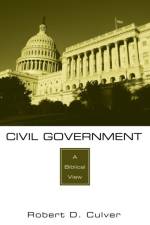
This book deserves careful attention. In it Culver faces up to a large cluster of important problematics which confront contemporary evangelical thinkers. It is basically a biblicaly study on the meaning of civil government. But the author also moves freely into the areas of historical and systematic theology as well as social and political theory . . . . he surveys in some depth and in an ordered sequence biblical teachings on the task of the state from the Genesis narratives through the successive epochs of biblical revelation to the New Testament epistles. In a sustained way he seeks to draw out some of the implications of these teachings for political life today . . . . In erudition this work may be ranked with the best in evangelical scholarship. -- Prof. Gordon Spykman Calvin College A carefully worked out, biblically conservative statement on politics and government; this is an excellent presentation . . . . the author lines up his evidence and support with admirable consistency. -- Christian Century In a lucid, well-organized fashion he traces out the Old and New Testament teaching on civil government and presents it as an aspect of God's creative and providential handiwork. -- Prof. Richard V. Pierard Indiana State University
Augustine's interpretation is spiritual--his were not scholarly or academic concerns--and John Leinenweber's translation is fresh and accessible, capturing the clarity, brilliance, and inspired passion of the original. John has said many things, stated Augustine, and almost all of them concern love. The first six of the ten homilies were delivered on the days of the Easter octave. This period proved too short for Augustine to cover the whole of the letter, and he preached four additional homilies later in the spring. In his Confessions, Augustine spoke of his great longing as a youth to love and be loved--a topic that appealed greatly to his listeners. During the course of delivering these homilies, he was interrupted time and again by applause and shouts of enthusiasm. The ten homilies are broken up into twenty-four short chapters, for example: The Commandment of Love, Two Loves (of God and of the World), Christ and Antichrists, Unanswered Prayer, God is Love, God Has Loved Us First, Love Casts Out Fear. His are in large part moral teachings, dealing with such topics as prayer, our enemies, fear of God, the church, the world (so important in Saint John's writings). What does one actually do to love God and others? What are the pitfalls of loving? How can one learn to love more? Throughout the homilies, Augustine's great desire to love and be loved and to live eternally with God are eloquently expressed. Believing himself ignorant of Scripture, he had initially considered himself ill-prepared for the priesthood. Augustine's subsequent tireless studies unleashed a stream of biblical commentaries that led him to be ranked with Thomas Aquinas as one of the greatest teachers the Western Church has ever produced, and one of its greatest Fathers. His towering intellect molded the thought of Western Christianity, and his ideas dominated the thinking of the Western world for a thousand years after his death. Augustine wrote profusely, explaining and defending the faith. Called Doctor of Grace, his best known works are his Confessions, one of the greatest spiritual classics of all time, and City of God, an exposition of a Christian philosophy of history.
This compelling question is central to a debate taking place among evangelicals today. Michael Horton, a preeminent voice for reformation in the church, has drawn together a group of leaders in the evangelical church to answer this question once and for all. - W. Robert Godfrey - Michael Horton - Alister McGrath - Kim Riddlebarger - Rick Ritchie - Rod Rosenbladt - Paul Schaefer - Robert Strimple These writers draw on Scripture, theology, and church history to address the Lordship salvation issue. They explain their positions clearly, taking care to avoid promulgating legalistic rules people need to follow to be considered Christian. But neither do they convey the feeling that rules no longer matter.
Philo of Alexandria, according to Cardinal Danielou, represents the first attempt to correct Greek philosophical thought with biblical revelation. Philo was a faithful Jew who studiously avoided syncretism with pagan religion: biblical worship could only be radically monotheistic. But Philo represents more than a spiritual master; he inaugurated Judeo-Christian philosophy itself. But even here, Philo avoided syncretism with Platonism and remained highly orthodox. Modifying Greek philosophy at the points where it conflicted with biblical revelation, Philo built the fundamentals of a Judeo-Christian way of looking at the world that would have a profound influence for centuries to come.
The present collection of essays, selected by a priest-teacher and laywoman-student at Loyola University, brings together wide-ranging, mind-opening, and absorbing studies on major aspects of biblical scholarship. The volume comprises four major sections. In the first, Free Scholarship in the Church, McKenzie emerges as an articulate spokesman for freedom of intellectual inquiry within the household of the faith. Part 2, Inspiration and Revelation, are lucid, intellectually exhilarating investigations into the meaning of God's word and the historical processes from which the Bible emerged. Part 3, Myth and the Old Testament, includes probing essays that bring the reader face to face with an important and difficult subject: the attitude of the biblical man to nature and to the mythologies of his pagan neighbors. The final section, Messianism, is devoted to a study of the hopes of Israel of old and their fulfillment in Jesus Christ, along with the use of messianic passages for apologetic purposes.
The beginnings of the Victorious Life Conference, which in the summer of 1918 grew into three gatherings in different parts of the country, may be placed in the years 1911 and 1912, when several young Christian workers in Philadelphia were led out into an experience in Christ which transformed their lives.
What do the New Testament writers actually teach about (1) the poor, (2) women, and (3) sexual minorities? Why do traditional commentaries and introductions so often ignore or treat superficially such burning questions churches grapple with today? Must we seek out specialized monographs to get adequate information and satisfactory answers in each area? At last, in a single volume Tom Hanks brings together the fruit of decades of study, examining each New Testament book in each of these three crucial areas, which often overlap in human experience (Latin American male liberation theologians often forget that the option for the poor may involve solidarity with a lesbian of color who wants to be ordained!). Building on his pioneering study on oppression and poverty in Biblical theology (Orbis 1984; Wipf 2000) and his Anchor Bible Dictionary article on Poverty in the New Testament (which the New York Times review commended for its balance), Hanks analyzes the teaching of each New Testament book regarding the main cause of poverty (oppression) and the variety of liberating Christian responses. Feminist and womanist studies are mined to highlight the presence/absence and role/leadership of women in each New Testament book. The remarkable absence of modern notions of family and family values in the New Testament books is emphasized, along with the prominence of sexual minorities as authors and subjects of the New Testament books. L. William Countryman comments regarding the poor, women and sexual minorities: Tom Hanks has brought these issues to the exegesis of the New Testament in a sustained and orderly fashion. He demonstrates beyond question that most of the New Testament authors were not interested in maintaining the household structures of the ancient Mediterranean and that, indeed, most of the individuals presented in the New Testament documents would not have seemed to be models of 'family values' either in their time or today....The works of Hanks and [Theodore W.] Jennings, with their detailed and careful argumentation, show that excellent work is being done in this vein. However surprising their conclusions may be to casual readers (or offensive to readers protecting what they conceive as orthodoxy), they are, in fact, deeply grounded in attentive scholarly work (Dirt, Greed & Sex, Minneapolis: Fortress, 2007, p. 251-252).
Twentieth century discussions of Edwards' covenant theology frequently named a tension in the purity of Edwards' Calvinism. Was his insistent teaching on the covenant of grace suggestive of incipient Arminianism, or was Perry Miller correct in asserting that Edwards rejected the covenant, with its abridging of God's freedom, by his categorical insistence on God's absolute sovereignty in salvation? Bogue explores the breadth of Edwards' writing, including many unpublished manuscripts, and interacts with a broad spectrum of secondary works to demonstrate conclusively that Calvinism and the covenant of grace are entirely consistent and do not exclude one another. The covenant of grace is not a device of man acting autonomously; it is a provision of the eternal, sovereign, electing God. As set forth by Edwards, it is simply the way the sovereign God has committed Himself to carry out what He has decreed from all eternity pertaining to the redemption of sinners.
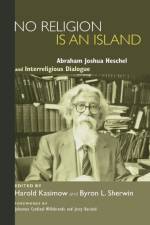
Rabbi Abraham Joshua Heschel remains one of the most important figures in American Jewish-Christian relations nearly twenty years after his death. He had a penetrating mind that was never arrogant and a moral passion that never moralized. Together, the thirteen essays of this book testify to his enduring legacy. Beginning with Rabbi Heschel's own No Religion Is An Island, these writings--by men and women who knew him, studied under him, and struggled with him, people from South Asian, Muslim, Jewish, and Christian traditions--reveal the humble yet soaring spirit of a person who know God transcended the barriers of nation, culture, religion, and historical enmity. As these essays demonstrate, Heschel was spiritual guide to people of many faiths. He won the admiration of men and women in many lands and traditions. Firmly rooted in his own Jewishness, he evoked the genius of other traditions, inspiring believers of all kinds to labor toward a more humane world. Contributors: the editors, Heschel's daughter Susannah, Jacob Y. Teshima, Daniel Berrigan, John C. Merkle, Eugene J. Fisher, John C. Bennett, Fredrick C. Holmgren, Riffat Hassan, Arvind Sharma, Antony Fernando, and Kenneth B. Smith.
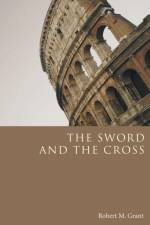
Throughout the early centuries of Christianity, the Roman government continually tried to suppress the new religion. Ultimately it failed, but only after a long period of struggle, misunderstanding, and persecution. Grant has placed this clash between government and Christianity in the context of the entire history of the policy of Roman rulers concerning religion. Tracing the government's attitude toward foreign religions from the early days of the republic on through the empire, Grant shows how Rome tried to preserve its religious and cultural traditions from all external influences. Thus, there was a long series of legal and judicial precedents for treating Christianity as subversive. The author analyzes these precedents and the particular teachings of Christianity which set the state against it. This is a scholarly study, but it is written with clarity and conciseness. Within its scope is a broad sweep of a dramatic period in religious history, a period which contains many fascinating parallels to the fight for freedom and human rights in the world today.
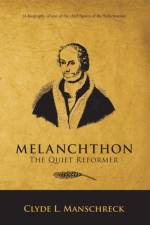
Philip Melanchthon was one of the most creative and effective thinkers of the Reformation, commonly ranked second only to Luther and Calvin by most historians. His contribution, however, was lost sight of in the controversy which plagued Lutheranism after Luther's death. He has often been treated as a replica of Luther, or as a mouthpiece for him; he was neither. In this landmark biography, Manschreck has explored the reformer's true stature and has demonstrated the enduring qualities of his contribution. To understand Melanchthon and to access his significance, wrote Manschreck, one must recognize the two historical movements which combined in him and which have never been reconciled in Protestantism -- the Renaissance and the Reformation....He cannot be explained in terms of either, for he transcends both. This is his greatness. This is his tragedy. As Melanchthon was the official representative of Protestantism at almost every colloquy in Germany from 1529 to 1560, influencing the very foundations of theology for all major Protestant denominations, we are indebted to Manschreck's effort to restore this reformer to his proper place in the historical record.
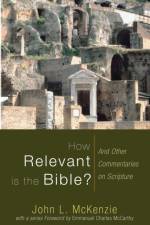
While it is true that today's civilization presents all sorts of questions about which the Bible had nothing to say directly, in many instances there are passages which, when properly understood, can lead us toward the right answer for modern Christians. And in many instances the Bible addresses itself explicitly to moral and spiritual concerns that are just as relevant today as they were thousands of years ago. But discerning the true intent of the scriptures is not as simple as many people have tried to make it. There are seeming (and sometimes actual) contradictions to be reconciled, there is the cloud of historical context to be clarified, the inaccuracies of translators, the findings of modern biblical criticism, research and archaeological discoveries to be considered. Expert guidance is indeed required. Father McKenzie tackles death, marriage, divorce, suffering, sexual morality, life after death, violence, love of neighbor, faith, the institutional church, prejudice and bigotry, prayer and personal holiness, the role of women in the church, priesthood and varieties of ministry, sin and radical evil. Chapters on these subjects are thought provoking, and readers will appreciate their journey through the scriptures with McKenzie as their perfect guide.
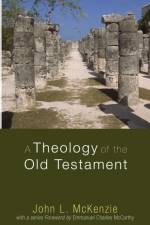
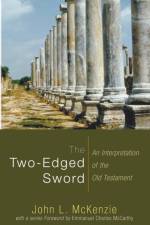
By thoroughly investigating every aspect of theology to be found in the Old Testament, Father McKenzie offers a total theological statement of this timeless record. The theology of the Old Testament, he writes, has to be the study of the reality of Yahweh. The Old Testament is the sole literary witness to that reality as the record of the experience of Israel. Seven categories outline the book: cult, revelation, history, nature, wisdom, political and social institutions, and the future of Israel. Together, these categories provide a pathway to God that is far more complete than that which can be experienced by any individual. For McKenzie, the Hebrew scriptures are to be understood as the independent record of the early Israelite community's experience with God, rather than as a prelude to or forecast of the New Testament.
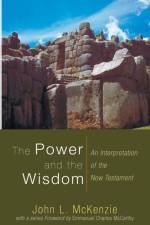
From the beginning of the New Testament era, there have been disputes over what individual passages meant, who wrote them, when they were written, and whether certain sayings could be directly attributed to Jesus. McKenzie's aim is not to destroy the credibility of the New Testament, but rather to enhance belief by allowing it to rest on a foundation freed from various manmade illusions and historically inaccurate assumptions that modern biblical research has discovered from both internal and external evidence about the writings. Father McKenzie takes on a variety of topics -- the real Jesus and the Son of man; gospels and gossip; the roles of Peter and Paul; divorce; the resurrection; the meaning of the Apocalypse -- to name but a few, in this highly informative look at key themes and episodes of the New Testament.
Christians are in a real battle. The kingdom of God and the kingdom of Satan are at odds. Christian preaching and teaching are God's armor in the battle. . . . May our thoughts become the prisoners of war of Christ. Then, and only then, are we really free--for real freedom is never the right to do what we please. That is imprisonment. It eventually shackles each of us to our own individual world of self-centeredness and wants. But real freedom is the liberty to do what is right. We have that freedom when we are united to God. Then we have His spirit, who gives us His character of righteousness, and we have His instructions, which give us His standards of right and wrong conduct. That truly liberates us to be and do what God wants us to be and do.
Reidar Thomte's Kierkegaard's Philosophy of Religion is an excellent read for students beginning their study of one of the greats of nineteenth and twentieth century philosophy. Thomte directly appropriates Kierkegaard's insightful language and discussion of the theological and philosophical issues that stimulated him, all of which are still alive and well today. This approach has the happy result that readers seeking an introduction do not have to be led through technical debates in order to approach Kierkegaard's thought. Thomte is a master of incisive summary; his presentations of crucial distinctions are level-headed and to the point. Kierkegaard's categories such as the stages on life's way (the aesthetic, the ethical, Religiousness A, and Religiousness B), the individual, subjectivity, the Paradox, the varieties of love, faith and knowledge, etc., are provocative and illuminating. Not only is this book a good a starter, it is also a comprehensive review of the principal issues in Kierkegaard's philosophy of religion. (by Robert L. Perkins, Editor, International Kierkegaard Commentary)
The question of authority has always been a lively issue within the Roman Catholic Church. While some have warned against the danger of democratizing the Church, others have warned against applying too narrowly the monarchical model which has been dominant in past centuries. Father McKenzie's thesis is that these political paradigms simply do not apply to the Church. The Christian community, he points out, is a unique society, and hence its understanding and use of authority must also be unique. McKenzie shows how Christian authority is unique by illuminating the understanding of authority that Jesus gave to the society which He founded. After a brilliant exposition of authority in the New Testament, the author traces how the Church has lost sight of these unique aspects, with a consequent erosion of both Christian authority and Christian freedom.
The key to understanding the Gospels, says Father McKenzie, is to read them carefully and inquisitively, then reread them, and reread them... Perhaps never before has there been such a need for a mature Christian faith, based solidly on the scriptures, that will stand against the secularity of the times. And perhaps never before has the work of scripture scholars been so helpful in giving the ordinary reader an understanding of the scriptures that is pertinent to his or her life. McKenzie, without being polemical or technical, provides a brief and readable guide to the Gospels that will deepen and enrich Christian faith.
McKenzie offers practical ideas on how lay persons can read and study the Bible, discussing best translations and best ways to approach difficult texts. With an appreciation for continuities between Old and New Testaments, he presents patterns, such as God's self-revelation as love, which thread throughout the Bible. The author also reveals insights into the Personality of Christ, emphasizing that Jesus was truly a man as well as God, experiencing the full range of human emotion. Finally, the book engages the place of sex in the Bible, and current trends within contemporary Catholicism.
Since the 1913 publication of James A. Montgomery's Aramaic Incantation Texts from Nippur, students of the bowls have used that book as the diving platform from which they enter a deep pool of study, In the intervening years, the body of work on incantation (or magic) bowls has continued to grow. Bowls in several ancient languages have attracted the attention of scholars from a variety of countries and traditions. The result has been the publication of a considerable number of translations of additional texts and fragments. Focusing only on those bowls inscribed in Aramaic and even then, only on the seventy-two extant bowls which could be personally read in photographs or facsimiles, Charles Isbell has, in Corpus of the Aramaic Incantation Bowls, compiled an impressive volume of work. Including the complete original texts, full translations, and annotations, Isbell supplements the text with a glossary of all inscribed words, an index of personal names, and a list of quotations from scripture.
Moving from Genesis through the Hebrew prophets, McKenzie has produced a moving picture of Hebrew religion produced by divine revelation. Throughout the work he confronts biblical ideas with modern thought and modern thought with biblical ideas. Themes include the Hebrew view of history, the backdrop of ancient Near Eastern religions and literary forms, and the unique role of Israel as a society governed immediately by the will of God. In short, McKenzie offers an engaging interpretation of the Old Testament which will challenge scholars and delightfully instruct the general reader.
In the composition of this book I experienced a growing conviction that the thing with which we believe we are familiar is not the New Testament; it is a conventionalized popular understanding of the New Testament. The simplicity of the New Testament can be deceptive. We have lived with it so long that its explosive power has become sweet reasonableness. I have noticed this not as a preacher but simply as a professional interpreter. It is our office to explain the text....The New Testament interpreter finds that he has the unpleasant task of liberating the text from certain encumbrances. John L. McKenzie, from the preface
In many of his books, John L. McKenzie has confined himself to the exposition of one theme. Here is a chance to encounter his thinking on a wide variety of biblical topics--a first-rate sampling of McKenzie at large. Besides the title chapter, he focuses on (among others) such intriguing subjects as The Real Jesus, The Real Mary, The State in Christian Perspective, War and Peace in the New Testament, Myths in the Bible, The Book of Revelation--and concludes with The Bible: A Progress Report. The Bible does not so much give answers as lead to answers. It puts the right questions directly in a form which does not permit evasion. It confronts us with challenges to action which are urgent. McKenzie does well to dig out and squarely state the hard questions which the Bible presents to the modern world.
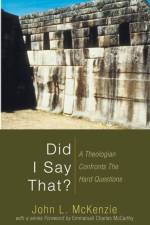
He did indeed say the acerbic, insightful, original, candid and frequently seemingly outrageous things in this long-awaited book. For this is one of America's top theologians come down from the ivory tower of scholarship to deal with the moral and ecclesiastical problems of everyday life in the crisp, colorful, and jargon-free style that have made John L. McKenzie one of the most widely read and highly regarded Catholic writers of our day. One of the few things Father McKenzie is not famous for is pulling his punches. When he talks about the problems of evil in modern life his indictments shy away from no sacred cows. His outspoken criticism of authority in the church, of ecclesiastical repression of personal and academic freedom have not necessarily made him friends in high places but they have influenced many. His tremendous depth of scriptural knowledge illuminates all his writing without ever slipping over to the pedantic. Best of all, his passionate concern for people and for the authentic message of the Gospels, is converted and focused onto the major moral problems which openly or covertly subvert the quality of contemporary Christian life--as it is lived very much in this world.
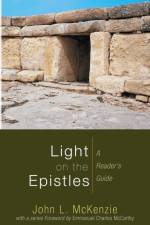
The Epistles, for all their disarming simplicity do not make easy reading; even in crisp, modern translations they pose a problem for the ordinary reader, no matter how interested and concerned. The exciting findings of modern biblical research compound the problem. Scholars know more with each passing year and the knowledge gap grows wider. This unique reader's guide is ideally suited to close that gap between the contemporary Christian and the Epistles. Written by the most distinguished Catholic scripture scholar of his day and designed to be read in conjunction with the New Testament it provides lucid and expert commentary and explanation. With a guide like John L. McKenzie and the option of setting your own pace -- the difficult suddenly becomes not only possible, but pleasurable.
Abonner på vårt nyhetsbrev og få rabatter og inspirasjon til din neste leseopplevelse.
Ved å abonnere godtar du vår personvernerklæring.