




















Gjør som tusenvis av andre bokelskere
Abonner på vårt nyhetsbrev og få rabatter og inspirasjon til din neste leseopplevelse.
Ved å abonnere godtar du vår personvernerklæring.Du kan når som helst melde deg av våre nyhetsbrev.

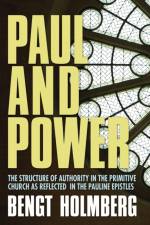
The study of the evolution of church structure and order has been subject to considerable research and debate, often with theological presuppositions determining the direction taken. In this highly original work, Bengt Holmberg separates historical groundwork from theological analysis by reviewing the issues from a sociological point of view. What emerges is an unusually lucid study of the network of power relationships which can be traced in the decades of St. Paul''s ministry. The principal actors and situations in the Pauline Epistles suggest what the organizational and leadership realities of the times were like and how Paul, his co-workers, and his churches related to one another.In Part One, Holmberg provides a historical description of the distribution of power at three levels in the primitive church: that between the church in Jerusalem and the apostle Paul; at the regional level where Paul operates in local churches personally, through co-workers and by letters; and at the local intrachurch level.In Part Two, Holmberg develops a sociological analysis of the shape and location of authority in the church. He examines the New Testament literature for evidence and then interprets it in terms of categories derived from modern theoretical sociology, and in particular from Max Weber''s sociology of authority. Holmberg describes the nature of authority in the early church and concludes that a charismatic authority was continuously reinstitutionalized through interaction of persons, institutions, and social forces within the church.This persuasive and provocative study combines serious New Testament interpretation with sociological analysis of a crucial issue in earliest Christianity. It advances the case of sociological exegesis by offering a model for further investigations of the entire structure of church leadership and authority in emergent Christianity.
The character of any religion as it is lived and practiced can be quite different from the prescriptions and ideals of its traditions and rituals. This bifurcation can be found also in the tension between the ideas people hold and the things they do. Jacob Neusner explains in the preface:The issue I address in these pages for a broad audience of people who care about religion in general, not Judaism in particular, is an urgent one: explaining what we see, not only what we read. So I decided to focus the book more sharply on what strikes me as Judaism''s most suggestive trait - the fairly broadly diffused knowledge of what matters and what doesn''t.Students, general readers, members of the clergy, and teachers will find here a lucid and compelling account of the actual life of Jewish people - in the synagogue, at home, in ritual - and of commonly held attitudes toward Holocaust and redemption, the Sabbath and festivals, study of the Torah, the State of Israel, and more.
Jeff and Ann had been dating for only a month, but they knew they were in love. Soon they were spending all of their free time together. But things started going wrong. They''d fight, then kiss and make up, only to fight some more. Finally, Ann told Jeff it was over. She didn''t love him anymore - besides, she wanted to date another guy. She said she loved me, said Jeff, crushed and bitter. I thought love was supposed to last. How can something so right become so wrong?Jeff and Ann''s story is one of many told in ''Next Time I Fall in Love''. In a helpful and readable book for teenagers, Chap Clark gives solid, practical advice on forming and keeping healthy dating relationships. He deals with questions like these:-What is love?-Why would anyone want to date me?-What can hurt a dating relationship?-Sex: How far is too far?-How can I know when it''s time to break up?-What can I do to improve my dating relationships?If you''re 13 to 25 years old - or if you know anyone that age - and if you''re interested in learning more about how to be happy, healthy, and whole in a dating relationship - then this book is for you.
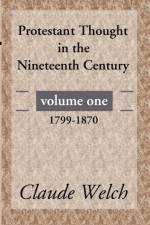
This comprehensive study analyzes the theological concerns of the major Protestant thinkers in Europe and the United States during the early part of the nineteenth century. The discussion ranges from such influential literary religious thinkers as Carlyle and Emerson to theological critics such as Feuerbach and Kierkegaard.
Modern theology is a maze of conflicting beliefs. In fact, the shape of contemporary theology has changed so much in this century--and especially since the 1960s-- that it''s hard to make sense of it all. Of not only what the various belief systems mean, but how we came to be where we are within those systems.In The End of Liberal Theology, respected theological lecturer and author Peter Toon introduces evangelicals to modern forms of doctrine and theology--both Protestant and Roman Catholic. He does so by discussing the basics of orthodoxy, by speaking to the various points of accommodation that have resulted in new forms of theology, and by dissecting liberalism and its effect on evangelicalism. This book is thus a ""family tree"" of modern theology, showing how the various contemporary forms, and those that preceded them, are related to each other.With its comprehensive analysis, The End of Liberal Theology is destined to be a yardstick by which critical evaluations of current doctrines--both old and new, liberal and conservative--will be made.
Abonner på vårt nyhetsbrev og få rabatter og inspirasjon til din neste leseopplevelse.
Ved å abonnere godtar du vår personvernerklæring.