
















Gjør som tusenvis av andre bokelskere
Abonner på vårt nyhetsbrev og få rabatter og inspirasjon til din neste leseopplevelse.
Ved å abonnere godtar du vår personvernerklæring.Du kan når som helst melde deg av våre nyhetsbrev.

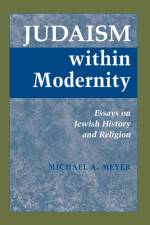
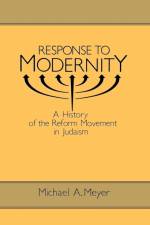
This collection of essays explores the effects of modernization on Jewish self-understanding. The author begins by examining Jewish historiography and the problems of periodization in modern Jewish history. He goes on to discuss the role of history in defining identity among Jews.
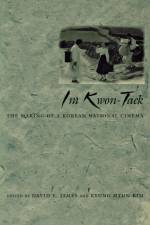
This collection of ten essays written about Im Kwon-Taek, better known as the father of New Korean cinema, takes a critical look at the situations of filmmakers in South Korea.
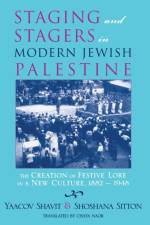
This fascinating case study describes the work of the people responsible for creating festive lore and its system of ceremonies and festivities-an inseparable part of every culture. In the case of the new modern Hebrew culture of Eretz Israel (modern Jewish Palestine)-a society of immigrants that left behind most of their traditional folkways-the creation of festival lore was a conscious and organized process guided by a national ideology and aesthetic values. This creative effort in a secular national society served as an alternative to the traditional religious system, adapted the ceremonies and festivals to a new historical reality, and created a new festival cycle that would give expression and joy to the values and symbols of the new Jewish society.Staging and Stagers in Modern Jewish Palestine claims that the system of ceremonies and festivals, in general, and each separate ceremony and festival were staged according to the staging instructions written by a defined group of cultural activists. The book examines three main stages-the educational network, rural society (particularly the cooperative sector), and urban society (most notably Tel Aviv)-and looks at the stagers themselves, who were schoolteachers, writers, artists, and cultural activists. Though cultural systems of festivals and ceremonies are often researched and described, scholarly literature rarely identifies their creators or studies in detail the manner in which these systems are created. Staging and Stagers in Modern Jewish Palestine sheds important light on the stagers of modern Jewish Palestine and also on the processes and mechanisms that created the performative lore in other cultures, in ancient as well as modern times.
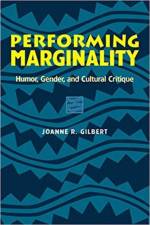
This is a rhetorical analysis of female stand-up comics that explores the relationships among humour, gender and power in contemporary culture. Here, Joanne R. Gilbert aims to illuminate the social, constructive and cultural implications of power and gender in popular entertainment.
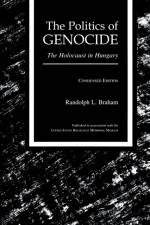
An abbreviated version of this work first published in 1981, and revised and expanded in 1994. The book explains in a rational and empirical context the historical, political, communal, and socioeconomic factors that contributed to the unfolding of this tragedy.
This work examines the historical relationship between American Jewry, the Jewish community in Israel and its predecessor, the ""yishuv"", the Jewish settlement in Palestine. The articles in this book range from Zionist movements in America to Israel's representation in contemporary prayer books.
This title portrays the career of George Edwards, Detroit's visionary police commissioner, whose efforts to bring racial equality, minority recruiting, and community policing to Detroit's police department in the early 1960s were met with much controversy within the city's administration.
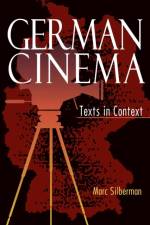
This text presents the history of the German cinema through close readings of films representing five major periods: Weimar cinema, cinema in the Third Reich, postwar cinema, East German cinema, and the New German cinema.
Kaplan, the founder of the Jewish Reconstructionist movement, here takes the major formulation of his theological approach, ""God as the power that makes for salvation"", and demonstrates how it can be used to invigorate the Jewish religion in a changing world.
This text challenges the conventional view of the Tosafists, showing that many individuals were influenced by ascetic and pietistic practices and were involved with mystical and magical doctrines.
This is a narrative history of the Tiger Stadium in Detroit, home to the Tigers baseball team. It is a history of the people who owned the stadium, and the games and the teams that played there from its beginnings in the 1850s through to the Tiger's 1997 season.
In spite of the difficulty of most American avant-garde films, one can read volumes and find almost no mention of how to view these films. Dreams of Chaos, Visions of Order addresses precisely this question: how-and to what extent-can viewers make sense of American avant-garde films? It is a controversial book that examines the implicit assumptions of traditional scholarship, advocates on alternative to dominant approaches to the avant-garde cinema, and questions some long-standing clichés about the history of the avant-garde.
Five of Hitchcock's most significant films were unavailable to the public for as long as two decades before their release in 1983-84. This highly readable volume collects the most important essays written about Hitchcock and the rereleased films since that time. Covering the entire range of contemporary film criticism and theory, these studies demonstrate Hitchcock's centrality to an understanding of how culture shapes film and how film shapes, and even creates culture.
Wings of Gauze is a multidisciplinary anthology of original essays written about the experiences of women of color in the United States - African American, Hispanic American, Native American, and Southeast Asian American. Written by social science and humanities scholars, community activists, and health professionals, the essays illustrate a variety of approaches from a range of academic disciplines, theoretical models, and individual perspectives. Testimony to the many layers of experience by women of color concerning health and illnesses, the essays broaden our understanding of the connections that exist between those experiences and the health issues and cultural standpoints that frame them.With some notable exceptions, recent feminist scholarship about women's health and the history of health care has focused primarily on the experiences of white middle-class women. Literature by health professional about people of color has focused upon illness and perceived deviance from white-defined norms rather than upon the political economy of health and alternative concepts of well-being. It also has focused on men rather than women, and on African Americans to the exclusion of other peoples of color. This collection - the first of its kind - is a shift away from this standard paradigm and instead makes women of color and their perceptions the central reality.The book includes creative writing, participant-observer perspectives, personal narratives, survey studies, and studies based on oral history. Specific health issues, including AIDS, domestic violence, substance abuse, cancer, reproductive health, surgery, sickle cell disease, infectious disease, mental health, and the economic dimensions of physical and psychological health, are addressed. While the focus of the book is on experiences of health and illness and on health policy, there are also essays on the experiences of women of color as health practitioners - ethno-therapists, healers, midwives, health aides, and community social workers.
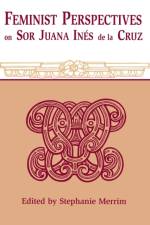
Presenting an examination of feminist issues in the works of Sor Juana Ines de la Cruz, this text discusses such topics as: obscure points in the life of Sor Juana Ines de la Cruz, and the model nun in the religious literature of Colonial Mexico.
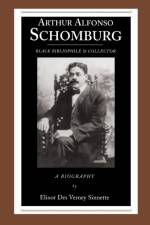
Offers a biography of the pioneering black collector whose detective work laid the foundation for the study of black history and culture. Arthur Alfonso Schomburg came to New York active in Caribbean revolutionary struggles. He searched out records of the black experience and built a collection of books, manuscripts, and art that had few rivals.
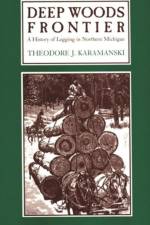
In Deep Woods Frontier, Theodore J. Karamanski examines the interplay between men and technology in the lumbering of Michigan's rugged Upper Peninsula. Three distinct periods emerged as the industry evolved. The pine era was a rough pioneering time when trees were felled by axe and floated to ports where logs were loaded on schooners for shipment to large cities. When the bulk of the pine forests had been cut, other entrepreneurs saw opportunity in the unexploited stands of maple and birch and harnessed the railroad to transport logs. Finally, in the pulpwood era, "weed trees," despised by previous loggers, are cut by chain saw, and moved by skidder and truck. Narrating the history of Michigan's forest industry, Karamanski provides a dynamic study of an important part of the Upper Peninsula's economy.
Alan Dundes' theses identifies a strong anal erotic element in German national character, citing numerous examples of scatological data from authentic compilations of German folklore. The examination of this single trait of German character is used to demonstrate that national character exists and that its existence is unambiguously documented by the folklore of a nation.
This biography of Walter Benjamin provides an introduction to his thought.
Despite the vicissitudes of their anomalous historical experience, the Jews survive as am identifiable entity. They have withstood one challenge after another - both physical and intellectual - somehow maintaining an historical continuity. How Jewish writers have dealt with this enigma serves as the subject of this volume.With these words from the Preface, Michael A. Meyer characterizes the scope of his Ideas of Jewish History. As the only volume of readings in the area of Jewish historiography and the philosophy of Jewish history, Ideas of Jewish History acquaints the reader with both the universal and the particular challenges inherent in the writing of Jewish history.
This is a biography of Isaac Leeser, a leading Jewish religious figure in the United States from 1829 until his death in 1868. Making use of archival and primary sources, it provides a study of a man who was responsible for constructing the cultural foundation of the American Jewish community.
Marc Ferro argues that film is an "agent and source of history" and offers a comprehensive survey of the conceptual interrelations between cinema and history. In developing his arguments, he provides some dozen models, each focusing on a single film or set of films.
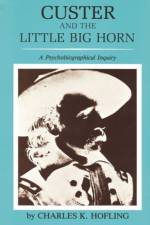
Few American battles have been the object of as much discussion and popular fascination as the Battle of the Little Big Horn. Yet after more than a century, a great number of questions remain unanswered. Many are destined to remain so. No white man survived to tell the tale, Indian accounts are inconsistent, and contemporary reports are distorted by political considerations.Charles K. Hofling, however, provides fresh insight to the events of June 1876 by exploring them from a unique perspective. Concluding that discussions of military tactics and strategy are not sufficient in themselves to explain Little Big Horn, Hofling turns his attention to the psychological context in which Custer operated in order to understand the decisions which produced his final disaster. Examining Custer's personal and military life, Hofling isolates those episodes of psychological significance which suggest personality traits which would account for Custer's behavior before and during the battle.
Abonner på vårt nyhetsbrev og få rabatter og inspirasjon til din neste leseopplevelse.
Ved å abonnere godtar du vår personvernerklæring.