

















Gjør som tusenvis av andre bokelskere
Abonner på vårt nyhetsbrev og få rabatter og inspirasjon til din neste leseopplevelse.
Ved å abonnere godtar du vår personvernerklæring.Du kan når som helst melde deg av våre nyhetsbrev.

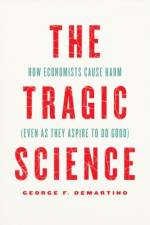
"The practice of economics, as any economist will tell you, is a powerful force for good. Economists are the guardians of the world's economies and financial systems. The applications of economic theory can alleviate poverty, reduce disease, and promote sustainability. While this narrative has been successfully propagated by economists, it belies a more challenging truth: economic interventions, including those that are deemed successful, also cause harm. Sometimes, the harm is manageable and short-lived. But often the harm is deep, enduring, and even irreparable. And too often the harm falls on those least able to survive it. In The Tragic Science, George F. DeMartino says what economists have too long ignored: that economists do great harm even as they aspire to do good. Everyone-including professionals in applied fields like public policy and government, and all those who are affected by economic practice-needs to understand how and why, and what can be done to address the problem. DeMartino isn't a whistleblower, and he's not casting his profession in nefarious terms. His argument is that economic harm is complicated, and economists aren't equipped by their professional training to understand the causes and implications of the harm its practice induces. Not least, the profession represses its "irreparable ignorance"-the impossibility of knowing enough to do what economists are presently doing. For instance, economics requires discovering causality, but causal explanations in the social world require fictitious 'counterfactual' accounts of the world that can't be proven to be right or wrong. As a consequence economists at best enjoy influence without control, which generates unpredictable harms. His case for change is centered on embracing irreparable ignorance, such as through "decision-making under deep uncertainty" (DMDU). DMDU represents a shift away from the field's longstanding hubris and paternalism and toward professional humility and respect for the autonomy of those whom economists seek to serve. The Tragic Science is an essential, clear-eyed recasting of the dangers arising from the practice of society's most powerful science"--
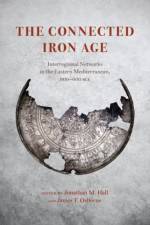
"The early first millennium BCE marks one of the most culturally diverse periods in the history of the eastern Mediterranean. Surveying the region from Greece to Iraq, one finds a host of cultures and political formations, all distinct, yet all visibly connected in meaningful ways. These include the early polities of Geometric period Greece, the Phrygian kingdom of central Anatolia, the Syro-Anatolian city-states, the seafaring Phoenicians and the Biblical Israelites of the southern Levant, the Urartian kingdom of the eastern Anatolian highlands, and the expansionary Neo-Assyrian Empire of northern Mesopotamia. This volume explicitly adopts an interdisciplinary approach to understanding the social and political significance of how interregional networks operated within and between Mediterranean cultures during that era"--
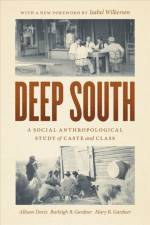
"Deep South was originally published in 1941, documenting in startling detail the nuances, character, and lived realities of racism in a southern town. Allison Davis and his co-authors, Burleigh and Mary Gardner, all went undercover, not revealing their scholarly project or even their association with one another. Their analysis notably revealed the importance of caste and class to both Black and White worldviews, and it anatomized how those are constructed, reified, and reinforced. Deep South is freshly relevant today to those interested in the concept of caste and how it continues to inform the many flavors of American inequality"--
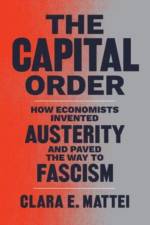
"For more than a century, governments facing financial crisis have resorted to the economic policies of austerity-cuts to wages, fiscal spending, and public benefits-as a means to regain solvency. While these policies have been successful in appeasing creditors, they've had devastating effects on social and economic welfare in countries all over the world. Today, as austerity remains a favored policy among troubled states, an important question remains: what if solvency was never really the goal? In Capital Order, political economist Clara E. Mattei traces the intellectual origins of austerity to uncover its originating motives: the protection of capital-and indeed capitalism-in times of social upheaval from below. Mattei traces modern austerity to its origins in interwar Britain and Italy, revealing how the threat of working-class power in the years after World War I animated a set of top-down economic policies that elevated owners, smothered workers, and imposed a rigid economic hierarchy across their societies. Where these policies "succeeded," relatively speaking, was in their enrichment of certain parties, including employers and foreign-trade interests, who accumulated power and capital at the expense of labor. Here, Mattei argues, is where the true value of austerity can be observed: its insulation of entrenched privilege and its elimination of all alternatives to capitalism. Drawing on newly uncovered archival material from Britain and Italy, much of it translated for the first time, Capital Order offers a damning and essential new account of the rise of austerity-and of modern economics-at the levers of contemporary political power"--
Abonner på vårt nyhetsbrev og få rabatter og inspirasjon til din neste leseopplevelse.
Ved å abonnere godtar du vår personvernerklæring.