








Gjør som tusenvis av andre bokelskere
Abonner på vårt nyhetsbrev og få rabatter og inspirasjon til din neste leseopplevelse.
Ved å abonnere godtar du vår personvernerklæring.Du kan når som helst melde deg av våre nyhetsbrev.

Authorities ranging from philosophers to politicians nowadays question the existence of concepts of society, whether in the present or the past. This book argues that social concepts most definitely existed in late medieval and early modern England, laying the foundations for modern models of society. The book analyzes social paradigms and how they changed in the period. A pervasive medieval model was the "body social," which imagined a society of three estates ΓÇô the clergy, the nobility, and the commonalty ΓÇô conjoined by interdependent functions, arranged in static hierarchies based upon birth, and rejecting wealth and championing poverty. Another model the book describes as "social humanist," that fundamentally questioned the body social, advancing merit over birth, mobility over stasis, and wealth over poverty. The theory of the body social was vigorously articulated between the 1480s and the 1550s. Parts of the old metaphor actually survived beyond 1550, but alternative models of social humanist thought challenged the body concept in the period, advancing a novel paradigm of merit, mobility, and wealth. The bookΓÇÖs methodology focuses on the intellectual context of a variety of contemporary texts.
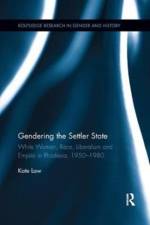
White women cut an ambivalent figure in the transnational history of the British Empire. They tend to be remembered as malicious harridans personifying the worst excesses of colonialism, as vacuous fusspots, whose lives were punctuated by a series of frivolous pastimes, or as casualties of patriarchy, constrained by male actions and gendered ideologies. This book, which places itself amongst other "new imperial histories", argues that the reality of the situation, is of course, much more intricate and complex. Focusing on post-war colonial Rhodesia, Gendering the Settler State provides a fine-grained analysis of the role(s) of white women in the colonial enterprise, arguing that they held ambiguous and inconsistent views on a variety of issues including liberalism, gender, race and colonialism.
This book maintains that it was not passive reception but active participation of readers-including those who listened to fiction read out loud-that fostered the Enlightenment. The decision to engage in intellectual debates, grounded in ideas often first found in fiction, allowed everyday people to participate in the questioning, and eventually the decision-making, of their own states.
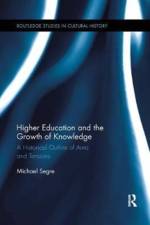
This book sketches the history of higher education, in parallel with the development of science. Its goal is to draw attention to the historical tensions between the aims of higher education and those of science, in the hope of contributing to improving the contemporary university. A helpful tool in analyzing these intellectual and social tensions is Karl Popper''s philosophy of science demarcating science and its social context. Popper defines a society that encourages criticism as "open," and argues convincingly that an open society is the most appropriate one for the growth of science. A "closed society," on the other hand, is a tribal and dogmatic society. Despite being the universal home of science today, the university, as an institution that is thousands of years old, carries traces of different past cultural, social, and educational traditions. The book argues that, by and large, the university was, and still is, a closed society and does not serve the best interests of the development of science and of students'' education.
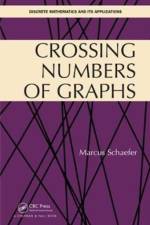
The first book devoted to the crossing number, an increasingly popular object of study with surprising connections. The field has matured into a large body of work, which includes identifiable core results and techniques. The book presents a wide variety of ideas and techniques in topological graph theory, discrete geometry, and computer science.
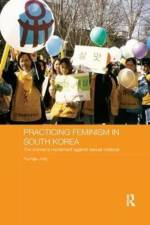
The Korean womenΓÇÖs movement, which is seen in both Western and non-Western countries as being exemplary in terms of womenΓÇÖs activism, experienced a dramatic change in its direction and strategy in the early 1990s. At the heart of the new approach was an increasing focus on sexual violence, which has had a huge impact on bringing womenΓÇÖs issues onto the public agenda in Korea. This book examines feminist practice in Korea by analyzing the experiences of the countryΓÇÖs first sexual assault center, the Korea Sexual Violence Relief Center. Based on extensive original research, including interviews with activists and extensive participant observation, it explores why feminist activists in South Korea chose to organize around the issue of sexual violence, the strategies it used to do so, what impact the movement has made and what challenges it still faces to achieve its objectives.
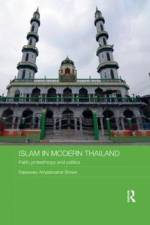
This book addresses the complexity of Islam in Thailand, by focusing on Islamic charities and institutions affiliated to the mosque. By extrapolating through Islam and the waqf (Islamic charity) in different regions of Thailand the diversity in races and institutions, it demonstrates the regional contrast within Thai Islam. The book also underlines the importance of internal histories of these separate spaces, and the processes by which institutions and ideologies become entrenched. It goes on to look at the socio economic transformation that is taking place within the context of trading networks through Islamic institutions and civil networks linked to mosques, madrasas and regional power brokers.
Originally published in 1987 and taking a review of the theories and processes of industrial relocation as its starting point, this book examines the nature of organisational and technologcal changes in detail and concludes with a series of industry case studies drawn from areas throughout the world.
Research on European integration is facing the pressing question of what holds `Europe¿ together in times of crisis, growing distributional conflict and instability in its neighbourhood. This book departs from the ideas of group cohesion in the EU, and reflects on the newest dynamics and practices of European identity. Whilst applying innovative qualitative, quantitative and experimental research methods and an interdisciplinary approach, this volume looks at a variety of issues such as European citizenship, mobility of European citizens, space-based identities, dual identities, student identity and value-sharing. In doing so, this volume presents new perspectives on this complex and dynamic subject and points to potential solutions both in the academic discourse and the political practice of the EU.
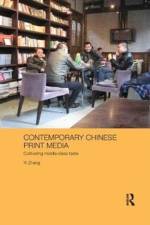
This book examines the transformations in form, genre, and content of contemporary Chinese print media. It describes and analyses the role of post-reform social stratification in the media, focusing particularly on how the changing practices and institutions of the industry correspond to and accelerate the emergence of a relatively affluent urban leisure-reading market.
This book explores accounting for biological assets under IAS 41 ¿ Agriculture, and explains the recent adjustments introduced by the IASB which allow firms to choose between cost or revaluation models concerning mature bearer plants. Identifying the firm and country-level drivers that explain disclosure and measurement practices of biological assets, this concise guide examines the value relevance of measuring those assets at fair value. Based on an international study of a wide selection of firms, countries and drivers, this book is vital for standard setters, stakeholders, students, accountants and auditors to better understand disclosure and measurement practices under IAS 41.
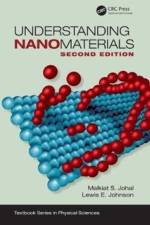
This edition represents a complete overhaul of the original work, giving a complete, self-contained introduction to nanomaterials. The organization has been completely revamped, with inclusion of fundamental physical chemistry and physics pertaining to relevant electrical, mechanical, and optical material properties.
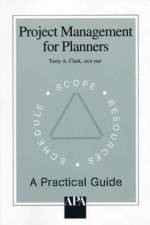
This book provides practicing planners with the knowledge of how to bring real world planning projects to a successful and efficient. It applies the five process groups of project management as identified in Project Management Institute's PMBOK (R) Guide and put them in the language of planners.
This book brings together the world's leading authorities on the evolution, biology, ecology, fisheries and conservation of parrotfishes. In doing so, it provides a comprehensive summary of the research conducted on this unique group of fishes and highlights emerging topics and future direction.
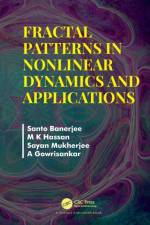
This book describes the basic idea, history, structure, methodology and analysis of fractals, the relationship between fractals and nonlinear dynamics, the applications of fractal and multifractal analysis in biomedical science, and how fractal signals and images are modelled by Iterated Function system.
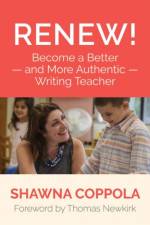
When was the last time you shook up your writing instruction? Shawna Coppola's new book is built on the premise that our students are ever-changing, and so is our global landscape. While there's nothing inherently wrong with relying on instructional strategies that have worked in the past, Shawna challenges writing teachers to rethink and revise their practice regularly.
This handbook provides a comprehensive survey of codes and sequences, ranging from mathematical foundations to applications in various areas and bridging the gap between theory and practice. Each chapter contains the contributions of leading researchers in the field.
Nanomaterials offer unique properties or combinations of properties as electrodes and electrolytes in a range of energy devices. This book describes the latest progress in the discovery and development of nanoelectrolytes and nanoelectrodes for supercapacitor applications.
This book presents a 360-degree picture of the world of insects and explores how their existence affects our lives: the "good, bad, and ugly" aspects of their interactions with humankind. It is an introductory text for undergraduate students in the life sciences, particularly those pursuing beginner courses in entomology, agriculture, and botany.
Small hydropower is increasingly important on a global level, and the possibility of local power generation could considerably improve living conditions in rural areas in developing countries. This thesis presents a numerical modelling approach to improve the design of low-cost machines like water wheels for increased hydraulic efficiency. Using a Computational Fluid Dynamics (CFD) approach, it explores effects of blade geometry, optimal wheel-width to channel-width ratio and channel bed conditions upstream and downstream to improve performance. With a power rating in the low kilowatt range, low-head hydropower machines seem to have a clear potential for small-scale energy generation.
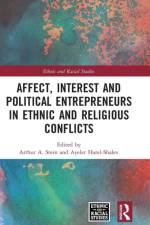
A multidisciplinary and multinational group of scholars address the bases of ethnic and religious conflict and the role of ideologies, institutions, and politicians in shaping political cleavages and conflicts. This book was originally published as a special issue of Ethnic and Racial Studies.
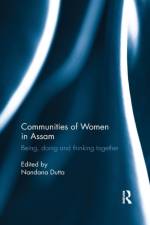
This book uses communities of women as a framework for reading women¿s experience, rights and aspirations in Assam and Northeast India. It examines the diversity in ideologies across women¿s communities in these regions. This volume highlights multifaceted aspects of women¿s groups and their participation in various issues of the state, society and culture.
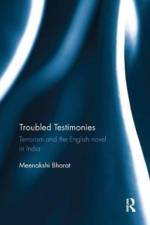
This is the first full length study of the theme of terror in the sub-continental novel in English from India. It places contemporary Indian literature it in the world context and analyzes the fictional coverage of the spread of terrorism through the length and breadth of the country and its cultural fallout.
This volume explores the impact of neoliberalism on education policies and pedagogical principles across South Asia. The essays in this volume critically examine the nature of the crisis and present alternatives and possibilities.
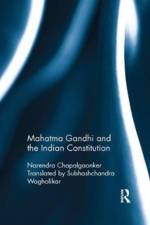
This volume explores important questions that are an intrinsically linked to the making of modern India. It looks at the underlying foundations of the Indian nation state and the role of leaders likeGandhi, Jawaharlal Nehru, Sardar Patel and B. R. Ambedkar. The volume also explores the linkages and the dissonances between Gandhi¿s idea and the Indian Constitution.
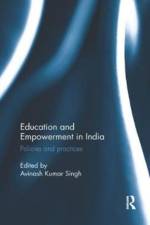
This volume explores the linkages between education and empowerment of women, marginalized groups and other disadvantaged sections of society. The essays explore various educational policies, principles and practices as means to social order as well as tools for empowerment of the oppressed.
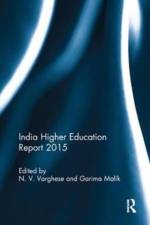
The India Higher Education Report 2015 traces the evolution of higher education and discusses the key role of committees and commissions whose reports and recommendations form the backdrop of contemporary developments. Authoritative and comprehensive, the volume examines a range of themes including equity, financing, employment, quality, and governance.
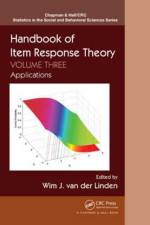
"It is highly recommended to researchers, academics, and practitioners working in the social and behavioural sciences. The book is a stupendous amalgamation of various esteemed researchers in the field of IRT and it would not be wrong to say that 'it is a bible of IRT'."~Ashwani KumarMishra, ISCB
Abonner på vårt nyhetsbrev og få rabatter og inspirasjon til din neste leseopplevelse.
Ved å abonnere godtar du vår personvernerklæring.