
















Gjør som tusenvis av andre bokelskere
Abonner på vårt nyhetsbrev og få rabatter og inspirasjon til din neste leseopplevelse.
Ved å abonnere godtar du vår personvernerklæring.Du kan når som helst melde deg av våre nyhetsbrev.

A thoughtfully constructed syllabus can be transformative for your students' learning, communicating the path they can take to succeed. This book demonstrates how you can construct your syllabus to be a motivating resource for your students that conveys a clear sense of your course's learning goals, how they can achieve them, and makes evident your teaching philosophy.
A thoughtfully constructed syllabus can be transformative for your students' learning, communicating the path they can take to succeed. This book demonstrates how you can construct your syllabus to be a motivating resource for your students that conveys a clear sense of your course's learning goals, how they can achieve them, and makes evident your teaching philosophy.
Thoughtfully combines research and field-tested practice to document the essential components for best practices in living learning communities and presents them as a clear blueprint - the LLC best practices model - for LLC design. Practitioners, researchers, and institutional leaders can use the book as a guide to more effectively allocate resources to create and sustain LLCs.
Thoughtfully combines research and field-tested practice to document the essential components for best practices in living learning communities and presents them as a clear blueprint - the LLC best practices model - for LLC design. Practitioners, researchers, and institutional leaders can use the book as a guide to more effectively allocate resources to create and sustain LLCs.
Designed to help institutional leaders become more competent in designing, building, and scaling high-quality competency-based education (CBE) programs, this book provides context, guidelines, and process. The book will serve administrators, higher education leaders, faculty, staff, and others who have an interest in CBE.
Designed to help institutional leaders become more competent in designing, building, and scaling high-quality competency-based education (CBE) programs, this book provides context, guidelines, and process. The book will serve administrators, higher education leaders, faculty, staff, and others who have an interest in CBE.
"Fourth edition published by Pearson Education, Inc. 2010"--T.p. verso.
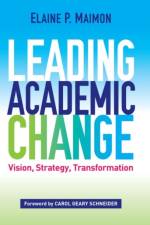
Written by a sitting college president who has presided over transformative change at a state university, this book takes on the big questions and issues of change and change management, what needs to be done and how to do it. The book describes how changes can be made, as well as why we must make them if our society is to thrive in the twenty-first century.
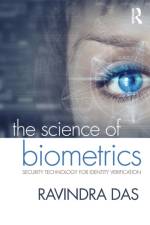
The Science of Biometrics: Security Technology for Identity Verification covers the technical aspects of iris and facial recognition, focusing primarily on the mathematical and statistical algorithms that run the verification and identification processes in these two modalities. Each chapter begins with a review of the technologies, examining how they work, their advantages and disadvantages, as well as some of their established market applications. Numerous approaches are examined. Facial recognition is much more of an emerging biometric technology than iris recognition; therefore, there are more algorithms that are currently being developed in that area. After this review, numerous applications of these two modalities are covered as well, some of which have just been commercially deployed while others are under research and development. Chapters 3 and 4 conclude with case studies to provide further application review. This book is directed to security managers, electronic security system designers, consultants, and system integrators, as well as electronic security system manufacturers working in access control and biometrics.
Conferring with students about reading allows for clearer access to one-on-one, in-the-moment teaching and learning, yet it can feel intimidating or overwhelming. Kari Yates and Christina Nosek want to help. Here they provide practical, reflective, student-centred teaching moves that you can use to develop an intentional, joy-filled conferring practice.
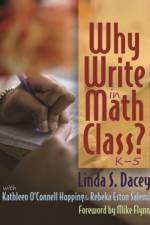
To help students communicate their mathematical thinking, many teachers have created classrooms where math talk has become a successful and joyful instructional practice. Building on that success, the ideas in Why Write in Math Class? help students construct, explore, represent, refine, connect, and reflect on mathematical ideas.
Discover what happens when your students step out of their daily routines and activate their engagement. Author Katherine Mills Hernandez argues that movement, talk, and the physical environment of the classroom all contribute and influence students' learning. The ideas in Activate! will help you create a classroom optimized for deeper engagement and lasting learning.
Ask successful writers and they'll tell you, the key to writing well is revision. Ask elementary school teachers and they'll tell you, the real challenge of writing instruction is teaching kids how to revise. Ruth Culham is both a successful writer and a writing teacher, and she's discovered how to teach writing and revision in a way that's accessible to both teacher and students.
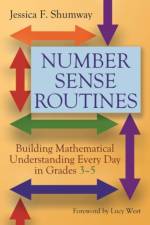
Upper elementary teachers have a big job: to help students deepen their mathematical understanding and become more efficient mathematicians. Number Sense Routines is about tapping into every child's innate number sense and providing daily, connected experiences that are responsive to children's learning needs.
When am I ever going to need this again?"" If you've heard students ask this in your English class, Jennifer Fletcher has just the answer. Teaching Literature Rhetorically shows you how to help your students develop transferable literacy skills that allow them to succeed not just in their English language arts classes, but, more importantly, their future lives in college, career, and beyond.
In this thoroughly updated second edition, Rick Wormeli provides a catalyst for serious reflection on current grading and assessment practices in differentiated classrooms. Coherent and effective standards-based grading practices for a high-stakes, accountability-focused world is also outlined. Wormeli addresses the challenges for teachers and administrators alike.
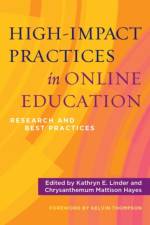
Offers the first comprehensive guide to how HIPs are being implemented in online environments and how HIPs can be adjusted to meet the needs of online learners. This multi-disciplinary approach will assist faculty and administrators to effectively implement HIPs in distance education courses and online programs.
Offers the first comprehensive guide to how HIPs are being implemented in online environments and how HIPs can be adjusted to meet the needs of online learners. This multi-disciplinary approach will assist faculty and administrators to effectively implement HIPs in distance education courses and online programs.
This compact, accessibly written text is designed for students to read and reflect on independently or to foster discussion in class on their motivations and dispositions toward community engagement and service learning. It prepares students to work with diverse individuals, groups, and organisations that may be outside their prior experience.
What do university leaders need to know and be able to do to internationalize their institutions? This volume provides professionals in international education with the foundational knowledge that informs leadership practices, together with suggested strategies for implementing and developing the wide range of functions, activities and skills associated with comprehensive internationalization.
What do university leaders need to know and be able to do to internationalize their institutions? This volume provides professionals in international education with the foundational knowledge that informs leadership practices, together with suggested strategies for implementing and developing the wide range of functions, activities and skills associated with comprehensive internationalization.
This compact, accessibly written text is designed for students to read and reflect on independently or to foster discussion in class on their motivations and dispositions toward community engagement and service learning. It prepares students to work with diverse individuals, groups, and organisations that may be outside their prior experience.
Routledge Performance Practitioners is a series of introductory guides to the key theatre-makers of the last century. Rudolf Laban was one of the leading dance theorists of the twentieth century. His work on dance analysis and notation raised the status of dance as both an art form and a scholarly discipline.
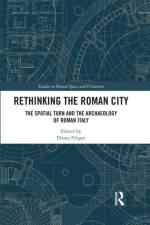
The spatial turn has brought forward new analytical imperatives about the importance of space in the relationship between physical and social networks of meaning. This volume explores this in relation to approaches and methodologies in the study of urban space in Roman Italy.
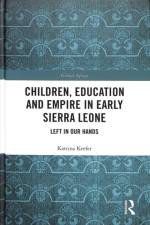
This book offers newly transcribed data and fills a lacuna in the scholarship of early Sierra Leone. It presents a narrative of children as they experienced a set of circumstances which were unique to Abolitionist historiography, and demonstrates how each element of that situation arose.
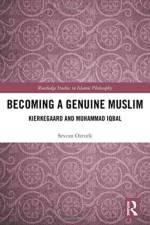
This book provides a Kierkegaardian reading of Muhammad Iqbal's idea of becoming a genuine Muslim. It reflects on the parallels between the philosophical approaches of Kierkegaard and Iqbal, and argues that, though there are certain parallels between their approaches, there is a significant difference between their philosophical stances.
This is the first text of its kind to integrate the existing frameworks of supervision into a comprehensive model of practice, providing a clear procedural guide for conducting professional and operational supervision. It provides supervisors with a range of administrative resources to support, record, and evaluate the supervision process.
Written by a stellar line-up of international contributors, this book argues that social change is needed to support the strategic and operational transformation of the Korean chaebol and SMEs. Specifically, it stresses the need for an appreciation of the gender, national and ethnic diversity emerging within the Korean workplace today.
Abonner på vårt nyhetsbrev og få rabatter og inspirasjon til din neste leseopplevelse.
Ved å abonnere godtar du vår personvernerklæring.