








Gjør som tusenvis av andre bokelskere
Abonner på vårt nyhetsbrev og få rabatter og inspirasjon til din neste leseopplevelse.
Ved å abonnere godtar du vår personvernerklæring.Du kan når som helst melde deg av våre nyhetsbrev.

This book provides fundamental information on various techniques for the detection of SARS-CoV-2 including reverse transcriptase (RT) PCR, loop-mediated isothermal amplification, immunodiagnostic tests, and CRISPR-Cas. It reviews various testing kits and detection methodologies that are currently being used for the detection of SARS-CoV-2 and examines strategies for the post-treatment detection and monitoring of SARS-CoV-2. Further, it assesses the diagnostic potential of several SARS-CoV-2 proteins; and analyzes their structural determinants and immunogenicity.In turn, the book evaluates the potential of CRISPR-Cas 12-based assays for the detection of SARS-CoV-2 using RNA extracted from patients. Lastly, it discusses the use of miniaturized biosensors for the detection of other types of coronavirus.
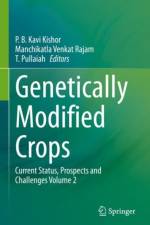
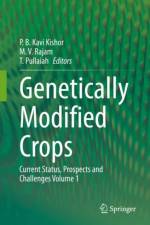
Genetic transformation is a key technology, in which genes are transferred from one organism to another in order to improve agronomic traits and ultimately help humans. However, there is concern in some quarters that genetically modified crops may disturb the ecosystem. A number of non-governmental organizations continue to protest against GM crops and foods, despite the fact that many organisms are genetically modified naturally in the course of evolution. In this context, there is a need to educate the public about the importance of GM crops in terms of food and nutritional security. This book provides an overview of various crop plants where genetic transformation has been successfully implemented to improve their agronomically useful traits. It includes information on the gene(s) transferred, the method of gene transfer and the beneficial effects of these gene transfers and the agronomic improvements compared to the wild plants. Further, it discusses the commercial prospects of these GM crops as well as the associated challenges. Given its scope, this book is a valuable resource for agricultural and horticultural scientists/experts wanting to explain to the public, politicians and non-governmental organizations the details of GM crops and how they can improve crops and the lives of farmers. It also appeals to researchers and postgraduate students.This volume focuses on the transgenics of mungbean, cowpea, chickpea, cotton, mulberrry, Jatropha, fingermillet, papaya, citrus plants and cassava. It also discusses CRISPR edited lines.
The abundance of organic pollutants found in wastewater affect urban surface waters. Traditional wastewater management technologies focus on the removal of suspended solids, nutrients and bacteria, however, new pollutants such as synthetic or naturally occurring chemicals are often not monitored in the environment despite having the potential to enter the environment and cause adverse ecological and human health effects. Collectively referred to as "emerging contaminants," they are mostly derived from domestic activities and occur in trace concentrations ranging from pico to micrograms per liter. Environmental contaminants are resistant to conventional wastewater treatment processes and most of them remain unaffected, causing contamination of receiving water. This in turn leads to the need for advanced wastewater treatment processes capable of removing environmental contaminants to ensure safe fresh water sources. This book provides an up-to-date overview of the current bioremediation strategies, including their limitations, challenges and their potential application to remove environmental pollutants. It also introduces the latest trends and advances in environmental bioremediation, and presents the state-of-the-art in biological and chemical wastewater treatment processes. As such, it will appeal to researchers and policy-makers, as well as undergraduate and graduate environmental sciences students.
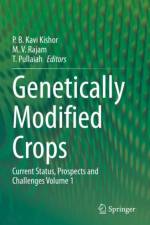
Genetic transformation is a key technology, in which genes are transferred from one organism to another in order to improve agronomic traits and ultimately help humans. However, there is apprehension in some quarters that genetically modified crops may disturb the ecosystem. A number of non-governmental organizations continue to protest against GM crops and foods, despite the fact that many organisms are genetically modified naturally in the course of evolution. In this context, there is a need to educate the public about the importance of GM crops in terms of food and nutritional security. This book provides an overview of various crop plants where genetic transformation has been successfully implemented to improve their agronomically useful traits. It includes information on the gene(s) transferred, the method of gene transfer and the beneficial effects of these gene transfers and agronomic improvements compared to the wild plants. Further, it discusses the commercial prospects of these GM crops as well as the associated challenges. Given its scope, this book is a valuable resource for agricultural and horticultural scientists/experts wanting to explain to the public, politicians and non-governmental organizations the details of GM crops and how they can improve crops and the lives of farmers.
Genetic transformation is a key technology, in which genes are transferred from one organism to another in order to improve agronomic traits and ultimately help humans. However, there is apprehension in some quarters that genetically modified crops may disturb the ecosystem. A number of non-governmental organizations continue to protest against GM crops and foods, despite the fact that many organisms are genetically modified naturally in the course of evolution. In this context, there is a need to educate the public about the importance of GM crops in terms of food and nutritional security. This book provides an overview of various crop plants where genetic transformation has been successfully implemented to improve their agronomically useful traits. It includes information on the gene(s) transferred, the method of gene transfer and the beneficial effects of these gene transfers and agronomic improvements compared to the wild plants. Further, it discusses the commercial prospects of these GM crops as well as the associated challenges. Given its scope, this book is a valuable resource for agricultural and horticultural scientists/experts wanting to explain to the public, politicians and non-governmental organizations the details of GM crops and how they can improve crops and the lives of farmers.
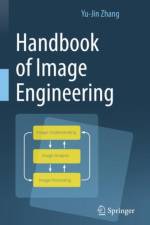
Image techniques have been developed and implemented for various purposes, and image engineering (IE) is a rapidly evolving, integrated discipline comprising the study of all the different branches of image techniques, and encompassing mathematics, physics, biology, physiology, psychology, electrical engineering, computer science and automation. Advances in the field are also closely related to the development of telecommunications, biomedical engineering, remote sensing, surveying and mapping, as well as document processing and industrial applications.IE involves three related and partially overlapping groups of image techniques: image processing (IP) (in its narrow sense), image analysis (IA) and image understanding (IU), and the integration of these three groups makes the discipline of image engineering an important part of the modern information era.This is the first handbook on image engineering, and provides a well-structured, comprehensiveoverview of this new discipline. It also offers detailed information on the various image techniques. It is a valuable reference resource for R&D professional and undergraduate students involved in image-related activities.
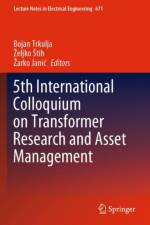
This book presents the proceedings of the 5th International Colloquium ¿Transformer Research and Asset Management,¿ held in Opatija, Croatia, on October 9¿12, 2019.The papers chiefly focus on three groups of topics:1. Numerical Modeling: Electromagnetic fields¿Coupled fields¿Transients¿Numerical modeling in design2. Materials, Components and New Technologies: Insulating materials¿Magnetic materials and transformer noise¿Transformer components¿New transformer technologies3. Transformer Lifecycle Management: Diagnostics and monitoring¿Failure¿Asset management¿In-service experiences.The Colloquium was organized by the Croatian National Committee of CIGRE together with the Faculty of Electrical Engineering and Computing in Zagreb and the Centre of Excellence for Transformers
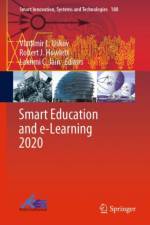
This book contains the contributions presented at the 7th international KES conference on Smart Education and e-Learning (KES SEEL-2020), which being held as a virtual conference on June 17-19, 2020. It contains fifty three high quality peer-reviewed papers that are grouped into several interconnected parts: Part 1 ¿ Smart Education, Part 2 ¿ Smart e-Learning, Part 3 ¿ Smart Pedagogy, Part 4 - Smart Education: Systems and Technology, Part 5 ¿ Smart Education: Case Studies and Research, Part 6 - Smart University Development: Organizational and Managerial Issues, Part 7 - Smart Education and Smart Universities and their Impact on Students with Disabilities, Part 8 - Mathematical Models in Smart Education and e-Learning, and Part 9 - Models of Professional Practice in Higher Education.Smart education and smart e-learning are emerging and rapidly growing areas with the potential to transform existing teaching strategies, learning environments, and educational activities and technology in the classroom. Smart education and smart e-learning focus on enabling instructors to develop new ways of achieving excellence in teaching in highly technological smart classrooms, and providing students with new opportunities to maximize their success and select the best options for their education, location and learning style, as well as the mode of content delivery. This book serves as a useful source of research data and valuable information on current research projects, best practices and case studies for faculty, scholars, Ph.D. students, administrators, and practitioners ¿ all those who are interested in smart education and smart e-learning.
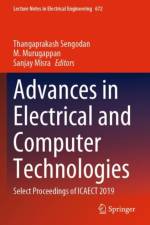
The book comprises select proceedings of the first International Conference on Advances in Electrical and Computer Technologies 2019 (ICAECT 2019). The papers presented in this book are peer reviewed and cover wide range of topics in Electrical and Computer Engineering fields. This book contains the papers presenting the latest developments in the areas of Electrical, Electronics, Communication systems and Computer Science such as smart grids, soft computing techniques in power systems, smart energy management systems, power electronics, feedback control systems, biomedical engineering, geo informative systems, grid computing, data mining, image and signal processing, video processing, computer vision, pattern recognition, cloud computing, pervasive computing, intelligent systems, artificial intelligence, neural network and fuzzy logic, broad band communication, mobile and optical communication, network security, VLSI, embedded systems, optical networks and wireless communication. This book will be of great use to the researchers and students in the areas of Electrical and Electronics Engineering, Communication systems and Computer Science.
Abonner på vårt nyhetsbrev og få rabatter og inspirasjon til din neste leseopplevelse.
Ved å abonnere godtar du vår personvernerklæring.