


























Gjør som tusenvis av andre bokelskere
Abonner på vårt nyhetsbrev og få rabatter og inspirasjon til din neste leseopplevelse.
Ved å abonnere godtar du vår personvernerklæring.Du kan når som helst melde deg av våre nyhetsbrev.

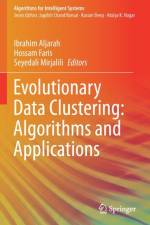
This book provides an in-depth analysis of the current evolutionary clustering techniques. It discusses the most highly regarded methods for data clustering. The book provides literature reviews about single objective and multi-objective evolutionary clustering algorithms. In addition, the book provides a comprehensive review of the fitness functions and evaluation measures that are used in most of evolutionary clustering algorithms. Furthermore, it provides a conceptual analysis including definition, validation and quality measures, applications, and implementations for data clustering using classical and modern nature-inspired techniques. It features a range of proven and recent nature-inspired algorithms used to data clustering, including particle swarm optimization, ant colony optimization, grey wolf optimizer, salp swarm algorithm, multi-verse optimizer, Harris hawks optimization, beta-hill climbing optimization. The book also covers applications of evolutionary data clustering indiverse fields such as image segmentation, medical applications, and pavement infrastructure asset management.
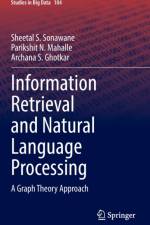
This book gives a comprehensive view of graph theory in informational retrieval (IR) and natural language processing(NLP). This book provides number of graph techniques for IR and NLP applications with examples. It also provides understanding of graph theory basics, graph algorithms and networks using graph. The book is divided into three parts and contains nine chapters. The first part gives graph theory basics and graph networks, and the second part provides basics of IR with graph-based information retrieval. The third part covers IR and NLP recent and emerging applications with case studies using graph theory. This book is unique in its way as it provides a strong foundation to a beginner in applying mathematical structure graph for IR and NLP applications. All technical details that include tools and technologies used for graph algorithms and implementation in Information Retrieval and Natural Language Processing with its future scope are explained in a clear and organized format.
This book reflects the latest research trends, methods and experimental results in the field of electrical and information technologies for rail transportation, which covers abundant state-of-the-art research theories and ideas. As a vital field of research that is highly relevant to current developments in a number of technological domains, the subjects it covered include intelligent computing, information processing, communication technology, automatic control, etc. The objective of the proceedings is to provide a major interdisciplinary forum for researchers, engineers, academicians and industrial professionals to present the most innovative research and development in the field of rail transportation electrical and information technologies. Engineers and researchers in academia, industry and government will also explore an insightful view of the solutions that combine ideas from multiple disciplines in this field. The volumes serve as an excellent reference work for researchers andgraduate students working on rail transportation and electrical and information technologies.
This book offers a unique new look at the familiar quantification theory from the point of view of mathematical symmetry and spatial symmetry. Symmetry exists in many aspects of our life¿for instance, in the arts and biology as an ingredient of beauty and equilibrium, and more importantly, for data analysis as an indispensable representation of functional optimality. This unique focus on symmetry clarifies the objectives of quantification theory and the demarcation of quantification space, something that has never caught the attention of researchers.Mathematical symmetry is well known, as can be inferred from Hirschfeld¿s simultaneous linear regressions, but spatial symmetry has not been discussed before, except for what one may infer from Nishisatös dual scaling. The focus on symmetry here clarifies the demarcation of quantification analysis and makes it easier to understand such a perennial problem as that of joint graphical display in quantification theory. The new framework will help advance the frontier of further developments of quantification theory. Many numerical examples are included to clarify the details of quantification theory, with a focus on symmetry as its operational principle. In this way, the book is useful not only for graduate students but also for researchers in diverse areas of data analysis.
This book addresses health professions educational challenges specific to non-Western cultures, implementing a shifting paradigm for educating future health professionals towards patient-centered care. While health professions education has received increasing attention in the last three decades, promoting student-centered learning principles pioneered by leaders in the medical community has, for the most part, remain rooted in the Western context. Building from Hofstede¿s analysis of the phenomena of cultural dimensions, which underpin the way people build and maintain their relationships with others and influence social, economic, and political well-being across nations, this book demarcates the different cultural dimensions between East and West, applied to medical education. The respective ¿hierarchical¿ and ¿collectivist¿ cultural dimensions are unpacked in several studies stemming from non-western countries, with the capacity to positively influence healthcare education and services. The book provides new insights for researchers and health professional educators to understand how cultural context influences the input, processes, and output of health professionals¿ education. Examples include how cultural context influences the ways in which students respond to teachers, how teachers giving feedback to students, and the challenges of peer feedback and group work. The authors also examine causes for student hesitation in proposing ideas, the pervasive cultural norm of maintaining harmony, the challenges of teamwork in clinical settings, the need to be sensitive to community health needs, the complexity of clinical decision making, and the challenge of how collectivist cultural values play into group dynamics. This book aims to advocate a more culturally-sensitive approach to educating health professionals, and will be relevant to both students and practitioners in numerous areas of public health and medical education.
This book reflects the latest research trends, methods, and experimental results in the field of electrical and information technologies for rail transportation, which covers abundant state-of-the-art research theories and ideas. As a vital field of research that is highly relevant to current developments in a number of technological domains, the subjects it covered include intelligent computing, information processing, communication technology, automatic control, etc. The objective of the proceedings is to provide a major interdisciplinary forum for researchers, engineers, academicians, and industrial professionals to present the most innovative research and development in the field of rail transportation electrical and information technologies. Engineers and researchers in academia, industry, and government will also explore an insightful view of the solutions that combine ideas from multiple disciplines in this field. The volumes serve as an excellent reference work for researchersand graduate students working on rail transportation and electrical and information technologies.
Abonner på vårt nyhetsbrev og få rabatter og inspirasjon til din neste leseopplevelse.
Ved å abonnere godtar du vår personvernerklæring.