


















Gjør som tusenvis av andre bokelskere
Abonner på vårt nyhetsbrev og få rabatter og inspirasjon til din neste leseopplevelse.
Ved å abonnere godtar du vår personvernerklæring.Du kan når som helst melde deg av våre nyhetsbrev.

This book constitutes the proceedings of the 13th International Conference on Service-Oriented Computing, ICSOC 2015, held in Goa, India, in November 2015. data services and cloud platform management; cloud services management; cloud services;
Fifth volume of a 40 volume series on nanoscience and nanotechnology, edited by the renowned scientist Challa S.S.R. Modern applications and state-of-the-art techniques are covered and make this volume an essential reading for research scientists in academia and industry.
In der vorliegenden Studie geht der Autor den mannigfaltigen Zusammenhängen von Gründung und Begründung in der Welt nach, um mit Martin Heidegger zu zeigen, dass all diese Zusammenhänge Freiheit voraussetzen, aus Freiheit hervorgehen oder doch zumindest freiheitsbedingt sind. Die Analyse des ontologischen Freiheitsbegriffs Heideggers nimmt so die Gestalt einer phänomenologischen Destruktion von ¿Grund¿ an. Der Fokus des Buches liegt auf Heideggers tatsächlichem Gebrauch des Begriffs ¿Freiheit¿. Ausgangspunkt der Untersuchung ist das Diktum ¿Die Freiheit ist der Grund des Grundes¿. Dieser Satz fällt in Heideggers ¿metaphysische Periode¿, die sich auf den Zeitraum von 1928 bis 1930 beschränkt und in der er versucht, einen positiven Begriff von Metaphysik, eine Metaphysik des Daseins, zu entwerfen. Zur Aufschlüsselung dieses Diktums konzentriert sich die Untersuchung daher auf eben jenen Zeitraum.Im ersten Kapitel wird der Begriff des Grundes systematisch und philosophiehistorisch untersucht, um unsere Praxis des Begründens offenzulegen und aufzuzeigen, wie diese Praxis bereits den Begriff von Welt präsupponiert. Das zweite Kapitel widmet sich Heideggers positivem Verständnis von Freiheit und weist nach, wie die beiden Begriffe ¿Grund¿ und ¿Freiheit¿ mittels des Weltbegriffs miteinander verwoben sind. Das dritte Kapitel zieht ein Resümee und setzt die Ergebnisse in einen breiteren phänomenologischen Kontext, der nicht allein auf Heidegger beschränkt bleibt. Das vierte und letzte Kapitel setzt sich mit den ethischen Implikationen von Heideggers ontologischem Freiheitsbegriff auseinander.
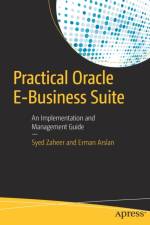
Learn to build and implement a robust Oracle E-Business Suite system using the new release, EBS 12.2. This hands-on, real-world guide explains the rationale for using an Oracle E-Business Suite environment in a business enterprise and covers the major technology stack changes from EBS version 11i through R12.2. You will learn to build up an EBS environment from a simple single-node installation to a complex multi-node high available setup. Practical Oracle E-Business Suite focuses on release R12.2, but key areas in R12.1 are also covered wherever necessary. Detailed instructions are provided for the installation of EBS R12.2 in single and multi-node configurations, the logic and methodology used in EBS patching, and cloning of EBS single-node and complex multi-node environments configured with RAC. This book also provides information on FMW used in EBS 12.2, as well as performance tuning and EBS 12.2 on engineered system implementations. Understand Oracle EBS software and the underlying technology stack componentsInstall/configure Oracle E-Business Suite R12.2 in simple and HA complex setupsManage Oracle EBS 12.2Use online patching (adop) for Installation of Oracle EBS patchesClone an EBS environment in simple and complex configurationsPerform and tune Oracle EBS in all layers (Application/DB/OS/NW)Secure E-Business Suite R12.2Who This Book Is For: Developers, data architects, and data scientists looking to integrate the most successful big data open stack architecture and how to choose the correct technology in every layer
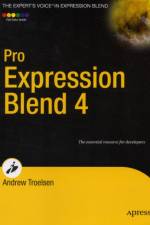
Pro Expression Blend 4 is for .NET developers and graphical artists who want to learn the ins and outs of the Expression Blend integrated development environment. You may know already that this tool can be used to build Windows Presentation Foundation (WPF), Silverlight, and Windows Phone 7 applications; however, this book will take you well beyond the basics and provide you with a detailed examination of key Blend topics, including workspace customization, graphics, layout, styles, themes, data binding, and the use of SketchFlow, giving you an excellent understanding of the Blend product and what it can do for you. Over the course of these eight chapters, you will learn numerous techniques to simplify the authoring of XAML using Blend. These include: Transforming a vector graphic into a custom control template with a few clicks of the mouse Generating complex animations using an integrated timeline editor Visually designing interactive data templates Creating prototypes (via SketchFlow) that can be transformed into production-level code Throughout Pro Expression Blend 4, you'll work with both Blend and .NET code to finalize fully-functional projects that will provide both valuable insights and a sound foundation for your future WPF and Silverlight projects. Each chapter will give you ample opportunity to build .NET software using Blend. However, this is not a programming book, per se. While some examples will require a manageable amount of C# code, this book is squarely focused on helping you gain mastery over the numerous tools, editors, designers, and wizards of the Microsoft Expression Blend IDE.
This paper provides a guideline for how the entire process chain of automotive after-sales services could be researched in China. A total of 301 Chinese workshop customers were surveyed to assess the critical success factors of after-sales services via partial least squares structural equation modelling.
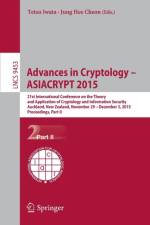
The two-volume set LNCS 9452 and 9453 constitutes the refereed proceedings of the 21st International Conference on the Theory and Applications of Cryptology and Information Security, ASIACRYPT 2015, held in Auckland, New Zealand, in November/December 2015.
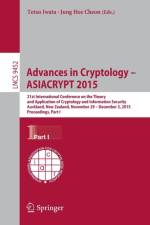
The two-volume set LNCS 9452 and 9453 constitutes the refereed proceedings of the 21st International Conference on the Theory and Applications of Cryptology and Information Security, ASIACRYPT 2015, held in Auckland, New Zealand, in November/December 2015.
The present volume I/25H is providing new data (excitation energies, spin-parities, half-lifes, branching ratios, cross-sections, spectroscopic factors, etc.) for nuclei with atomic numbers Z ranging from 54 (Xe) to 105 (Db) published in 2013-2014, thus updating previous compilations provided in the Landolt-B├╢rnstein volumes I/25A-F. The data presented are collected from all kinds of nuclear reactions, including data for nuclei far from the stability line. Since the time of collection of data for the volumes I/25A-F many new data appeared from new measurements and evaluations. The properties of excited nuclear states are of importance for scientific and practical applications. No systematic compilation of such data has been performed so far. The present compilation has been prepared by two eminent experts in the field. One of the characteristics of Landolt-B├╢rnstein is that data are evaluated before they are accepted for compilation. The idea is to present ΓÇÿbest valuesΓÇÖ which can be used with confidence by non-experts. In view of the large amount of data availablesome of the information is given only on the online platform SpringerMaterials.
Abonner på vårt nyhetsbrev og få rabatter og inspirasjon til din neste leseopplevelse.
Ved å abonnere godtar du vår personvernerklæring.