


















Gjør som tusenvis av andre bokelskere
Abonner på vårt nyhetsbrev og få rabatter og inspirasjon til din neste leseopplevelse.
Ved å abonnere godtar du vår personvernerklæring.Du kan når som helst melde deg av våre nyhetsbrev.

This book describes the latest minimally invasive approaches in endodontics and explains the principles that guide them. The advantages and limitations of these approaches are critically analyzed with the intention of defining new endodontic gold standards. The trend toward the use of more conservative procedures within endodontics reflects the wider adoption of minimally invasive dentistry in general and is being fostered by the introduction of new materials, devices, instruments, and techniques as well as the use of magnification and advanced three-dimensional diagnostic imaging technologies. In this book, readers will find clear explanation of these advances and their impacts. Minimally invasive access to the root canal system is described, and detailed attention is devoted to the application of novel strategies in root canal instrumentation and disinfection, root canal filling, coronal restoration, retreatment, and endodontic surgery. Minimally invasive alternatives to completeendodontic treatment, such as vital pulp therapies, and to dental extraction and implant placement, including surgical extrusion, intentional replantation, and tooth autotransplantation, are also discussed. Minimally Invasive Approaches in Endodontic Practice will be of value for endodontists at all levels of experience.
This book presents a unique analysis of the learning derived from East-West contacts in social work and reflects on the discipline's inalienable trans-national dimensions, of high actuality in the face of the re-emergence of nationalisms. The fundamental transformations in Europe subsequent to the revolutions of 1989 had a profound impact on social work in terms of raising sharply the profession¿s relationship with politics. The exchanges between western schools of social work and the emergent academic partner institutions in former Communist countries formed a valuable testing ground for the essential principles and competences of social work in terms of their universal scientific basis on the one hand and their regard for cultural and national values and contexts on the other. The chapters in this contributed volume focus on lessons derived from fundamental social and political transformations, highlighted by East-West encounters and intra-national divisions, and thereby have important messages for mastering impending transformations in the light of the global COVID-19 health crisis. They demonstrate how cultural and social divisions can be addressed constructively with direct implications for training and practice in dramatically changing contexts:Lithuanian social work¿s claim to professional autonomy vs. authoritarianism in popular and political culture Social work between civil society and the state ¿ lessons for and from Hungary in a European contextWhen Europe¿s East, West, North and South meet: learning from cross-country collaboration in creating an international social work master programmeNordic-Baltic cooperation in social work researcher education: A Finnish perspective on the impact on scientific, historical and linguistic similarities and differencesIntra-national similarities and differences in social work and theirsignificance for developing European dimensions of research and educationSocial work, political conflict and European society: reflections from Northern Ireland European Social Work After 1989: East-West Exchanges Between Universal Principles and Cultural Sensitivity is an invaluable resource for social work educators; social work practitioners confronted with national and international divisions; students of social work, of social administration and policy; and any policy researcher with a comparative focus.
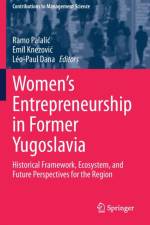
This book explores the historical, current and future prospects of women¿s entrepreneurial activities in the former Yugoslavia, a region that is currently in a process of transition from socialism to a free-market economy. Each chapter presents the past, present and future of female entrepreneurship for each individual country. Some of the questions that the book answers include: Have women been historically and culturally ignored, marginalized, or systematically forbidden to run their own businesses? What are the status quo and future prospects for this group? And, is the investment climate conducive to women-owned businesses?The book provides an extensive overview of female entrepreneurship, its promotion and development, the role of the state, and other key factors that shape the female entrepreneurship ecosystem. Readers will gain an overall perspective on the essential issues and challenges to women¿s entrepreneurship, entrepreneurial initiatives and innovation,policy structures and institutional support to female entrepreneurship in the region.
Globalization is not a new phenomenon, but it is posing new challenges to humans and natural ecosystems in the 21st century. From climate change to increasingly mobile human populations to the global economy, the relationship between humans and their environment is being modified in ways that will have long-term impacts on ecological health, biodiversity, ecosystem goods and services, population vulnerability, and sustainability. These changes and challenges are perhaps nowhere more evident than in island ecosystems. Buffeted by rising ocean temperatures, extreme weather events, sea-level rise, climate change, tourism, population migration, invasive species, and resource limitations, islands represent both the greatest vulnerability to globalization and also the greatest scientific opportunity to study the significance of global changes on ecosystem processes, human-environment interactions, conservation, environmental policy, and island sustainability.Inthis book, we study islands through the lens of Land Cover/Land Use Change (LCLUC) and the multi-scale and multi-thematic drivers of change. In addition to assessing the key processes that shape and re-shape island ecosystems and their land cover/land use changes, the book highlights measurement and assessment methods to characterize patterns and trajectories of change and models to examine the social-ecological drivers of change on islands. For instance, chapters report on the results of a meta-analysis to examine trends in published literature on islands, a satellite image time-series to track changes in urbanization, social surveys to support household analyses, field sampling to represent the state of resources and their limitations on islands, and dynamic systems models to link socio-economic data to LCLUC patterns. The authors report on a diversity of islands, conditions, and circumstances that affect LCLUC patterns and processes, often informed through perspectives rooted, forinstance, in conservation, demography, ecology, economics, geography, policy, and sociology.
Abonner på vårt nyhetsbrev og få rabatter og inspirasjon til din neste leseopplevelse.
Ved å abonnere godtar du vår personvernerklæring.