




Gjør som tusenvis av andre bokelskere
Abonner på vårt nyhetsbrev og få rabatter og inspirasjon til din neste leseopplevelse.
Ved å abonnere godtar du vår personvernerklæring.Du kan når som helst melde deg av våre nyhetsbrev.

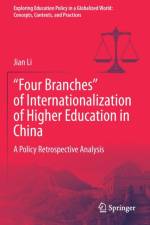
This book examines the emerging power of ¿Four Branches¿ of internationalization of higher education in China from a policy retrospective analysis. In particular, branch one includes China's policy on studying abroad after the reform and opening up; branch two concentrates on China's policy on studying in China after the reform and opening up; branch three explores the policy of Sino-foreign cooperation in running schools; branch four examines the policy of foreign exchange and cooperation. All these four emerging branches are interdependent, and all contribute to shaping the landscape of internationalization of higher education system in contemporary China. In addition, the conclusion and remarks are also offered in this book.The most important features of this book are: (1) new academic conceptualization; (2) comprehensive investigation of the new idea of ¿Four Branches¿ of internationalization of higher education in China from a policy retrospective analysis; (3)critically review and epitomize the contextualized construction of ¿Four Branches¿ of internationalization of higher education in China for constructing modern education model or system from conceptual, practical, and strategically scopes.The intended readers are scholars and researchers who are interested and work in research on China internationalization development in China and the administrators and stakeholders in Chinese education system and graduate students who majoring and minoring in the field of international education.
This book discusses the challenges faced by the homo resaliens and his need for a transition to a more sustainable social, economic, and environmental system. It fills a gap in the existing literature and provides a new perspective by changing the etymology of the word resilience: no more resiliere, but resalio. By comparing and analysing the relevant literature, the author has coined the term homo resaliens (resilient man), in contrast to the failure of the homo oeconomicus, the corruption of the homo politicus, the incompleteness of homo sustinens, and the limits of homo ecologicus. Opening a new debate in which the role of academia and res publica are fundamental to safeguard human communities and future generations, this book will greatly assist governments that wish to understand the socio-political and economic implication of resilience in terms of social inclusiveness and long termsocial and environmental sustainability.
This book showcases empirical studies on workplace bullying from a range of Asian countries, including China, India, Indonesia, Israel, Japan, Jordan, Malaysia, Pakistan, Singapore, South Korea, Sri Lanka, Thailand, UAE and Vietnam, and is the first-of-its-kind single academic project documenting workplace emotional abuse in the world¿s largest continent. It encompasses the ¿varieties of workplace bullying¿ conceptualization in addition to category-based harassment and abusive supervision, and presents target, bystander and interventionist perspectives, along with contextualized insights into the phenomenon. The book speaks to the significance of sociocultural factors and draws on several theoretical and substantive bases including dignity, social cynicism, coping, gender, sexual orientation, job insecurity, turnover intention, affective events theory, attribution theory, regulation and policy initiatives. Covering all major regions in Asia where workplace bullying has been foundto occur, namely West Asia, South Asia, Southeast Asia and East Asia, the book portrays studies which engage both positivist and postpositivist paradigms, utilize an array of methods and include a range of industrial sectors and employment contracts and all levels of the organization. While focused on Asia, the book¿s insights have international relevance and are of interest to the worldwide community of researchers, practitioners and students of organizational studies, human resource management, industrial sociology, work psychology, industrial relations, labour law, corporate law, health sciences, social work and Asian studies.
Abonner på vårt nyhetsbrev og få rabatter og inspirasjon til din neste leseopplevelse.
Ved å abonnere godtar du vår personvernerklæring.