















Gjør som tusenvis av andre bokelskere
Abonner på vårt nyhetsbrev og få rabatter og inspirasjon til din neste leseopplevelse.
Ved å abonnere godtar du vår personvernerklæring.Du kan når som helst melde deg av våre nyhetsbrev.

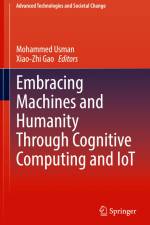
This book sheds light on systems that learn extensively, with purpose and naturally interact with humans. Improving operations and increasing competitive differentiation among manufacturing organizations by harnessing the power of cognitive abilities, IoT can help build and influence the flow of information¿making the shop floor more cognitive through effective processing, analysis, and operational optimization. Now we are seeing the first-hand potential of cognitive computing¿its ability to transform businesses, governments, and society. The real potential of the cognitive age can be realized by combining data analysis and statistical reasoning of machines with uniquely human qualities, such as self-directed goals, common sense, and moral values, improving operations and increasing competitive differentiation among manufacturing organizations. By harnessing the power of cognitive abilities, IoT can help build and influence the flow of information¿making the shop floor more cognitive through effective processing, analysis, and operational optimization. Cognitive initiatives come in all shapes and sizes, from change to strategy and everything in between. What most successful projects have in common, no matter how ambitious, is they start with a clear view of what technology can do. Therefore, the first job of a cognitive scientists is to gain a firm understanding of cognitive abilities, as presented in this book.
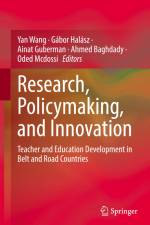
This book presents an update on teacher and education development research, policymaking and innovation within the Belt and Road Countries. It illustrates cases from 18 Belt and Road countries: Albania, Cambodia, China, Hungary, India, Israel, Kazakhstan, Kyrgyzstan, Lithuania, Malaysia, Mongolia, Qatar, Russia, Singapore, Sri Lanka, Syria, Tajikistan and Turkey. It identifies regularities and patterns of teacher development in the context of education development, and explores the characteristics of education policy and practice of the Belt and Road countries. It will be of interest to all researchers, educators and policymakers involved in teacher development and/or education development.
This book focuses on the new and old methods for the synthesis of various heterocycles using Lawesson¿s reagent. The book covers an important and rapidly growing branch of heterocyclic chemistry and can serve as a guide to those who are completing their education and are about to enter the job market. Students will be able to find all Lawesson¿s reagent-assisted protocols for the synthesis of heterocycles in one place. This feature of the book provides an important benefit, because sometimes users want to see all the possibilities and relevant information for making a particular compound using one particular reagent. The purpose of this valuable resource is to provide the knowledge not only to students but also to pharmacologists, biochemists, organic and medicinal chemists, researchers, and academic professionals for easy access to synthetic protocols for different heterocycles using Lawesson¿s reagent. The book will be greatly helpful for everyone involved inthe field and can pave the way for better understanding and quantification of heterocycle synthesis.
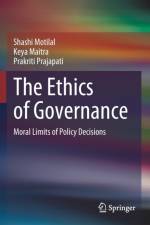
The Ethics of Governance: Moral Limits of Policy Decisions offers a toolbox drawn from normative ethics which finds applications in public governance, primarily focusing on policy making and executive action. It includes ethical concepts and principles culled from different philosophical traditions, ranging from more familiar Western theories to non-Western ethical perspectives, thereby providing a truly global, decolonized and expanded normative lens on issues of governance. The book takes a unique and original approach; it demonstrates the use of the ethical toolbox in the context of actual examples of governance challenges.Taking three major case studies each representing an aspect of human-human and/or human-nature and/or human-animal relationship, the book attempts to show the significance of public practical reasoning in policy decisions with the aim of arriving at reasonable responses. Acknowledging the challenges that policy makers often face, the book highlights thefact that policy making is hardly an exercise yielding a black-or-white solution; rather it involves finding the most reasonable normative outcome (course of action) in a given situation, especially employing an expanded understanding of values including well-being, sustainability, interdependence and community. This effort that helps bridge the gap between ethical theorists and policy practitioners exemplifies the necessary role of ¿engaged philosophy¿ in public governance.In the major case studies, Boxes offer facts and figures along with pertinent ethical questions that have been raised and discussed. Aiming to aid the engagement of a diverse audience including non-philosophy readers, each chapter also includes Boxes containing examples, shorter case studies, at-a-glance charts, and tables with comprehensive ethical tools for a quick recap.
Abonner på vårt nyhetsbrev og få rabatter og inspirasjon til din neste leseopplevelse.
Ved å abonnere godtar du vår personvernerklæring.