












Gjør som tusenvis av andre bokelskere
Abonner på vårt nyhetsbrev og få rabatter og inspirasjon til din neste leseopplevelse.
Ved å abonnere godtar du vår personvernerklæring.Du kan når som helst melde deg av våre nyhetsbrev.

This book continues the discussion on recent developments relating to ethical and sustainable issues in accounting and finance from Volumes I and II, looking into topics such as the importance of good governance in accounting, tax, auditing and fraud examination, ethics, sustainability, environmental issues and new technologies and their effects on accounting and finance, focusing in particular on environmental and sustainability reporting in the oil and gas and banking sectors. The book also considers the growing importance of audit quality in this time of the COVID-19 pandemic.
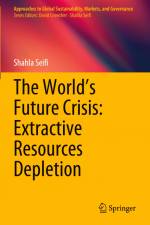
This book focuses mainly on strategic decision making at a global level, which is rarely considered in approaches to sustainability. This book makes a unique contribution as the work looks at global consequences of mineral exhaustion and steps that can be taken to alleviate the impending problems. This book highlights how sustainability has become one of the most important issues for businesses, governments and society at large. This book explores the topic of sustainability as one that is under much debate as to what it actually is and how it can be achieved, but it is completely evident that the resources of the planet are fixed in quantity, and once used, cannot be reused except through being reused in one form or another. This is particularly true of the mineral resources of the planet. These are finite in quantity, and once fully extracted, extra quantities are no longer available for future use. This book argues and presents evidencethat the remaining mineral resources are diminishing significantly and heading towards exhaustion. Once mined and consumed, they are no longer available for future use other than what can be recycled and reused. This book demonstrates that future scarcity means that best use must be made of what exists, as sustainability depends upon this, and best use is defined as utility rather than economic value, which must be considered at a global level rather than a national level. Moreover, sustainability depends upon both availability in the present and in the future, so the use of resources requires attention to the future as well as to the present. This book investigates the alternative methods of achieving the global distribution of these mineral resources and proposes an optimum solution. This book adds to the discourse through the understanding of the importance of the depletion and finiteness of raw materials and their use for the present and the future, in order to achieve and maintain sustainability.
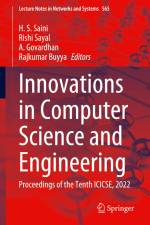
This book features a collection of high-quality, peer-reviewed research papers presented at the 9th International Conference on Innovations in Computer Science & Engineering (ICICSE 2021), held at Guru Nanak Institutions, Hyderabad, India, on September 3-4, 2021. It covers the latest research in data science and analytics, cloud computing, machine learning, data mining, big data and analytics, information security and privacy, wireless and sensor networks and IoT applications, artificial intelligence, expert systems, natural language processing, image processing, computer vision, and artificial neural networks.
This book focuses on Chinäs experience in development over the past 70 years and its significance, as well as building a community with a shared future for mankind. The book consists of a collection of papers contributed by researchers from many countries, covering the topics of world order, a community with a shared future for mankind, ¿the Belt and Road¿ initiative, exchange and mutual learning between civilizations, China Model, China and the World, multi-bilateral relationship, sustainable development.
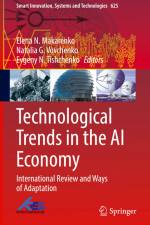
This book is devoted to the study of artificial intelligence from a new perspective ¿ not just a technology but a social institution with complex social connections and relationships. The book systematically highlights technological trends of the artificial intelligence economy and considers all the components of its cascade effect with an overview of international experience and substantiation of promising ways of adapting to the modern stage of technological transit of economic systems. The cascade effect is understood as a chain of interdependent events that are triggered as artificial intelligence takes root in society and the economy. Among the technological trends (current areas of the practical application of artificial intelligence), highlighted in the book, are ¿smart¿ homes, digital regions, the use of artificial intelligence to ensure cybersecurity, as well as the optimization of business processes based on artificial intelligence.The book interprets the economics of artificial intelligence as a result of the transition to a digital technological order. A review of modern experience and regulatory perspectives of the institutionalization of the artificial intelligence economy is carried out. The legal framework for combating cyber threats in the artificial intelligence economy has been determined. The promising frameworks for using artificial intelligence in various branches of industry are presented. The book provides practical examples, case studies and proposed frameworks for using AI in various sectors of the economy, which allows using the book as a practical guide to managing the artificial intelligence economy.
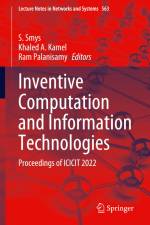
This book is a collection of best selected papers presented at the International Conference on Inventive Computation and Information Technologies (ICICIT 2020), organized during 24-25 September 2020. The book includes papers in the research area of information sciences and communication engineering. The book presents novel and innovative research results in theory, methodology and applications of communication engineering and information technologies.
Abonner på vårt nyhetsbrev og få rabatter og inspirasjon til din neste leseopplevelse.
Ved å abonnere godtar du vår personvernerklæring.