






















Gjør som tusenvis av andre bokelskere
Abonner på vårt nyhetsbrev og få rabatter og inspirasjon til din neste leseopplevelse.
Ved å abonnere godtar du vår personvernerklæring.Du kan når som helst melde deg av våre nyhetsbrev.

This book restores to view a masterpiece of beauty and legal scholarship, which has been lost for almost two hundred years. Produced anonymously in 1838, The Tree of Legal Knowledge is an elaborate visualization in five large colored plates of the law as stated in Sir William Blackstone¿s Commentaries on the Laws of England. Intended as ¿an assistant for students in the study of law,¿ the study aid was not a simple diagram but a beautiful tree with each branch and twig labeled with legal terms and concepts from the Commentaries. Not for law students only, the original was also intended to be of use to the practicing attorney and educated gentleman ¿in consolidating his learning and forming an instructive and ornamental appendage to an office.¿Although Blackstone¿s Commentaries had been first published eighty years earlier, it remained the primary source for knowledge of English law and required reading for American law students. The Commentaries remain relevant today and are frequently cited by the U.S. Supreme Court as a source for the original understanding of legal rights and obligations at the time of American Independence. Despite its artistic beauty and academic significance, The Tree of Legal Knowledge had seemingly disappeared shortly after its publication. It is not included in the collection of any library, including the Library of Congress or in Yale University¿s Blackstone Collection, the largest in the world. It is not listed in the comprehensive Bibliographical Catalog of William Blackstone, edited by Ann Jordan Laeuchli, published for the Yale Law Library in 2015. The present volume reproduces the only extant copy of The Tree of Legal Knowledge. It includes an introduction by the editor that places The Tree in historical context and identifies the anonymous author, an otherwise unknown lawyer. In addition, it reprints the original author¿s introduction and ¿explanation of the branches,¿ both extensively annotated. This book restores this lost masterpiece to its proper place in legal history. The Tree is a beautiful¿and accurate¿depiction of English law as expounded in Blackstone¿s Commentaries, the single most important book in the history of the common law.
This book discusses the extent and nature of COVID-19 pandemic in India and its effect on the society and economy. The suggested management practices discussed here are also not stereotype. At the same time, it highlights deficiency in development fundamentals in India on several dimensions, especially health, education, quality of public spending, taxation orientation, external trade involvement across states, etc., deficiencies which create an inbuilt bottleneck toward the creation of a more equal society. While discussing these, the book throws light on how they were expectedly exacerbated by the sudden negative shock in the form of COVID-19 pandemic. Thus, the book has highlighted the COVID pandemic and its response in India in the background of certain less discussed aspects of development fundamentals. The contents would be of interest to researchers and students studying socioeconomic aspect of developmental economics and also to policy makers and non-government entities involved in mitigating effects of pandemic in the socioeconomic sphere.
This book consists of general reports of the International Conference on Judicial Management from Comparative Perspective. This conference held on November 8¿10, 2017, at Tianjin University, was organized by China Law Society (CLS) and International Association of Procedural Law Congress (IAPL). The general reporters are prominent scholars who have been selected worldwide by the IAPL Presidium to organize national reporters who shall do researches of his/her own state under the guide of the general reporter¿s questionnaire on the specific subject. By this way, the comparative studies are trying to depend on national researches but overcome the general style of ¿talk past each other.¿ Moreover, the general reports summarize and give comment on the various system, phenomena or situation from comparative perspective, from which the audience will read their own orientation, doctrines and theories.
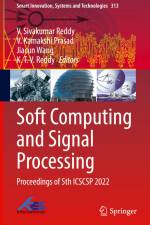
This book presents selected research papers on current developments in the fields of soft computing and signal processing from the Fourth International Conference on Soft Computing and Signal Processing (ICSCSP 2021). The book covers topics such as soft sets, rough sets, fuzzy logic, neural networks, genetic algorithms and machine learning and discusses various aspects of these topics, e.g., technological considerations, product implementation and application issues.
The book addresses the gaps in the body of knowledge from two grounds. Firstly, it adds value through explaining the dynamics of natural resource governance by focusing on the particular arenas of biodiversity resources, water resources and climate change in developing country context. Secondly, it critically scrutinizes the market-centric perspectives on one hand and combines political economy questions that are generally overlooked in discussions of current resource governance framework, on the other. It develops a new framework to examine the reasons behind the degradations of natural resources to offer sustainable solutions to the problems. It shows that the natural resources have been exploited beyond sustainable limits due to the structural rigidities, embedded in, and reproduced by, fragile institutions and unequal power-sharing arrangements under the market-centric economic system. The book formulates a new understanding of sustainability in case of usage and management of natural resources by incorporating the idea of human sociality. It highlights the importance of the well-being of nature, and human beings must go side by side; one without the other is not a sustainable option. The book contains key learnings for scholars and researchers working in the field of development studies who wish to gain a deeper understanding on the sustainable natural resource governance specifically in the contexts of developing countries. For policymakers and policy advocates, the book serves as the groundwork on policies regarding biodiversity resources, water resources, and climate change, specific to the context of developing countries, providing more relevant contents in terms of laying out justification for policy objectives.
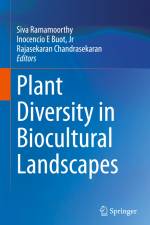
The edited book highlights comprehensive studies on plant diversity dynamics, ecosystem processes, and best conservation practices from the interdisciplinary perspectives such as the botanists, ecologists, conservation biologists, geneticists, cell biologists, molecular biotechnologists, and social scientists. The main focus of the book is to address biodiversity loss and ecosystem collapse amidst the escalating climate change problems, aggravated by anthropogenic activities in biocultural landscapes. The book describes the biocultural landscape of today, ecology of plant diversity, botany of keystone and other rare species of economic and pharmaceutical significance, ecosystem processes, conservation, and emerging frameworks to sustain biocultural landscapes in the Anthropocene. Biocultural landscapes are tracks of land in many parts of the world, shaped by unique human-nature interactions. Many of these landscapes are populated with indigenous peoples with a unique way of life including their interaction with plants and the environment. The relationship between humans and nature in biocultural landscapes used to be harmonious. However, as the human population surges, much pressure has been experienced by the landscape, hence, the loss of biodiversity and degradation of ecosystem services that cascade to agricultural systems. The book is of interest to teachers, professors, policymakers, researchers, and advocates in the fields of botany, ecology, taxonomy, biodiversity conservation, environmental science, molecular biology and genomics, molecular ecology, agriculture, and Agri-tourism, forestry, social science, and climate change professionals. Also, the book serves as a good reference and additional reading material for undergraduate and graduate students.
The Bulletin of Mathematical Biology, the official journal of the Society for Mathematical Biology, disseminates original research findings and other information relevant to the interface of biology and the mathematical sciences. Contributions should have relevance to both fields. In order to accommodate the broad scope of new developments, the journal accepts a variety of contributions, including:Original research articles focused on new biological insights gained with the help of tools from the mathematical sciences or new mathematical tools and methods with demonstrated applicability to biological investigationsResearch in mathematical biology educationReviewsCommentariesPerspectives, and contributions that discuss issues important to the professionAll contributions are peer-reviewed.
This book highlights that an independent judiciary is indispensable for the very existence of any society based on democratic values, such as the observance of the rule of law and respect for the human rights of individuals. In order to ensure that the judiciary¿s interpretation of the law is not bound by the will of the executive and that it is able to call the executive to account by protecting the life as well as liberty of the governed, it is imperative to guarantee, among other things, a transparent method of appointment and the security of tenure of the judges. Taking into account the importance of an independent judiciary in a democratic society, the framers of the Constitution of Bangladesh, 1972, following in the footsteps of the framers of the Constitutions of India and Pakistan, incorporated in the Constitution the ideal of safeguarding the independence of the judiciary as one of its basic features. This book, however, makes it manifestly evident that the key elements for realising such an ideal have not adequately been guaranteed by the Constitution. Consequently, this book sheds light on how succeeding generations of executives have sought to undermine the independence of the judiciary.Accordingly, this book puts forward recommendations for the insertion of detailed norms in the Constitution of Bangladesh for establishing the best means for excluding patronage appointments to the bench and for guaranteeing the security of tenure of the judges. This book asserts that the incorporation of such norms, safeguards the independence of the superior judiciary to decide cases without fear or favour. This book, therefore, seeks to address the gap that exists between the theory and practice concerning the independence of the judiciary in Bangladesh.Since no book is currently available in the market that critically examines these issues in a systematic and structured manner, this research enhances knowledge by not only identifying the flaws,deficiencies and lacunae of the constitutional provisions concerning the method of appointment of the judges of the Supreme Court of Bangladesh but also the measures undertaken by the current Bangladeshi regime to dispense with the transparent method of removal of the judges involving a body of judicial character.
This book presents the proceedings of International Conference on Emerging Research in Computing, Information, Communication and Applications, ERCICA 2020. The conference provides an interdisciplinary forum for researchers, professional engineers and scientists, educators and technologists to discuss, debate and promote research and technology in the upcoming areas of computing, information, communication and their applications. The book discusses these emerging research areas, providing a valuable resource for researchers and practicing engineers alike.
1 Introduction.- 2 Liquid milk and liquid milk products.- 3 Concentrated and dried milk products.- 4 Dairy protein products.- 5 Cream and cream-based products.- 6 Butter, margarine and spreads.- 7 Cheese.- 8 Fermented milks.- 9 Ice cream and related products.
One Systems, Processes and the Role of Process Control Hardware.- 1 Signals, systems and process control.- 1.1 Introduction.- 1.2 A system approach to process control systems.- 1.3 Signals.- 1.4 Systems.- 1.5 The basic analytical concept of process control systems.- References.- 2 The basic process unit.- 2.1 Introduction.- 2.2 The basic process unit.- 2.3 Basic process unit data processing.- 2.4 Process hardware for data input.- 2.5 Process hardware for data output.- 2.6 Auxiliary data for process control.- References.- 3 Stratification of control tasks and data communication.- 3.1 Introduction.- 3.2 Stratification of computer tasks.- 3.3 Control levels and computer input/output hardware.- 3.4 Characteristics of process control computer systems.- 3.5 A survey of process control computer hardware.- 3.6 Communication codes and circuits.- 3.7 Channel capacity.- 3.8 Types of connection and communication hardware.- 3.9 Practical suggestions and recommendations.- 3.10 Open-ended communication in process control.- 3.11 Communication of smart process devices.- References.- Two The Role of Software in Process Control Systems.- 4 The relative roles of software and hardware.- 4.1 Introduction.- 4.2 Data processing.- 4.3 Software for process control data processing.- 4.4 Software versus hardware.- References.- 5 System software.- 5.1 Introduction.- 5.2 Basic concepts of real-time operating systems.- 5.3 Structure and functions of real-time operating systems.- 5.4 Data and symbols for the operating systems.- 5.5 System software.- 5.6 Cost, safety and reliability of operating system software.- References.- 6 Application programs and databases.- 6.1 Introduction.- 6.2 Application program tasks.- 6.3 Structure and timing requirement of application programs.- 6.4 Database and basic process software.- 6.5 Distributed database.- 6.6 Extended real-time software.- References.- Three The Man-Machine Interface.- 7 Reduction and visualization of data and procedures.- 7.1 Introduction.- 7.2 Operator-system communication.- 7.3 Visualization and data logging.- 7.4 Recognition of process states.- References.- 8 Process management and control.- 8.1 Introduction.- 8.2 Process states.- 8.3 Operator/process interaction - actions, commands and timing.- 8.4 Process protection and automatic actions.- References.- 9 The role of the operator in process control systems.- 9.1 Introduction.- 9.2 Formalization of the operator's role.- 9.3 Artificial inferencing tools - expert systems for process supervision and diagnostics.- 9.4 Controlling the operator's work using a process control system.- 9.5 The operator's reaction to process control systems.- 9.6 The limits of the operator's function.- References.- Four System Design.- 10 The feasibility study.- 10.1 Introduction.- 10.2 Data volumes and flows.- 10.3 Stratification of process control and basic system design.- 10.4 Cost/benefit analysis.- 10.5 Benefits.- References.- 11 Computer control system design.- 11.1 Introduction.- 11.2 Communication design.- 11.3 Data transmission units.- 11.4 Designing control and dispatching centres.- 12 Cost-effective system selection.- 12.1 Introduction.- 12.2 Buying and testing hardware.- 12.3 Designing and testing software.- 12.4 Human factors in system assembly.- 12.5 Programming teams.- References.- 13 The integrated approach.- 13.1 Introduction.- 13.2 Mounting and installation procedure.- 13.3 Testing and reliability.- 13.4 System commissioning.- 13.5 Commissioning and safety.- 13.6 Training personnel.- 13.7 Maintenance.- References.- Author index.
1. Introduction.- The History of Microprocessors.- Advanced Microprocessors.- Terminology.- Von Neumann Architecture vis-a-vis Harvard Architecture.- Parallel versus Multiprocessor.- Multiprogramming.- Topology.- Orthogonality.- Granularity.- Summary.- Notes.- 2. Advanced Computer Concepts.- General Comments.- Data and Data Types.- Boolean.- Integer.- Ordinal.- Real Operands.- Literal.- Pixels.- Arrays and Records.- Semantic Gap.- Instruction Sets.- Addressing Modes.- Register Direct Modes.- Memory Address Modes.- Special Address Modes.- Program Control Modes.- Inherent Mode.- Pipelining.- General Description.- Reduction of Pipeline Latency.- Depth.- Memory Management.- General Design Considerations.- Segmentation.- Paging.- Cache Memory.- Virtual Memory.- Summary.- Notes.- 3. Reduced-Instruction-Set, Writable-Instruction-Set, and Very-Long-Instruction-Word Computers.- Reduced-Instruction-Set Computer (RISC).- Philosophy.- Evolution.- Characteristics.- Implementation in the Berkeley RISC.- Pipelining Caveats.- Motorola 88100.- The AMD Processors.- The MIPS Processor.- Hewlett-Packard SPECTRUM.- ACORN ARM (VL86C010).- Integraph Clipper.- Gallium Arsenide RISC Processor.- Writable-Instruction-Set Computer (WISC).- Very-Long-Instruction-Word Computer (VLIW).- Philosophy.- Intel i860.- Summary.- Notes.- 4. Data-Flow Computers.- Concept Behind Data Flow.- Examples of Data-Flow Computers.- Static Data-Flow Computers.- Dynamic Data-Flow Computers.- The NEC PD7281 Data-Flow Microprocessor.- Summary.- Notes.- 5. Case Study: The AM29000.- Internal Organization.- Pipeline Structure.- Registers.- Instruction Fetch Unit.- Branch Target Cache.- Program Counter Unit.- Execution Unit.- Register File.- Address Unit.- Arithmetic-Logic Unit.- Memory-Management Unit.- Development Tools.- Hardware.- Software.- Summary.- 6. Case Study: The Inmos Transputer.- Hardware Description of Transputer.- Language.- Primitive Processes and Constructs.- Compiler.- Hierarchical Decomposition.- Alternative Construct.- Parallel Construct.- Arrays.- Replicator.- Time.- Types and Data Structures.- Compile-Time Allocation.- Program Development.- Configuration.- Programs.- Output Guards.- Summary.- Notes.- 7. Microprocessors for Signal and Image Processing.- Texas Instruments' TMS320 Family.- TMS32010 and TMS320C10 Digital Signal Processors.- TMS32011 Digital Signal Processor.- TMS32010-25 Digital Signal Processor.- TMS32020 and TMS320C25 Digital Signal Processors.- WE DSP32 (AT&T) Digital Signal Processor.- Data Arithmetic Unit.- Control Arithmetic Unit.- Memory.- Serial and Parallel Input-Output.- Inmos A100 Digital Signal Processor.- IMS A100 Cascadable Signal Processor.- IMS A110 Image and Signal Processing Subsystem.- Texas Instruments' TMS34010 Graphics Processor.- Summary.- 8. Microprocessors and Multiprocessing.- General.- Topologies.- Link-Oriented Networks.- Bus-Oriented Topologies.- Case Study of Multiprocessing with the Transputer.- Summary.
In this introductory textbook to epidemiology, students will discover the knowledge and skills required for managing population-based health care under health reform. Fundamental epidemiological techniques are presented teaching students to assess the health status of populations served; determine appropriate interventions based upon knowledge of factors which affect health status; and evaluate the impact of health care systems, programs, technologies, and policies on the health status of populations. Each chapter includes case studies and discussion questions.
Abonner på vårt nyhetsbrev og få rabatter og inspirasjon til din neste leseopplevelse.
Ved å abonnere godtar du vår personvernerklæring.