
















Gjør som tusenvis av andre bokelskere
Abonner på vårt nyhetsbrev og få rabatter og inspirasjon til din neste leseopplevelse.
Ved å abonnere godtar du vår personvernerklæring.Du kan når som helst melde deg av våre nyhetsbrev.

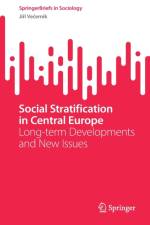
This book provides a comparative and contemporary account of social stratification in the Central European states of Czechia, Poland, Hungary, and Slovakia (the Visegrad Four ¿ V4 group), and also by contrast with Austria. It looks at the shared history of these countries as part of the erstwhile Austro-Hungarian Empire. While the V4 states experienced, for decades, the regressive authoritarian Soviet rule, Austria escaped this fate. The question is how some common historical roots, impact of the communist regime, and transition paths have shaped the specific social structures of V4 countries which differ despite belonging to a relatively homogeneous region. The book examines the changes and developments through analyses of large comparative surveys and other data collected after 1990, most notably using the European Union¿s survey ¿Statistics on Income and Living Conditions¿ (EU-SILC) that has been fielded since 2005. The book starts with an outline of the long-term developmentsin key social structure dimensions which occurred during the post-communist transition. The analytical chapters then discuss topics previously not much examined in social stratification perspective: subjective well-being, couples¿ status, cultural activities and differences among retirees. This book is intended for social scientists working on stratification research, and, specifically, V4 societies and politics.
It is my greatest honor to be asked to write this foreword for the first edition of the Atlas of Endoscopic Major Pulmonary Resections by Dr Dominique Gossot. I have known Dr Gossot for over 15 years and have worked with him for many workshops and thoracic meetings. He is a pioneer in video-assisted thoracic surgery, and one of the most innovative thoracic surgeons I have known. Minimally invasive surgery has set a new standard of care for all surgical disciplines. Video-assisted thoracic surgery (VATS) offers a much kinder approach to the management of a wide variety of surgical conditions c- pared with conventional thoracotomy for these patients. Anatomical or major lung resections are a complex set of procedures commonly performed by thoracic s- geons. The adoption of the VATS approach for these procedures has received increasing acceptance by the thoracic surgical community, our pulmonologist and oncology colleagues, as well as the patients over the past two decades. There is now a growing body of evidence in the literature showing that the VATS approach is safe, oncologically sound, and associated with much lower morbidity compared with its conventional counterparts in the management of early lung cancers and benign conditions. Although there have been other books and atlases on VATS, this volume distinguishes itself in two respects.
Abonner på vårt nyhetsbrev og få rabatter og inspirasjon til din neste leseopplevelse.
Ved å abonnere godtar du vår personvernerklæring.