

























Gjør som tusenvis av andre bokelskere
Abonner på vårt nyhetsbrev og få rabatter og inspirasjon til din neste leseopplevelse.
Ved å abonnere godtar du vår personvernerklæring.Du kan når som helst melde deg av våre nyhetsbrev.

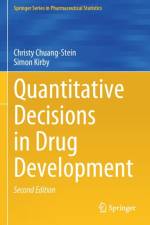
This book offers a high-level treatise of evidence-based decisions in drug development. Because of the inseparable relationship between designs and decisions, a good portion of this book is devoted to the design of clinical trials. The book begins with an overview of product development and regulatory approval pathways. It then discusses how to incorporate prior knowledge into study design and decision making at different stages of drug development. The latter include selecting appropriate metrics to formulate decisions criteria, determining go/no-go decisions for progressing a drug candidate to the next stage and predicting the effectiveness of a product. Lastly, it points out common mistakes made by drug developers under the current drug-development paradigm.The book offers useful insights to statisticians, clinicians, regulatory affairs managers and decision-makers in the pharmaceutical industry who have a basic understanding of the drug-development process and the clinical trials conducted to support drug-marketing authorization. The authors provide software codes for select analytical approaches discussed in the book. The book includes enough technical details to allow statisticians to replicate the quantitative illustrations so that they can generate information to facilitate decision-making themselves.
This book describes how a key signal/image processing algorithm ¿ that of the fast Hartley transform (FHT) or, via a simple conversion routine between their outputs, of the real¿data version of the ubiquitous fast Fourier transform (FFT) ¿ might best be formulated to facilitate computationally-efficient solutions. The author discusses this for both 1-D (such as required, for example, for the spectrum analysis of audio signals) and m¿D (such as required, for example, for the compression of noisy 2-D images or the watermarking of 3-D video signals) cases, but requiring few computing resources (i.e. low arithmetic/memory/power requirements, etc.). This is particularly relevant for those application areas, such as mobile communications, where the available silicon resources (as well as the battery-life) are expected to be limited. The aim of this monograph, where silicon¿based computing technology and a resource¿constrained environment is assumed and the data is real-valued in nature, hasthus been to seek solutions that best match the actual problem needing to be solved.
Abonner på vårt nyhetsbrev og få rabatter og inspirasjon til din neste leseopplevelse.
Ved å abonnere godtar du vår personvernerklæring.