

























Gjør som tusenvis av andre bokelskere
Abonner på vårt nyhetsbrev og få rabatter og inspirasjon til din neste leseopplevelse.
Ved å abonnere godtar du vår personvernerklæring.Du kan når som helst melde deg av våre nyhetsbrev.

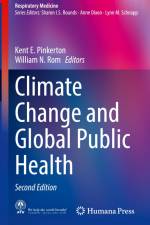
This book is a guide to the research, findings, and discussions of US and international experts on climate change and respiratory health. Since the publication of the first edition, climate change has been increasingly acknowledged as being directly related to the prevalence and incidence of respiratory morbidity. Evidence is increasing that climate change does drive respiratory disease onset and exacerbation as a result of increased ambient and indoor air pollution, desertification, heat stress, wildfires, and the geographic and temporal spread of pollens, molds and infectious agents. This second edition is fully updated to include the latest research by international experts on topics such as heat waves causing critical care-related diseases, climate-driven air pollution increases, and high-level ozone and ozone exposure linked to idiopathic pulmonary fibrosis, lung cancer, and acute lower respiratory infection. Seven new chapters have also been added on extreme weather and agricultural safety in California; desert dust effects on lung health; climate policy and the EPA; California's integrated approach to air quality and climate change; integrating climate change, the environment, and sustainability themes into professional health science courses; and the role of the physician as climate advocate. This is an ideal guide for all pulmonologists and health professionals treating patients with pulmonary disease.
This book articulates a unified theory of capitalism as an attempt to provide a comprehensive scientific theory of this social system. A unified theory of capitalism is not the combination of the predominant economic theories¿neoclassical, classical, and Keynesian¿so as to make them compatible. It is not a composite economic theory. It is a new economic theory. Predictions of the theory¿s models were consistent with eight basic empirical regularities of capitalism dealing with economic growth, income inequality, employment level, and environment degradation. Therefore, the unified theory can be accepted as a good approximation of the real capitalist world. But the models were constructed at a high level of abstraction. Also problematic was the need to work out more fully the public policy implications of the theory. It is, therefore, no wonder that essays on the unified theory to answer these questions are a natural outcome of a new scientific endeavor attempting to reach aunity of knowledge in economics.
Abonner på vårt nyhetsbrev og få rabatter og inspirasjon til din neste leseopplevelse.
Ved å abonnere godtar du vår personvernerklæring.