




Gjør som tusenvis av andre bokelskere
Abonner på vårt nyhetsbrev og få rabatter og inspirasjon til din neste leseopplevelse.
Ved å abonnere godtar du vår personvernerklæring.Du kan når som helst melde deg av våre nyhetsbrev.

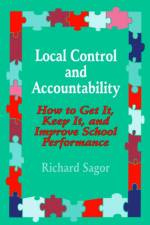
The increasing call for local control and accountability in United States' schools has resulted in a rapid bid by public schools to decentralize. This book includes techniques that have been used successfully by schools to implement and maintain local control programmes and policies to assist professionals involved in the decentralization process.
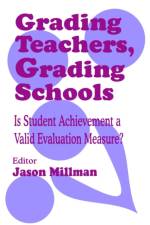
In an extensive review of teacher and school evaluation, one is not likely to find an issue more divisive than the question of how best, in high-stakes contexts, to evaluate how well teachers and schools accomplish their task of educating students. This book explores four contemporary approaches to evaluating the effectiveness of teachers and schools.
One of a series of practical references for teachers, this handbook provides general information on the background of the environmental studies curriculum in the United States. It contains current information on publications, standards and special materials for the curriculum, and is designed to be adapted to suit particular schools.
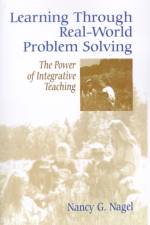
Engage your students in simultaneous learning - in language arts, science, math, and social studies - and help them create relevant experiences while pursuing real-life goals.
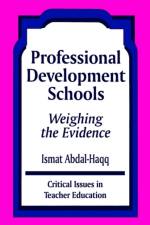
Commissioned by the AACTE in the United States, this book examines the purposes of professional development schools - which collaborate to improve curriculum, instruction and structure - and the problems encountered and the evidence for success or otherwise.
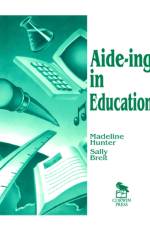
This effective guide has been used to train not only aides and volunteers but also teachers and administrators throughout the world. Madeline Hunter describes a number of staff meeting plans for using the principles of learning in daily classroom planning and teaching.
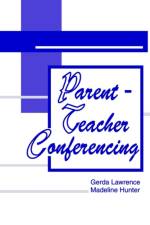
Although teachers hold many conferences with parents, most receive very little training in crucial communication theory and conferencing skills. This guide identifies the purposes of parent conferences and demonstrates skills including how to hold an effective conference; how to deliver an unwelcome message; and how to handle an uncommunicative parent.
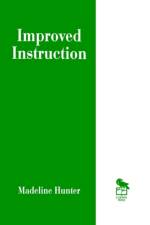
This is a clear, useful guide for teachers, administrators and student teachers in which Madeline Hunter offers ten step-by-step plans for staff development meetings. Each plan focuses on: one area of meeting; topics for staff discussion; long-range objectives; and follow-up activities.
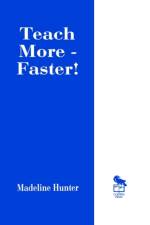
The elements which influence a student's rate and degree of learning are outlined in this volume. Madeline Hunter demonstrates a diversity of practical teaching techniques, including how to design practice so that it does `make perfect' and how to avoid the `black holes' in any sequence of learning.
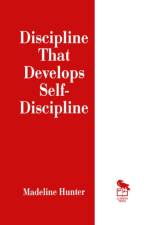
This 'how-to' book for teachers and administrators at all grades presents many proven techniques for reducing the time and effort spent on trying the achieve the important goal of student self-discipline.
This work describes how curriculum development, instruction, assessment, and teaching are different in a process-oriented learning organization.
This book details the steps that need to be taken to move from a traditional school system to a true learning organization.
The contributors present a strong case for teaching the learning process--which evidence shows can be more effective than the teaching of specific disciplines.
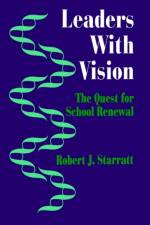
This book provides a new vision and theory of educational leadership. Robert J Starratt explores the `vision' element of leadership, and examines the policies, programmes and organizational arrangements which often impede this vision. Leaders with Vision provides a unique focus for principals and teachers who wish to exercise leadership in the ongoing work of school renewal.
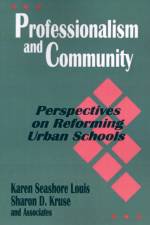
School-based professional community is a concept that portrays teachers as working together towards a set of shared goals of improved professionalism for themselves and increased learning opportunities for students. Attempts to put this into practice in urban schools in the United States have met with varying degrees of success. Using case studies, the contributors to this book examine the reasons for this inconsistency, focusing on the structural, social and human relations conditions of schooling.
This book provides unique insights into one of the United States' most comprehensive school-restructuring movements, the Accelerated Schools Project. Since its inception in 1986, the Project has aimed to transform school cultures which slow down learning through remediation into cultures which accelerate the learning of all students. The contributors to the book explore the challenges which face those involved in the Project.
Critical issues facing the future of teacher education are presented in this book. The contributors tackle factors including: multicultural education for an increasingly multicultural population; using technology in teacher preparation programmes; developing teacher leadership abilities for on the spot decision-making; and international perspectives in teacher education.
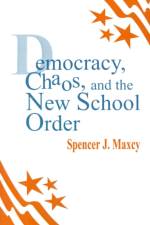
The author of this innovative book develops the thesis that educational reform in its current state is incomplete and ill-suited to democratic nations. Maxcy argues that 'decentralization' philosophies could seriously damage schools and children. He advocates a comprehensive 'new school order' to suit the changing features of postmodern culture. Key themes in this text include: poststructuralist versus structuralist assumptions; and order versus chaos in popular reform movements.Democracy, Chaos and the New School Order should become a landmark in postmodern approaches to education.
Based on a study of a group of teachers and principals, this book details the Maine Academy for School Leaders' programme which argues that there is a direct correlation between leadership effectiveness and the improvement of student performance. The authors explore the soundness of the programme's innovative ideas by following closely the results gained by the study group.
This guide provides educators and administrators with 21 quality tools for solving problems in the school environment and beyond. Each of the procedures is clearly described and has been adapted for use at four levels within the school system: district, school, classroom and home.
This book shows principals how they can make better decisions by using evaluation in a systematic way to find solutions to school problems. Cases of `real-life' problems are presented and analyzed and examples of solutions for commonly encountered problems are presented.The author demonstrates how the actual practice of school administrators can be studied and analyzed so as to inform theory/model building and how the resulting model in turn produces an instrument that allows school administrators to more systematically evaluate school problems and make decisions about them.
This book argues that if schools are to be successful learning places, the needs of teachers must be placed on a par with those of the students. The authors show how Total Quality Education schools address this problem, making learning an ongoing experience for both teachers and students.
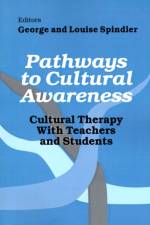
Cultural therapy is a way of helping people cope with cultural diversity and societal inequity through the mediation of the school as a central institution for cultural transmission and maintenance.This book illustrates how cultural therapy can be applied in educational settings to promote better understanding among teachers and students. Each chapter presents a situation in which the author has been intimately involved, offering a variety of approaches to, and interpretations of, cultural therapy.
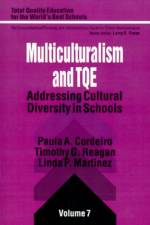
The authors of this book confront barriers of discrimination that must be overcome to ensure an equitable education for all students. Specific activities and approaches are included to broaden awareness, understanding and communication. The volume provides practical examples that can be used to incorporate the philosophy of TQE with multicultural teaching in positive and supporting ways.
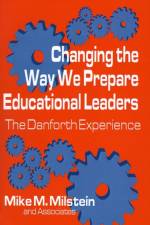
Educational practitioners in America have become disillusioned with university preparation programmes that fail to prepare them for the realities of the workplace. This volume summarizes the knowledge gained from five of the programmes instigated by the Danforth Foundation in its efforts to stimulate new approaches to the training of educational leaders. The ramifications of what has been learned is discussed and an analysis of future issues for American schools is provided.
By understanding the realities, complex relationships and conditions of practice that influence urban schooling, educators can take advantage of the opportunities that urban settings present. The authors identify nine key problems of practice affecting city schools in the United States and provide examples of the possible interventions needed to improve the education of urban youth. The theory, research and analytic tools relevant to each issue are presented clearly and in a non-technical way.
Abonner på vårt nyhetsbrev og få rabatter og inspirasjon til din neste leseopplevelse.
Ved å abonnere godtar du vår personvernerklæring.