












Gjør som tusenvis av andre bokelskere
Abonner på vårt nyhetsbrev og få rabatter og inspirasjon til din neste leseopplevelse.
Ved å abonnere godtar du vår personvernerklæring.Du kan når som helst melde deg av våre nyhetsbrev.

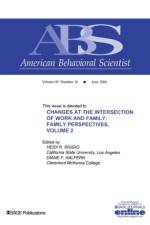
The largest social change in the last 50 years has been the increase in the number of women, especially mothers of young children, in the formal work force The May 2006 and June 2006 volumes of American Behavioral Scientist look at how this powerful transformation has impacted the venerable foundations of work and family, and reflect on the changes needed in organizational practices, social and public policy, families, and society in general to adapt to the changing 21st century workforce.Changes at the Intersection of Work and Family: Organizational and Worker Perspectives, Volume 1 (May 2006), edited by Diane F. Halpern and Heidi Riggio, focuses on organizational and worker perspectives. Many studies have shown that there is a substantial and practical return-on-investment for employers that adopt and commit to policies that help employees better manage the needs of both work and family, including fewer missed days of work, fewer "come late" or "leave early" days, reduced employee turnover, improved morale, and a better commitment to the employer. Volume 1 emphasizes topics such as the need for improved work-life policies, successful and promising public policy approaches, long-term work-life case studies from IBM, the dual-earner 60-hour work week, work-family and obesity and other health issues, the real and perceived negative consequences of taking advantage of family-friendly policies, the differences between male and female caregivers, and a whole-life approach to managing work and family.Changes at the Intersection of Work and Family: Family Perspectives, Volume 2 (June 2006), edited by Heidi Riggio and Diane F. Halpern, highlights family perspectives and issues such as working parents' expanding need for child care, after-school care, elder care, and medical leave. The six articles in this volume examine how policymakers and organizations can help maximize working families' health, productivity and happiness. Volume 2 covers subjects such as maternal employment and healthy child and young adult development, how working affects mothers' self-identity and other positive factors, the stress of parents coping with after-school child care, why community programs and support such as after-school programs are so necessary to working families, and how dual-earning households mutually influence each others retirement planning.The same important point is made in all of the articles in both volumes: there are tremendous changes taking place in families and in workplaces, and social, organizational, and public policies must be better aligned to meet to the needs of and to benefit from the greater diversity in today's families and workforce. Written by outstanding scholars and researchers in public policy, economics, sociology, psychology, business, and family studies, including Barbara Gault, Vicky Lovell, E. Jeffrey Hill et al., Tammy D. Allen, Jeremy Armstrong, Robert Drago et al., Noelle Chesley, Stewart D. Friedman, Allen W. Gottfried, Adele E. Gottfried, Patricia M. Raskin, Rosalind C. Barnett, Karen C. Gareis, Marcie Pitts-Catasouphes, and Phyllis Moen, the articles in both volumes ask critical questions and offer some interesting and sensible solutions to the changing realities of work and family. These volumes should be in the library and in the classrooms of everyone interested in Public Policy, Business/Management, Psychology, Family Studies, Sociology, and Economics.
In George Bush's Second Inaugural Address, he stated, "so it is the policy of the United States to seek and support the growth of democratic movements and institutions in every nation and culture ..."Along with such a formidable challenge, comes the essential need for scholars and policy makers alike to gain a deeper understanding of the interrelationship between law, society, and culture. Collected from the successful 2005 Syracuse conference of the same name, the papers in this unique issue of The ANNALS zero in on critical studies that focus on other societies - which are evolving toward (or away from) constitutional democracy and a rule of law. Not to be confused with Social Darwinism, the term legal evolution in this context refers to the development or changes of law; and the papers included here demonstrate value-free objectivity - not labeling the results as either "good" or "bad." Rather than offering a prescriptive or claiming a precise forecast, this collection of thoughtful research examines the sociocultural foundations on which law is built, constructing the groundwork for the advancement of policy and further exploration in this intriguing area of study. The intense research conducted by these authors shines through as they elucidate the patterns of legal development and governmental change in societies abroad. Their reports and analysis will help readers understand the diversity of sociolegal systems and divergent paths that have been followed as laws have developed in a wide variety of societies, including South Africa, Germany, Latin America Sudan, Saudi-Arabia, and China. Terrorism remains an underlying issue in both a domestic and global perspective. Can law contribute to the control of terrorism? Are we moving toward global rules of law? What are the consequences of transitioning toward democracy? The thoughtful papers in this issue address these and other timely topics. How can legal evolution be a useful tool for analyzing social change? How well does law in any society express and implement the needs of the population? What effect do social mores have on the effectiveness of law? The complexity of these questions cannot be easily answered. However, after carefully reviewing the rich collection of ideas gathered in this single issue, scholars and policy makers will gain a deeper understanding of the evolution of law and constitutional democracy.
In George Bush's Second Inaugural Address, he stated, "so it is the policy of the United States to seek and support the growth of democratic movements and institutions in every nation and culture ..."Along with such a formidable challenge, comes the essential need for scholars and policy makers alike to gain a deeper understanding of the interrelationship between law, society, and culture. Collected from the successful 2005 Syracuse conference of the same name, the papers in this unique issue of The ANNALS zero in on critical studies that focus on other societies - which are evolving toward (or away from) constitutional democracy and a rule of law. Not to be confused with Social Darwinism, the term legal evolution in this context refers to the development or changes of law; and the papers included here demonstrate value-free objectivity - not labeling the results as either "good" or "bad." Rather than offering a prescriptive or claiming a precise forecast, this collection of thoughtful research examines the sociocultural foundations on which law is built, constructing the groundwork for the advancement of policy and further exploration in this intriguing area of study. The intense research conducted by these authors shines through as they elucidate the patterns of legal development and governmental change in societies abroad. Their reports and analysis will help readers understand the diversity of sociolegal systems and divergent paths that have been followed as laws have developed in a wide variety of societies, including South Africa, Germany, Latin America Sudan, Saudi-Arabia, and China. Terrorism remains an underlying issue in both a domestic and global perspective. Can law contribute to the control of terrorism? Are we moving toward global rules of law? What are the consequences of transitioning toward democracy? The thoughtful papers in this issue address these and other timely topics. How can legal evolution be a useful tool for analyzing social change? How well does law in any society express and implement the needs of the population? What effect do social mores have on the effectiveness of law? The complexity of these questions cannot be easily answered. However, after carefully reviewing the rich collection of ideas gathered in this single issue, scholars and policy makers will gain a deeper understanding of the evolution of law and constitutional democracy.
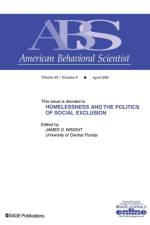
"Homelessness is not one problem, but many different kinds of problems involving many different kinds of people, each of them homeless for different reasons or who have become homeless in different ways... Among the homeless of today are men, women, children, and whole families; victims of domestic violence and male abandonment; young, middle-aged, and elderly; veterans; illegal immigrants; persons of every ethnic description; people who are homeless for strictly economic reasons; others who are homeless because they drink and drug too much; the lucid and the deranged; and on through a long list...." James Wright University of Central Florida Bringing together international perspectives from sociology, political science, public policy, criminology, urban studies, adolescent research, and social work, this fascinating April 2005 issue of American Behavioral Scientist (ABS), entitled Homelessness and the Politics of Social Exclusion focuses on pioneering research about how the homeless are marginalized in societies around the world and the consequences of this social exclusion. Based on presentations at the American Sociological Association's 2003 Annual Meeting, the authors of this unique volume discuss: Why the characteristics of both Los Angeles and Berlin homeless populations are similar despite different welfare systems and public policies (von Mahs)How staff create, sustain, and escalate conflict in a drop-in center for street kids (Joniak)Structural changes in Japanese society and the recent growth of homelessness (Hasegawa)The risks and conditions of semipermanent makeshift housing such as RVs (Wakin)Whether the presence of homeless persons near or in residential areas is a mark of encroaching urban disorder that undermines neighborhood quality and engenders fear among neighborhood residents (Farrell)Marginality and criminal victimization among homeless people (Lee and Schreck)The complex relationships between homeless women and their intimate partners (Wesley and Wright)
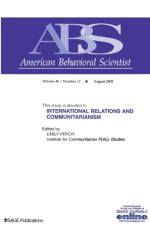
Communitarianism is an intriguing social theory that states community and the social bonds of family, traditional values, and education are the main building blocks of a new supranational global order. One of its strongest proponents, Amitai Etzioni, posits that the "transnational threats facing humankind today are so overwhelming that soon all nations will experience a convergence of values and priorities, which will lay the groundwork for eventual global governance. " The eight articles presented by the August 2005 issue of American Behavioral Scientist offer a fascinating and spirited dialogue regarding the concurrences and contradictions of communitarianism within the context of international relations. They tackle a range of topics first addressed in Etzioni's treatise From Empire to Community: A New Approach to International Relations, including:Evaluating the European Union as a test case for communitarianism (Goldgeier) How communitarianism predicts that U.S. hegemony will be transcended and how this fits in with the U.S.', particularly the Bush administration's, grand strategy (Hentz) Does Etizioni's nationalistic approach to U.S. foreign policy negate communitarianism's ethical problem-solving framework? (Falk) Communitarian Realism and the emergence of common norms through coping with global challenges (Gvosdev) The four fatal flaws of Communitarianism (Gray) Whether sustainable economic or political integration is possible without global social assimilation taking place (Müllerson) Etzioni's Response, including a quick summary of the communitarian paradigm (Etzioni) A call by Ambassador Max M. Kampelman to bolster international community through the elimination of all nuclear weapons, the establishment of a national voluntary Civilian Conservation Corps for 18-21 year olds, and the creation of a new education incentive along the lines of the Roosevelt G.I. Bill of Rights.This issue offers a balanced view of a much-disputed theory and belongs in the library of every political scientist , sociologist , and everyone interested in the state of the world around them.
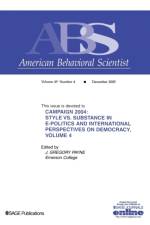
The 2004 American Presidential campaign was a watershed event for many reasons, but especially because the line between statesmanship and showmanship became extremely blurred. Because of the importance of this American election, American Behavioral Scientist is dedicating four issues, entitled Campaign 2004, Volumes 1-4, edited by J. Gregory Payne of Emerson College, to analysis of Campaign 2004, both Presidential and Senatorial, and contemporary issues and dynamics in political communication.According to public relations guru, James Grunig, political communication is more and more about meaningful relationships the public has with candidates who try to mirror their values, beliefs, and attitudes. Campaign 2004 was unique because of the use of new technologies such as cable television talk shows, the Internet, Web pages, blogs, and VNRs (simulated video new releases) enabled candidates to target their messages and communication images to smaller groups. The new media challenged the traditional mainstream media by providing a venue for unrestrained, less commercial, and sometimes more global information. Campaign 2004 also shamelessly used staged pseudoevents and celebrity spectacles as "infotainment,' and spent over $620 million on mostly negative political advertising to spell out issues and to try to set the future political agenda. The four volumes of Campaign 2004 evaluate the successes and failures of Campaign 2004 and offer some practical insights for future campaigns.Volume I of Campaign 2004 concentrates on campaign rhetoric and the battle for attention in the campaign primaries. Volume 2 changes direction by focusing on the effectiveness of presidential debates, political advertising, and leadership, as well as showcasing the Senate races in South Dakota and Illinois. Volume 3 considers trends in new media, mediated reality, and the politics of pseudoevents and celebrity/spectacle, while Volume 4 offers international reflections and perspectives on democracy, and elections in the Middle East and Europe. Campaign 2004, Volumes 1-4 belongs in the library of every one interested in political science, political communication, international relations, mass communication, mass media, journalism, sociology, marketing/advertising, discourse analysis, and rhetoric.Volume 1: Constructing the New American Ideals/Idols in Democracy (ISBN: 1-4129-3921-6)Volume 2: De/Constructing the Mediated Realities of Presidential debates, Political Advertising, and Showvase Senate Races (ISBN: 1-4129-3922-4)Volume 3: The Political Celebrity Spectacle: De/Constructing Image Meaning/Mongering (ISBN: 1-4129-3923-2)Volume 4: Style versus Substance in E-Politics and International Perspectives on Democracy (ISBN: 1-4129-3924-0)
Exercises in Media WritingKey Features: Review Questions help you recall and master core chapter concepts Writing ExercisesDynamics of Media Writing, Second Edition.
Conducting Research in Psychology: Measuring the Weight of Smoke provides students an engaging introduction to psychological research by employing humor, stories, and hands-on activities.
Social Work Practice With Older Adults by Jill Chonody and Barbra Teater presents a contemporary framework based on the World Health Organization’s active aging policy that allows forward-thinking students to focus on client strengths and resources when working with the elderly. The Actively Aging framework takes into account health, social, behavioral, economic, and personal factors as they relate to aging, but also explores environmental issues, which aligns with the new educational standards put forth by the Council on Social Work Education. Covering micro, mezzo, and macro practice domains, the text examines all aspects of working with aging populations, from assessment through termination.
Does testable, replicable empirical evidence exist to support the notion that biology can help explain political behavior? The past practice of political science has been to ignore the growing biological knowledge base. Perhaps because mass-scale politics seem so cerebral and rational, scholars of politics are prone to conclude that it somehow transcends biology. Not true. This fascinating issue of The ANNALS draws on the recent advancements in biological insights and applies them to political science. Pulling from a range of topics ΓÇô including the role of personality traits in political decisions; personal temperament and social behavior; and how neuroendocrine mechanisms (stress-coping strategies) and social dominance influence leadership potential ΓÇô this issue calls for the cooperation between political scientists and life scientists. Other social sciences merge biological research with their studies. In psychology, research has connected personal traits (such as risk-taking, depression, extroversion) to neurotransmitter levels and genetics. Evolutionary psychology has demonstrated that universal human tendencies are products of evolutionary pressures. In economics, behavioral economics and neuroeconimcs draw heavily from biological concepts. And in sociology, long-established research tradition has attempted to connect neurotransmitters and hormones to social behavior. Now is the time for political science to embrace natural science. Biology is a stronger force than ever, interacting with human culture in complex ways. By leveraging that knowledge, political science is positioned to make giant strides forward in new avenues of research. Most of the compelling articles included in the collection rely on original and empirical findings. Students and researchers will find this special issue a unique and inspiring perspective on applying the remarkable techniques developed in neuroscience, experimental economics, computer simulations, psychophysiology, behavioral genetics, and molecular biology to future political science research projects.
This updated bestseller offers a roadmap for reflective practice that presents research-based information and ideas and strategies for engaging in reflective practice alone, with partners, in small groups, and even schoolwide.
Criminological Theory: A Text/Reader, Third Edition, by Stephen G. Tibbetts and Craig T. Hemmens helps you understand criminological theory, with each authored section of the text enhanced by empirical research articles that put theory into context. Key criminological theories are introduced and followed by articles that show how criminological theory can be applied to current policies, challenges, and issues, making it easier for you to connect theory and application.New to the Third Edition: Updated journal articles introduce you to important topics, such as media consumption and support for capital punishment, gender differences in delinquency, bias and police stops, and the effectiveness of reintegrative shaming and restorative justice. A new section dedicated entirely to feminist perspectives introduces you to feminist models of crime and underscores the importance of examining research related to female offending. A stronger global view integrated throughout the book increases your exposure to criminological research and theory across nations and continents. Several of the new readings are written by authors or use samples from outside the United States, including South Africa, Brazil, Canada, Korea, and more. New case studies examine offender motives to help you apply the theories discussed to interesting and memorable examples. Policy is now integrated into each section, allowing you to see the practical policy implications of each theory. Coverage of critical topics has been expanded throughout to introduce you to important issues, such as the influence of employment on criminal behavior, the success of school programs in reducing delinquent behavior, and federal sentencing guidelines in regard to crack versus powder cocaine. Statistics, graphs, and tables have all been updated to demonstrate the most recent trends in criminology.
The new Fifth Edition of The SAGE Handbook of Qualitative Research has been significantly revised, and draws together a team of leading scholars to present the latest in the theory and practice of qualitative research.
This accessible book is one volume of a four-book series enabling understanding of Academic Language development among English Language Learners and speakers of non-standard English.
Culture has returned to the poverty research agenda. Over the past decade, sociologists, demographers, and even economists have begun asking questions about the role of culture in many aspects of poverty, at times even explaining the behavior of low-income populations in reference to cultural factors. This book deals with this topic.
In Read, Talk, Write, Laura Robb brings her trademark practicality with 35 lessons and reproducibles that ensure your students succeed as well as love what they do.
This book demystifies blended learning for teachers and schools looking for alternatives to a traditional approach to teaching. The educational landscape is changing, but teachers and schools need practical resources to help them navigate these changes so that they are exciting, not scary.
For Evidence-Based Writing: Fiction, renowned teacher Leslie Blauman combed the standards and her classroom bookshelves to craft lessons that make writing about reading a clear, concrete process.
This book provides new perspectives on tackling bullying based on those who are at the heart of the interaction-the ones we have traditionally labelled the bully.
One of the most historically successful publications at CQ Press, this title is focused on Washington - an organization must have an office in Washington to be listed.
Use this resource to promote academic success for English learners in the K-5 classroom through an approach that integrates inquiry-based science lessons with language rich, hands-on experiences.
The SAGE Encyclopedia of Alcohol examines the history of alcohol worldwide and goes beyond the historical lens to examine alcohol as a cultural and social phenomenon, used both for good and for ill.
This practical, easy-to-use handbook offers a comprehensive plan, guiding general educators, special educators, administrators, and school psychologists through the eligibility and evaluation stages that ensure students get the best services and support they need to be successful.
This practical resource enables teachers to confidently plan and manage effective mobile technology lessons, with step-by-step instructions for digital photography, video, ePublishing and more so that students are transformed into content creators.
Presenting excerpts from documents on the important events of each year for the United States and the World, this volume includes 60 to 70 events with well over 100 documents from the previous year, from official reports and surveys to speeches from leaders and opinion makers, to court cases, legislation, testimony, and more.
A collection of practical articles on best practices in classroom management and assessment by the premier researchers and authors in the US and UK.
Offers a practical, step-by-step guide to help students develop and practice essential skills necessary for their careers as counselors. This book focuses on activities and application and also encourages deep reflection at every stage to help the student internalize the concepts presented.
This practical follow-up to Bray and McClaskey's first book brings theory to practice. Teachers will discover how to build a shared vision that supports personalized learning using the Universal Design for Learning (UDL) framework.
Abonner på vårt nyhetsbrev og få rabatter og inspirasjon til din neste leseopplevelse.
Ved å abonnere godtar du vår personvernerklæring.