



























Gjør som tusenvis av andre bokelskere
Abonner på vårt nyhetsbrev og få rabatter og inspirasjon til din neste leseopplevelse.
Ved å abonnere godtar du vår personvernerklæring.Du kan når som helst melde deg av våre nyhetsbrev.

Lionel Robbins's now famous lectures on the history of economic thought comprise one of the greatest accounts since World War II of the evolution of economic ideas. This volume represents the first time those lectures have been published. Lord Robbins (1898-1984) was a remarkably accomplished thinker, writer, and public figure. He made important contributions to economic theory, methodology, and policy analysis, directed the economic section of Winston Churchill's War Cabinet, and served as chairman of the Financial Times. As a historian of economic ideas, he ranks with Joseph Schumpeter and Jacob Viner as one of the foremost scholars of the century. These lectures, delivered at the London School of Economics between 1979 and 1981 and tape-recorded by Robbins's grandson, display his mastery of the intellectual history of economics, his infectious enthusiasm for the subject, and his eloquence and incisive wit. They cover a broad chronological range, beginning with Plato, Aristotle, and Aquinas, focusing extensively on Adam Smith, Thomas Malthus and the classicals, and finishing with a discussion of moderns and marginalists from Marx to Alfred Marshall. Robbins takes a varied and inclusive approach to intellectual history. As he says in his first lecture: "e;I shall go my own sweet way--sometimes talk about doctrine, sometimes talk about persons, sometimes talk about periods."e; The lectures are united by Robbins's conviction that it is impossible to understand adequately contemporary institutions and social sciences without understanding the ideas behind their development. Authoritative yet accessible, combining the immediacy of the spoken word with Robbins's exceptional talent for clear, well-organized exposition, this volume will be welcomed by anyone interested in the intellectual origins of the modern world.
Cultures around the world have regarded self-fulfillment as the ultimate goal of human striving and as the fundamental test of the goodness of a human life. The ideal has also been criticized, however, as egotistical or as so value-neutral that it fails to distinguish between, for example, self-fulfilled sinners and self-fulfilled saints. Alan Gewirth presents here a systematic and highly original study of self-fulfillment that seeks to overcome these and other arguments and to justify the high place that the ideal has been accorded. He does so by developing an ethical theory that ultimately grounds the value of self-fulfillment in the idea of the dignity of human beings. Gewirth begins by distinguishing two models of self- fulfillment--aspiration-fulfillment and capacity-fulfillment--and shows how each of these contributes to the intrinsic value of human life. He then distinguishes between three types of morality--universalist, particularist, and personalist--and shows how each contributes to the values embodied in self-fulfillment. Building on these ideas, he develops a Odialectical' conception of reason that shows how human rights are central to self-fulfillment. Gewirth also argues that self-fulfillment has a social as well as an individual dimension: that the nature of society and the obstacles that disadvantaged groups face affect strongly the character of the self-fulfillment that persons can achieve. Bold in scope and rigorous in execution, Self-Fulfillment is a powerful new contribution to moral, social, and political philosophy.
Charles Siewert presents a distinctive approach to consciousness that emphasizes our first-person knowledge of experience and argues that we should grant consciousness, understood in this way, a central place in our conception of mind and intentionality. Written in an engaging manner that makes its recently controversial topic accessible to the thoughtful general reader, this book challenges theories that equate consciousness with a functional role or with the mere availability of sensory information to cognitive capacities. Siewert argues that the notion of phenomenal consciousness, slighted in some recent theories, can be made evident by noting our reliance on first-person knowledge and by considering, from the subject's point of view, the difference between having and lacking certain kinds of experience. This contrast is clarified by careful attention to cases, both actual and hypothetical, indicated by research on brain-damaged patients' ability to discriminate visually without conscious visual experience--what has become known as "e;blindsight."e; In addition, Siewert convincingly defends such approaches against objections that they make an illegitimate appeal to "e;introspection."e; Experiences that are conscious in Siewert's sense differ from each other in ways that only what is conscious can--in phenomenal character--and having this character gives them intentionality. In Siewert's view, consciousness is involved not only in the intentionality of sense experience and imagery, but in that of nonimagistic ways of thinking as well. Consciousness is pervasively bound up with intelligent perception and conceptual thought: it is not mere sensation or "e;raw feel."e; Having thus understood consciousness, we can better recognize how, for many of us, it possesses such deep intrinsic value that life without it would be little or no better than death.
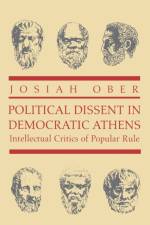
How and why did the Western tradition of political theorizing arise in Athens during the late fifth and fourth centuries B.C.? By interweaving intellectual history with political philosophy and literary analysis, Josiah Ober argues that the tradition originated in a high-stakes debate about democracy. Since elite Greek intellectuals tended to assume that ordinary men were incapable of ruling themselves, the longevity and resilience of Athenian popular rule presented a problem: how to explain the apparent success of a regime "e;irrationally"e; based on the inherent wisdom and practical efficacy of decisions made by non-elite citizens? The problem became acute after two oligarchic coups d' tat in the late fifth century B.C. The generosity and statesmanship that democrats showed after regaining political power contrasted starkly with the oligarchs' violence and corruption. Since it was no longer self-evident that "e;better men"e; meant "e;better government,"e; critics of democracy sought new arguments to explain the relationship among politics, ethics, and morality. Ober offers fresh readings of the political works of Thucydides, Plato, and Aristotle, among others, by placing them in the context of a competitive community of dissident writers. These thinkers struggled against both democratic ideology and intellectual rivals to articulate the best and most influential criticism of popular rule. The competitive Athenian environment stimulated a century of brilliant literary and conceptual innovation. Through Ober's re-creation of an ancient intellectual milieu, early Western political thought emerges not just as a "e;footnote to Plato,"e; but as a dissident commentary on the first Western democracy.
Japanese industry is the envy of the world for its efficient and humane management practices. Yet, as William Tsutsui argues, the origins and implications of "e;Japanese-style management"e; are poorly understood. Contrary to widespread belief, Japan's acclaimed strategies are not particularly novel or even especially Japanese. Tsutsui traces the roots of these practices to Scientific Management, or Taylorism, an American concept that arrived in Japan at the turn of the century. During subsequent decades, this imported model was embraced--and ultimately transformed--in Japan's industrial workshops. Imitation gave rise to innovation as Japanese managers sought a "e;revised"e; Taylorism that combined mechanistic efficiency with respect for the humanity of labor. Tsutsui's groundbreaking study charts Taylorism's Japanese incarnation, from the "e;efficiency movement"e; of the 1920s, through Depression-era "e;rationalization"e; and wartime mobilization, up to postwar "e;productivity"e; drives and quality-control campaigns. Taylorism became more than a management tool; its spread beyond the factory was a potent intellectual template in debates over economic growth, social policy, and political authority in modern Japan. Tsutsui's historical and comparative perspectives reveal the centrality of Japanese Taylorism to ongoing discussions of Japan's government-industry relations and the evolution of Fordist mass production. He compels us to rethink what implications Japanese-style management has for Western industries, as well as the future of Japan itself.
A major casualty of the assassin's bullet that struck down Israeli Prime Minister Yitzhak Rabin was a prospective peace accord between Syria and Israel. For the first time, a negotiator who had unique access to Rabin, as well as detailed knowledge of Syrian history and politics, tells the inside story of the failed negotiations. His account provides a key to understanding not only U.S. diplomacy in the Middle East but also the larger Arab-Israeli peace process. During the period from 1992 to 1996, Itamar Rabinovich was Israel's ambassador to Washington, and the chief negotiator with Syria. In this book, he looks back at the course of negotiations, terms of which were known to a surprisingly small group of American, Israeli, and Syrian officials. After Benjamin Netanyahu's election as Israel's prime minister in May 1996, a controversy developed. Even with Netanyahu's change of policy and harder line toward Damascus, Syria began claiming that both Rabin and his successor Peres had pledged full withdrawal from the Golan Heights. Rabinovich takes the reader through the maze of diplomatic subtleties to explain the differences between hypothetical discussion and actual commitment. "e;To the students of past history and contemporary politics,"e; he writes, "e;nothing is more beguiling than the myriad threads that run across the invisible line which separates the two."e; The threads of this story include details of Rabin's negotiations and their impact through two subsequent Israeli administrations in less than a year, the American and Egyptian roles, and the ongoing debate between Syria and Israel on the factual and legal bases for resuming talks. The author portrays all sides and participants with remarkable flair and empathy, as only a privileged player in the events could do. In any assessment of future negotiations in the Middle East, Itamar Rabinovich's book will prove indispensable.
The late eighteenth century witnessed an influx of black women to the slave-trading ports of the American Northeast. The formation of an early African American community, bound together by shared experiences and spiritual values, owed much to these women's voices. The significance of their writings would be profound for all African Americans' sense of their own identity as a people. Katherine Clay Bassard's book is the first detailed account of pre-Emancipation writings from the period of 1760 to 1863, in light of a developing African American religious culture and emerging free black communities. Her study--which examines the relationship among race, culture, and community--focuses on four women: the poet Phillis Wheatley and poet and essayist Ann Plato, both Congregationalists; and the itinerant preacher Jarena Lee, and Shaker eldress Rebecca Cox Jackson, who, with Lee, had connections with African Methodism. Together, these women drew on what Bassard calls a "e;spirituals matrix,"e; which transformed existing literary genres to accommodate the spiritual music and sacred rituals tied to the African diaspora. Bassard's important illumination of these writers resurrects their path-breaking work. They were cocreators, with all black women who followed, of African American intellectual life.
In this powerful work, Susan Friedman moves feminist theory out of paralyzing debates about us and them, white and other, first and third world, and victimizers and victims. Throughout, Friedman adapts current cultural theory from global and transnational studies, anthropology, and geography to challenge modes of thought that exaggerate the boundaries of gender, race, ethnicity, sexuality, class, and national origin. The author promotes a transnational and heterogeneous feminism, which, she maintains, can replace the proliferation of feminisms based on difference. She argues for a feminist geopolitical literacy that goes beyond fundamentalist identity politics and absolutist poststructuralist theory, and she continually focuses the reader's attention on those locations where differences are negotiated and transformed. Pervading the book is a concern with narrative: the way stories and cultural narratives serve as a primary mode of thinking about the politically explosive question of identity. Drawing freely on modernist novels, contemporary film, popular fiction, poetry, and mass media, the work features narratives of such writers and filmmakers as Gish Jen, Julie Dash, June Jordon, James Joyce, Gloria Anzald%a, Neil Jordon, Virginia Woolf, Mira Nair, Zora Neale Hurston, E. M. Forster, and Irena Klepfisz. Defending the pioneering role of academic feminists in the knowledge revolution, this work draws on a wide variety of twentieth-century cultural expressions to address theoretical issues in postmodern feminism.
This ground-breaking work documents Russian efforts to appropriate Western solutions to the problem of economic backwardness since the time of Catherine the Great. Entangled then as now with issues of cultural borrowing, educated Russians searched for Western nations, ideas, and social groups that embodied universal economic truths applicable to their own country. Esther Kingston-Mann describes Russian Westernization--which emphasized German as well as Anglo-U.S. economics--while she raises important questions about core values of Western culture and how cultural values and priorities are determined. This is the first historical account of the significant role played by Russian social scientists in nineteenth-century Western economic and social thought. In an era of rapid Western colonial expansion, the Russian quest for the "e;right"e; Western economic model became more urgent: Was Russia condemned to the fate of India if it did not become an England? In the 1900s, Russian liberal economists emphasized cultural difference and historical context, while Marxists and prerevolutionary government reformers declared that inexorable economic laws doomed peasants and their "e;medieval"e; communities. On the eve of 1917, both the tsarist regime and its leading critics agreed that Russia must choose between Western-style progress or "e;feudal"e; stagnation. And when peasants and communes survived until Stalin's time, he mercilessly destroyed them in the name of progress. Today Russia's painful modernizing traditions shape the policies of contemporary reformers, who seem as certain as their predecessors that economic progress requires wholesale obliteration of the past.
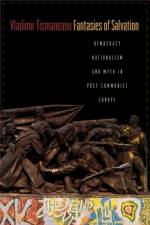
Eastern Europe has become an ideological battleground since the collapse of the Soviet Union, with liberals and authoritarians struggling to seize the ground lost by Marxism. In Fantasies of Salvation, Vladimir Tismaneanu traces the intellectual history of this struggle and warns that authoritarian nationalists pose a serious threat to democratic forces. A leading observer of the often baffling world of post-Communist Europe, Tismaneanu shows that extreme nationalistic and authoritarian thought has been influential in Eastern Europe for much of this century, while liberalism has only shallow historical roots. Despite democratic successes in places such as the Czech Republic and Poland, he argues, it would be a mistake for the West to assume that liberalism will always triumph. He backs this argument by showing how nationalist intellectuals have encouraged ethnic hatred in such countries as Russia, Romania, and the former Yugoslavia by reviving patriotic myths of heroes, scapegoats, and historical injustices. And he shows how enthusiastically these myths have been welcomed by people desperate for some form of "e;salvation"e; from political and economic uncertainty. On a theoretical level, Tismaneanu challenges the common ideas that the ideological struggle is between "e;right"e; and "e;left"e; or between "e;nationalists"e; and "e;internationalists."e; In a careful analysis of the conflict's ideological roots, he argues that it is more useful and historically accurate to view the struggle as between those who embrace the individualist traditions of the Enlightenment and those who reject them. Tismaneanu himself has been active in the intellectual battles he describes, particularly in his native Romania, and makes insightful use of interviews with key members of the dissident movements of the 1970s and 1980s. He offers original observations of countries from the Baltic to the Black Sea and expresses his ideas in a vivid and forceful style. Fantasies of Salvation is an indispensable book for both academic and nonacademic readers who wish to understand the forces shaping one of the world's most important and unpredictable regions.
This is the first book to describe the intimate relationship between Latin literature and the politics of ancient Rome. Until now, most scholars have viewed classical Latin literature as a product of aesthetic concerns. Thomas Habinek shows, however, that literature was also a cultural practice that emerged from and intervened in the political and social struggles at the heart of the Roman world. Habinek considers major works by such authors as Cato, Cicero, Horace, Ovid, and Seneca. He shows that, from its beginnings in the late third century b.c. to its eclipse by Christian literature six hundred years later, classical literature served the evolving interests of Roman and, more particularly, aristocratic power. It fostered a prestige dialect, for example; it appropriated the cultural resources of dominated and colonized communities; and it helped to defuse potentially explosive challenges to prevailing values and authority. Literature also drew upon and enhanced other forms of social authority, such as patriarchy, religious ritual, cultural identity, and the aristocratic procedure of self-scrutiny, or existimatio. Habinek's analysis of the relationship between language and power in classical Rome breaks from the long Romantic tradition of viewing Roman authors as world-weary figures, aloof from mundane political concerns--a view, he shows, that usually reflects how scholars have seen themselves. The Politics of Latin Literature will stimulate new interest in the historical context of Latin literature and help to integrate classical studies into ongoing debates about the sociology of writing.
A generation ago, scholars saw interest groups as the single most important element in the American political system. Today, political scientists are more likely to see groups as a marginal influence compared to institutions such as Congress, the presidency, and the judiciary. Frank Baumgartner and Beth Leech show that scholars have veered from one extreme to another not because of changes in the political system, but because of changes in political science. They review hundreds of books and articles about interest groups from the 1940s to today; examine the methodological and conceptual problems that have beset the field; and suggest research strategies to return interest-group studies to a position of greater relevance. The authors begin by explaining how the group approach to politics became dominant forty years ago in reaction to the constitutional-legal approach that preceded it. They show how it fell into decline in the 1970s as scholars ignored the impact of groups on government to focus on more quantifiable but narrower subjects, such as collective-action dilemmas and the dynamics of recruitment. As a result, despite intense research activity, we still know very little about how groups influence day-to-day governing. Baumgartner and Leech argue that scholars need to develop a more coherent set of research questions, focus on large-scale studies, and pay more attention to the context of group behavior. Their book will give new impetus and direction to a field that has been in the academic wilderness too long.
From ritual killings to subtle acts of self-denial, the practice and rhetoric of sacrifice has a special centrality in modern American literature. In a compelling interdisciplinary investigation, Susan Mizruchi portrays an episode in American cultural history when the literary movement of realism and the fledgling field of sociology both converged in the belief that sacrifice is basic to sociality. This is a book about the fascination that sacrifice held for writers--principally Herman Melville, Henry James, and W.E.B. Du Bois--and also for those who articulated the main tenets of modern social theory, an inquiry that eventually spans historical events such as public lynchings and the political scapegoating of immigrants a century ago. The execution in Billy Budd Sailor, the death of Du Bois's first-born son in The Souls of Black Folk, Henry James's preoccupation with renunciation and scapegoating, and the self-denying working classes of Norris and Stein all illustrate repeated stagings of sacrificial rituals from a Biblical past. For Mizruchi, the peculiar persistence of this aesthetic construct becomes a guide to a rich theological and social-scientific tradition distinctive to the late nineteenth and early twentieth centuries, and including such influential works as Smith's Lectures on the Religion of the Semites, Frazer's Golden Bough, and Ross's Sin and Society. The major features of sacrifice--its original association with spiritual doubt, its function as a form of spiritual economics that sustained divisions between the fortunate and the bereft, and its role in fixing boundaries between aliens and kin--held strong symbolic value for writers struggling to reconcile faith with rationalism, and communal coherence with capitalist expansion. Mizruchi eloquently demonstrates how the conceptual power of sacrifice made it a key mediator of cultural change, from the decline of sympathy and the significance of "e;race"e; in an emerging multicultural society to the revival of maternal self-sacrifice.
The subject of personal identity is one of the most central and most contested and exciting in philosophy. Ever since Locke, psychological and bodily criteria have vied with one another in conflicting accounts of personal identity. Carol Rovane argues that, as things stand, the debate is unresolvable since both sides hold coherent positions that our common sense, she maintains, is conflicted; so any resolution to the debate is bound to be revisionary. She boldly offers such a revisionary theory of personal identity by first inquiring into the nature of persons.Rovane begins with a premise about the distinctive ethical nature of persons to which all substantive ethical doctrines, ranging from Kantian to egoist, can subscribe. From this starting point, she derives two startling metaphysical possibilities: there could be group persons composed of many human beings and muliple persons within a single human being. Her conclusions supports Locke's distinction between persons and human beings, but on altogether new grounds. These grounds lie in her radically normative analysis of the condition of personal identity, as the condition in which a certain normative commitment arises, namely, the commitment to achieve overall rational unity within a rational point of view. It is by virtue of this normative commitment that individual agents can engage one another specifically as persons, and possess the distinctive ethical status of persons.Carol Rovan is Associate Professor of Philosophy at Yale University.Originally published in 1997.The Princeton Legacy Library uses the latest print-on-demand technology to again make available previously out-of-print books from the distinguished backlist of Princeton University Press. These editions preserve the original texts of these important books while presenting them in durable paperback and hardcover editions. The goal of the Princeton Legacy Library is to vastly increase access to the rich scholarly heritage found in the thousands of books published by Princeton University Press since its founding in 1905.
Based on more than three decades of observation, Robert Jervis concludes in this provocative book that the very foundations of many social science theories--especially those in political science--are faulty. Taking insights from complexity theory as his point of departure, the author observes that we live in a world where things are interconnected, where unintended consequences of our actions are unavoidable and unpredictable, and where the total effect of behavior is not equal to the sum of individual actions. Jervis draws on a wide range of human endeavors to illustrate the nature of these system effects. He shows how increasing airport security might actually cost lives, not save them, and how removing dead trees (ostensibly to give living trees more room) may damage the health of an entire forest. Similarly, he highlights the interconnectedness of the political world as he describes how the Cold War played out and as he narrates the series of events--with their unintended consequences--that escalated into World War I. The ramifications of developing a rigorous understanding of politics are immense, as Jervis demonstrates in his critique of current systemic theories of international politics--especially the influential work done by Kenneth Waltz. Jervis goes on to examine various types of negative and positive feedback, bargaining in different types of relationships, and the polarizing effects of alignments to begin building a foundation for a more realistic, more nuanced, theory of international politics. System Effects concludes by examining what it means to act in a system. It shows how political actors might modify their behavior in anticipation of system effects, and it explores how systemic theories of political behavior might account for the role of anticipation and strategy in political action. This work introduces powerful new concepts that will reward not only international relations theorists, but also all social scientists with interests in comparative politics and political theory.
Despite costing hundreds of billions of dollars and subsidizing everything from homeownership and child care to health insurance, tax expenditures (commonly known as tax loopholes) have received little attention from those who study American government. This oversight has contributed to an incomplete and misleading portrait of U.S. social policy. Here Christopher Howard analyzes the "e;hidden"e; welfare state created by such programs as tax deductions for home mortgage interest and employer-provided retirement pensions, the Earned Income Tax Credit, and the Targeted Jobs Tax Credit. Basing his work on the histories of these four tax expenditures, Howard highlights the distinctive characteristics of all such policies. Tax expenditures are created more routinely and quietly than traditional social programs, for instance, and over time generate unusual coalitions of support. They expand and contract without deliberate changes to individual programs. Howard helps the reader to appreciate the historic links between the hidden welfare state and U.S. tax policy, which accentuate the importance of Congress and political parties. He also focuses on the reasons why individuals, businesses, and public officials support tax expenditures. The Hidden Welfare State will appeal to anyone interested in the origins, development, and structure of the American welfare state. Students of public finance will gain new insights into the politics of taxation. And as policymakers increasingly promote tax expenditures to address social problems, the book offers some sobering lessons about how such programs work.
The well-known historian and political scientist Zeev Sternhell here advances a radically new interpretation of the founding of modern Israel. The founders claimed that they intended to create both a landed state for the Jewish people and a socialist society. However, according to Sternhell, socialism served the leaders of the influential labor movement more as a rhetorical resource for the legitimation of the national project of establishing a Jewish state than as a blueprint for a just society. In this thought-provoking book, Sternhell demonstrates how socialist principles were consistently subverted in practice by the nationalist goals to which socialist Zionism was committed. Sternhell explains how the avowedly socialist leaders of the dominant labor party, Mapai, especially David Ben Gurion and Berl Katznelson, never really believed in the prospects of realizing the "e;dream"e; of a new society, even though many of their working-class supporters were self-identified socialists. The founders of the state understood, from the very beginning, that not only socialism but also other universalistic ideologies like liberalism, were incompatible with cultural, historical, and territorial nationalism. Because nationalism took precedence over universal values, argues Sternhell, Israel has not evolved a constitution or a Bill of Rights, has not moved to separate state and religion, has failed to develop a liberal concept of citizenship, and, until the Oslo accords of 1993, did not recognize the rights of the Palestinians to independence. This is a controversial and timely book, which not only provides useful historical background to Israel's ongoing struggle to mobilize its citizenry to support a shared vision of nationhood, but also raises a question of general significance: is a national movement whose aim is a political and cultural revolution capable of coexisting with the universal values of secularism, individualism, and social justice? This bold critical reevaluation will unsettle long-standing myths as it contributes to a fresh new historiography of Zionism and Israel. At the same time, while it examines the past, The Founding Myths of Israel reflects profoundly on the future of the Jewish State.
In June 1994 the United States went to the brink of war with North Korea. With economic sanctions impending, President Bill Clinton approved the dispatch of substantial reinforcements to Korea, and plans were prepared for attacking the North's nuclear weapons complex. The turning point came in an extraordinary private diplomatic initiative by former President Jimmy Carter and others to reverse the dangerous American course and open the way to a diplomatic settlement of the nuclear crisis. Few Americans know the full details behind this story or perhaps realize the devastating impact it could have had on the nation's post-Cold War foreign policy. In this lively and authoritative book, Leon Sigal offers an inside look at how the Korean nuclear crisis originated, escalated, and was ultimately defused. He begins by exploring a web of intelligence failures by the United States and intransigence within South Korea and the International Atomic Energy Agency. Sigal pays particular attention to an American mindset that prefers coercion to cooperation in dealing with aggressive nations. Drawing upon in-depth interviews with policymakers from the countries involved, he discloses the details of the buildup to confrontation, American refusal to engage in diplomatic give-and-take, the Carter mission, and the diplomatic deal of October 1994. In the post-Cold War era, the United States is less willing and able than before to expend unlimited resources abroad; as a result it will need to act less unilaterally and more in concert with other nations. What will become of an American foreign policy that prefers coercion when conciliation is more likely to serve its national interests? Using the events that nearly led the United States into a second Korean War, Sigal explores the need for policy change when it comes to addressing the challenge of nuclear proliferation and avoiding conflict with nations like Russia, Iran, and Iraq. What the Cuban missile crisis was to fifty years of superpower conflict, the North Korean nuclear crisis is to the coming era.
As new states in the former East bloc begin to reckon with their criminal pasts in the years following a revolutionary change of regimes, a basic pattern emerges: In those states where some form of retributive justice has been publicly enacted, there has generally been much less of a recourse to collective retributive violence. In Settling Accounts, John Borneman explores the attempts by these aspiring democratic states to invoke the principles of the "e;rule of law"e; as a means of achieving retributive justice, that is, convicting wrongdoers and restoring dignity to victims of moral injuries. Democratic regimes, Borneman maintains, require a strict form of accountability that holds leaders responsible for acts of criminality. This accountability is embodied in the principles of the rule of law, and retribution is at the moral center of these principles. Drawing from his ethnographic work in the former East Germany and with select comparisons to other East-Central European states, Borneman critically examines the construction of categories of criminality. He argues against the claims that economic growth, liberal democracy, or acts of reconciliation are adequate means to legitimate the transformed East bloc states. The cycles of violence in states lacking a system of retributive justice help to support this claim. Invocation of the principles of the rule of law must be seen as a chance for a more democratic, more accountable, and less violent world.
In Corrupting Youth, Peter Euben explores the affinities between Socratic philosophy and Athenian democratic culture as a way to think about issues of politics and education, both ancient and modern. The book moves skillfully between antiquity and the present, from ancient to contemporary political theory, and from Athenian to American democracy. It draws together important recent work by political theorists with the views of classical scholars in ways that shine new light on significant theoretical debates such as those over discourse ethics, rational choice, and political realism, and on political issues such as school vouchers and education reform. Euben not only argues for the generative capacity of classical texts and Athenian political thought, he demonstrates it by thinking with them to provide a framework for reflecting more deeply about socially divisive issues such as the war over the canon and the "e;politicization"e; of the university. Drawing on Aristophanes' Clouds, Sophocles' Antigone and Oedipus Tyrannos, and Plato's Apology of Socrates, Gorgias, and Protagoras, Euben develops a view of democratic political education. Arguing that Athenian democratic practices constituted a tradition of accountability and self-critique that Socrates expanded into a way of doing philosophy, Euben suggests a necessary reciprocity between political philosophy and radical democracy. By asking whether we can or should take "e;Socrates"e; out of the academy and put him back in front of a wider audience, Euben argues for anchoring contemporary higher education in appreciative yet skeptical encounter with the dramatic figure in Plato's dialogues.
The most basic assertions about our bodies--that they are ours and distinguish us from each other, that they are private and have boundaries, races, and genders--are all political theories, constructed in legal texts for political purposes. So argues Alan Hyde in this first account of the body in legal thought. Hyde demonstrates that none of the constructions of the body in legal texts are universal truths that rest solely on body experience. Drawing on an array of fascinating case material, he shows that legal texts can construct all kinds of bodies, including those that are not owned at all, that are just like other bodies, that are public, open, and accessible to others. Further, the language, images, and metaphors of the body in legal texts can often convince us of positions to which we would not assent as a matter of political theory. Through analysis of legal texts, Hyde shows, for example, how law's words construct the vagina as the most searchable body part; the penis as entirely under mental control; the bone marrow that need not be shared with a half-sibling who will die without it; and urine that must be surrendered for drug testing in rituals of national purification. This book will interest anyone concerned with cultural studies, gender studies, ethnic studies, and political theory, or anyone who has heard the phrase "e;body constructed in discourse"e; and wants to see, step by step, exactly how this is done.
Voice mail. E-mail. Bar codes. Desktops. Laptops. Networks. The Web. In this exciting book, Gene Rochlin takes a closer look at how these familiar and pervasive productions of computerization have become embedded in all our lives, forcing us to narrow the scope of our choices, our modes of control, and our experiences with the real world. Drawing on fascinating narratives from fields that range from military command, air traffic control, and international fund transfers to library cataloging and supermarket checkouts, Rochlin shows that we are rapidly making irreversible and at times harmful changes in our business, social, and personal lives to comply with the formalities and restrictions of information systems. The threat is not the direct one once framed by the idea of insane robots or runaway mainframes usurping human functions for their own purposes, but the gradual loss of control over hardware, software, and function through networks of interconnection and dependence. What Rochlin calls the computer trap has four parts: the lure, the snare, the costs, and the long-term consequences. The lure is obvious: the promise of ever more powerful and adaptable tools with simpler and more human-centered interfaces. The snare is what usually ensues. Once heavily invested in the use of computers to perform central tasks, organizations and individuals alike are committed to new capacities and potentials, whether they eventually find them rewarding or not. The varied costs include a dependency on the manufacturers of hardware and software--and a seemingly pathological scramble to keep up with an incredible rate of sometimes unnecessary technological change. Finally, a lack of redundancy and an incredible speed of response make human intervention or control difficult at best when (and not if) something goes wrong. As Rochlin points out, this is particularly true for those systems whose interconnections and mechanisms are so deeply concealed in the computers that no human being fully understands them.
Ever since Adolph Berle and Gardiner Means wrote their classic 1932 analysis of the American corporation, The Modern Corporation and Private Property, social scientists have been intrigued and challenged by the evolution of this crucial part of American social and economic life. Here William Roy conducts a historical inquiry into the rise of the large publicly traded American corporation. Departing from the received wisdom, which sees the big, vertically integrated corporation as the result of technological development and market growth that required greater efficiency in larger scale firms, Roy focuses on political, social, and institutional processes governed by the dynamics of power. The author shows how the corporation started as a quasi-public device used by governments to create and administer public services like turnpikes and canals and then how it germinated within a system of stock markets, brokerage houses, and investment banks into a mechanism for the organization of railroads. Finally, and most particularly, he analyzes its flowering into the realm of manufacturing, when at the turn of this century, many of the same giants that still dominate the American economic landscape were created. Thus, the corporation altered manufacturing entities so that they were each owned by many people instead of by single individuals as had previously been the case.
Against the backdrop of one of the great transformations of our century, the sudden and unexpected fall of communism as a ruling system, Charles Maier recounts the history and demise of East Germany. Dissolution is his poignant, analytically provocative account of the decline and fall of the late German Democratic Republic. This book explains the powerful causes for the disintegration of German communism as it constructs the complex history of the GDR. Maier looks at the turning points in East Germany's forty-year history and at the mix of coercion and consent by which the regime functioned. He analyzes the GDR as it evolved from the purges of the 1950s to the peace movements and emerging youth culture of the 1980s, and then turns his attention to charges of Stasi collaboration that surfaced after 1989. In the context of describing the larger collapse of communism, Maier analyzes German elements that had counterparts throughout the Soviet bloc, including its systemic and eventually terminal economic crisis, corruption and privilege in the SED, the influence of the Stasi and the plight of intellectuals and writers, and the slow loss of confidence on the part of the ruling elite. He then discusses the mass protests and proliferation of dissident groups in 1989, the collapse of the ruling party, and the troubled aftermath of unification. Dissolution is the first book that spans the communist collapse and the ensuing process of unification, and that draws on newly available archival documents from the last phases of the GDR, including Stasi reports, transcripts of Politburo and Central Committee debates, and papers from the Economic Planning Commission, the Council of Ministers, and the office files of key party officials. This book is further bolstered by Maier's extensive knowledge of European history and the Cold War, his personal observations and conversations with East Germans during the country's dramatic transition, and memoirs and other eyewitness accounts published during the four-decade history of the GDR.
The American Dream is in serious danger, according to Robert Wuthnow--not because of economic conditions, but because its moral underpinnings have been forgotten. In the past this vision was not simply a formula for success, but a moral perspective that framed our thinking about work and money in terms of broader commitments to family, community, and humanitarian values. Nowadays, we are working harder than ever, and yet many of us feel that we are not realizing our higher aspirations as individuals or as a people. Here Wuthnow examines the struggles in which American families are now engaged as they try to balance work and family, confront the pressures of consumerism, and find meaning in their careers. He suggests that we can find economic instruction and inspiration in the nation's past--in such figures as Benjamin Franklin, for instance, who was at once the prudent Poor Richard, the engaged public person, and the enthusiastic lover of life. Drawing on first-hand accounts from scores of people in all walks of life and from a national survey, the book shows that work and money cannot be understood in terms of economic theories alone, but are inevitably rooted in our concepts of ourselves and in the symbolic rituals and taboos of everyday life. By examining these implicit cultural understandings of work and money, the book provides a foundation for bringing moral reasoning more fully to bear on economic decisions. It re-examines the moral arguments that were prominent earlier in our history, shows how these arguments were set aside with the development of economistic thinking, and suggests their continuing relevance in the lives of people who have effectively resisted the pressures of greater financial commitments. Demonstrating that most Americans do bring values implicitly to bear on their economic decisions, the book shows how some people are learning to do this more effectively and, in the process, gain greater control over their work and finances. At a time when policymakers are raising questions about the very survival of the American dream, Poor Richard's Principle offers an analysis of how moral restraint can once again play a more prominent role in guiding our thinking.
During the twelve years from 1933 until 1945, the concentration camp operated as a terror society. In this pioneering book, the renowned German sociologist Wolfgang Sofsky looks at the concentration camp from the inside as a laboratory of cruelty and a system of absolute power built on extreme violence, starvation, "e;terror labor,"e; and the business-like extermination of human beings. Based on historical documents and the reports of survivors, the book details how the resistance of prisoners was broken down. Arbitrary terror and routine violence destroyed personal identity and social solidarity, disrupted the very ideas of time and space, perverted human work into torture, and unleashed innumerable atrocities. As a result, daily life was reduced to a permanent struggle for survival, even as the meaning of self-preservation was extinguished. Sofsky takes us from the searing, unforgettable image of the Muselmann--Auschwitz jargon for the "e;walking dead"e;--to chronicles of epidemics, terror punishments, selections, and torture. The society of the camp was dominated by the S.S. and a system of graduated and forced collaboration which turned selected victims into accomplices of terror. Sofsky shows that the S.S. was not a rigid bureaucracy, but a system with ample room for autonomy. The S.S. demanded individual initiative of its members. Consequently, although they were not required to torment or murder prisoners, officers and guards often exploited their freedom to do so--in passing or on a whim, with cause, or without. The order of terror described by Sofsky culminated in the organized murder of millions of European Jews and Gypsies in the death-factories of Auschwitz and Treblinka. By the end of this book, Sofsky shows that the German concentration camp system cannot be seen as a temporary lapse into barbarism. Instead, it must be conceived as a product of modern civilization, where institutionalized, state-run human cruelty became possible with or without the mobilizing feelings of hatred.
The horrors of the Great Famine (1315-1322), one of the severest catastrophes ever to strike northern Europe, lived on for centuries in the minds of Europeans who recalled tales of widespread hunger, class warfare, epidemic disease, frighteningly high mortality, and unspeakable crimes. Until now, no one has offered a perspective of what daily life was actually like throughout the entire region devastated by this crisis, nor has anyone probed far into its causes. Here, the distinguished historian William Jordan provides the first comprehensive inquiry into the Famine from Ireland to western Poland, from Scandinavia to central France and western Germany. He produces a rich cultural history of medieval community life, drawing his evidence from such sources as meteorological and agricultural records, accounts kept by monasteries providing for the needy, and documentation of military campaigns. Whereas there has been a tendency to describe the food shortages as a result of simply bad weather or else poor economic planning, Jordan sets the stage so that we see the complex interplay of social and environmental factors that caused this particular disaster and allowed it to continue for so long. Jordan begins with a description of medieval northern Europe at its demographic peak around 1300, by which time the region had achieved a sophisticated level of economic integration. He then looks at problems that, when combined with years of inundating rains and brutal winters, gnawed away at economic stability. From animal diseases and harvest failures to volatile prices, class antagonism, and distribution breakdowns brought on by constant war, northern Europeans felt helplessly besieged by acts of an angry God--although a cessation of war and a more equitable distribution of resources might have lessened the severity of the food shortages. Throughout Jordan interweaves vivid historical detail with a sharp analysis of why certain responses to the famine failed. He ultimately shows that while the northern European economy did recover quickly, the Great Famine ushered in a period of social instability that had serious repercussions for generations to come.
Despite the outpouring of works on constitutional theory in the past several decades, no general introduction to the field has been available. Stephen Griffin provides here an original contribution to American constitutional theory in the form of a short, lucid introduction to the subject for scholars and an informed lay audience. He surveys in an unpolemical way the theoretical issues raised by judicial practice in the United States over the past three centuries, particularly since the Warren Court, and locates both theory and practices that have inspired dispute among jurists and scholars in historical context. At the same time he advances an argument about the distinctive nature of our American constitutionalism, regarding it as an instance of the interpenetration of law and politics. American Constitutionalism is unique in considering the perspectives of both law and political science in relation to constitutional theory. Constitutional theories produced by legal scholars do not usually discuss state-centered theories of American politics, the importance of institutions, behaviorist research on judicial decision making, or questions of constitutional reform, but this book takes into account the political science literature on these and other topics. The work also devotes substantial attention to judicial review and its relationship to American democracy and theories of constitutional interpretation.
In America today, the problem of achieving racial justice--whether through "e;color-blind"e; policies or through affirmative action--provokes more noisy name-calling than fruitful deliberation. In Color Conscious, K. Anthony Appiah and Amy Gutmann, two eminent moral and political philosophers, seek to clear the ground for a discussion of the place of race in politics and in our moral lives. Provocative and insightful, their essays tackle different aspects of the question of racial justice; together they provide a compelling response to our nation's most vexing problem. Appiah begins by establishing the problematic nature of the idea of race. He draws on the scholarly consensus that "e;race"e; has no legitimate biological basis, exploring the history of its invention as a social category and showing how the concept has been used to explain differences among groups of people by mistakenly attributing various "e;essences"e; to them. Appiah argues that, while people of color may still need to gather together, in the face of racism, under the banner of race, they need also to balance carefully the calls of race against the many other dimensions of individual identity; and he suggests, finally, what this might mean for our political life. Gutmann examines alternative political responses to racial injustice. She argues that American politics cannot be fair to all citizens by being color blind because American society is not color blind. Fairness, not color blindness, is a fundamental principle of justice. Whether policies should be color-conscious, class conscious, or both in particular situations, depends on an open-minded assessment of their fairness. Exploring timely issues of university admissions, corporate hiring, and political representation, Gutmann develops a moral perspective that supports a commitment to constitutional democracy. Appiah and Gutmann write candidly and carefully, presenting many-faceted interpretations of a host of controversial issues. Rather than supplying simple answers to complex questions, they offer to citizens of every color principled starting points for the ongoing national discussions about race.
Classical images of state-socialism developed in contemporary social sciences were founded on simple presuppositions. State-socialist regimes were considered to be politically stable due to their pervasive institutional and ideological control over the everyday lives of their citizens, impervious to reform and change, and representative of extreme political and economic dependency. Despite their contrasting historical experiences, they have been treated as basically identical in their institutional design, social and economic structures, and policies. Grzegorz Ekiert challenges this notion in a comparative analysis of the major political crises in post-1945 East Central Europe: Hungary (1956-63), Czechoslovakia (1968-76), and Poland (1980-89). The author maintains that the nature and consequences of these crises can better explain the distinctive experiences of East Central European countries under communist rule than can the formal characteristics of their political and economic systems or their politically dependent status. He explores how political crises reshaped party-state institutions, redefined relations between party and state institutions, altered the relationship between the state and various groups and organizations within society, and modified the political practices of these regimes. He shows how these events transformed cultural categories, produced collective memories, and imposed long-lasting constraints on mass political behavior and the policy choices of ruling elites. These crises shaped the political evolution of the region, produced important cross-national differences among state-socialist regimes, and contributed to the distinctive patterns of their collapse.
Abonner på vårt nyhetsbrev og få rabatter og inspirasjon til din neste leseopplevelse.
Ved å abonnere godtar du vår personvernerklæring.