



















Gjør som tusenvis av andre bokelskere
Abonner på vårt nyhetsbrev og få rabatter og inspirasjon til din neste leseopplevelse.
Ved å abonnere godtar du vår personvernerklæring.Du kan når som helst melde deg av våre nyhetsbrev.

Why do democracies win wars? This is a critical question in the study of international relations, as a traditional view--expressed most famously by Alexis de Tocqueville--has been that democracies are inferior in crafting foreign policy and fighting wars. In Democracies at War, the first major study of its kind, Dan Reiter and Allan Stam come to a very different conclusion. Democracies tend to win the wars they fight--specifically, about eighty percent of the time. Complementing their wide-ranging case-study analysis, the authors apply innovative statistical tests and new hypotheses. In unusually clear prose, they pinpoint two reasons for democracies' success at war. First, as elected leaders understand that losing a war can spell domestic political backlash, democracies start only those wars they are likely to win. Secondly, the emphasis on individuality within democratic societies means that their soldiers fight with greater initiative and superior leadership. Surprisingly, Reiter and Stam find that it is neither economic muscle nor bandwagoning between democratic powers that enables democracies to win wars. They also show that, given societal consent, democracies are willing to initiate wars of empire or genocide. On the whole, they find, democracies' dependence on public consent makes for more, rather than less, effective foreign policy. Taking a fresh approach to a question that has long merited such a study, this book yields crucial insights on security policy, the causes of war, and the interplay between domestic politics and international relations.
With the end of the Cold War, the International Monetary Fund emerged as the most powerful international institution in history. But how much influence can the IMF exert over fiercely contested issues in domestic politics that affect the lives of millions? In Lending Credibility, Randall Stone develops the first systematic approach to answering this question. Deploying an arsenal of methods from a range of social sciences rarely combined, he mounts a forceful challenge to conventional wisdom. Focusing on the former Soviet bloc, Stone finds that the IMF is neither as powerful as some critics fear, nor as weak as others believe, but that the answer hinges on the complex factor of how much credibility it can muster from country to country. Stone begins by building a formal, game-theoretic model of lending credibility, which he then subjects to sophisticated quantitative testing on original data from twenty-six countries over the 1990s. Next come detailed, interview-based case studies on negotiations between the IMF and Russia, Ukraine, Poland, and Bulgaria. Stone asserts that the IMF has exerted startling influence over economic policy in smaller countries, such as Poland and Bulgaria. However, where U.S. foreign policy interests come more heavily into play, as in Russia, the IMF cannot credibly commit to enforcing the loans-for-policy contract. This erodes its ability to facilitate enduring market reforms. Stone's context is the postcommunist transition in Europe and Asia, but his findings carry implications for IMF activities the world over.
Guesstimation is a book that unlocks the power of approximation--it's popular mathematics rounded to the nearest power of ten! The ability to estimate is an important skill in daily life. More and more leading businesses today use estimation questions in interviews to test applicants' abilities to think on their feet. Guesstimation enables anyone with basic math and science skills to estimate virtually anything--quickly--using plausible assumptions and elementary arithmetic. Lawrence Weinstein and John Adam present an eclectic array of estimation problems that range from devilishly simple to quite sophisticated and from serious real-world concerns to downright silly ones. How long would it take a running faucet to fill the inverted dome of the Capitol? What is the total length of all the pickles consumed in the US in one year? What are the relative merits of internal-combustion and electric cars, of coal and nuclear energy? The problems are marvelously diverse, yet the skills to solve them are the same. The authors show how easy it is to derive useful ballpark estimates by breaking complex problems into simpler, more manageable ones--and how there can be many paths to the right answer. The book is written in a question-and-answer format with lots of hints along the way. It includes a handy appendix summarizing the few formulas and basic science concepts needed, and its small size and French-fold design make it conveniently portable. Illustrated with humorous pen-and-ink sketches, Guesstimation will delight popular-math enthusiasts and is ideal for the classroom.
Putting Greek writer Nikos Kazantzakis's vast output into the context of his lifelong spiritual quest and the turbulent politics of twentieth-century Greece, Peter Bien argues that Kazantzakis was a deeply flawed genius--not always artistically successful, but a remarkable figure by any standard. This is the second and final volume of Bien's definitive and monumental biography of Kazantzakis (1883-1957). It covers his life after 1938, the period in which he wrote Zorba the Greek and The Last Temptation of Christ, the novels that brought him his greatest fame. A demonically productive novelist, poet, playwright, travel writer, autobiographer, and translator, Kazantzakis was one of the most important Greek writers of the twentieth century and the only one to achieve international recognition as a novelist. But Kazantzakis's writings were just one aspect of an obsessive struggle with religious, political, and intellectual problems. In the 1940s and 1950s, a period that included the Greek civil war and its aftermath, Kazantzakis continued this engagement with undiminished energy, despite every obstacle, producing in his final years novels that have become world classics.
This book puts forward a much-needed reappraisal of Immanuel Kant's conception of and response to skepticism, as set forth principally in the Critique of Pure Reason. It is widely recognized that Kant's theoretical philosophy aims to answer skepticism and reform metaphysics--Michael Forster makes the controversial argument that those aims are closely linked. He distinguishes among three types of skepticism: "e;veil of perception"e; skepticism, which concerns the external world; Humean skepticism, which concerns the existence of a priori concepts and synthetic a priori knowledge; and Pyrrhonian skepticism, which concerns the equal balance of opposing arguments. Forster overturns conventional views by showing how the first of these types was of little importance for Kant, but how the second and third held very special importance for him, namely because of their bearing on the fate of metaphysics. He argues that Kant undertook his reform of metaphysics primarily in order to render it defensible against these types of skepticism. Finally, in a critical appraisal of Kant's project, Forster argues that, despite its strengths, it ultimately fails, for reasons that carry interesting broader philosophical lessons. These reasons include inadequate self-reflection and an underestimation of the resources of Pyrrhonian skepticism.
The Jewish Social Contract begins by asking how a traditional Jew can participate politically and socially and in good faith in a modern democratic society, and ends by proposing a broad, inclusive notion of secularity. David Novak takes issue with the view--held by the late philosopher John Rawls and his followers--that citizens of a liberal state must, in effect, check their religion at the door when discussing politics in a public forum. Novak argues that in a "e;liberal democratic state, members of faith-based communities--such as tradition-minded Jews and Christians--ought to be able to adhere to the broad political framework wholly in terms of their own religious tradition and convictions, and without setting their religion aside in the public sphere. Novak shows how social contracts emerged, rooted in biblical notions of covenant, and how they developed in the rabbinic, medieval, and "e;modern periods. He offers suggestions as to how Jews today can best negotiate the modern social contract while calling upon non-Jewish allies to aid them in the process. The Jewish Social Contract will prove an enlightening and innovative contribution to the ongoing debate about the role of religion in liberal democracies.
Rethinking Europe's Future is a major reevaluation of Europe's prospects as it enters the twenty-first century. David Calleo has written a book worthy of the complexity and grandeur of the challenges Europe now faces. Summoning the insights of history, political economy, and philosophy, he explains why Europe was for a long time the world's greatest problem and how the Cold War's bipolar partition brought stability of a sort. Without the Cold War, Europe risks revisiting its more traditional history. With so many contingent factors--in particular Russia and Europe's Muslim neighbors--no one, Calleo believes, can pretend to predict the future with assurance. Calleo's book ponders how to think about this future. The book begins by considering the rival ''lessons'' and trends that emerge from Europe's deeper past. It goes on to discuss the theories for managing the traditional state system, the transition from autocratic states to communitarian nation states, the enduring strength of nation states, and their uneasy relationship with capitalism. Calleo next focuses on the Cold War's dynamic legacies for Europe--an Atlantic Alliance, a European Union, and a global economy. These three systems now compete to define the future. The book's third and major section examines how Europe has tried to meet the present challenges of Russian weakness and German reunification. Succeeding chapters focus on Maastricht and the Euro, on the impact of globalization on Europeanization, and on the EU's unfinished business--expanding into ''Pan Europe,'' adapting a hybrid constitution, and creating a new security system. Calleo presents three models of a new Europe--each proposing a different relationship with the U.S. and Russia. A final chapter probes how a strong European Union might affect the world and the prospects for American hegemony. This is a beautifully written book that offers rich insight into a critical moment in our history, whose outcome will shape the world long after our time.
A crucial challenge for economists is figuring out how people interpret the world and form expectations that will likely influence their economic activity. Inflation, asset prices, exchange rates, investment, and consumption are just some of the economic variables that are largely explained by expectations. Here George Evans and Seppo Honkapohja bring new explanatory power to a variety of expectation formation models by focusing on the learning factor. Whereas the rational expectations paradigm offers the prevailing method to determining expectations, it assumes very theoretical knowledge on the part of economic actors. Evans and Honkapohja contribute to a growing body of research positing that households and firms learn by making forecasts using observed data, updating their forecast rules over time in response to errors. This book is the first systematic development of the new statistical learning approach. Depending on the particular economic structure, the economy may converge to a standard rational-expectations or a "e;rational bubble"e; solution, or exhibit persistent learning dynamics. The learning approach also provides tools to assess the importance of new models with expectational indeterminacy, in which expectations are an independent cause of macroeconomic fluctuations. Moreover, learning dynamics provide a theory for the evolution of expectations and selection between alternative equilibria, with implications for business cycles, asset price volatility, and policy. This book provides an authoritative treatment of this emerging field, developing the analytical techniques in detail and using them to synthesize and extend existing research.
From the 1910 overthrow of "e;Czar"e; Joseph Cannon to the reforms enacted when Republicans took over the House in 1995, institutional change within the U.S. Congress has been both a product and a shaper of congressional politics. For several decades, scholars have explained this process in terms of a particular collective interest shared by members, be it partisanship, reelection worries, or policy motivations. Eric Schickler makes the case that it is actually interplay among multiple interests that determines institutional change. In the process, he explains how congressional institutions have proved remarkably adaptable and yet consistently frustrating for members and outside observers alike. Analyzing leadership, committee, and procedural restructuring in four periods (1890-1910, 1919-1932, 1937-1952, and 1970-1989), Schickler argues that coalitions promoting a wide range of member interests drive change in both the House and Senate. He shows that multiple interests determine institutional innovation within a period; that different interests are important in different periods; and, more broadly, that changes in the salient collective interests across time do not follow a simple logical or developmental sequence. Institutional development appears disjointed, as new arrangements are layered on preexisting structures intended to serve competing interests. An epilogue assesses the rise and fall of Newt Gingrich in light of these findings. Schickler's model of "e;disjointed pluralism"e; integrates rational choice theory with historical institutionalist approaches. It both complicates and advances efforts at theoretical synthesis by proposing a fuller, more nuanced understanding of institutional innovation--and thus of American political development and history.
A small group founded Amnesty International in 1961 to translate human rights principles into action. Diplomacy of Conscience provides a rich account of how the organization pioneered a combination of popular pressure and expert knowledge to advance global human rights. To an extent unmatched by predecessors and copied by successors, Amnesty International has employed worldwide publicity campaigns based on fact-finding and moral pressure to urge governments to improve human rights practices. Less well known is Amnesty International's significant impact on international law. It has helped forge the international community's repertoire of official responses to the most severe human rights violations, supplementing moral concern with expertise and conceptual vision. Diplomacy of Conscience traces Amnesty International's efforts to strengthen both popular human rights awareness and international law against torture, disappearances, and political killings. Drawing on primary interviews and archival research, Ann Marie Clark posits that Amnesty International's strenuously cultivated objectivity gave the group political independence and allowed it to be critical of all governments violating human rights. Its capacity to investigate abuses and interpret them according to international standards helped it foster consistency and coherence in new human rights law. Generalizing from this study, Clark builds a theory of the autonomous role of nongovernmental actors in the emergence of international norms pitting moral imperatives against state sovereignty. Her work is of substantial historical and theoretical relevance to those interested in how norms take shape in international society, as well as anyone studying the increasing visibility of nongovernmental organizations on the international scene.
How did the world come to be organized into sovereign states? Daniel Philpott argues that two historical revolutions in ideas are responsible. First, the Protestant Reformation ended medieval Christendom and brought a system of sovereign states in Europe, culminating at the Peace of Westphalia in 1648. Second, ideas of equality and colonial nationalism brought a sweeping end to colonial empires around 1960, spreading the sovereign states system to the rest of the globe. In both cases, revolutions in ideas about legitimate political authority profoundly altered the "e;constitution"e; that establishes basic authority in the international system. Ideas exercised influence first by shaping popular identities, then by exercising social power upon the elites who could bring about new international constitutions. Swaths of early modern Europeans, for instance, arrived at Protestant beliefs, then fought against the temporal powers of the Church on behalf of the sovereignty of secular princes, who could overthrow the formidable remains of a unified medieval Christendom. In the second revolution, colonial nationalists, domestic opponents of empire, and rival superpowers pressured European cabinets to relinquish their colonies in the name of equality and nationalism, resulting in a global system of sovereign states. Bringing new theoretical and historical depth to the study of international relations, Philpott demonstrates that while shifts in military, economic, and other forms of material power cannot be overlooked, only ideas can explain how the world came to be organized into a system of sovereign states.
Learning to argue and persuade in a highly competitive environment is only one aspect of life on a high-school debate team. Teenage debaters also participate in a distinct cultural world--complete with its own jargon and status system--in which they must negotiate complicated relationships with teammates, competitors, coaches, and parents as well as classmates outside the debating circuit. In Gifted Tongues, Gary Alan Fine offers a rich description of this world as a testing ground for both intellectual and emotional development, while seeking to understand adolescents as social actors. Considering the benefits and drawbacks of the debating experience, he also recommends ways of reshaping programs so that more high schools can use them to boost academic performance and foster specific skills in citizenship. Fine analyzes the training of debaters in rapid-fire speech, rules of logical argumentation, and the strategic use of evidence, and how this training instills the core values of such American institutions as law and politics. Debates, however, sometimes veer quickly from fine displays of logic to acts of immaturity--a reflection of the tensions experienced by young people learning to think as adults. Fine contributes to our understanding of teenage years by encouraging us not to view them as a distinct stage of development but rather a time in which young people draw from a toolkit of both childlike and adult behaviors. A well-designed debate program, he concludes, nurtures the intellect while providing a setting in which teens learn to make better behavioral choices, ones that will shape relationships in their personal, professional, and civic lives.
What does becoming American have to do with becoming religious? Many immigrants become more religious after coming to the United States. Taiwanese are no different. Like many Asian immigrants to the United States, Taiwanese frequently convert to Christianity after immigrating. But Americanization is more than simply a process of Christianization. Most Taiwanese American Buddhists also say they converted only after arriving in the United States even though Buddhism is a part of Taiwan's dominant religion. By examining the experiences of Christian and Buddhist Taiwanese Americans, Getting Saved in America tells "e;a story of how people become religious by becoming American, and how people become American by becoming religious."e; Carolyn Chen argues that many Taiwanese immigrants deal with the challenges of becoming American by becoming religious. Based on in-depth interviews with Taiwanese American Christians and Buddhists, and extensive ethnographic fieldwork at a Taiwanese Buddhist temple and a Taiwanese Christian church in Southern California, Getting Saved in America is the first book to compare how two religions influence the experiences of one immigrant group. By showing how religion transforms many immigrants into Americans, it sheds new light on the question of how immigrants become American.
Soccer is the world's favorite pastime, a passion for billions around the globe. In the United States, however, the sport is a distant also-ran behind football, baseball, basketball, and hockey. Why is America an exception? And why, despite America's leading role in popular culture, does most of the world ignore American sports in return? Offside is the first book to explain these peculiarities, taking us on a thoughtful and engaging tour of America's sports culture and connecting it with other fundamental American exceptionalisms. In so doing, it offers a comparative analysis of sports cultures in the industrial societies of North America and Europe. The authors argue that when sports culture developed in the late nineteenth and early twentieth centuries, nativism and nationalism were shaping a distinctly American self-image that clashed with the non-American sport of soccer. Baseball and football crowded out the game. Then poor leadership, among other factors, prevented soccer from competing with basketball and hockey as they grew. By the 1920s, the United States was contentedly isolated from what was fast becoming an international obsession. The book compares soccer's American history to that of the major sports that did catch on. It covers recent developments, including the hoopla surrounding the 1994 soccer World Cup in America, the creation of yet another professional soccer league, and American women's global preeminence in the sport. It concludes by considering the impact of soccer's growing popularity as a recreation, and what the future of sports culture in the country might say about U.S. exceptionalism in general.
In Gender, Class, and Freedom in Modern Political Theory, Nancy Hirschmann demonstrates not merely that modern theories of freedom are susceptible to gender and class analysis but that they must be analyzed in terms of gender and class in order to be understood at all. Through rigorous close readings of major and minor works of Hobbes, Locke, Rousseau, Kant, and Mill, Hirschmann establishes and examines the gender and class foundations of the modern understanding of freedom. Building on a social constructivist model of freedom that she developed in her award-winning book The Subject of Liberty: Toward a Feminist Theory of Freedom, she makes in her new book another original and important contribution to political and feminist theory. Despite the prominence of "e;state of nature"e; ideas in modern political theory, Hirschmann argues, theories of freedom actually advance a social constructivist understanding of humanity. By rereading "e;human nature"e; in light of this insight, Hirschmann uncovers theories of freedom that are both more historically accurate and more relevant to contemporary politics. Pigeonholing canonical theorists as proponents of either "e;positive"e; or "e;negative"e; liberty is historically inaccurate, she demonstrates, because theorists deploy both conceptions of freedom simultaneously throughout their work.
In this controversial look at nationalism, Gregory Jusdanis offers a sweeping defense of the nation as a protector of cultural difference and a catalyst for modernization. Since the end of the Cold War, the nation-state has undergone intense scrutiny among critics in the media and the academy. Many believe that civic nationalism may be fruitful but that cultural nationalism fosters xenophobia and backward thinking. Jusdanis, however, emphasizes the positive collaboration between nation-building and culture. Through a series of critical readings of multicultural, postcolonial, and globalization theories, the author reveals how nationalism enables people to defend their distinctive ways of life, to fight colonial oppression, and to build an independent society of citizens. He explains why people over the last two hundred years have politicized their ethnic identities and have sought a union of culture and power within an autonomous nation-state. While seeking to defend nationalism, Jusdanis also examines its potential to unleash extraordinary violence into the world. He thus proposes federalism as a political solution to the challenges posed by nationalism and globalization. Jusdanis applies the tools of disciplines ranging from anthropology to philosophy, as he explores the nation-building projects of numerous and diverse countries around the world. What emerges is a fresh perspective on the subjects of national culture, identity, political nations, globalization, postcolonialism, and diaspora.
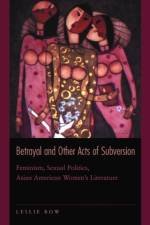
Asian American women have long dealt with charges of betrayal within and beyond their communities. Images of their "e;disloyalty"e; pervade American culture, from the daughter who is branded a traitor to family for adopting American ways, to the war bride who immigrates in defiance of her countrymen, to a figure such as Yoko Ono, accused of breaking up the Beatles with her "e;seduction"e; of John Lennon. Leslie Bow here explores how representations of females transgressing the social order play out in literature by Asian American women. Questions of ethnic belonging, sexuality, identification, and political allegiance are among the issues raised by such writers as Jeanne Wakatsuki Houston, Bharati Mukherjee, Jade Snow Wong, Amy Tan, Sky Lee, Le Ly Hayslip, Wendy Law-Yone, Fiona Cheong, and Nellie Wong. Beginning with the notion that feminist and Asian American identity are mutually exclusive, Bow analyzes how women serve as boundary markers between ethnic or national collectives in order to reveal the male-based nature of social cohesion. In exploring the relationship between femininity and citizenship, liberal feminism and American racial discourse, and women's domestic abuse and human rights, the author suggests that Asian American women not only mediate sexuality's construction as a determiner of loyalty but also manipulate that construction as a tool of political persuasion in their writing. The language of betrayal, she argues, offers a potent rhetorical means of signaling how belonging is policed by individuals and by the state. Bow's bold analysis exposes the stakes behind maintaining ethnic, feminist, and national alliances, particularly for women who claim multiple loyalties.
This is the first book to analyze our suburban literary tradition. Tracing the suburb's emergence as a crucial setting and subject of the twentieth-century American novel, Catherine Jurca identifies a decidedly masculine obsession with the suburban home and a preoccupation with its alternative--the experience of spiritual and emotional dislocation that she terms "e;homelessness."e; In the process, she challenges representations of white suburbia as prostrated by its own privileges. In novels as disparate as Tarzan (written by Tarzana, California, real-estate developer Edgar Rice Burroughs), Richard Wright's Native Son, and recent fiction by John Updike and Richard Ford, Jurca finds an emphasis on the suburb under siege, a place where the fortunate tend to see themselves as powerless. From Babbitt to Rabbit, the suburban novel casts property owners living in communities of their choosing as dispossessed people. Material advantages become artifacts of oppression, and affluence is fraudulently identified as impoverishment. The fantasy of victimization reimagines white flight as a white diaspora. Extending innovative trends in the study of nineteenth-century American culture, Jurca's analysis suggests that self-pity has played a constitutive role in white middle-class identity in the twentieth century. It breaks new ground in literary history and cultural studies, while telling the story of one of our most revered and reviled locations: "e;the little suburban house at number one million and ten Volstead Avenue"e; that Edith Wharton warned would ruin American life and letters.
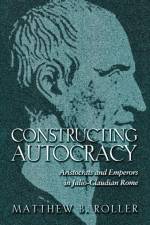
Rome's transition from a republican system of government to an imperial regime comprised more than a century of civil upheaval and rapid institutional change. Yet the establishment of a ruling dynasty, centered around a single leader, came as a cultural and political shock to Rome's aristocracy, who had shared power in the previous political order. How did the imperial regime manage to establish itself and how did the Roman elites from the time of Julius Caesar to Nero make sense of it? In this compelling book, Matthew Roller reveals a "e;dialogical"e; process at work, in which writers and philosophers vigorously negotiated and contested the nature and scope of the emperor's authority, despite the consensus that he was the ultimate authority figure in Roman society.Roller seeks evidence for this "e;thinking out"e; of the new order in a wide range of republican and imperial authors, with an emphasis on Lucan and Seneca the Younger. He shows how elites assessed the impact of the imperial system on traditional aristocratic ethics and examines how several longstanding authority relationships in Roman society--those of master to slave, father to son, and gift-creditor to gift-debtor--became competing models for how the emperor did or should relate to his aristocratic subjects. By revealing this ideological activity to be not merely reactive but also constitutive of the new order, Roller contributes to ongoing debates about the character of the Roman imperial system and about the "e;politics"e; of literature.
Focusing on Shakespeare's Hamlet as foremost a study of grief, Alexander Welsh offers a powerful analysis of its protagonist as the archetype of the modern hero. For over two centuries writers and critics have viewed Hamlet's persona as a fascinating blend of self-consciousness, guilt, and wit. Yet in order to understand more deeply the modernity of this Shakespearean hero, Welsh first situates Hamlet within the context of family and mourning as it was presented in other revenge tragedies of Shakespeare's time. Revenge, he maintains, appears as a function of mourning rather than an end in itself. Welsh also reminds us that the mourning of a son for his father may not always be sincere. This book relates the problem of dubious mourning to Hamlet's ascendancy as an icon of Western culture, which began late in the eighteenth century, a time when the thinking of past generations--or fathers--represented to many an obstacle to human progress. Welsh reveals how Hamlet inspired some of the greatest practitioners of modernity's quintessential literary form, the novel. Goethe's Wilhelm Meister's Apprenticeship, Scott's Redgauntlet, Dickens's Great Expectations, Melville's Pierre, and Joyce's Ulysses all enhance our understanding of the play while illustrating a trend in which Hamlet ultimately becomes a model of intense consciousness. Arguing that modern consciousness mourns for the past, even as it pretends to be free of it, Welsh offers a compelling explanation of why Hamlet remains marvelously attractive to this day.
The fictional Dr. Strabismus sets out to write a new comprehensive theory of music. But music's tendency to deconstruct itself combined with the complexities of postmodernism doom him to failure. This is the parable that frames The Sense of Music, a novel treatment of music theory that reinterprets the modern history of Western music in the terms of semiotics. Based on the assumption that music cannot be described without reference to its meaning, Raymond Monelle proposes that works of the Western classical tradition be analyzed in terms of temporality, subjectivity, and topic theory. Critical of the abstract analysis of musical scores, Monelle argues that the score does not reveal music's sense. That sense--what a piece of music says and signifies--can be understood only with reference to history, culture, and the other arts. Thus, music is meaningful in that it signifies cultural temporalities and themes, from the traditional manly heroism of the hunt to military power to postmodern "e;polyvocality."e; This theoretical innovation allows Monelle to describe how the Classical style of the eighteenth century--which he reads as a balance of lyric and progressive time--gave way to the Romantic need for emotional realism. He argues that irony and ambiguity subsequently eroded the domination of personal emotion in Western music as well as literature, killing the composer's subjectivity with that of the author. This leaves Dr. Strabismus suffering from the postmodern condition, and Raymond Monelle with an exciting, controversial new approach to understanding music and its history.
Decisive biotechnological interventions in the lottery of human life--to enhance our bodies and brains and perhaps irreversibly change our genetic makeup--have been widely rejected as unethical and undesirable, and have often met with extreme hostility. But in Enhancing Evolution, leading bioethicist John Harris dismantles objections to genetic engineering, stem-cell research, designer babies, and cloning to make a forthright, sweeping, and rigorous ethical case for using biotechnology to improve human life. Human enhancement, Harris argues, is a good thing--good morally, good for individuals, good as social policy, and good for a genetic heritage that needs serious improvement. Enhancing Evolution defends biotechnological interventions that could allow us to live longer, healthier, and even happier lives by, for example, providing us with immunity from cancer and HIV/AIDS. But the book advocates far more than therapies designed to free us from sickness and disability. Harris champions the possibility of influencing the very course of evolution to give us increased mental and physical powers--from reasoning, concentration, and memory to strength, stamina, and reaction speed. Indeed, he supports enhancing ourselves in almost any way we desire. And it's not only morally defensible to enhance ourselves, Harris says. In some cases, it's morally obligatory. Whether one looks upon biotechnology with hope, fear, or a little of both, Enhancing Evolution makes a case for it that no one can ignore.
Self-deception raises complex questions about the nature of belief and the structure of the human mind. In this book, Alfred Mele addresses four of the most critical of these questions: What is it to deceive oneself? How do we deceive ourselves? Why do we deceive ourselves? Is self-deception really possible? Drawing on cutting-edge empirical research on everyday reasoning and biases, Mele takes issue with commonplace attempts to equate the processes of self-deception with those of stereotypical interpersonal deception. Such attempts, he demonstrates, are fundamentally misguided, particularly in the assumption that self-deception is intentional. In their place, Mele proposes a compelling, empirically informed account of the motivational causes of biased beliefs. At the heart of this theory is an appreciation of how emotion and motivation may, without our knowing it, bias our assessment of evidence for beliefs. Highlighting motivation and emotion, Mele develops a pair of approaches for explaining the two forms of self-deception: the "e;straight"e; form, in which we believe what we want to be true, and the "e;twisted"e; form, in which we believe what we wish to be false. Underlying Mele's work is an abiding interest in understanding and explaining the behavior of real human beings. The result is a comprehensive, elegant, empirically grounded theory of everyday self-deception that should engage philosophers and social scientists alike.
Some of the most innovative writers of contemporary literature are writing in diaspora in their second or third language. Here Azade Seyhan describes the domain of transnational poetics they inhabit. She begins by examining the works of selected bilingual and bicultural writers of the United States (including Oscar Hijuelos, Maxine Hong Kingston, and Eva Hoffman) and Germany (Libuse Monikova, Rafik Schami, and E. S. Ozdamar, among others), developing a new framework for understanding the relationship between displacement, memory, and language. Considering themes of loss, witness, translation, identity, and exclusion, Seyhan interprets diasporic literatures as condensed archives of cultural and linguistic memory that give integrity and coherence to pasts ruptured by migration. The book next compares works by contemporary Chicana and Turkish-German women writers as innovative and sovereign literary voices within the larger national cultures of the United States and Germany. Seyhan identifies in American multiculturalism critical clues for analyzing new cultural formations in Europe and maintains that Germany's cultural transformation suggests new ways of reading the American literary mosaic. Her approach, however, extends well beyond these two literatures. She creates a critical map of a "e;third geography,"e; where a transnational, multilingual literary movement is gathering momentum. Writing Outside the Nation both contributes to and departs from postcolonial studies in that it focuses specifically on transnational writers working outside of their "e;mother tongue"e; and compares American and German diasporic literatures within a sophisticated conceptual framework. It illustrates how literature's symbolic economy can reclaim lost personal and national histories, as well as connect disparate and distant cultural traditions.
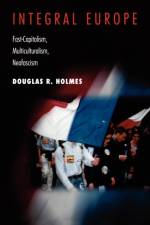
Over the past 15 years, the project of advanced European integration has followed a complex secular and cosmopolitan agenda. As that agenda has evolved, however, so have various hard-line populist movements with goals diametrically opposed to the ideals of a harmonious European Union. Spearheaded by figures such as Jean-Marie Le Pen, the controversial leader of France's National Front party, these radical movements have become increasingly influential and, because of their philosophical affinities with fascism and national socialism--politically worrisome. In Integral Europe, anthropologist Douglas Holmes posits that such movements are philosophically rooted in integralism, a sensibility that, in its most benign form, enables people to maintain their ethnic identity and solidarity within the context of an increasingly pluralistic society. Taken to irrational extremes by people like Le Pen, integralism is being used to inflame people's feelings of alienation and powerlessness, the by-products of impersonal, transnational "e;fast-capitalism."e; The consequences are an invidious politics of exclusion that spawns cultural nationalism, racism, and social disorder. The analysis moves from northern Italy to Strasbourg and Brussels, the two venues of the European Parliament, and finally to the East End of London. This multi-sited ethnography provides critical perspective on integralism as a form of intimate cultural practice and a violent idiom of estrangement. It combines a wide-ranging review of modern and historical scholarship with two years of field research that included personal interviews with right-wing activists, among them Le Pen and neo-Nazis in inner London. Fascinating, provocative, and sobering, Integral Europe offers a rare inside look at one of modern Europe's most unsettling political trends.
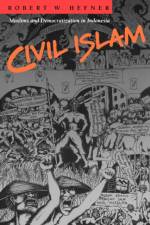
Civil Islam tells the story of Islam and democratization in Indonesia, the world's largest Muslim nation. Challenging stereotypes of Islam as antagonistic to democracy, this study of courage and reformation in the face of state terror suggests possibilities for democracy in the Muslim world and beyond. Democratic in the early 1950s and with rich precedents for tolerance and civility, Indonesia succumbed to violence. In 1965, Muslim parties were drawn into the slaughter of half a million communists. In the aftermath of this bloodshed, a "e;New Order"e; regime came to power, suppressing democratic forces and instituting dictatorial controls that held for decades. Yet from this maelstrom of violence, repressed by the state and denounced by conservative Muslims, an Islamic democracy movement emerged, strengthened, and played a central role in the 1998 overthrow of the Soeharto regime. In 1999, Muslim leader Abdurrahman Wahid was elected President of a reformist, civilian government. In explaining how this achievement was possible, Robert Hefner emphasizes the importance of civil institutions and public civility, but argues that neither democracy nor civil society is possible without a civilized state. Against portrayals of Islam as inherently antipluralist and undemocratic, he shows that Indonesia's Islamic reform movement repudiated the goal of an Islamic state, mobilized religiously ecumenical support, promoted women's rights, and championed democratic ideals. This broadly interdisciplinary and timely work heightens our awareness of democracy's necessary pluralism, and places Indonesia at the center of our efforts to understand what makes democracy work.
Hayashi's Econometrics promises to be the next great synthesis of modern econometrics. It introduces first year Ph.D. students to standard graduate econometrics material from a modern perspective. It covers all the standard material necessary for understanding the principal techniques of econometrics from ordinary least squares through cointegration. The book is also distinctive in developing both time-series and cross-section analysis fully, giving the reader a unified framework for understanding and integrating results. Econometrics has many useful features and covers all the important topics in econometrics in a succinct manner. All the estimation techniques that could possibly be taught in a first-year graduate course, except maximum likelihood, are treated as special cases of GMM (generalized methods of moments). Maximum likelihood estimators for a variety of models (such as probit and tobit) are collected in a separate chapter. This arrangement enables students to learn various estimation techniques in an efficient manner. Eight of the ten chapters include a serious empirical application drawn from labor economics, industrial organization, domestic and international finance, and macroeconomics. These empirical exercises at the end of each chapter provide students a hands-on experience applying the techniques covered in the chapter. The exposition is rigorous yet accessible to students who have a working knowledge of very basic linear algebra and probability theory. All the results are stated as propositions, so that students can see the points of the discussion and also the conditions under which those results hold. Most propositions are proved in the text. For those who intend to write a thesis on applied topics, the empirical applications of the book are a good way to learn how to conduct empirical research. For the theoretically inclined, the no-compromise treatment of the basic techniques is a good preparation for more advanced theory courses.
In the decades between the two World Wars, Japan made a dramatic entry into the modern age, expanding its capital industries and urbanizing so quickly as to rival many long-standing Western industrial societies. How the Japanese made sense of the sudden transformation and the subsequent rise of mass culture is the focus of Harry Harootunian's fascinating inquiry into the problems of modernity. Here he examines the work of a generation of Japanese intellectuals who, like their European counterparts, saw modernity as a spectacle of ceaseless change that uprooted the dominant historical culture from its fixed values and substituted a culture based on fantasy and desire. Harootunian not only explains why the Japanese valued philosophical understandings of these events, often over sociological or empirical explanations, but also locates Japan's experience of modernity within a larger global process marked by both modernism and fascism. What caught the attention of Japanese thinkers was how the production of desire actually threatened historical culture. These intellectuals sought to "e;overcome"e; the materialism and consumerism associated with the West, particularly the United States. They proposed versions of a modernity rooted in cultural authenticity and aimed at infusing meaning into everyday life, whether through art, memory, or community. Harootunian traces these ideas in the works of Yanagita Kunio, Tosaka Jun, Gonda Yasunosuke, and Kon Wajiro, among others, and relates their arguments to those of such European writers as George Simmel, Siegfried Kracauer, Walter Benjamin, and Georges Bataille. Harootunian shows that Japanese and European intellectuals shared many of the same concerns, and also stresses that neither Japan's involvement with fascism nor its late entry into the capitalist, industrial scene should cause historians to view its experience of modernity as an oddity. The author argues that strains of fascism ran throughout most every country in Europe and in many ways resulted from modernizing trends in general. This book, written by a leading scholar of modern Japan, amounts to a major reinterpretation of the nature of Japan's modernity.
Comic in tone and serious in intent, this book gives a vivid portrait of academic life in the nineties. With campus populations and critical perspectives changing rapidly, academic debate needs to look beyond the old ideal of common purposes and communal agreement. How can we learn from people we won't end up agreeing with? This question is explored by four very different scholars, who meet and argue at a series of comparative literature conferences: David Damrosch, liberal humanist and organizer of the group; Vic Addams, an independent scholar of aesthetic leanings (and author of The Utility of Futility); Marsha Doddvic, a feminist film theorist; and the Israeli semiotician Dov Midrash. Throughout the 1990s, in four cities, they meet and debate the problems of disciplinary definition and survival, the relation of literary theory to society, the politics of cultural studies, and the virtues and vices of autobiographical criticism. As their partly antagonistic, increasingly serious, surprisingly fond, and always funny relationship develops, Damrosch seeks common ground with his friends despite the fundamental differences among them. Can a self-parodying deconstructionist and a Proust aficionado appreciate and improve each other's work? Can a wealthy, windsurfing medievalist and a champion of Chicana lesbian memoir find friendship? Hilarious exchanges and comic moments, as well as cameo appearances by well-known theorists, will entertain all literary-minded readers. Academic insiders will also be reminded of the foibles and quirks of their own disciplines and departments. At the same time, this exploration of the uses and abuses of literary and cultural criticism offers a running commentary on identity politics and poses serious questions about the state and future of the academy.
For the last sixty years, American foreign and defense policymaking has been dominated by a network of institutions created by one piece of legislation--the 1947 National Security Act. This is the definitive study of the intense political and bureaucratic struggles that surrounded the passage and initial implementation of the law. Focusing on the critical years from 1937 to 1960, Douglas Stuart shows how disputes over the lessons of Pearl Harbor and World War II informed the debates that culminated in the legislation, and how the new national security agencies were subsequently transformed by battles over missions, budgets, and influence during the early cold war. Stuart provides an in-depth account of the fight over Truman's plan for unification of the armed services, demonstrating how this dispute colored debates about institutional reform. He traces the rise of the Office of the Secretary of Defense, the transformation of the CIA, and the institutionalization of the National Security Council. He also illustrates how the development of this network of national security institutions resulted in the progressive marginalization of the State Department. Stuart concludes with some insights that will be of value to anyone interested in the current debate over institutional reform.
Abonner på vårt nyhetsbrev og få rabatter og inspirasjon til din neste leseopplevelse.
Ved å abonnere godtar du vår personvernerklæring.