












Gjør som tusenvis av andre bokelskere
Abonner på vårt nyhetsbrev og få rabatter og inspirasjon til din neste leseopplevelse.
Ved å abonnere godtar du vår personvernerklæring.Du kan når som helst melde deg av våre nyhetsbrev.

In his best-selling Irrational Exuberance, Robert Shiller cautioned that society's obsession with the stock market was fueling the volatility that has since made a roller coaster of the financial system. Less noted was Shiller's admonition that our infatuation with the stock market distracts us from more durable economic prospects. These lie in the hidden potential of real assets, such as income from our livelihoods and homes. But these ''ordinary riches,'' so fundamental to our well-being, are increasingly exposed to the pervasive risks of a rapidly changing global economy. This compelling and important new book presents a fresh vision for hedging risk and securing our economic future. Shiller describes six fundamental ideas for using modern information technology and advanced financial theory to temper basic risks that have been ignored by risk management institutions--risks to the value of our jobs and our homes, to the vitality of our communities, and to the very stability of national economies. Informed by a comprehensive risk information database, this new financial order would include global markets for trading risks and exploiting myriad new financial opportunities, from inequality insurance to intergenerational social security. Just as developments in insuring risks to life, health, and catastrophe have given us a quality of life unimaginable a century ago, so Shiller's plan for securing crucial assets promises to substantially enrich our condition. Once again providing an enormous service, Shiller gives us a powerful means to convert our ordinary riches into a level of economic security, equity, and growth never before seen. And once again, what Robert Shiller says should be read and heeded by anyone with a stake in the economy.
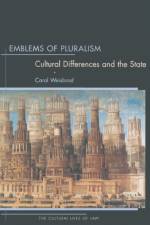
From outlawing polygamy and mandating public education to protecting the rights of minorities, the framing of group life by the state has been a subject of considerable interest and controversy throughout the history of the United States. The subject continues to be important in many countries. This book deals with state responses to cultural difference through the examination of a number of encounters between individuals, groups, and the state, in the United States and elsewhere. The book opens the concepts of groups and the state, arguing for the complexity of their relations and interpenetrations. Carol Weisbrod draws on richly diverse historical and cultural material to explore various structures that have been seen as appropriate for adjusting relations between states and internal groups. She considers the experience of the Mormons, the Amish, and Native Americans in the United States, the Mennonites in Germany, and the Jews in Russia to illustrate arrangements and accommodations in different times and places. The Minorities Treaties of the League of Nations, political federalism, religious exemptions, nonstate schools, and rules about adoption are among the mechanisms discussed that sustain cultural difference and create frameworks for group life, and, finally, individual life. At bottom, Emblems of Pluralism concerns not only relations between the state and groups, public and private, but also issues of identity and relations between the self and others.
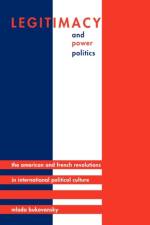
This book examines the causes and consequences of a major transformation in both domestic and international politics: the shift from dynastically legitimated monarchical sovereignty to popularly legitimated national sovereignty. It analyzes the impact of Enlightenment discourse on politics in eighteenth-century Europe and the United States, showing how that discourse facilitated new authority struggles in Old Regime Europe, shaped the American and French Revolutions, and influenced the relationships between the revolutionary regimes and the international system. The interaction between traditional and democratic ideas of legitimacy transformed the international system by the early nineteenth century, when people began to take for granted the desirability of equality, individual rights, and restraint of power. Using an interpretive, historically sensitive approach to international relations, the author considers the complex interplay between elite discourses about political legitimacy and strategic power struggles within and among states. She shows how culture, power, and interests interacted to produce a crucial yet poorly understood case of international change. The book not only shows the limits of liberal and realist theories of international relations, but also demonstrates how aspects of these theories can be integrated with insights derived from a constructivist perspective that takes culture and legitimacy seriously. The author finds that cultural contests over the terms of political legitimacy constitute one of the central mechanisms by which the character of sovereignty is transformed in the international system--a conclusion as true today as it was in the eighteenth century.
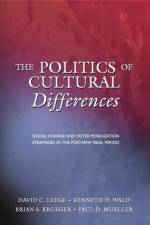
How did Republicans manage to hold the White House through much of the past half century even as the Democratic Party held the hearts of most American voters? The authors of this groundbreaking study argue that they did so by doing what Democrats have also excelled at: triggering psychological mechanisms that deepen cultural divisions in the other party's coalition, thereby leading many of its voters either to choose the opposing ticket or to stay home. The Politics of Cultural Differences is the first book to develop and carefully test a general theory of cultural politics in the United States, one that offers a compelling new perspective on America's changing political order and political conflict in the post-New Deal period (1960-1996). David Leege, Kenneth Wald, Brian Krueger, and Paul Mueller move beyond existing scholarship by formulating a theory of campaign strategies that emphasizes cultural conflict regarding patriotism, race, gender, and religion. Drawing on National Election Studies data, they find that Republican politicians deployed powerful symbols (e.g., "e;tax and spend liberals"e;) to channel targeted voters toward the minority party. And as partisanship approached parity in the 1990s, Democratic leaders proved as adept at deploying their own symbols, such as "e;a woman's right to choose,"e; to disassemble the Republican coalition. A blend of sophisticated theory and advanced empirical tools, this book lays bare the cultural dimensions of American political life.
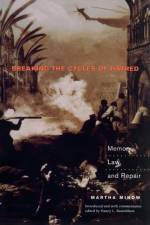
Violence so often begets violence. Victims respond with revenge only to inspire seemingly endless cycles of retaliation. Conflicts between nations, between ethnic groups, between strangers, and between family members differ in so many ways and yet often share this dynamic. In this powerful and timely book Martha Minow and others ask: What explains these cycles and what can break them? What lessons can we draw from one form of violence that might be relevant to other forms? Can legal responses to violence provide accountability but avoid escalating vengeance? If so, what kinds of legal institutions and practices can make a difference? What kinds risk failure? Breaking the Cycles of Hatred represents a unique blend of political and legal theory, one that focuses on the double-edged role of memory in fueling cycles of hatred and maintaining justice and personal integrity. Its centerpiece comprises three penetrating essays by Minow. She argues that innovative legal institutions and practices, such as truth commissions and civil damage actions against groups that sponsor hate, often work better than more conventional criminal proceedings and sanctions. Minow also calls for more sustained attention to the underlying dynamics of violence, the connections between intergroup and intrafamily violence, and the wide range of possible responses to violence beyond criminalization. A vibrant set of freestanding responses from experts in political theory, psychology, history, and law examines past and potential avenues for breaking cycles of violence and for deepening our capacity to avoid becoming what we hate. The topics include hate crimes and hate-crimes legislation, child sexual abuse and the statute of limitations, and the American kidnapping and internment of Japanese Latin Americans during World War II. Commissioned by Nancy Rosenblum, the essays are by Ross E. Cheit, Marc Galanter, Fredrick C. Harris, Judith Lewis Herman, Carey Jaros, Frederick M. Lawrence, Austin Sarat, Ayelet Shachar, Eric K. Yamamoto, and Iris Marion Young.
Determining which moral principles should guide political action is a vexing question in political theory. This is especially true when faced with the "e;toleration paradox"e;: believing that something is morally wrong but also believing that it is wrong to suppress it. In this book, Alex Tuckness argues that John Locke's potential contribution to this debate--what Tuckness terms the "e;legislative point of view"e;--has long been obscured by overemphasis on his doctrine of consent. Building on a line of reasoning Locke made explicit in his later writings on religious toleration, Tuckness explores the idea that we should act politically only on those moral principles that a reasonable legislator would endorse; someone, that is, who would avoid enacting measures that could be self-defeating when applied by fallible human beings. Tuckness argues that the legislative point of view has implications that go far beyond the question of religious toleration. Locke suggests an approach to political justification that is a provocative alternative to the utilitarian, contractualist, and perfectionist approaches dominating contemporary liberalism. The legislative point of view is relevant to our thinking about many types of disputed principles, Tuckness writes. He examines claims of moral wrong, invocations of the public good, and contested political roles with emphasis on the roles of legislators and judges. This book is must reading not only for students and scholars of Locke but all those interested in liberalism, toleration, and constitutional theory.
This book reconsiders the dominant Western understandings of freedom through the lens of women's real-life experiences of domestic violence, welfare, and Islamic veiling. Nancy Hirschmann argues that the typical approach to freedom found in political philosophy severely reduces the concept's complexity, which is more fully revealed by taking such practical issues into account. Hirschmann begins by arguing that the dominant Western understanding of freedom does not provide a conceptual vocabulary for accurately characterizing women's experiences. Often, free choice is assumed when women are in fact coerced--as when a battered woman who stays with her abuser out of fear or economic necessity is said to make this choice because it must not be so bad--and coercion is assumed when free choices are made--such as when Westerners assume that all veiled women are oppressed, even though many Islamic women view veiling as an important symbol of cultural identity. Understanding the contexts in which choices arise and are made is central to understanding that freedom is socially constructed through systems of power such as patriarchy, capitalism, and race privilege. Social norms, practices, and language set the conditions within which choices are made, determine what options are available, and shape our individual subjectivity, desires, and self-understandings. Attending to the ways in which contexts construct us as "e;subjects"e; of liberty, Hirschmann argues, provides a firmer empirical and theoretical footing for understanding what freedom means and entails politically, intellectually, and socially.
The Dialectic of Essence offers a systematic new account of Plato's metaphysics. Allan Silverman argues that the best way to make sense of the metaphysics as a whole is to examine carefully what Plato says about ousia (essence) from the Meno through the middle period dialogues, the Phaedo and the Republic, and into several late dialogues including the Parmenides, the Sophist, the Philebus, and the Timaeus. This book focuses on three fundamental facets of the metaphysics: the theory of Forms; the nature of particulars; and Plato's understanding of the nature of metaphysical inquiry. Silverman seeks to show how Plato conceives of "e;Being"e; as a unique way in which an essence is related to a Form. Conversely, partaking ("e;having"e;) is the way in which a material particular is related to its properties: Particulars, thus, in an important sense lack essence. Additionally, the author closely analyzes Plato's idea that the relation between Forms and particulars is mediated by form-copies. Even when some late dialogues provide a richer account of particulars, Silverman maintains that particulars are still denied essence. Indeed, with the Timaeus's introduction of the receptacle, there are no particulars of the traditional variety. This book cogently demonstrates that when we understand that Plato's concern with essence lies at the root of his metaphysics, we are better equipped to find our way through the labyrinth of his dialogues and to better appreciate how they form a coherent theory.
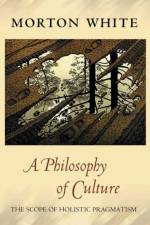
In this book, one of America's leading philosophers offers a sweeping reconsideration of the philosophy of culture in the twentieth century. Morton White argues that the discipline is much more important than is often recognized, and that his version of holistic pragmatism can accommodate its breadth. Going beyond Quine's dictum that philosophy of science is philosophy enough, White suggests that it should contain the word "e;culture"e; in place of "e;science."e; He defends the holistic view that scientific belief is tested by experience but that such testing is rightly applied to systems or conjunctions of beliefs, not isolated beliefs. He adds, however, that we test ethical systems by appealing to feelings of moral obligation as well as to sensory experiences. In the course of his lucidly written analysis, White treats central issues in the philosophy of science, of religion, of art, of history, of law, of politics, and of morality. While doing so he examines the views of Quine, Tarski, Goodman, and Rawls, and shows how they are related to the approaches of Peirce, James, Duhem, Russell, Dewey, Carnap, and the later Wittgenstein. He also discusses the ideas of the legal philosophers Holmes and Hart from a holistic standpoint. White demonstrates how his version of pragmatism bridges the traditional gulf between analytic and synthetic truth as well as that between moral and scientific belief. Indeed, the high point of the book is a brilliant presentation of his view of ethics, based on the idea that our scientific theories face the tribunal of observation whereas our ethical views face the joint tribunal of observation and moral feeling. Scholars and students of the history of ideas and of philosophy will welcome A Philosophy of Culture as the highly finished product of more than sixty years of philosophical reflection by an important thinker.
How should a prize be awarded after a horse race? Should it go to the best rider, the best person, or the one who finishes first? To what extent are bystanders blameworthy when they do nothing to prevent harm? Are there any objective standards of moral responsibility with which to address such perennial questions? In this fluidly written and lively book, Daniel Robinson takes on the prodigious task of setting forth the contours of praise and blame. He does so by mounting an important and provocative new defense of a radical theory of moral realism and offering a critical appraisal of prevailing alternatives such as determinism and behaviorism and of their conceptual shortcomings. The version of moral realism that arises from Robinson's penetrating inquiry--an inquiry steeped in Aristotelian ethics but deeply informed by modern scientific knowledge of human cognition--is independent of cognition and emotion. At the same time, Robinson carefully explores how such human attributes succeed or fail in comprehending real moral properties. Through brilliant analyses of constitutional and moral luck, of biosocial and genetic versions of psychological determinism, and of relativistic-anthropological accounts of variations in moral precepts, he concludes that none of these conceptions accounts either for the nature of moral properties or the basis upon which they could be known. Ultimately, the theory that Robinson develops preserves moral properties even while acknowledging the conditions that undermine the powers of human will.
Broken glass, twisted beams, piles of debris--these are the early memories of the children who grew up amidst the ruins of the Third Reich. More than five decades later, German youth inhabit manicured suburbs and stroll along prosperous pedestrian malls. Shattered Past is a bold reconsideration of the perplexing pattern of Germany's twentieth-century history. Konrad Jarausch and Michael Geyer explore the staggering gap between the country's role in the terrors of war and its subsequent success as a democracy. They argue that the collapse of Communism, national reunification, and the postmodern shift call for a new reading of the country's turbulent development, one that no longer suggests continuity but rupture and conflict. Comprising original essays, the book begins by reexamining the nationalist, socialist, and liberal master narratives that have dominated the presentation of German history but are now losing their hold. Treated next are major issues of recent debate that suggest how new kinds of German history might be written: annihilationist warfare, complicity with dictatorship, the taming of power, the impact of migration, the struggle over national identity, redefinitions of womanhood, and the development of consumption as well as popular culture. The concluding chapters reflect on the country's gradual transition from chaos to civility. This penetrating study will spark a fresh debate about the meaning of the German past during the last century. There is no single master narrative, no Weltgeist, to be discovered. But there is a fascinating story to be told in many different ways.
This book is the first systematic comparison of the civic integration of Jews in the United States and France--specifically, from the two countries' revolutions through the American republic and the Napoleonic era (1775-1815). Frederic Jaher develops a vehicle for a broader and uniquely rich analysis of French and American nation-building and political culture. He returns grand theory to historical scholarship by examining the Jewish encounter with state formation and Jewish acquisition of civic equality from the perspective of the "e;paradigm of liberal inclusiveness"e; as formulated by Alexis de Tocqueville and Louis Hartz. Jaher argues that the liberal paradigm worked for American Jews but that France's illiberal impulses hindered its Jewish population in acquiring full civic rights. He also explores the relevance of the Tocqueville-Hartz theory for other marginalized groups, particularly blacks and women in France and America. However, the experience of these groups suggests that the theory has its limits. A central issue of this penetrating study is whether a state with democratic-liberal pretensions (America) can better protect the rights of marginalized enclaves than can a state with authoritarian tendencies (France). The Tocqueville-Hartz thesis has become a major issue in political science, and this book marks the first time it has been tested in a historical study. The Jews and the Nation returns a unifying theory to a discipline fragmented by microtopical scholarship.
When Crusader armies on their way to the Holy Land attacked Jewish communities in the Rhine Valley, many Jews chose suicide over death at the hands of Christian mobs. With their defiant deaths, the medieval Jewish martyr was born. With the literary commemoration of the victims, Jewish martyrology followed. Beautiful Death examines the evolution of a long-neglected corpus of Hebrew poetry, the laments reflecting the specific conditions of Jewish life in northern France. The poems offer insight into everyday life and into the ways medieval French Jews responded to persecution. They also suggest that poetry was used to encourage resistance to intensifying pressures to convert. The educated Jewish elite in northern France was highly acculturated. Their poetry--particularly that emerging from the innovative Tosafist schools--reflects their engagement with the vernacular renaissance unfolding around them, as well as conscious and unconscious absorption of Christian popular beliefs and hagiographical conventions. At the same time, their extraordinary poems signal an increasingly harsh repudiation of Christianity's sacred symbols and beliefs. They reveal a complex relationship to Christian culture as Jews internalized elements of medieval culture even while expressing a powerful revulsion against the forms and beliefs of Christian life. This gracefully written study crosses traditional boundaries of history and literature and of Jewish and general medieval scholarship. Focusing on specific incidents of persecution and the literary commemorations they produced, it offers unique insights into the historical conditions in which these poems were written and performed.
Power in the Portrayal unveils a fresh and vital perspective on power relations in eleventh- and twelfth-century Muslim Spain as reflected in historical and literary texts of the period. Employing the methods of the new historical literary study in looking at a range of texts, Ross Brann reveals the paradoxical relations between the Andalusi Muslim and Jewish elites in an era when long periods of tolerance and respect were punctuated by outbreaks of tension and hostility. The examined Arabic texts reveal a fragmented perception of the Jew in eleventh-century al-Andalus. They depict seemingly contradictory figures at whose poles are an intelligent, skilled, and noble Jew deserving of homage and a vile, stupid, and fiendish enemy of God and Islam. For their part, the Hebrew and Judeo-Arabic texts display a deep-seated reluctance to portray Muslims in any light at all. Brann cogently demonstrates that these representations of Jews and Muslims--each of which is concerned with issues of sovereignty and the exercise of power--reflect the shifting, fluctuating, and ambivalent relations between elite members of two of the ethno-religious communities of al-Andalus. Brann's accessible prose is enriched by his splendid translations; the original texts are also included. This book is the first to study the construction of social meaning in Andalusi Arabic, Judeo-Arabic, and Hebrew literary texts and historical chronicles. The novel approach illuminates nuances of respect, disinterest, contempt, and hatred reflected in the relationship between Muslims and Jews in medieval Spain.
Culture, 1922 traces the intellectual and institutional deployment of the culture concept in England and America in the first half of the twentieth century. With primary attention to how models of culture are created, elaborated upon, transformed, resisted, and ignored, Marc Manganaro works across disciplinary lines to embrace literary, literary critical, and anthropological writing. Tracing two traditions of thinking about culture, as elite products and pursuits and as common and shared systems of values, Manganaro argues that these modernist formulations are not mutually exclusive and have indeed intermingled in complex and interesting ways throughout the development of literary studies and anthropology. Beginning with the important Victorian architects of culture--Matthew Arnold and Edward Tylor--the book follows a number of main figures, schools, and movements up to 1950 such as anthropologist Franz Boas, his disciples Edward Sapir, Ruth Benedict, and Zora Neale Hurston, literary modernists T. S. Eliot and James Joyce, functional anthropologist Bronislaw Malinowski, modernist literary critic I. A. Richards, the New Critics, and Kenneth Burke. The main focus here, however, is upon three works published in 1922, the watershed year of Modernism--Eliot's The Waste Land, Malinowski's Argonauts of the Western Pacific, and Joyce's Ulysses. Manganaro reads these masterworks and the history of their reception as efforts toward defining culture. This is a wide-ranging and ambitious study about an ambiguous and complex concept as it moves within and between disciplines.
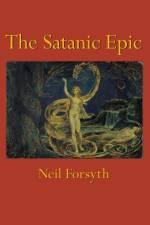
The Satan of Paradise Lost has fascinated generations of readers. This book attempts to explain how and why Milton's Satan is so seductive. It reasserts the importance of Satan against those who would minimize the poem's sympathy for the devil and thereby make Milton orthodox. Neil Forsyth argues that William Blake got it right when he called Milton a true poet because he was "e;of the Devils party"e; even though he set out "e;to justify the ways of God to men."e; In seeking to learn why Satan is so alluring, Forsyth ranges over diverse topics--from the origins of evil and the relevance of witchcraft to the status of the poetic narrator, the epic tradition, the nature of love between the sexes, and seventeenth-century astronomy. He considers each of these as Milton introduces them: as Satanic subjects. Satan emerges as the main challenge to Christian belief. It is Satan who questions and wonders and denounces. He is the great doubter who gives voice to many of the arguments that Christianity has provoked from within and without. And by rooting his Satanic reading of Paradise Lost in Biblical and other sources, Forsyth retrieves not only an attractive and heroic Satan but a Milton whose heretical energies are embodied in a Satanic character with a life of his own.
Ana Enriqueta Teran is arguably Venezuela's finest poet. Celebrated throughout the Spanish-speaking world, she is almost unknown among anglophones. Until now only a handful of her poems have been translated into English, giving at best a diluted impression of a uniquely intense imagination. This bilingual edition reveals the power and beauty of this poet's Spanish poems through English versions of corresponding force. It invites readers to enter Teran's world--a world at once strongly Venezuelan and universally human, imbued with great beauty, sardonic humor, pitiless compassion, lucid wisdom, and joyful affirmation. Selected from several volumes of Teran's work, these poems span half a century of composition and show an extraordinary range in both form and substance. Some are written in closed forms, some in free verse. Some are carefully evocative representations of the landscapes and cityscapes that have nourished the poet's intelligence and imagination. Others are dramatic character studies. All are infused with Teran's rare sensibility and realized through language that manages to be at once graceful, urgent, and explosive. This volume is a treasure for all lovers of poetry. Deal Struck with Happiness ? How much sweetness to make right the night and this clutch of anemones near thin smooth consoling stones, stones havens of southern weather. Of a woman who watches Cepheids quaver among lightbursting mangroves. Of a woman who offers cats-eyes and clematis only, Islands, for the sake of setting right her deal struck with happiness.
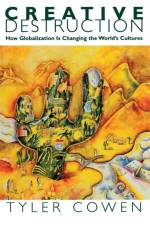
A Frenchman rents a Hollywood movie. A Thai schoolgirl mimics Madonna. Saddam Hussein chooses Frank Sinatra's "e;My Way"e; as the theme song for his fifty-fourth birthday. It is a commonplace that globalization is subverting local culture. But is it helping as much as it hurts? In this strikingly original treatment of a fiercely debated issue, Tyler Cowen makes a bold new case for a more sympathetic understanding of cross-cultural trade. Creative Destruction brings not stale suppositions but an economist's eye to bear on an age-old question: Are market exchange and aesthetic quality friends or foes? On the whole, argues Cowen in clear and vigorous prose, they are friends. Cultural "e;destruction"e; breeds not artistic demise but diversity. Through an array of colorful examples from the areas where globalization's critics have been most vocal, Cowen asks what happens when cultures collide through trade, whether technology destroys native arts, why (and whether) Hollywood movies rule the world, whether "e;globalized"e; culture is dumbing down societies everywhere, and if national cultures matter at all. Scrutinizing such manifestations of "e;indigenous"e; culture as the steel band ensembles of Trinidad, Indian handweaving, and music from Zaire, Cowen finds that they are more vibrant than ever--thanks largely to cross-cultural trade. For all the pressures that market forces exert on individual cultures, diversity typically increases within society, even when cultures become more like each other. Trade enhances the range of individual choice, yielding forms of expression within cultures that flower as never before. While some see cultural decline as a half-empty glass, Cowen sees it as a glass half-full with the stirrings of cultural brilliance. Not all readers will agree, but all will want a say in the debate this exceptional book will stir.
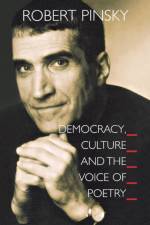
The place of poetry in modern democracy is no place, according to conventional wisdom. The poet, we hear, is a casualty of mass entertainment and prosaic public culture, banished to the artistic sidelines to compose variations on insipid themes for a dwindling audience. Robert Pinsky, however, argues that this gloomy diagnosis is as wrongheaded as it is familiar. Pinsky, whose remarkable career as a poet itself undermines the view, writes that to portray poetry and democracy as enemies is to radically misconstrue both. The voice of poetry, he shows, resonates with profound themes at the very heart of democratic culture. There is no one in America better to write on this topic. One of the country's most accomplished poets, Robert Pinsky served an unprecedented two terms as America's Poet Laureate (1997-2000) and led the immensely popular multimedia Favorite Poem Project, which invited Americans to submit and read aloud their favorite poems. Pinsky draws on his experiences and on characteristically sharp and elegant observations of individual poems to argue that expecting poetry to compete with show business is to mistake its greatest democratic strength--its intimate, human scale--as a weakness. As an expression of individual voice, a poem implicitly allies itself with ideas about individual dignity that are democracy's bedrock, far more than is mass participation. Yet poems also summon up communal life.. Even the most inward-looking work imagines a reader. And in their rhythms and cadences poems carry in their very bones the illusion and dynamic of call and response. Poetry, Pinsky writes, cannot help but mediate between the inner consciousness of the individual reader and the outer world of other people. As part of the entertainment industry, he concludes, poetry will always be small and overlooked. As an art--and one that is inescapably democratic--it is massive and fundamental.
Research on interior-point methods (IPMs) has dominated the field of mathematical programming for the last two decades. Two contrasting approaches in the analysis and implementation of IPMs are the so-called small-update and large-update methods, although, until now, there has been a notorious gap between the theory and practical performance of these two strategies. This book comes close to bridging that gap, presenting a new framework for the theory of primal-dual IPMs based on the notion of the self-regularity of a function. The authors deal with linear optimization, nonlinear complementarity problems, semidefinite optimization, and second-order conic optimization problems. The framework also covers large classes of linear complementarity problems and convex optimization. The algorithm considered can be interpreted as a path-following method or a potential reduction method. Starting from a primal-dual strictly feasible point, the algorithm chooses a search direction defined by some Newton-type system derived from the self-regular proximity. The iterate is then updated, with the iterates staying in a certain neighborhood of the central path until an approximate solution to the problem is found. By extensively exploring some intriguing properties of self-regular functions, the authors establish that the complexity of large-update IPMs can come arbitrarily close to the best known iteration bounds of IPMs. Researchers and postgraduate students in all areas of linear and nonlinear optimization will find this book an important and invaluable aid to their work.
Though the search for good selectors dates back to the early twentieth century, selectors play an increasingly important role in current research. This book is the first to assemble the scattered literature into a coherent and elegant presentation of what is known and proven about selectors--and what remains to be found. The authors focus on selection theorems that are related to the axiom of choice, particularly selectors of small Borel or Baire classes. After examining some of the relevant work of Michael and Kuratowski & Ryll-Nardzewski and presenting background material, the text constructs selectors obtained as limits of functions that are constant on the sets of certain partitions of metric spaces. These include selection theorems for maximal monotone maps, for the subdifferential of a continuous convex function, and for some geometrically defined maps, namely attainment and nearest-point maps. Assuming only a basic background in analysis and topology, this book is ideal for graduate students and researchers who wish to expand their general knowledge of selectors, as well as for those who seek the latest results.
By "e;literary criticism"e; we usually mean a self-conscious act involving the technical and aesthetic appraisal, by individuals, of autonomous works of art. Aristotle and Plato come to mind. The word "e;social"e; does not. Yet, as this book shows, it should--if, that is, we wish to understand where literary criticism as we think of it today came from. Andrew Ford offers a new understanding of the development of criticism, demonstrating that its roots stretch back long before the sophists to public commentary on the performance of songs and poems in the preliterary era of ancient Greece. He pinpoints when and how, later in the Greek tradition than is usually assumed, poetry was studied as a discipline with its own principles and methods. The Origins of Criticism complements the usual, history-of-ideas approach to the topic precisely by treating criticism as a social as well as a theoretical activity. With unprecedented and penetrating detail, Ford considers varying scholarly interpretations of the key texts discussed. Examining Greek discussions of poetry from the late sixth century B.C. through the rise of poetics in the late fourth, he asks when we first can recognize anything like the modern notions of literature as imaginative writing and of literary criticism as a special knowledge of such writing. Serving as a monumental preface to Aristotle's Poetics, this book allows readers to discern the emergence, within the manifold activities that might be called criticism, of the historically specific discourse on poetry that has shaped subsequent Western approaches to literature.
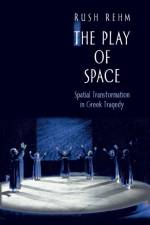
Is "e;space"e; a thing, a container, an abstraction, a metaphor, or a social construct? This much is certain: space is part and parcel of the theater, of what it is and how it works. In The Play of Space, noted classicist-director Rush Rehm offers a strikingly original approach to the spatial parameters of Greek tragedy as performed in the open-air theater of Dionysus. Emphasizing the interplay between natural place and fictional setting, between the world visible to the audience and that evoked by individual tragedies, Rehm argues for an ecology of the ancient theater, one that "e;nests"e; fifth-century theatrical space within other significant social, political, and religious spaces of Athens. Drawing on the work of James J. Gibson, Kurt Lewin, and Michel Foucault, Rehm crosses a range of disciplines--classics, theater studies, cognitive psychology, archaeology and architectural history, cultural studies, and performance theory--to analyze the phenomenology of space and its transformations in the plays of Aeschylus, Sophocles, and Euripides. His discussion of Athenian theatrical and spatial practice challenges the contemporary view that space represents a "e;text"e; to be read, or constitutes a site of structural dualities (e.g., outside-inside, public-private, nature-culture). Chapters on specific tragedies explore the spatial dynamics of homecoming ("e;space for returns"e;); the opposed constraints of exile ("e;eremetic space"e; devoid of normal community); the power of bodies in extremis to transform their theatrical environment ("e;space and the body"e;); the portrayal of characters on the margin ("e;space and the other"e;); and the tragic interactions of space and temporality ("e;space, time, and memory"e;). An appendix surveys pre-Socratic thought on space and motion, related ideas of Plato and Aristotle, and, as pertinent, later views on space developed by Newton, Leibniz, Descartes, Kant, and Einstein. Eloquently written and with Greek texts deftly translated, this book yields rich new insights into our oldest surviving drama.
In these writings by one of our most creative legal philosophers, Meir Dan-Cohen explores the nature of the self and its response to legal commands and mounts a challenge to some prevailing tenets of legal theory and the neighboring moral, political, and economic thought. The result is an insider's critique of liberalism that extends contemporary liberalism's Kantian strand, combining it with postmodernist ideas about the contingent and socially constructed self to build a thoroughly original perspective on some of the most vital concerns of legal and moral theory. Dan-Cohen looks first at the ubiquity of legal coercion and considers its decisive impact on the nature of legal discourse and communication, on law's normative aspirations and claim to obedience, and on the ideal of the rule of law. He moves on to discuss basic values, stressing the preeminence of individual identity and human dignity over the more traditional liberal preoccupations with preference-based choice and experiential harm. Dan-Cohen then focuses more directly on the normative ramifications of the socially constructed self. Fundamental concepts such as responsibility and ownership are reinterpreted to take account of the constitutive role that social practices--particularly law and morality--play in the formation of the self. Throughout, Dan-Cohen draws on a uniquely productive mix of philosophical traditions and subjects, blending the methods of analytic philosophy with the concerns of Continental philosophers to reconceive the self and its relation to ethics and the law.
Descartes thought that we could achieve absolute certainty by starting with radical doubt. He adopts this strategy in the Meditations on First Philosophy, where he raises sweeping doubts with the famous dream argument and the hypothesis of an evil demon. But why did Descartes think we should take these exaggerated doubts seriously? And if we do take them seriously, how did he think any of our beliefs could ever escape them? Janet Broughton undertakes a close study of Descartes's first three meditations to answer these questions and to present a fresh way of understanding precisely what Descartes was up to. Broughton first contrasts Descartes's doubts with those of the ancient skeptics, arguing that Cartesian doubt has a novel structure and a distinctive relation to the commonsense outlook of everyday life. She then argues that Descartes pursues absolute certainty by uncovering the conditions that make his radical doubt possible. She gives a unified account of how Descartes uses this strategy, first to find certainty about his own existence and then to argue that God exists. Drawing on this analysis, Broughton provides a new way to understand Descartes's insistence that he hasn't argued in a circle, and she measures his ambitions against those of contemporary philosophers who use transcendental arguments in their efforts to defeat skepticism. The book is a powerful contribution both to the history of philosophy and to current debates in epistemology.
From Kosovo to Quebec, Ireland to East Timor, nationalism has been a recurrent topic of intense debate. It has been condemned as a source of hatred and war, yet embraced for stimulating community feeling and collective freedom. Joan Cocks explores the power, danger, and allure of nationalism by examining its place in the thought of eight politically engaged intellectuals of the nineteenth and twentieth centuries: the antagonist of capital, Karl Marx; the critics of imperialism Rosa Luxemburg, Hannah Arendt, and Frantz Fanon; the liberal pluralist Isaiah Berlin; the neonationalist Tom Nairn, and the post-colonial writers, V. S. Naipaul and Edward Said. Cocks not only sheds new light on the complexities of nationalism but also reveals the tensions that have inspired and troubled intellectuals who have sought to lead lives between detached criticism and political passion. In lively, conversational prose, Cocks assesses their treatment of questions such as the mythology of national identity, the right to national self-determination, and the morality of nationalist violence. While ultimately critical of nationalism, she engages sympathetically even with its defenders. By illuminating the links that distinguished minds have drawn between thought and action on nationalism in politics, this stimulating work provides a rich foundation from which we ourselves might think or act more wisely when confronting a phenomenon that, in fundamental and perplexing ways, has shaped our world.
How should politicians act? When should they try to lead public opinion and when should they follow it? Should politicians see themselves as experts, whose opinions have greater authority than other people's, or as participants in a common dialogue with ordinary citizens? When do virtues like toleration and willingness to compromise deteriorate into moral weakness? In this innovative work, Andrew Sabl answers these questions by exploring what a democratic polity needs from its leaders. He concludes that there are systematic, principled reasons for the holders of divergent political offices or roles to act differently. Sabl argues that the morally committed civil rights activist, the elected representative pursuing legislative results, and the grassroots organizer determined to empower ordinary citizens all have crucial democratic functions. But they are different functions, calling for different practices and different qualities of political character. To make this case, he draws on political theory, moral philosophy, leadership studies, and biographical examples ranging from Everett Dirksen to Ella Baker, Frances Willard to Stokely Carmichael, Martin Luther King Jr. to Joe McCarthy. Ruling Passions asks democratic theorists to pay more attention to the "e;governing pluralism"e; that characterizes a diverse, complex democracy. It challenges moral philosophy to adapt its prescriptions to the real requirements of democratic life, to pay more attention to the virtues of political compromise and the varieties of human character. And it calls on all democratic citizens to appreciate "e;democratic constancy"e;: the limited yet serious standard of ethical character to which imperfect democratic citizens may rightly hold their leaders--and themselves.
This is a bold new study of the recent emergence of democracy in Latin America. Leonardo Avritzer shows that traditional theories of democratization fall short in explaining this phenomenon. Scholars have long held that the postwar stability of Western Europe reveals that restricted democracy, or "e;democratic elitism,"e; is the only realistic way to guard against forces such as the mass mobilizations that toppled European democracies after World War I. Avritzer challenges this view. Drawing on the ideas of Jurgen Habermas, he argues that democracy can be far more inclusive and can rely on a sphere of autonomous association and argument by citizens. He makes this argument by showing that democratic collective action has opened up a new "e;public space"e; for popular participation in Latin American politics. Unlike many theorists, Avritzer builds his case empirically. He looks at human rights movements in Argentina and Brazil, neighborhood associations in Brazil and Mexico, and election-monitoring initiatives in Mexico. Contending that such participation has not gone far enough, he proposes a way to involve citizens even more directly in policy decisions. For example, he points to experiments in "e;participatory budgeting"e; in two Brazilian cities. Ultimately, the concept of such a space beyond the reach of state administration fosters a broader view of democratic possibility, of the cultural transformation that spurred it, and of the tensions that persist, in a region where democracy is both new and different from the Old World models.
Since the fall of communism, public opinion in Russia, including that of a now more diverse elite, has become a substantial factor in that country's policymaking process. What this opinion might be and how it responds to American actions is the subject of this study. William Zimmerman offers important and sometimes disturbing insight into the thinking of citizens in America's former Cold War adversary about such matters as NATO expansion. Drawing on nearly a decade of unprecedented surveys he conducted with a wide spectrum of the Russian public, he gauges the impact of Russia's opening on its foreign policy and how liberal democrats orient themselves to foreign policy. He also shows that insights from the study of American foreign policy are often "e;portable"e; to the study of Russian foreign policy attitudes. As Zimmerman shows, the general public, which had a modest but real role in foreign policy decision making, tended much more toward isolationism than did the predominant elites who steered Russia's foreign policy in the 1990s. Interspersing smooth prose with a wide array of richly informative tables, the book represents an invaluable opportunity to discern probable shifts in Russian foreign policy that domestic political changes would bring. And it powerfully suggests that the West, by forging its own policies toward Russia with more prudence, can have a say in the outcome of the great choice facing Russia--whether to forge ahead with democracy or slip back into authoritarianism.
Immigration is perhaps the most enduring and elemental leitmotif of America. This book is the most powerful study to date of the politics and policies it has inspired, from the founders' earliest efforts to shape American identity to today's revealing struggles over Third World immigration, noncitizen rights, and illegal aliens. Weaving a robust new theoretical approach into a sweeping history, Daniel Tichenor ties together previous studies' idiosyncratic explanations for particular, pivotal twists and turns of immigration policy. He tells the story of lively political battles between immigration defenders and doubters over time and of the transformative policy regimes they built. Tichenor takes us from vibrant nineteenth-century politics that propelled expansive European admissions and Chinese exclusion to the draconian restrictions that had taken hold by the 1920s, including racist quotas that later hampered the rescue of Jews from the Holocaust. American global leadership and interest group politics in the decades after World War II, he argues, led to a surprising expansion of immigration opportunities. In the 1990s, a surge of restrictionist fervor spurred the political mobilization of recent immigrants. Richly documented, this pathbreaking work shows that a small number of interlocking temporal processes, not least changing institutional opportunities and constraints, underlie the turning tides of immigration sentiments and policy regimes. Complementing a dynamic narrative with a host of helpful tables and timelines, Dividing Lines is the definitive treatment of a phenomenon that has profoundly shaped the character of American nationhood.
Abonner på vårt nyhetsbrev og få rabatter og inspirasjon til din neste leseopplevelse.
Ved å abonnere godtar du vår personvernerklæring.