



























Gjør som tusenvis av andre bokelskere
Abonner på vårt nyhetsbrev og få rabatter og inspirasjon til din neste leseopplevelse.
Ved å abonnere godtar du vår personvernerklæring.Du kan når som helst melde deg av våre nyhetsbrev.

Despite decades of developments in immunization and drug therapy, tuberculosis remains among the leading causes of human mortality, and no country has successfully eradicated the disease. Reenvisioning tuberculosis from the perspective of population biology, this book examines why the disease is so persistent and what must be done to fight it. Treating tuberculosis and its human hosts as dynamic, interacting populations, Christopher Dye seeks new answers to key questions by drawing on demography, ecology, epidemiology, evolution, and population genetics. Dye uses simple mathematical models to investigate how cases and deaths could be reduced, and how interventions could lead to TB elimination.Dye's analysis reveals a striking gap between the actual and potential impact of current interventions, especially drug treatment, and he suggests placing more emphasis on early case detection and the treatment of active or incipient tuberculosis. He argues that the response to disappointingly slow rates of disease decline is not to abandon long-established principles of chemotherapy, but to implement them with greater vigor. Summarizing epidemiological insights from population biology, Dye stresses the need to take a more inclusive view of the factors that affect disease, including characteristics of the pathogen, individuals and populations, health care systems, and physical and social environments.In broadening the horizons of TB research, The Population Biology of Tuberculosis demonstrates what must be done to prevent, control, and defeat this global threat in the twenty-first century.
The essential introduction to modern physical oceanographyWith the advent of computers, novel instruments, satellite technology, and increasingly powerful modeling tools, we know more about the ocean than ever before. Yet we also have a new generation of oceanographers who have become increasingly distanced from the object of their study. Ever fewer scientists collect the observational data on which they base their research. Instead, many download information without always fully understanding how far removed it is from the original data, with opportunity for great misinterpretation. This textbook introduces modern physical oceanography to beginning graduate students in marine sciences and experienced practitioners in allied fields. Real observations are strongly emphasized, as are their implications for understanding the behavior of the global ocean.Written by a leading physical oceanographer, Modern Observational Physical Oceanography explains what the observational revolution of the past twenty-five years has taught us about the real, changing fluid ocean. Unlike any other book, it provides a broad and accessible treatment of the subject, covering everything from modern methods of observation and data analysis to the fluid dynamics and modeling of ocean processes and variability. Fully illustrated in color throughout, the book describes the fundamental concepts that are needed before delving into more advanced topics, including internal-inertial waves, tides, balanced motions, and large-scale circulation physics.Provides an accessible introduction to modern physical oceanographyWritten by a leading physical oceanographerEmphasizes real observations of the fluid oceanFeatures hundreds of color illustrationsAn online illustration package is available to professors
The most comprehensive advanced graduate-level textbook on the subjectThis is a graduate-level textbook on the global circulation of the Earth's atmosphere-the large-scale system of winds by which energy is transported around the planet, from the tropical latitudes to the poles. Written by David Randall, one of the world's foremost experts on the subject, it is the most comprehensive textbook on the topic. Intended for Earth science students who have completed some graduate-level coursework in atmospheric dynamics, the book will help students build on that foundation, preparing them for research in the field.The book describes the many phenomena of the circulation and explains them in terms of current ideas from fluid dynamics and thermodynamics, with frequent use of isentropic coordinates and using the methods of vector calculus. It emphasizes the key roles of water vapor and clouds, includes detailed coverage of energy flows and transformations, and pays close attention to scale interactions. The book also describes the major historical contributions of key scientists, giving a human dimension to the narrative, and it closes with a discussion of how the global circulation is evolving as the Earth's climate changes.The most comprehensive graduate-level textbook on the subjectWritten by one of the world's leading expertsConnects global circulation and climate phenomenaAddresses energy, moisture, and angular-momentum balance; the hydrologic cycle; and atmospheric turbulence and convectionEmphasizes the energy cycle of the atmosphere; the role of moist processes; and circulation as an unpredictable, chaotic processHelps prepare students for researchAn online illustration package is available to professors
The Earth's climate system depends entirely on the Sun for its energy. Solar radiation warms the atmosphere and is fundamental to atmospheric composition, while the distribution of solar heating across the planet produces global wind patterns and contributes to the formation of clouds, storms, and rainfall. The Sun's Influence on Climate provides an unparalleled introduction to this vitally important relationship.This accessible primer covers the basic properties of the Earth's climate system, the structure and behavior of the Sun, and the absorption of solar radiation in the atmosphere. It explains how solar activity varies and how these variations affect the Earth's environment, from long-term paleoclimate effects to century timescales in the context of human-induced climate change, and from signals of the 11-year sunspot cycle to the impacts of solar emissions on space weather in our planet's upper atmosphere.Written by two of the leading authorities on the subject, The Sun's Influence on Climate is an essential primer for students and nonspecialists alike.
Thirty years ago, biologists could get by with a rudimentary grasp of mathematics and modeling. Not so today. In seeking to answer fundamental questions about how biological systems function and change over time, the modern biologist is as likely to rely on sophisticated mathematical and computer-based models as traditional fieldwork. In this book, Sarah Otto and Troy Day provide biology students with the tools necessary to both interpret models and to build their own. The book starts at an elementary level of mathematical modeling, assuming that the reader has had high school mathematics and first-year calculus. Otto and Day then gradually build in depth and complexity, from classic models in ecology and evolution to more intricate class-structured and probabilistic models. The authors provide primers with instructive exercises to introduce readers to the more advanced subjects of linear algebra and probability theory. Through examples, they describe how models have been used to understand such topics as the spread of HIV, chaos, the age structure of a country, speciation, and extinction. Ecologists and evolutionary biologists today need enough mathematical training to be able to assess the power and limits of biological models and to develop theories and models themselves. This innovative book will be an indispensable guide to the world of mathematical models for the next generation of biologists. A how-to guide for developing new mathematical models in biology Provides step-by-step recipes for constructing and analyzing models Interesting biological applications Explores classical models in ecology and evolution Questions at the end of every chapter Primers cover important mathematical topics Exercises with answers Appendixes summarize useful rules Labs and advanced material available
Ecological Models and Data in R is the first truly practical introduction to modern statistical methods for ecology. In step-by-step detail, the book teaches ecology graduate students and researchers everything they need to know in order to use maximum likelihood, information-theoretic, and Bayesian techniques to analyze their own data using the programming language R. Drawing on extensive experience teaching these techniques to graduate students in ecology, Benjamin Bolker shows how to choose among and construct statistical models for data, estimate their parameters and confidence limits, and interpret the results. The book also covers statistical frameworks, the philosophy of statistical modeling, and critical mathematical functions and probability distributions. It requires no programming background--only basic calculus and statistics. Practical, beginner-friendly introduction to modern statistical techniques for ecology using the programming language R Step-by-step instructions for fitting models to messy, real-world data Balanced view of different statistical approaches Wide coverage of techniques--from simple (distribution fitting) to complex (state-space modeling) Techniques for data manipulation and graphical display Companion Web site with data and R code for all examples
Why were some countries able to build "e;developmental states"e; in the decades after World War II while others were not? Through a richly detailed examination of India's experience, Locked in Place argues that the critical factor was the reaction of domestic capitalists to the state-building project. During the 1950s and 1960s, India launched an extremely ambitious and highly regarded program of state-led development. But it soon became clear that the Indian state lacked the institutional capacity to carry out rapid industrialization. Drawing on newly available archival sources, Vivek Chibber mounts a forceful challenge to conventional arguments by showing that the insufficient state capacity stemmed mainly from Indian industrialists' massive campaign, in the years after Independence, against a strong developmental state. Chibber contrasts India's experience with the success of a similar program of state-building in South Korea, where political elites managed to harness domestic capitalists to their agenda. He then develops a theory of the structural conditions that can account for the different reactions of Indian and Korean capitalists as rational responses to the distinct development models adopted in each country. Provocative and marked by clarity of prose, this book is also the first historical study of India's post-colonial industrial strategy. Emphasizing the central role of capital in the state-building process, and restoring class analysis to the core of the political economy of development, Locked in Place is an innovative work of theoretical power that will interest development specialists, political scientists, and historians of the subcontinent.
African Americans and Latinos earn lower grades and drop out of college more often than whites or Asians. Yet thirty years after deliberate minority recruitment efforts began, we still don't know why. In The Shape of the River, William Bowen and Derek Bok documented the benefits of affirmative action for minority students, their communities, and the nation at large. But they also found that too many failed to achieve academic success. In The Source of the River, Douglas Massey and his colleagues investigate the roots of minority underperformance in selective colleges and universities. They explain how such factors as neighborhood, family, peer group, and early schooling influence the academic performance of students from differing racial and ethnic origins and differing social classes. Drawing on a major new source of data--the National Longitudinal Survey of Freshmen--the authors undertake a comprehensive analysis of the diverse pathways by which whites, African Americans, Latinos, and Asians enter American higher education. Theirs is the first study to document the different characteristics that students bring to campus and to trace out the influence of these differences on later academic performance. They show that black and Latino students do not enter college disadvantaged by a lack of self-esteem. In fact, overconfidence is more common than low self-confidence among some minority students. Despite this, minority students are adversely affected by racist stereotypes of intellectual inferiority. Although academic preparation is the strongest predictor of college performance, shortfalls in academic preparation are themselves largely a matter of socioeconomic disadvantage and racial segregation. Presenting important new findings, The Source of the River documents the ongoing power of race to shape the life chances of America's young people, even among the most talented and able.
The Berlin Wall was the symbol of the Cold War. For the first time, this path-breaking book tells the behind-the-scenes story of the communists' decision to build the Wall in 1961. Hope Harrison's use of archival sources from the former East German and Soviet regimes is unrivalled, and from these sources she builds a highly original and provocative argument: the East Germans pushed the reluctant Soviets into building the Berlin Wall. This fascinating work portrays the different approaches favored by the East Germans and the Soviets to stop the exodus of refugees to West Germany. In the wake of Stalin's death in 1953, the Soviets refused the East German request to close their border to West Berlin. The Kremlin rulers told the hard-line East German leaders to solve their refugee problem not by closing the border, but by alleviating their domestic and foreign problems. The book describes how, over the next seven years, the East German regime managed to resist Soviet pressures for liberalization and instead pressured the Soviets into allowing them to build the Berlin Wall. Driving the Soviets Up the Wall forces us to view this critical juncture in the Cold War in a different light. Harrison's work makes us rethink the nature of relations between countries of the Soviet bloc even at the height of the Cold War, while also contributing to ongoing debates over the capacity of weaker states to influence their stronger allies.
Why are people continually surprised to discover that money is "e;just"e; meaning? Mutual Life, Limited spends time among those who, in acknowledging the fictions of finance, are making money anew. It documents ongoing efforts to remake money and finance by Islamic bankers who seek to avoid interest and local currency proponents who would stand outside of national economies. It asks how alternative moneys both escape and reenact dominant forms of money and finance, and reflects critically on their broader implications for scholarship. Based on fieldwork among participants in a local currency system in Ithaca, New York, and among Islamic banking practitioners in the United States, Indonesia, and elsewhere, this book exploits the convergence between the reflexivity of monetary alternatives and social inquiry by questioning the equivalence between money and ethnography. Can money ever be adequate to the value backing it? Can social description ever be adequate to messy and contingent realities? Bill Maurer's ethnographic discovery is that ethnography as such--the holistic description of a way of life--cannot be sustained when faced with a set of practices that anticipates and incorporates it in advance. His fluently written book represents an unprecedented critique of social scientific approaches to money through an ethnographic description of specific monetary alternatives, while also speaking broadly to the very problem of anthropological knowledge in the twenty-first century.
Under what conditions should we expect states to do things radically differently all of a sudden? In this book, David Welch seeks to answer this question, constructing a theory of foreign policy change inspired by organization theory, cognitive and motivational psychology, and prospect theory. He then "e;test drives"e; the theory in a series of comparative case studies in the security and trade domains: Argentina's decision to go to war over the Falklands/Malvinas vs. Japan's endless patience with diplomacy in its conflict with Russia over the Northern Territories; America's decision to commit large-scale military force to Vietnam vs. its ultimate decision to withdraw; and Canada's two abortive flirtations with free trade with the United States in 1911 and 1948 vs. its embrace of free trade in the late 1980s. Painful Choices has three main objectives: to determine whether the general theory project in the field of international relations can be redeemed, given disappointment with previous attempts; to reflect on what this reveals about the possibilities and limits of general theory; and to inform policy. Welch argues that earlier efforts at general theory erred by aiming to explain state behavior, which is an intractable problem. Instead, since inertia is the default expectation in international politics, all we need do is to explain changes in behavior. Painful Choices shows that this is a tractable problem with clear implications for intelligence analysts and negotiators.
Is Russian history one big inevitable failure? The Soviet Union's demise and Russia's ensuing troubles have led many to wonder. But this is to look through a skewed prism indeed. In this provocative and elegantly written short history of Russia, Marshall Poe takes us well beyond the Soviet haze deep into the nation's fascinating--not at all inevitable, and in key respects remarkably successful--past. Tracing Russia's course from its beginnings to the present day, Poe shows that Russia was the only non-Western power to defend itself against Western imperialism for centuries. It did so by building a powerful state that molded society to its military needs. Thus arose the only non-Western path to modern society--a unique path neither "e;European"e; nor "e;Asian"e; but, most aptly, "e;Russian."e; From the fifteenth to the eighteenth centuries, Russia prevailed despite unparalleled onslaughts by powerful Western armies. However, while Europe nurtured limited government, capitalism, and scientific and cultural revolution, early Russian society cultivated autocracy and command economics. Both Europe and Russia eventually created modern infrastructures, but the European model proved more productive and powerful. The post-World War I communist era can be seen as a natural continuation of Russia's autocratic past that, despite its tragic turns, kept Russia globally competitive for decades. The Russian moment in world history thus began with its first confrontations with Europe in the fifteenth century, and ended in 1991 with the Soviet collapse. Written with verve and great insight, The Russian Moment in World History will be widely read and vigorously debated by those who seek a clear and unequivocal understanding of the complex history that has made Russia what it is today.
Although political and legal institutions are essential to any nation's economic development, the forces that have shaped these institutions are poorly understood. Drawing on rich evidence about the development of the American states from the mid-nineteenth to the late twentieth century, this book documents the mechanisms through which geographical and historical conditions--such as climate, access to water transportation, and early legal systems--impacted political and judicial institutions and economic growth. The book shows how a state's geography and climate influenced whether elites based their wealth in agriculture or trade. States with more occupationally diverse elites in 1860 had greater levels of political competition in their legislature from 1866 to 2000. The book also examines the effects of early legal systems. Because of their colonial history, thirteen states had an operational civil-law legal system prior to statehood. All of these states except Louisiana would later adopt common law. By the late eighteenth century, the two legal systems differed in their balances of power. In civil-law systems, judiciaries were subordinate to legislatures, whereas in common-law systems, the two were more equal. Former civil-law states and common-law states exhibit persistent differences in the structure of their courts, the retention of judges, and judicial budgets. Moreover, changes in court structures, retention procedures, and budgets occur under very different conditions in civil-law and common-law states. The Evolution of a Nation illustrates how initial geographical and historical conditions can determine the evolution of political and legal institutions and long-run growth.
The President of Williams College faces a firestorm for not allowing the women's lacrosse team to postpone exams to attend the playoffs. The University of Michigan loses $2.8 million on athletics despite averaging 110,000 fans at each home football game. Schools across the country struggle with the tradeoffs involved with recruiting athletes and updating facilities for dozens of varsity sports. Does increasing intensification of college sports support or detract from higher education's core mission? James Shulman and William Bowen introduce facts into a terrain overrun by emotions and enduring myths. Using the same database that informed The Shape of the River, the authors analyze data on 90,000 students who attended thirty selective colleges and universities in the 1950s, 1970s, and 1990s. Drawing also on historical research and new information on giving and spending, the authors demonstrate how athletics influence the class composition and campus ethos of selective schools, as well as the messages that these institutions send to prospective students, their parents, and society at large. Shulman and Bowen show that athletic programs raise even more difficult questions of educational policy for small private colleges and highly selective universities than they do for big-time scholarship-granting schools. They discover that today's athletes, more so than their predecessors, enter college less academically well-prepared and with different goals and values than their classmates--differences that lead to different lives. They reveal that gender equity efforts have wrought large, sometimes unanticipated changes. And they show that the alumni appetite for winning teams is not--as schools often assume--insatiable. If a culprit emerges, it is the unquestioned spread of a changed athletic culture through the emulation of highly publicized teams by low-profile sports, of men's programs by women's, and of athletic powerhouses by small colleges. Shulman and Bowen celebrate the benefits of collegiate sports, while identifying the subtle ways in which athletic intensification can pull even prestigious institutions from their missions. By examining how athletes and other graduates view The Game of Life--and how colleges shape society's view of what its rules should be--Bowen and Shulman go far beyond sports. They tell us about higher education today: the ways in which colleges set policies, reinforce or neglect their core mission, and send signals about what matters.
This book gives a comprehensive and self-contained introduction to the theory of symmetric Markov processes and symmetric quasi-regular Dirichlet forms. In a detailed and accessible manner, Zhen-Qing Chen and Masatoshi Fukushima cover the essential elements and applications of the theory of symmetric Markov processes, including recurrence/transience criteria, probabilistic potential theory, additive functional theory, and time change theory. The authors develop the theory in a general framework of symmetric quasi-regular Dirichlet forms in a unified manner with that of regular Dirichlet forms, emphasizing the role of extended Dirichlet spaces and the rich interplay between the probabilistic and analytic aspects of the theory. Chen and Fukushima then address the latest advances in the theory, presented here for the first time in any book. Topics include the characterization of time-changed Markov processes in terms of Douglas integrals and a systematic account of reflected Dirichlet spaces, and the important roles such advances play in the boundary theory of symmetric Markov processes. This volume is an ideal resource for researchers and practitioners, and can also serve as a textbook for advanced graduate students. It includes examples, appendixes, and exercises with solutions.
This is the fourth and final volume in the Princeton Lectures in Analysis, a series of textbooks that aim to present, in an integrated manner, the core areas of analysis. Beginning with the basic facts of functional analysis, this volume looks at Banach spaces, Lp spaces, and distribution theory, and highlights their roles in harmonic analysis. The authors then use the Baire category theorem to illustrate several points, including the existence of Besicovitch sets. The second half of the book introduces readers to other central topics in analysis, such as probability theory and Brownian motion, which culminates in the solution of Dirichlet's problem. The concluding chapters explore several complex variables and oscillatory integrals in Fourier analysis, and illustrate applications to such diverse areas as nonlinear dispersion equations and the problem of counting lattice points. Throughout the book, the authors focus on key results in each area and stress the organic unity of the subject. A comprehensive and authoritative text that treats some of the main topics of modern analysis A look at basic functional analysis and its applications in harmonic analysis, probability theory, and several complex variables Key results in each area discussed in relation to other areas of mathematics Highlights the organic unity of large areas of analysis traditionally split into subfields Interesting exercises and problems illustrate ideas Clear proofs provided
In Reclaiming the Game, William Bowen and Sarah Levin disentangle the admissions and academic experiences of recruited athletes, walk-on athletes, and other students. In a field overwhelmed by reliance on anecdotes, the factual findings are striking--and sobering. Anyone seriously concerned about higher education will find it hard to wish away the evidence that athletic recruitment is problematic even at those schools that do not offer athletic scholarships. Thanks to an expansion of the College and Beyond database that resulted in the highly influential studies The Shape of the River and The Game of Life, the authors are able to analyze in great detail the backgrounds, academic qualifications, and college outcomes of athletes and their classmates at thirty-three academically selective colleges and universities that do not offer athletic scholarships. They show that recruited athletes at these schools are as much as four times more likely to gain admission than are other applicants with similar academic credentials. The data also demonstrate that the typical recruit is substantially more likely to end up in the bottom third of the college class than is either the typical walk-on or the student who does not play college sports. Even more troubling is the dramatic evidence that recruited athletes "e;underperform:"e; they do even less well academically than predicted by their test scores and high school grades. Over the last four decades, the athletic-academic divide on elite campuses has widened substantially. This book examines the forces that have been driving this process and presents concrete proposals for reform. At its core, Reclaiming the Game is an argument for re-establishing athletics as a means of fulfilling--instead of undermining--the educational missions of our colleges and universities.
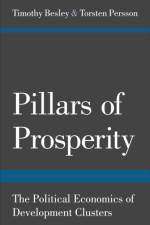
"e;Little else is required to carry a state to the highest degree of opulence from the lowest barbarism, but peace, easy taxes, and a tolerable administration of justice; all the rest being brought about by the natural course of things."e; So wrote Adam Smith a quarter of a millennium ago. Using the tools of modern political economics and combining economic theory with a bird's-eye view of the data, this book reinterprets Smith's pillars of prosperity to explain the existence of development clusters--places that tend to combine effective state institutions, the absence of political violence, and high per-capita incomes. To achieve peace, the authors stress the avoidance of repressive government and civil conflict. Easy taxes, they argue, refers not to low taxes, but a tax system with widespread compliance that collects taxes at a reasonable cost from a broad base, like income. And a tolerable administration of justice is about legal infrastructure that can support the enforcement of contracts and property rights in line with the rule of law. The authors show that countries tend to enjoy all three pillars of prosperity when they have evolved cohesive political institutions that promote common interests, guaranteeing the provision of public goods. In line with much historical research, international conflict has also been an important force behind effective states by fostering common interests. The absence of common interests and/or cohesive political institutions can explain the existence of very different development clusters in fragile states that are plagued by poverty, violence, and weak state capacity.
Spain's development from a premodern society into a modern unified nation-state with an integrated economy was painfully slow and varied widely by region. Economic historians have long argued that high internal transportation costs limited domestic market integration, while at the same time the Castilian capital city of Madrid drew resources from surrounding Spanish regions as it pursued its quest for centralization. According to this view, powerful Madrid thwarted trade over large geographic distances by destroying an integrated network of manufacturing towns in the Spanish interior. Challenging this long-held view, Regina Grafe argues that decentralization, not a strong and powerful Madrid, is to blame for Spain's slow march to modernity. Through a groundbreaking analysis of the market for bacalao--dried and salted codfish that was a transatlantic commodity and staple food during this period--Grafe shows how peripheral historic territories and powerful interior towns obstructed Spain's economic development through jurisdictional obstacles to trade, which exacerbated already high transport costs. She reveals how the early phases of globalization made these regions much more externally focused, and how coastal elites that were engaged in trade outside Spain sought to sustain their positions of power in relation to Madrid. Distant Tyranny offers a needed reassessment of the haphazard and regionally diverse process of state formation and market integration in early modern Spain, showing how local and regional agency paradoxically led to legitimate governance but economic backwardness.
Over-the-counter (OTC) markets for derivatives, collateralized debt obligations, and repurchase agreements played a significant role in the global financial crisis. Rather than being traded through a centralized institution such as a stock exchange, OTC trades are negotiated privately between market participants who may be unaware of prices that are currently available elsewhere in the market. In these relatively opaque markets, investors can be in the dark about the most attractive available terms and who might be offering them. This opaqueness exacerbated the financial crisis, as regulators and market participants were unable to quickly assess the risks and pricing of these instruments. Dark Markets offers a concise introduction to OTC markets by explaining key conceptual issues and modeling techniques, and by providing readers with a foundation for more advanced subjects in this field. Darrell Duffie covers the basic methods for modeling search and random matching in economies with many agents. He gives an overview of asset pricing in OTC markets with symmetric and asymmetric information, showing how information percolates through these markets as investors encounter each other over time. This book also features appendixes containing methodologies supporting the more theory-oriented of the chapters, making this the most self-contained introduction to OTC markets available.
Structural Macroeconometrics provides a thorough overview and in-depth exploration of methodologies, models, and techniques used to analyze forces shaping national economies. In this thoroughly revised second edition, David DeJong and Chetan Dave emphasize time series econometrics and unite theoretical and empirical research, while taking into account important new advances in the field. The authors detail strategies for solving dynamic structural models and present the full range of methods for characterizing and evaluating empirical implications, including calibration exercises, method-of-moment procedures, and likelihood-based procedures, both classical and Bayesian. The authors look at recent strides that have been made to enhance numerical efficiency, consider the expanded applicability of dynamic factor models, and examine the use of alternative assumptions involving learning and rational inattention on the part of decision makers. The treatment of methodologies for obtaining nonlinear model representations has been expanded, and linear and nonlinear model representations are integrated throughout the text. The book offers a rich array of implementation algorithms, sample empirical applications, and supporting computer code. Structural Macroeconometrics is the ideal textbook for graduate students seeking an introduction to macroeconomics and econometrics, and for advanced students pursuing applied research in macroeconomics. The book's historical perspective, along with its broad presentation of alternative methodologies, makes it an indispensable resource for academics and professionals.
Oversight answers the question of whether black and Latino legislators better represent minority interests in Congress than white legislators, and it is the first book on the subject to focus on congressional oversight rather than roll-call voting. In this important book, Michael Minta demonstrates that minority lawmakers provide qualitatively better representation of black and Latino interests than their white counterparts. They are more likely to intervene in decision making by federal agencies by testifying in support of minority interests at congressional oversight hearings. Minority legislators write more letters urging agency officials to enforce civil rights policies, and spend significant time and effort advocating for solutions to problems that affect all racial and ethnic groups, such as poverty, inadequate health care, fair housing, and community development. In Oversight, Minta argues that minority members of Congress act on behalf of broad minority interests--inside and outside their districts--because of a shared bond of experience and a sense of linked fate. He shows how the presence of black and Latino legislators in the committee room increases the chances that minority perspectives and concerns will be addressed in committee deliberations, and also how minority lawmakers are effective at countering negative stereotypes about minorities in policy debates on issues like affirmative action and affordable housing.
Population-based survey experiments have become an invaluable tool for social scientists struggling to generalize laboratory-based results, and for survey researchers besieged by uncertainties about causality. Thanks to technological advances in recent years, experiments can now be administered to random samples of the population to which a theory applies. Yet until now, there was no self-contained resource for social scientists seeking a concise and accessible overview of this methodology, its strengths and weaknesses, and the unique challenges it poses for implementation and analysis. Drawing on examples from across the social sciences, this book covers everything you need to know to plan, implement, and analyze the results of population-based survey experiments. But it is more than just a "e;how to"e; manual. This lively book challenges conventional wisdom about internal and external validity, showing why strong causal claims need not come at the expense of external validity, and how it is now possible to execute experiments remotely using large-scale population samples. Designed for social scientists across the disciplines, Population-Based Survey Experiments provides the first complete introduction to this methodology. Offers the most comprehensive treatment of the subject Features a wealth of examples and practical advice Reexamines issues of internal and external validity Can be used in conjunction with downloadable data from ExperimentCentral.org for design and analysis exercises in the classroom
What causes genocide? Why do some stand by, doing nothing, while others risk their lives to help the persecuted? Ethics in an Age of Terror and Genocide analyzes riveting interviews with bystanders, Nazi supporters, and rescuers of Jews during the Holocaust to lay bare critical psychological forces operating during genocide. Monroe's insightful examination of these moving--and disturbing--interviews underscores the significance of identity for moral choice. Monroe finds that self-image and identity--especially the sense of self in relation to others--determine and delineate our choice options, not just morally but cognitively. She introduces the concept of moral salience to explain how we establish a critical psychological relationship with others, classifying individuals in need as "e;people just like us"e; or reducing them to strangers perceived as different, threatening, or even beyond the boundaries of our concern. Monroe explicates the psychological dehumanization that is a prerequisite for genocide and uses her knowledge of human behavior during the Holocaust to develop a broader theory of moral choice, one applicable to other forms of ethnic, religious, racial, and sectarian prejudice, aggression, and violence. Her book fills a long-standing void in ethics and suggests that identity is more fundamental than reasoning in our treatment of others.
As recently as the early 1970s, the news media was one of the most respected institutions in the United States. Yet by the 1990s, this trust had all but evaporated. Why has confidence in the press declined so dramatically over the past 40 years? And has this change shaped the public's political behavior? This book examines waning public trust in the institutional news media within the context of the American political system and looks at how this lack of confidence has altered the ways people acquire political information and form electoral preferences. Jonathan Ladd argues that in the 1950s, '60s, and early '70s, competition in American party politics and the media industry reached historic lows. When competition later intensified in both of these realms, the public's distrust of the institutional media grew, leading the public to resist the mainstream press's information about policy outcomes and turn toward alternative partisan media outlets. As a result, public beliefs and voting behavior are now increasingly shaped by partisan predispositions. Ladd contends that it is not realistic or desirable to suppress party and media competition to the levels of the mid-twentieth century; rather, in the contemporary media environment, new ways to augment the public's knowledgeability and responsiveness must be explored. Drawing on historical evidence, experiments, and public opinion surveys, this book shows that in a world of endless news sources, citizens' trust in institutional media is more important than ever before.
Why did the twentieth century witness unprecedented organized genocide? Can we learn why genocide is perpetrated by comparing different cases of genocide? Is the Holocaust unique, or does it share causes and features with other cases of state-sponsored mass murder? Can genocide be prevented? Blending gripping narrative with trenchant analysis, Eric Weitz investigates four of the twentieth century's major eruptions of genocide: the Soviet Union under Stalin, Nazi Germany, Cambodia under the Khmer Rouge, and the former Yugoslavia. Drawing on historical sources as well as trial records, memoirs, novels, and poems, Weitz explains the prevalence of genocide in the twentieth century--and shows how and why it became so systematic and deadly. Weitz depicts the searing brutality of each genocide and traces its origins back to those most powerful categories of the modern world: race and nation. He demonstrates how, in each of the cases, a strong state pursuing utopia promoted a particular mix of extreme national and racial ideologies. In moments of intense crisis, these states targeted certain national and racial groups, believing that only the annihilation of these "e;enemies"e; would enable the dominant group to flourish. And in each instance, large segments of the population were enticed to join in the often ritualistic actions that destroyed their neighbors. This book offers some of the most absorbing accounts ever written of the population purges forever associated with the names Stalin, Hitler, Pol Pot, and Milosevic. A controversial and richly textured comparison of these four modern cases, it identifies the social and political forces that produce genocide.
Handwringing about political apathy is as old as democracy itself. As early as 425 BC, the playwright Aristophanes ridiculed his fellow Athenians for gossiping in the market instead of voting. In more recent decades, calls for greater civic engagement as a democratic cure-all have met with widespread agreement. But how realistic--or helpful--is it to expect citizens to devote more attention and energy to politics? In Attention Deficit Democracy, Ben Berger provides a surprising new perspective on the problem of civic engagement, challenging idealists who aspire to revolutionize democracies and their citizens, but also taking issue with cynics who think that citizens cannot--and need not--do better. "e;Civic engagement"e; has become an unwieldy and confusing catchall, Berger argues. We should talk instead of political, social, and moral engagement, figuring out which kinds of engagement make democracy work better, and how we might promote them. Focusing on political engagement and taking Alexis de Tocqueville and Hannah Arendt as his guides, Berger identifies ways to achieve the political engagement we want and need without resorting to coercive measures such as compulsory national service or mandatory voting. By providing a realistic account of the value of political engagement and practical strategies for improving it, while avoiding proposals we can never hope to achieve, Attention Deficit Democracy makes a persuasive case for a public philosophy that much of the public can actually endorse.
Party competition for votes in free and fair elections involves complex interactions by multiple actors in political landscapes that are continuously evolving, yet classical theoretical approaches to the subject leave many important questions unanswered. Here Michael Laver and Ernest Sergenti offer the first comprehensive treatment of party competition using the computational techniques of agent-based modeling. This exciting new technology enables researchers to model competition between several different political parties for the support of voters with widely varying preferences on many different issues. Laver and Sergenti model party competition as a true dynamic process in which political parties rise and fall, a process where different politicians attack the same political problem in very different ways, and where today's political actors, lacking perfect information about the potential consequences of their choices, must constantly adapt their behavior to yesterday's political outcomes. Party Competition shows how agent-based modeling can be used to accurately reflect how political systems really work. It demonstrates that politicians who are satisfied with relatively modest vote shares often do better at winning votes than rivals who search ceaselessly for higher shares of the vote. It reveals that politicians who pay close attention to their personal preferences when setting party policy often have more success than opponents who focus solely on the preferences of voters, that some politicians have idiosyncratic "e;valence"e; advantages that enhance their electability--and much more.
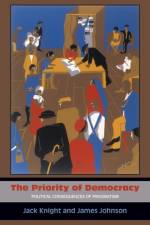
Pragmatism and its consequences are central issues in American politics today, yet scholars rarely examine in detail the relationship between pragmatism and politics. In The Priority of Democracy, Jack Knight and James Johnson systematically explore the subject and make a strong case for adopting a pragmatist approach to democratic politics--and for giving priority to democracy in the process of selecting and reforming political institutions. What is the primary value of democracy? When should we make decisions democratically and when should we rely on markets? And when should we accept the decisions of unelected officials, such as judges or bureaucrats? Knight and Johnson explore how a commitment to pragmatism should affect our answers to such important questions. They conclude that democracy is a good way of determining how these kinds of decisions should be made--even if what the democratic process determines is that not all decisions should be made democratically. So, for example, the democratically elected U.S. Congress may legitimately remove monetary policy from democratic decision-making by putting it under the control of the Federal Reserve. Knight and Johnson argue that pragmatism offers an original and compelling justification of democracy in terms of the unique contributions democratic institutions can make to processes of institutional choice. This focus highlights the important role that democracy plays, not in achieving consensus or commonality, but rather in addressing conflicts. Indeed, Knight and Johnson suggest that democratic politics is perhaps best seen less as a way of reaching consensus or agreement than as a way of structuring the terms of persistent disagreement.
The recent economic crisis was a dramatic reminder that capitalism can both produce and destroy. It's a system that by its very nature encourages predators and creators, locusts and bees. But, as Geoff Mulgan argues in this compelling, imaginative, and important book, the economic crisis also presents a historic opportunity to choose a radically different future for capitalism, one that maximizes its creative power and minimizes its destructive force. In an engaging and wide-ranging argument, Mulgan digs into the history of capitalism across the world to show its animating ideas, its utopias and dystopias, as well as its contradictions and possibilities. Drawing on a subtle framework for understanding systemic change, he shows how new political settlements reshaped capitalism in the past and are likely to do so in the future. By reconnecting value to real-life ideas of growth, he argues, efficiency and entrepreneurship can be harnessed to promote better lives and relationships rather than just a growth in the quantity of material consumption. Healthcare, education, and green industries are already becoming dominant sectors in the wealthier economies, and the fields of social innovation, enterprise, and investment are rapidly moving into the mainstream--all indicators of how capital could be made more of a servant and less a master. This is a book for anyone who wonders where capitalism might be heading next--and who wants to help make sure that its future avoids the mistakes of the past. This edition of The Locust and the Bee includes a new afterword in which the author lays out some of the key challenges facing capitalism in the twenty-first century.
Abonner på vårt nyhetsbrev og få rabatter og inspirasjon til din neste leseopplevelse.
Ved å abonnere godtar du vår personvernerklæring.