




























Gjør som tusenvis av andre bokelskere
Abonner på vårt nyhetsbrev og få rabatter og inspirasjon til din neste leseopplevelse.
Ved å abonnere godtar du vår personvernerklæring.Du kan når som helst melde deg av våre nyhetsbrev.

Convolution and Equidistribution explores an important aspect of number theory--the theory of exponential sums over finite fields and their Mellin transforms--from a new, categorical point of view. The book presents fundamentally important results and a plethora of examples, opening up new directions in the subject. The finite-field Mellin transform (of a function on the multiplicative group of a finite field) is defined by summing that function against variable multiplicative characters. The basic question considered in the book is how the values of the Mellin transform are distributed (in a probabilistic sense), in cases where the input function is suitably algebro-geometric. This question is answered by the book's main theorem, using a mixture of geometric, categorical, and group-theoretic methods. By providing a new framework for studying Mellin transforms over finite fields, this book opens up a new way for researchers to further explore the subject.
This book makes a significant inroad into the unexpectedly difficult question of existence of Frechet derivatives of Lipschitz maps of Banach spaces into higher dimensional spaces. Because the question turns out to be closely related to porous sets in Banach spaces, it provides a bridge between descriptive set theory and the classical topic of existence of derivatives of vector-valued Lipschitz functions. The topic is relevant to classical analysis and descriptive set theory on Banach spaces. The book opens several new research directions in this area of geometric nonlinear functional analysis. The new methods developed here include a game approach to perturbational variational principles that is of independent interest. Detailed explanation of the underlying ideas and motivation behind the proofs of the new results on Frechet differentiability of vector-valued functions should make these arguments accessible to a wider audience. The most important special case of the differentiability results, that Lipschitz mappings from a Hilbert space into the plane have points of Frechet differentiability, is given its own chapter with a proof that is independent of much of the work done to prove more general results. The book raises several open questions concerning its two main topics.
This textbook offers a concise yet rigorous introduction to calculus of variations and optimal control theory, and is a self-contained resource for graduate students in engineering, applied mathematics, and related subjects. Designed specifically for a one-semester course, the book begins with calculus of variations, preparing the ground for optimal control. It then gives a complete proof of the maximum principle and covers key topics such as the Hamilton-Jacobi-Bellman theory of dynamic programming and linear-quadratic optimal control. Calculus of Variations and Optimal Control Theory also traces the historical development of the subject and features numerous exercises, notes and references at the end of each chapter, and suggestions for further study. Offers a concise yet rigorous introduction Requires limited background in control theory or advanced mathematics Provides a complete proof of the maximum principle Uses consistent notation in the exposition of classical and modern topics Traces the historical development of the subject Solutions manual (available only to teachers) Leading universities that have adopted this book include: University of Illinois at Urbana-Champaign ECE 553: Optimum Control Systems Georgia Institute of Technology ECE 6553: Optimal Control and Optimization University of Pennsylvania ESE 680: Optimal Control Theory University of Notre Dame EE 60565: Optimal Control
Electromagnetic complex media are artificial materials that affect the propagation of electromagnetic waves in surprising ways not usually seen in nature. Because of their wide range of important applications, these materials have been intensely studied over the past twenty-five years, mainly from the perspectives of physics and engineering. But a body of rigorous mathematical theory has also gradually developed, and this is the first book to present that theory. Designed for researchers and advanced graduate students in applied mathematics, electrical engineering, and physics, this book introduces the electromagnetics of complex media through a systematic, state-of-the-art account of their mathematical theory. The book combines the study of well posedness, homogenization, and controllability of Maxwell equations complemented with constitutive relations describing complex media. The book treats deterministic and stochastic problems both in the frequency and time domains. It also covers computational aspects and scattering problems, among other important topics. Detailed appendices make the book self-contained in terms of mathematical prerequisites, and accessible to engineers and physicists as well as mathematicians.
Modern complex large-scale dynamical systems exist in virtually every aspect of science and engineering, and are associated with a wide variety of physical, technological, environmental, and social phenomena, including aerospace, power, communications, and network systems, to name just a few. This book develops a general stability analysis and control design framework for nonlinear large-scale interconnected dynamical systems, and presents the most complete treatment on vector Lyapunov function methods, vector dissipativity theory, and decentralized control architectures. Large-scale dynamical systems are strongly interconnected and consist of interacting subsystems exchanging matter, energy, or information with the environment. The sheer size, or dimensionality, of these systems necessitates decentralized analysis and control system synthesis methods for their analysis and design. Written in a theorem-proof format with examples to illustrate new concepts, this book addresses continuous-time, discrete-time, and hybrid large-scale systems. It develops finite-time stability and finite-time decentralized stabilization, thermodynamic modeling, maximum entropy control, and energy-based decentralized control. This book will interest applied mathematicians, dynamical systems theorists, control theorists, and engineers, and anyone seeking a fundamental and comprehensive understanding of large-scale interconnected dynamical systems and control.
In recent decades, governments and NGOs--in an effort to promote democracy, freedom, fairness, and stability throughout the world--have organized teams of observers to monitor elections in a variety of countries. But when more organizations join the practice without uniform standards, are assessments reliable? When politicians nonetheless cheat and monitors must return to countries even after two decades of engagement, what is accomplished? Monitoring Democracy argues that the practice of international election monitoring is broken, but still worth fixing. By analyzing the evolving interaction between domestic and international politics, Judith Kelley refutes prevailing arguments that international efforts cannot curb government behavior and that democratization is entirely a domestic process. Yet, she also shows that democracy promotion efforts are deficient and that outside actors often have no power and sometimes even do harm. Analyzing original data on over 600 monitoring missions and 1,300 elections, Kelley grounds her investigation in solid historical context as well as studies of long-term developments over several elections in fifteen countries. She pinpoints the weaknesses of international election monitoring and looks at how practitioners and policymakers might help to improve them.
In applying the standards of modern literary criticism to medieval Arabic literature, Andras Hamori concentrates on those aspects of the literature that appear most alien to modern Western taste: the limitation of themes, the sedimentation with conventions, and the use of elusive patterns of composition.The first part of the book approaches Arabic literature from the historical point of view, concentrating on the transformations in poetic genres and poetic attitudes towards time and society in the literature between the sixth and the tenth centuries. The problems of poetic technique are then discussed, with special emphasis on poetic unity and the use of conventions. The third part of the book deals with methods of composition in prose through an examination of the orders and disorders in two tales from the Arabian Nights.Originally published in 1974.The Princeton Legacy Library uses the latest print-on-demand technology to again make available previously out-of-print books from the distinguished backlist of Princeton University Press. These editions preserve the original texts of these important books while presenting them in durable paperback and hardcover editions. The goal of the Princeton Legacy Library is to vastly increase access to the rich scholarly heritage found in the thousands of books published by Princeton University Press since its founding in 1905.
Local government is the hidden leviathan of American politics: it accounts for nearly a tenth of gross domestic product, it collects nearly as much in taxes as the federal government, and its decisions have an enormous impact on Americans' daily lives. Yet political scientists have few explanations for how people vote in local elections, particularly in the smaller cities, towns, and suburbs where most Americans live. Drawing on a wide variety of data sources and case studies, this book offers the first comprehensive analysis of electoral politics in America's municipalities. Arguing that current explanations of voting behavior are ill suited for most local contests, Eric Oliver puts forward a new theory that highlights the crucial differences between local, state, and national democracies. Being small in size, limited in power, and largely unbiased in distributing their resources, local governments are "e;managerial democracies"e; with a distinct style of electoral politics. Instead of hinging on the partisanship, ideology, and group appeals that define national and state elections, local elections are based on the custodial performance of civic-oriented leaders and on their personal connections to voters with similarly deep community ties. Explaining not only the dynamics of local elections, Oliver's findings also upend many long-held assumptions about community power and local governance, including the importance of voter turnout and the possibilities for grassroots political change.
Preferential trading arrangements (PTAs) play an increasingly prominent role in the global political economy, two notable examples being the European Union and the North American Free Trade Agreement. These agreements foster economic integration among member states by enhancing their access to one another's markets. Yet despite the importance of PTAs to international trade and world politics, until now little attention has been focused on why governments choose to join them and how governments design them. This book offers valuable new insights into the political economy of PTA formation. Many economists have argued that the roots of these agreements lie in the promise they hold for improving the welfare of member states. Others have posited that trade agreements are a response to global political conditions. Edward Mansfield and Helen Milner argue that domestic politics provide a crucial impetus to the decision by governments to enter trade pacts. Drawing on this argument, they explain why democracies are more likely to enter PTAs than nondemocratic regimes, and why as the number of veto players--interest groups with the power to block policy change--increases in a prospective member state, the likelihood of the state entering a trade agreement is reduced. The book provides a novel view of the political foundations of trade agreements.
For decades the European Union tried changing its institutions, but achieved only unsatisfying political compromises and modest, incremental treaty revisions. In late 2009, however, the EU was successfully reformed through the Treaty of Lisbon. Reforming the European Union examines how political leaders ratified this treaty against all odds and shows how this victory involved all stages of treaty reform negotiations--from the initial proposal to referendums in several European countries. The authors emphasize the strategic role of political leadership and domestic politics, and they use state-of-the-art methodology, applying a comprehensive data set for actors' reform preferences. They look at how political leaders reacted to apparent failures of the process by recreating or changing the rules of the game. While domestic actors played a significant role in the process, their influence over the outcome was limited as leaders ignored negative referendums and plowed ahead with intended reforms. The book's empirical analyses shed light on critical episodes: strategic agenda setting during the European Convention, the choice of ratification instrument, intergovernmental bargaining dynamics, and the reaction of the German Council presidency to the negative referendums in France, the Netherlands, and Ireland.
The World Trade Organization (WTO) oversees the negotiation and enforcement of formal rules governing international trade. Why do countries choose to adjudicate their trade disputes in the WTO rather than settling their differences on their own? In Why Adjudicate?, Christina Davis investigates the domestic politics behind the filing of WTO complaints and reveals why formal dispute settlement creates better outcomes for governments and their citizens. Davis demonstrates that industry lobbying, legislative demands, and international politics influence which countries and cases appear before the WTO. Democratic checks and balances bias the trade policy process toward public lawsuits and away from informal settlements. Trade officials use legal complaints to manage domestic politics and defend trade interests. WTO dispute settlement enables states and domestic groups to signal resolve more effectively, thereby enhancing the information available to policymakers and reducing the risk of a trade war. Davis establishes her argument with data on trade disputes and landmark cases, including the Boeing-Airbus controversy over aircraft subsidies, disagreement over Chinese intellectual property rights, and Japan's repeated challenges of U.S. steel industry protection. In her analysis of foreign trade barriers against U.S. exports, Davis explains why the United States gains better outcomes for cases taken to formal dispute settlement than for those negotiated. Case studies of Peru and Vietnam show that legal action can also benefit developing countries.
In 70 CE, the Jews were an agrarian and illiterate people living mostly in the Land of Israel and Mesopotamia. By 1492 the Jewish people had become a small group of literate urbanites specializing in crafts, trade, moneylending, and medicine in hundreds of places across the Old World, from Seville to Mangalore. What caused this radical change? The Chosen Few presents a new answer to this question by applying the lens of economic analysis to the key facts of fifteen formative centuries of Jewish history. Maristella Botticini and Zvi Eckstein offer a powerful new explanation of one of the most significant transformations in Jewish history while also providing fresh insights into the growing debate about the social and economic impact of religion.
What makes for war or for a stable international system? Are there general principles that should govern foreign policy? In The Cold War and After, Marc Trachtenberg, a leading historian of international relations, explores how historical work can throw light on these questions. The essays in this book deal with specific problems--with such matters as nuclear strategy and U.S.-European relations. But Trachtenberg's main goal is to show how in practice a certain type of scholarly work can be done. He demonstrates how, in studying international politics, the conceptual and empirical sides of the analysis can be made to connect with each other, and ,how historical, theoretical, and even policy issues can be tied together in an intellectually respectable way. These essays address a wide variety of topics, from theoretical and policy issues, such as the question of preventive war and the problem of international order, to more historical subjects--for example, American policy on Eastern Europe in 1945 and Franco-American relations during the Nixon-Pompidou period. But in each case the aim is to show how a theoretical perspective can be brought to bear on the analysis of historical issues, and how historical analysis can shed light on basic conceptual problems.
This book presents Ariel Rubinstein's lecture notes for the first part of his well-known graduate course in microeconomics. Developed during the fifteen years that Rubinstein taught the course at Tel Aviv University, Princeton University, and New York University, these notes provide a critical assessment of models of rational economic agents, and are an invaluable supplement to any primary textbook in microeconomic theory. In this fully revised and expanded second edition, Rubinstein retains the striking originality and deep simplicity that characterize his famously engaging style of teaching. He presents these lecture notes with a precision that gets to the core of the material, and he places special emphasis on the interpretation of key concepts. Rubinstein brings this concise book thoroughly up to date, covering topics like modern choice theory and including dozens of original new problems. Written by one of the world's most respected and provocative economic theorists, this second edition of Lecture Notes in Microeconomic Theory is essential reading for students, teachers, and research economists. Fully revised, expanded, and updated Retains the engaging style and method of Rubinstein's well-known lectures Covers topics like modern choice theory Features numerous original new problems--including 21 new review problems Solutions manual (available only to teachers) can be found at: http://gametheory.tau.ac.il/microTheory/.
A woman glances at a broken clock and comes to believe it is a quarter past seven. Yet, despite the broken clock, it really does happen to be a quarter past seven. Her belief is true, but it isn't knowledge. This is a classic illustration of a central problem in epistemology: determining what knowledge requires in addition to true belief. In this provocative book, Richard Foley finds a new solution to the problem in the observation that whenever someone has a true belief but not knowledge, there is some significant aspect of the situation about which she lacks true beliefs--something important that she doesn't quite "e;get."e; This may seem a modest point but, as Foley shows, it has the potential to reorient the theory of knowledge. Whether a true belief counts as knowledge depends on the importance of the information one does or doesn't have. This means that questions of knowledge cannot be separated from questions about human concerns and values. It also means that, contrary to what is often thought, there is no privileged way of coming to know. Knowledge is a mutt. Proper pedigree is not required. What matters is that one doesn't lack important nearby information. Challenging some of the central assumptions of contemporary epistemology, this is an original and important account of knowledge.
The success of the agricultural policy adopted in 1965 has given India the hope of escaping from its circle of poverty. At the same time the increased rate of economic development seems to have exacerbated social tensions and accentuated disparities that may eventually undermine the foundations of rural political stability.Originally published in 1971.The Princeton Legacy Library uses the latest print-on-demand technology to again make available previously out-of-print books from the distinguished backlist of Princeton University Press. These editions preserve the original texts of these important books while presenting them in durable paperback and hardcover editions. The goal of the Princeton Legacy Library is to vastly increase access to the rich scholarly heritage found in the thousands of books published by Princeton University Press since its founding in 1905.
Established in 221 BCE, the Chinese empire lasted for 2,132 years before being replaced by the Republic of China in 1912. During its two millennia, the empire endured internal wars, foreign incursions, alien occupations, and devastating rebellions--yet fundamental institutional, sociopolitical, and cultural features of the empire remained intact. The Everlasting Empire traces the roots of the Chinese empire's exceptional longevity and unparalleled political durability, and shows how lessons from the imperial past are relevant for China today. Yuri Pines demonstrates that the empire survived and adjusted to a variety of domestic and external challenges through a peculiar combination of rigid ideological premises and their flexible implementation. The empire's major political actors and neighbors shared its fundamental ideological principles, such as unity under a single monarch--hence, even the empire's strongest domestic and foreign foes adopted the system of imperial rule. Yet details of this rule were constantly negotiated and adjusted. Pines shows how deep tensions between political actors including the emperor, the literati, local elites, and rebellious commoners actually enabled the empire's basic institutional framework to remain critically vital and adaptable to ever-changing sociopolitical circumstances. As contemporary China moves toward a new period of prosperity and power in the twenty-first century, Pines argues that the legacy of the empire may become an increasingly important force in shaping the nation's future trajectory.
In late antiquity, as Christianity emerged from Judaism, it was not only the new religion that was being influenced by the old. The rise and revolutionary challenge of Christianity also had a profound influence on rabbinic Judaism, which was itself just emerging and, like Christianity, trying to shape its own identity. In The Jewish Jesus, Peter Schafer reveals the crucial ways in which various Jewish heresies, including Christianity, affected the development of rabbinic Judaism. He even shows that some of the ideas that the rabbis appropriated from Christianity were actually reappropriated Jewish ideas. The result is a demonstration of the deep mutual influence between the sister religions, one that calls into question hard and fast distinctions between orthodoxy and heresy, and even Judaism and Christianity, during the first centuries CE.
Pioneering biblical critic, theorist of democracy, and legendary conflater of God and nature, Jewish philosopher Baruch Spinoza (1632-1677) was excommunicated by the Sephardic Jews of Amsterdam in 1656 for his "e;horrible heresies"e; and "e;monstrous deeds."e; Yet, over the past three centuries, Spinoza's rupture with traditional Jewish beliefs and practices has elevated him to a prominent place in genealogies of Jewish modernity. The First Modern Jew provides a riveting look at how Spinoza went from being one of Judaism's most notorious outcasts to one of its most celebrated, if still highly controversial, cultural icons, and a powerful and protean symbol of the first modern secular Jew. Ranging from Amsterdam to Palestine and back again to Europe, the book chronicles Spinoza's posthumous odyssey from marginalized heretic to hero, the exemplar of a whole host of Jewish identities, including cosmopolitan, nationalist, reformist, and rejectionist. Daniel Schwartz shows that in fashioning Spinoza into "e;the first modern Jew,"e; generations of Jewish intellectuals--German liberals, East European maskilim, secular Zionists, and Yiddishists--have projected their own dilemmas of identity onto him, reshaping the Amsterdam thinker in their own image. The many afterlives of Spinoza are a kind of looking glass into the struggles of Jewish writers over where to draw the boundaries of Jewishness and whether a secular Jewish identity is indeed possible. Cumulatively, these afterlives offer a kaleidoscopic view of modern Jewish cultureand a vivid history of an obsession with Spinoza that continues to this day.
We all played tag when we were kids. What most of us don't realize is that this simple chase game is in fact an application of pursuit theory, and that the same principles of games like tag, dodgeball, and hide-and-seek are also at play in military strategy, high-seas chases by the Coast Guard, and even romantic pursuits. In Chases and Escapes, Paul Nahin gives us the first complete history of this fascinating area of mathematics, from its classical analytical beginnings to the present day. Drawing on game theory, geometry, linear algebra, target-tracking algorithms, and much more, Nahin also offers an array of challenging puzzles with their historical background and broader applications. Chases and Escapes includes solutions to all problems and provides computer programs that readers can use for their own cutting-edge analysis. Now with a gripping new preface on how the Enola Gay escaped the shock wave from the atomic bomb dropped on Hiroshima, this book will appeal to anyone interested in the mathematics that underlie pursuit and evasion.Some images inside the book are unavailable due to digital copyright restrictions.
Touching on issues of power, authority, and domination, Manhunts takes an in-depth look at the hunting of humans in the West, from ancient Sparta, through the Middle Ages, to the modern practices of chasing undocumented migrants. Incorporating historical events and philosophical reflection, Gregoire Chamayou examines the systematic and organized search for individuals and small groups on the run because they have defied authority, committed crimes, seemed dangerous simply for existing, or been categorized as subhuman or dispensable. Chamayou begins in ancient Greece, where young Spartans hunted and killed Helots (Sparta's serfs) as an initiation rite, and where Aristotle and other philosophers helped to justify raids to capture and enslave foreigners by creating the concept of natural slaves. He discusses the hunt for heretics in the Middle Ages; New World natives in the early modern period; vagrants, Jews, criminals, and runaway slaves in other eras; and illegal immigrants today. Exploring evolving ideas about the human and the subhuman, what we owe to enemies and people on the margins of society, and the supposed legitimacy of domination, Chamayou shows that the hunting of humans should not be treated ahistorically, and that manhunting has varied as widely in its justifications and aims as in its practices. He investigates the psychology of manhunting, noting that many people, from bounty hunters to Balzac, have written about the thrill of hunting when the prey is equally intelligent and cunning. An unconventional history on an unconventional subject, Manhunts is an in-depth consideration of the dynamics of an age-old form of violence.
America's Mission argues that the global strength and prestige of democracy today are due in large part to America's impact on international affairs. Tony Smith documents the extraordinary history of how American foreign policy has been used to try to promote democracy worldwide, an effort that enjoyed its greatest triumphs in the occupations of Japan and Germany but suffered huge setbacks in Latin America, Vietnam, and elsewhere. With new chapters and a new introduction and epilogue, this expanded edition also traces U.S. attempts to spread democracy more recently, under presidents Clinton, Bush, and Obama, and assesses America's role in the Arab Spring.
The sexual revolution is justly celebrated for the freedoms it brought--birth control, the decriminalization of abortion, the liberalization of divorce, greater equality between the sexes, women's massive entry into the workforce, and more tolerance of homosexuality. But as Pascal Bruckner, one of France's leading writers, argues in this lively and provocative reflection on the contradictions of modern love, our new freedoms have also brought new burdens and rules--without, however, wiping out the old rules, emotions, desires, and arrangements: the couple, marriage, jealousy, the demand for fidelity, the war between constancy and inconstancy. It is no wonder that love, sex, and relationships today are so confusing, so difficult, and so paradoxical. Drawing on history, politics, psychology, literature, pop culture, and current events, this book--a best seller in France--exposes and dissects these paradoxes. With his customary brilliance and wit, Bruckner traces the roots of sexual liberation back to the Enlightenment in order to explain love's supreme paradox, epitomized by the 1960s oxymoron of "e;free love"e;: the tension between freedom, which separates, and love, which attaches. Ashamed that our sex lives fail to live up to such liberated ideals, we have traded neuroses of repression for neuroses of inadequacy, and we overcompensate: "e;Our parents lied about their morality,"e; Bruckner writes, but "e;we lie about our immorality.? Mixing irony and optimism, Bruckner argues that, when it comes to love, we should side neither with the revolutionaries nor the reactionaries. Rather, taking love and ourselves as we are, we should realize that love makes no progress and that its messiness, surprises, and paradoxes are not merely the sources of its pain--but also of its pleasure and glory.
The Ultimate Book of Saturday Science is Neil Downie's biggest and most astounding compendium yet of science experiments you can do in your own kitchen or backyard using common household items. It may be the only book that encourages hands-on science learning through the use of high-velocity, air-driven carrots. Downie, the undisputed maestro of Saturday science, here reveals important principles in physics, engineering, and chemistry through such marvels as the Helevator--a contraption that's half helicopter, half elevator--and the Rocket Railroad, which pumps propellant up from its own track. The Riddle of the Sands demonstrates why some granular materials form steep cones when poured while others collapse in an avalanche. The Sunbeam Exploder creates a combustible delivery system out of sunlight, while the Red Hot Memory experiment shows you how to store data as heat. Want to learn to tell time using a knife and some butter? There's a whole section devoted to exotic clocks and oscillators that teaches you how. The Ultimate Book of Saturday Science features more than seventy fun and astonishing experiments that range in difficulty from simple to more challenging. All of them are original, and all are guaranteed to work. Downie provides instructions for each one and explains the underlying science, and also presents experimental variations that readers will want to try.
Introducing new evidence from more than 600 secret Ottoman documents, this book demonstrates in unprecedented detail that the Armenian Genocide and the expulsion of Greeks from the late Ottoman Empire resulted from an official effort to rid the empire of its Christian subjects. Presenting these previously inaccessible documents along with expert context and analysis, Taner Akcam's most authoritative work to date goes deep inside the bureaucratic machinery of Ottoman Turkey to show how a dying empire embraced genocide and ethnic cleansing. Although the deportation and killing of Armenians was internationally condemned in 1915 as a "e;crime against humanity and civilization,"e; the Ottoman government initiated a policy of denial that is still maintained by the Turkish Republic. The case for Turkey's "e;official history"e; rests on documents from the Ottoman imperial archives, to which access has been heavily restricted until recently. It is this very source that Akcam now uses to overturn the official narrative. The documents presented here attest to a late-Ottoman policy of Turkification, the goal of which was no less than the radical demographic transformation of Anatolia. To that end, about one-third of Anatolia's 15 million people were displaced, deported, expelled, or massacred, destroying the ethno-religious diversity of an ancient cultural crossroads of East and West, and paving the way for the Turkish Republic. By uncovering the central roles played by demographic engineering and assimilation in the Armenian Genocide, this book will fundamentally change how this crime is understood and show that physical destruction is not the only aspect of the genocidal process.
This exquisitely illustrated volume provides an in-depth look at spring-blooming wildflowers of the Northeast, from old favorites to lesser-known species. Featuring more than 500 full-color photos in a stunning large-sized format, the book delves deep into the life histories, lore, and cultural uses of more than 35 plant species. The rich narrative covers topics such as the naming of wildflowers; the reasons for taxonomic changes; pollination of flowers and dispersal of seeds; uses by Native Americans; related species in other parts of the world; herbivores, plant pathogens, and pests; medicinal uses; and wildflower references in history, literature, and art. The photos capture the beauty of these plants and also illustrate the concepts discussed in the text.A book unlike any other, Spring Wildflowers of the Northeast combines the latest scientific research with an accessible, entertaining style, making it the ideal volume for readers of all levels of expertise.Showcases the Northeast's most spectacular spring-blooming wildflowersFeatures more than 500 full-color photosCovers the life histories, lore, and cultural uses of more than 35 speciesCombines the latest scientific research with an easy-to-read styleOffers something new for seasoned botanists as well as armchair naturalists
Elliptic Tales describes the latest developments in number theory by looking at one of the most exciting unsolved problems in contemporary mathematics-the Birch and Swinnerton-Dyer Conjecture. In this book, Avner Ash and Robert Gross guide readers through the mathematics they need to understand this captivating problem.The key to the conjecture lies in elliptic curves, which may appear simple, but arise from some very deep-and often very mystifying-mathematical ideas. Using only basic algebra and calculus while presenting numerous eye-opening examples, Ash and Gross make these ideas accessible to general readers, and, in the process, venture to the very frontiers of modern mathematics.
Ever wonder why cats land on their feet? Or what holds a spinning top upright? Or whether it is possible to feel the Earth's rotation in an airplane? Why Cats Land on Their Feet is a compendium of paradoxes and puzzles that readers can solve using their own physical intuition. And the surprising answers to virtually all of these astonishing paradoxes can be arrived at with no formal knowledge of physics. Mark Levi introduces each physical problem, sometimes gives a hint or two, and then fully explains the solution. Here readers can test their critical-thinking skills against a whole assortment of puzzles and paradoxes involving floating and diving, sailing and gliding, gymnastics, bike riding, outer space, throwing a ball from a moving car, centrifugal force, gyroscopic motion, and, of course, falling cats. Want to figure out how to open a wine bottle with a book? Or how to compute the square root of a number using a tennis shoe and a watch? Why Cats Land on Their Feet shows you how, and all that's required is a familiarity with basic high-school mathematics. This lively collection also features an appendix that explains all physical concepts used in the book, from Newton's laws to the fundamental theorem of calculus.
Ancient Christians invoked sin to account for an astonishing range of things, from the death of God's son to the politics of the Roman Empire that worshipped him. In this book, award-winning historian of religion Paula Fredriksen tells the surprising story of early Christian concepts of sin, exploring the ways that sin came to shape ideas about God no less than about humanity. Long before Christianity, of course, cultures had articulated the idea that human wrongdoing violated relations with the divine. But Sin tells how, in the fevered atmosphere of the four centuries between Jesus and Augustine, singular new Christian ideas about sin emerged in rapid and vigorous variety, including the momentous shift from the belief that sin is something one does to something that one is born into. As the original defining circumstances of their movement quickly collapsed, early Christians were left to debate the causes, manifestations, and remedies of sin. This is a powerful and original account of the early history of an idea that has centrally shaped Christianity and left a deep impression on the secular world as well.
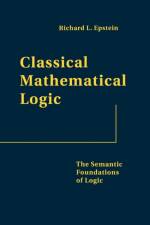
In Classical Mathematical Logic, Richard L. Epstein relates the systems of mathematical logic to their original motivations to formalize reasoning in mathematics. The book also shows how mathematical logic can be used to formalize particular systems of mathematics. It sets out the formalization not only of arithmetic, but also of group theory, field theory, and linear orderings. These lead to the formalization of the real numbers and Euclidean plane geometry. The scope and limitations of modern logic are made clear in these formalizations. The book provides detailed explanations of all proofs and the insights behind the proofs, as well as detailed and nontrivial examples and problems. The book has more than 550 exercises. It can be used in advanced undergraduate or graduate courses and for self-study and reference. Classical Mathematical Logic presents a unified treatment of material that until now has been available only by consulting many different books and research articles, written with various notation systems and axiomatizations.
Abonner på vårt nyhetsbrev og få rabatter og inspirasjon til din neste leseopplevelse.
Ved å abonnere godtar du vår personvernerklæring.