

Gjør som tusenvis av andre bokelskere
Abonner på vårt nyhetsbrev og få rabatter og inspirasjon til din neste leseopplevelse.
Ved å abonnere godtar du vår personvernerklæring.Du kan når som helst melde deg av våre nyhetsbrev.

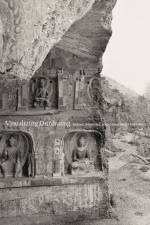
A beautifully illustrated study of the caves at Dunhuang, exploring how this important Buddhist site has been visualized from its creation to today Situated at the crossroads of the northern and southern routes of the ancient silk routes in western China, Dunhuang is one of the richest Buddhist sites in the world, with more than 500 richly decorated cave temples constructed between the fourth and fourteenth centuries. The sculptures, murals, portable paintings, and manuscripts found in the Mogao and Yulin Caves at Dunhuang represent every aspect of Buddhism. From its earliest construction to the present, this location has been visualized by many individuals, from the architects, builders, and artists who built the caves to twentieth-century explorers, photographers, and conservators, as well as contemporary artists. Visualizing Dunhuang: Seeing, Studying, and Conserving the Caves is a paperback edition of the ninth volume of the magnificent nine-volume hardback set, and examines how the Lo Archive, a vast collection of photographs taken in the 1940s of the Mogao and Yulin Caves, inspires a broad range of scholarship. Lavishly illustrated with selected Lo Archive and modern photographs, the essays address three main areas--Dunhuang as historical record, as site, and as art and art history. Leading experts across three continents examine a wealth of topics, including expeditionary photography and cave architecture, to demonstrate the intellectual richness of Dunhuang. Diverse as they are in their subjects and methodologies, the essays represent only a fraction of what can be researched about Dunhuang. The high concentration of caves at Mogao and Yulin and their exceptional contents chronicle centuries of artistic styles, shifts in Buddhist doctrine, and patterns of political and private patronage--providing an endless source of material for future work. Contributors include Neville Agnew, Dora Ching, Jun Hu, Annette Juliano, Richard Kent, Wei-Cheng Lin, Cary Liu, Maria Menshikova, Jerome Silbergeld, Roderick Whitfield, and Zhao Shengliang. Published in association with the Tang Center for East Asian Art, Princeton University
"The year's finest mathematical writing from around the world. This annual anthology brings together the year's finest mathematics writing from around the world. Featuring promising new voices alongside some of the foremost names in the field, The Best Writing on Mathematics 2020 makes available to a wide audience many articles not easily found anywhere else--and you don't need to be a mathematician to enjoy them. These writings offer surprising insights into the nature, meaning, and practice of mathematics today. They delve into the history, philosophy, teaching, and everyday aspects of math, and take readers behind the scenes of today's hottest mathematical debates.Here, Steven Strogatz reveals how calculus drives advances in virology, Paul Thagard argues that the power of mathematics stems from its combination of realistic and fictional qualities, and Erica Klarreich describes how Hao Huang used the combinatorics of cube nodes to solve a longstanding problem in computer science. In other essays, John Baez tells how he discovered the irresistible attractions of algebraic geometry, Mark Colyvan compares the radically different explanatory practices of mathematics and science, and Boris Odehnal reviews some surprising properties of multidimensional geometries" --from the back cover.
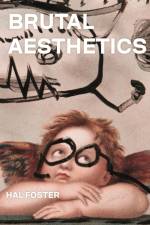
In Brutal Aesthetics, leading art historian and critic Hal Foster explores how postwar artists and writers searched for a new foundation of culture after the mass devastation of World War II, the Holocaust, and the atomic bomb. Inspired by "positive barbarism," the enigmatic idea that modernist art can teach us how to survive a civilization become barbaric, Foster examines the variety of ways key figures from the early 1940s to the early 1960s sought to develop a "brutal aesthetics" adequate to the destruction all around them. With a focus on the philosopher Georges Bataille, the painters Jean Dubuffet and Asger Jorn, and the sculptors Eduardo Paolozzi and Claes Oldenburg, Foster investigates this manifold move to strip art down, or to reveal it as already bare, in order to begin again.
Thanks to modern technological advances, we now enjoy seemingly unlimited access to information. Yet how did information become so central to our everyday lives, and how did its processing and storage make our data-driven era possible? This volume is the first to consider these questions in comprehensive detail, tracing the global emergence of information practices, technologies, and more, from the premodern era to the present. With entries that span archives to algorithms, and scribes to surveilling, this is the ultimate reference on how information has shaped and been shaped by societies.
The first complete account of the ideas and writings of a major figure in twentieth-century intellectual lifeWalter Kaufmann (1921-1980) was a charismatic philosopher, critic, translator, and poet who fled Nazi Germany at the age of eighteen, emigrating alone to the United States. He was astonishingly prolific until his untimely death at age fifty-nine, writing some dozen major books, all marked by breathtaking erudition and a provocative essayistic style. He single-handedly rehabilitated Nietzsche's reputation after World War II and was enormously influential in introducing postwar American readers to existentialism. Until now, no book has examined his intellectual legacy.Stanley Corngold provides the first in-depth study of Kaufmann's thought, covering all his major works. He shows how Kaufmann speaks to many issues that concern us today, such as the good of philosophy, the effects of religion, the persistence of tragedy, and the crisis of the humanities in an age of technology. Few scholars in modern times can match Kaufmann's range of interests, from philosophy and literature to intellectual history and comparative religion, from psychology and photography to art and architecture. Corngold provides a heartfelt portrait of a man who, to an extraordinary extent, transfigured his personal experience in the pages of his books.This original study, both appreciative and critical, is the definitive intellectual life of one of the twentieth century's most engaging yet neglected thinkers. It will introduce Kaufmann to a new generation of readers and serves as a fitting tribute to a scholar's incomparable libido sciendi, or lust for knowledge.
In this book, Scott Soames argues that the revolution in the study of language and mind that has taken place since the late nineteenth century must be rethought. The central insight in the reigning tradition is that propositions are representational. To know the meaning of a sentence or the content of a belief requires knowing which things it represents as being which ways, and therefore knowing what the world must be like if it is to conform to how the sentence or belief represents it. These are truth conditions of the sentence or belief. But meanings and representational contents are not truth conditions, and there is more to propositions than representational content. In addition to imposing conditions the world must satisfy if it is to be true, a proposition may also impose conditions on minds that entertain it. The study of mind and language cannot advance further without a conception of propositions that allows them to have contents of both of these sorts. Soames provides it.He does so by arguing that propositions are repeatable, purely representational cognitive acts or operations that represent the world as being a certain way, while requiring minds that perform them to satisfy certain cognitive conditions. Because they have these two types of content-one facing the world and one facing the mind-pairs of propositions can be representationally identical but cognitively distinct. Using this breakthrough, Soames offers new solutions to several of the most perplexing problems in the philosophy of language and mind.
The Political Machine investigates the essential role that material culture plays in the practices and maintenance of political sovereignty. Through an archaeological exploration of the Bronze Age Caucasus, Adam Smith demonstrates that beyond assemblies of people, polities are just as importantly assemblages of things-from ballots and bullets to crowns, regalia, and licenses. Smith looks at the ways that these assemblages help to forge cohesive publics, separate sovereigns from a wider social mass, and formalize governance-and he considers how these developments continue to shape politics today.Smith shows that the formation of polities is as much about the process of manufacturing assemblages as it is about disciplining subjects, and that these material objects or "e;machines"e; sustain communities, orders, and institutions. The sensibilities, senses, and sentiments connecting people to things enabled political authority during the Bronze Age and fortify political power even in the contemporary world. Smith provides a detailed account of the transformation of communities in the Caucasus, from small-scale early Bronze Age villages committed to egalitarianism, to Late Bronze Age polities predicated on radical inequality, organized violence, and a centralized apparatus of rule.From Bronze Age traditions of mortuary ritual and divination to current controversies over flag pins and Predator drones, The Political Machine sheds new light on how material goods authorize and defend political order.
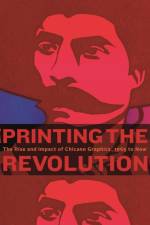
"In the 1960s, activist Chicano artists forged a remarkable history of printmaking that remains vital today. Many artists came of age during the civil rights, labor, anti-war, feminist and LGBTQ+ movements and channeled the period's social activism into assertive aesthetic statements that announced a new political and cultural consciousness among people of Mexican descent in the United States. ÆPrinting the Revolution! explores the rise of Chicano graphics within these early social movements and the ways in which Chicanx artists since then have advanced innovative printmaking practices attuned to social justice. More than reflecting the need for social change, the works featured in the catalogue and exhibition project and revise notions of Chicanx identity, spur political activism, and school viewers in new understandings of U.S. and international history. By employing diverse visual and artistic modes from satire, to portraiture, to appropriation, conceptualism, and politicized pop, the artists in this exhibition build an enduring and inventive graphic tradition that has yet to be fully integrated into the history of U.S. printmaking. This exhibition is the first to unite historic civil rights-era prints alongside works by contemporary printmakers, including several that embrace expanded graphics that exist beyond the paper substrate. While the dominant mode of printmaking among Chicanx artists remains screenprinting, the installation features works in a wide range of techniques and presentation strategies, from installation art to public interventions, augmented reality, and shareable graphics that circulate in the digital realm. The exhibition is also the first to consider how Chicanx mentors, print centers, and networks nurtured other artists, including several who drew inspiration from the example of Chicanx printmaking. Featured artists and collectives include Rupert Garcâia, Malaquias Montoya, Ester Hernâandez, the Royal Chicano Air Force, David Avalos, Elizabeth Sisco, Louis Hock, Sandra Fernâandez, Juan de Dios Mora, the Dominican York Proyecto Grafâica, Enrique Chagoya, Renâe Castro, Juan Fuentes, and Linda Lucero, among others. ÆPrinting the Revolution! features more than 100 works drawn from the Smithsonian American Art Museum's pioneering collection of Latinx art. The Museum's Chicanx graphics holdings rose significantly with an important gift in 1995 from the renowned scholar Tomâas Ybarra-Frausto. Since then, other major donations and an ambitious acquisition program have built one of the largest museum collections of Chicanx graphics on the East Coast."--
A vivid and moving portrait of America's farm familiesFarming is essential to the American economy and our daily lives, yet few of us have much contact with farmers except through the food we eat. Who are America's farmers? Why is farming important to them? How are they coping with dramatic changes to their way of life? In the Blood paints a vivid and moving portrait of America's farm families, shedding new light on their beliefs, values, and complicated relationship with the land.Drawing on more than two hundred in-depth interviews, Robert Wuthnow presents farmers in their own voices as they speak candidly about their family traditions, aspirations for their children, business arrangements, and conflicts with family members. They describe their changing relationships with neighbors, their shifting views about religion, and the subtle ways they defend their personal independence. Wuthnow shares the stories of farmers who operate dairies, raise livestock, and grow our fruit and vegetables. We hear from corn and soybean farmers, wheat-belt farmers, and cotton growers. We gain new insights into how farmers assign meaning to the land, and how they grapple with the increasingly difficult challenges of biotechnology and global markets.In the Blood reveals how, despite profound changes in modern agriculture, farming remains an enduring commitment that runs deeply in the veins of today's farm families.
How an obscure Puritan sermon came to be seen as a founding document of American identity and exceptionalism"e;For we must consider that we shall be as a city upon a hill,"e; John Winthrop warned his fellow Puritans at New England's founding in 1630. More than three centuries later, Ronald Reagan remade that passage into a timeless celebration of American promise. How were Winthrop's long-forgotten words reinvented as a central statement of American identity and exceptionalism? In As a City on a Hill, leading American intellectual historian Daniel Rodgers tells the surprising story of one of the most celebrated documents in the canon of the American idea. In doing so, he brings to life the ideas Winthrop's text carried in its own time and the sharply different yearnings that have been attributed to it since.As a City on a Hill shows how much more malleable, more saturated with vulnerability, and less distinctly American Winthrop's "e;Model of Christian Charity"e; was than the document that twentieth-century Americans invented. Across almost four centuries, Rodgers traces striking shifts in the meaning of Winthrop's words-from Winthrop's own anxious reckoning with the scrutiny of the world, through Abraham Lincoln's haunting reference to this "e;almost chosen people,"e; to the "e;city on a hill"e; that African Americans hoped to construct in Liberia, to the era of Donald Trump.As a City on a Hill reveals the circuitous, unexpected ways Winthrop's words came to lodge in American consciousness. At the same time, the book offers a probing reflection on how nationalism encourages the invention of "e;timeless"e; texts to straighten out the crooked realities of the past.
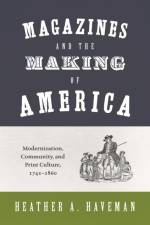
From the colonial era to the onset of the Civil War, Magazines and the Making of America looks at how magazines and the individuals, organizations, and circumstances they connected ushered America into the modern age. How did a magazine industry emerge in the United States, where there were once only amateur authors, clumsy technologies for production and distribution, and sparse reader demand? What legitimated magazines as they competed with other media, such as newspapers, books, and letters? And what role did magazines play in the integration or division of American society?From their first appearance in 1741, magazines brought together like-minded people, wherever they were located and whatever interests they shared. As America became socially differentiated, magazines engaged and empowered diverse communities of faith, purpose, and practice. Religious groups could distinguish themselves from others and demarcate their identities. Social-reform movements could energize activists across the country to push for change. People in specialized occupations could meet and learn from one another to improve their practices. Magazines built translocal communities-collections of people with common interests who were geographically dispersed and could not easily meet face-to-face. By supporting communities that crossed various axes of social structure, magazines also fostered pluralistic integration.Looking at the important role that magazines had in mediating and sustaining critical debates and diverse groups of people, Magazines and the Making of America considers how these print publications helped construct a distinctly American society.
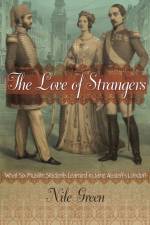
How a group of Iranian students sought love and learning in Jane Austen's LondonIn July 1815, six Iranian students arrived in London under the escort of their chaperone, Captain Joseph D'Arcy. Their mission was to master the modern sciences behind the rapid rise of Europe. Over the next four years, they lived both the low life and high life of Regency London, from being down and out after their abandonment by D'Arcy to charming their way into society and landing on the gossip pages. The Love of Strangers tells the story of their search for love and learning in Jane Austen's England.Drawing on the Persian diary of the student Mirza Salih and the letters of his companions, Nile Green vividly describes how these adaptable Muslim migrants learned to enjoy the opera and take the waters at Bath. But there was more than frivolity to their student years in London. Burdened with acquiring the technology to defend Iran against Russia, they talked their way into the observatories, hospitals, and steam-powered factories that placed England at the forefront of the scientific revolution. All the while, Salih dreamed of becoming the first Muslim to study at Oxford.The Love of Strangers chronicles the frustration and fellowship of six young men abroad to open a unique window onto the transformative encounter between an Evangelical England and an Islamic Iran at the dawn of the modern age. This is that rarest of books about the Middle East and the West: a story of friendships.
Abonner på vårt nyhetsbrev og få rabatter og inspirasjon til din neste leseopplevelse.
Ved å abonnere godtar du vår personvernerklæring.