





Gjør som tusenvis av andre bokelskere
Abonner på vårt nyhetsbrev og få rabatter og inspirasjon til din neste leseopplevelse.
Ved å abonnere godtar du vår personvernerklæring.Du kan når som helst melde deg av våre nyhetsbrev.

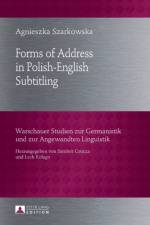
This book is the first study on forms of address in Polish-English subtitling from a multidisciplinary perspective. It departs from a contrastive analysis of forms of address in Polish and in English, then discusses the methodological tools and, finally, presents the empirical study on the translation of Polish forms of address in English TV subtitles.
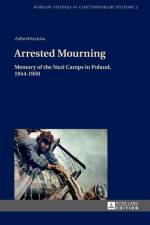
Woycicka reconstructs Polish controversies surrounding the memory and commemoration of Nazi concentration camps in the initial postwar years and describes how these debates were silenced under Stalinism. Using comparisons with other European countries, she explores which phenomena were specific for Poland and which had a broad character.
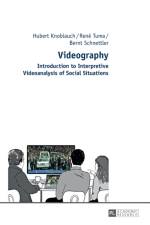
This book explains how to collect and analyze video data on natural interactions as part of an ethnographic research design. It includes all practical, technical and methodological aspects of the research process. It comes equipped with detailed, user-friendly aids, including suggestions for further reading, technical pointers, and case studies.
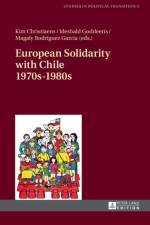
The overthrow of the Chilean president Allende in 1973 and the military dictatorship of Pinochet ignited one of the largest social movements of the 20th century. This volume analyzes the impact of the Chilean crisis in Western and Eastern Europe, and offers new insights to the history of the Cold War, of transnational activism, and of human rights.
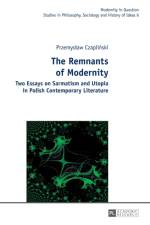
Post-communist Polish culture faced a problem: how to reconcile a growing demand for individual autonomy with a growing need for interpersonal and interspecies solidarity. The author argues that writers sought a solution in the processing of remnants - in the productive destruction of two leftovers of modernity: Sarmatian and utopia.
Gustaw Herling's A World Apart is one of the most important books about soviet camps and communist ideology in the Stalinist period, but it was relatively unknown till Solzhenitsyn's The Gulag Archipelago in the 1970s. In this first monograph on Herling's fascinating life, Bolecki discusses hitherto unknown documents from the writer's archive.
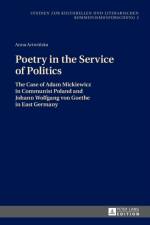
This book analyzes the ideology-based reception of Adam Mickiewicz in Communist Poland and of Johann Wolfgang von Goethe in East Germany, the dynamics of that process and the strategies used to exploit the iconic status of the poets for the purpose of reaffirming the legitimacy of the new system.
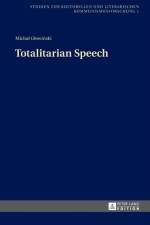
Totalitarian Speech brings together a range of texts on totalitarian manipulations of language. The volume collects the work of over three decades, including essays written during the communist era and more recent pieces assessing the legacy of totalitarian ways of thinking in contemporary Poland.
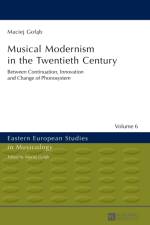
This history of twentieth-century musical modernism emphasizes musical structure in its cultural context. The book uses several methodological models according to different interpretations of the subsequent phases of the twentieth-century musical modernism.
This volume unites papers delivered at the Third Conference on Language Contact in Times of Globalization (LCTG3) at the University of Greifswald in 2011. It deals with contact-induced change, linguistic borrowing, code-switching, transcultural literacy, multilingualism in public space as well as language attitudes and linguistic power.
The book focuses on Russian-Hebrew bilingual speech. It identifies, describes and accounts for diverse types of bilingual varieties spoken in the Russian immigrant community in Israel. Therefore an interdisciplinary approach was chosen, examining the structural aspects of the immigrants' speech under consideration of their personal social networks.
The volume explores intersections between the traditional utopian discourse and recent media: music, comics, TV series, feature films, documentaries, fan fiction, computer games and web projects. It shows the variety of forms of expression of utopian impulses and their relocation and reinterpretation in the contemporary culture of convergence.
The work comprises adaptation studies of selected utopian/dystopian fictions written and filmed in Europe and America during the last century. It focusses on ways of constructing fictional realities as well as on techniques of rendering literary utopias/dystopias into film and allows a deep insight into the history of cinema.
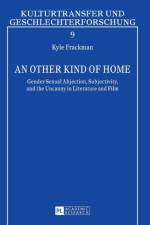
This book examines 19th- and 20th-century German literature and film, works by Wedekind, Musil, Ataman, and Sanoussi-Bliss, following themes of gender, sexuality, belonging, abjection, race, and disease. Encountering mutual dependence and abhorrence, the characters rarely experience acceptance, showing that home is a difficult place to find.
The contributions in this volume explore topics situated in three major thematic areas: metaphorical and metonymic underpinnings of meaning in natural languages as well as non-linguistic representational systems, structures of meaning across the lexicogrammatical continuum, and the advancement of a cognitive linguist's theoretical tools.
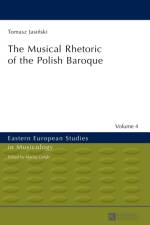
Musical rhetoric is an important phenomenon in Polish baroque music. The achievements of old Polish masters were determined by the main trends of the baroque era. Polish music provides examples of almost all rhetorical figures known at that time, largely reflecting the European repertoire of interpretative devices.
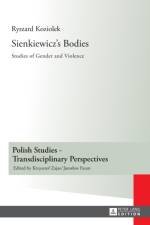
Sienkiewicz is more than a juggler of genius in narrative prose. This conservative writer knew that no unproblematic representation of reality was possible. The energy of his narratives disturbs narrative order and exposes the heteronomy of a superficially unified style, thus generating fissures, but never ruining the architecture of the text.
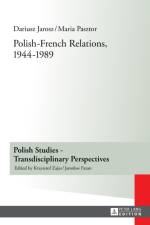
This book describes the Polish-French relations during the period of the Cold War, 1944-1989. It contains not only political issues, but also economic, cultural, scientific and educational relations. The text has widely focused on mutual contacts of both countries' communist parties.
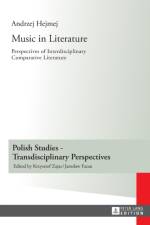
Captures links between music and literature in the light of recent proposals from theorists of intertextuality and comparative literature, and at the same time diagnoses the current state of comparative literature as a field of literary research.
The work outlines British and Spanish relations in the first half of the 19th century. Great Britain was on the peak of its power and Spain was making efforts to overcome the crisis of the falling empire. Interests as well as potential dangers made both countries review their policy of hostility and find the grounds for cooperation.
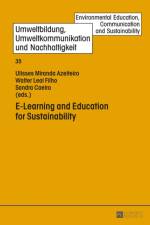
Almost 30 years after the concept of sustainable development appeared, goals should be reached in 2014 since it's the last year of the UN Decade on Education for Sustainable Development (ESD). This book aims to contribute to Education for Sustainability by discussing the use of e-learning in the progresses towards Sustainable Development or ESD.
This first monograph of the life and oeuvre of Marcin Mielczewski (d. 1651) sets it in the context of musical life at the courts of the Polish Vasas, particularly King Ladislaus IV and Bishop Charles Ferdinand. Much attention is devoted to the evidence of the reception of Mielczewski's music in seventeenth-century Europe.
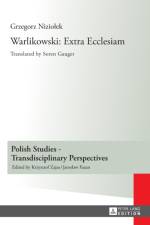
This book joins Krzysztof Warlikowski's theater with the dynamic changes in Polish society following 1989, using strategies borrowed from psychoanalysis, theater anthropology, performance studies, and cultural poetics. The plays are analyzed in terms of their affective impacts, as symptoms of social drama.
The book deals with contemporary French philosophy from Bataille to Derrida (Sartre, Aron, Levinas, Foucault, Deleuze, Lyotard etc.).
The book presents new metaphysical tendencies in 20th century French philosophy (1930s-1960s). Particular attention is given to the writings of Louis Lavelle, Ferdinand Alquie, Jean Wahl, Maurice Merleau-Ponty, and Emmanuel Levinas. The book provides clues as to how these thinkers have influenced more recent tendencies in French thought.
The most comprehensive book in English on the Nobel Laureate Czeslaw Milosz combines literary and historical approaches to his poems, essays, literary criticism and translations and to his poetic self-image. It offers an account of the Polish cultural milieu in the 20th century and interprets the fate of poetry under two totalitarian regimes.
This is a reader's book about Wislawa Szymborska's poetry. She holds the Nobel Prize in Literature of 1996. The Contents of the book are the Nobel Lecture held in Stockholm at the official ceremony by the poet in December 1996, a choice of Polish essays about Szmyborska's poetry and translations of her works into German, English, Spanish and French.
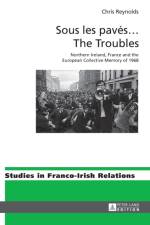
Through a comparison with the paradigmatic French events of mai 68, this book explores how Northern Ireland's 1968 has been marginalised in the way the events are remembered at a European level. It argues a case for its inclusion on the list of countries that make up this Europe-wide period of revolt.
The book discusses the evolution of the urban chronotope in the selected novels by Peter Ackroyd, an acclaimed British author. The examined narratives illustrate the transformation from the postmodern tenets of historiographic metafiction into a unique urban mythopoetics by means of a semiotic analysis.
Abonner på vårt nyhetsbrev og få rabatter og inspirasjon til din neste leseopplevelse.
Ved å abonnere godtar du vår personvernerklæring.