




Gjør som tusenvis av andre bokelskere
Abonner på vårt nyhetsbrev og få rabatter og inspirasjon til din neste leseopplevelse.
Ved å abonnere godtar du vår personvernerklæring.Du kan når som helst melde deg av våre nyhetsbrev.

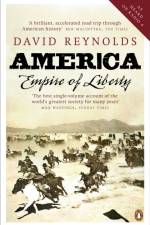
It was Thomas Jefferson who envisioned the United States as a great 'empire of liberty.' In the first new one-volume history in two decades, David Reynolds takes Jefferson's phrase as a key to the saga of America - helping unlock both its grandeur and its paradoxes. He examines how the anti-empire of 1776 became the greatest superpower the world has seen, how the country that offered liberty and opportunity on a scale unmatched in Europe nevertheless founded its prosperity on the labour of black slaves and the dispossession of the Native Americans. He explains how these tensions between empire and liberty have often been resolved by faith - both the evangelical Protestantism that has energized U.S. politics since the foundation of the nation and the larger faith in American righteousness that has impelled the country's expansion. Reynolds' account is driven by a compelling argument which illuminates our contemporary world.
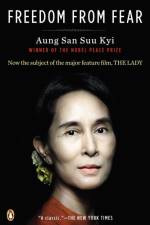
Freedom from Fear - collected writings from the Nobel Peace prize winner Aung San Suu KyiAung San Suu Kyi's collected writings - edited by her late husband, whom the ruling military junta prevented from visiting Burma as he was dying of cancer - reflects her greatest hopes and fears for her fellow Burmese people, and her concern about the need for international co-operation in the continuing fight for Burma's freedom. Bringing together her most powerful speeches, letters and interviews, this remarkable collection gives a voice to Burma's 'woman of destiny', whose fate remains in the hands of her enemies.Recipient of the Nobel Peace Prize and the Sakharov Prize for Freedom of Thought, and leader of Burma's National League for Democracy, Aung San Suu Kyi is one of the world's greatest living defenders of freedom and democracy, and an inspiration to millions worldwide. This book sits alongside Nelson Mandela's memoir Long Walk to Freedom.'This book is bound to become a classic for a new generation of Asians who value democracy even more highly than Westerners do, simply because they are deprived of the basic freedoms that Westerners take for granted'The New York Times'Aung San Suu Kyi's extraordinary achievement has been to confront the regime peacefully, reasonably and persuasively... [in] one of the most laudable continuing acts of political courage' Financial Times'Such is the depth of passion and learning that she brings to her writings about national identity and its links with culture and language that she has attracted the admiration of intellectuals around the world' Sunday Times Aung San Suu Kyi is the leader of Burma's National League for Democracy. She was placed under house arrest in Rangoon in 1989, where she remained for almost 15 of the 21 years until her release in 2010, becoming one of the world's most prominent political prisoners. She is also the author of Letters from Burma.
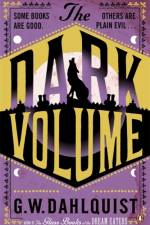
Some books are good . . . others are plain evil: the adventures of our three intrepid heroes continue in the breath-taking sequel to The Glass Books of the Dream Eaters, in G.W. Dahlquist's The Dark Volume, within which resides every reader's blackest nightmare . . .On a barren coast, young heiress Miss Temple awakes from a fever to discover herself friendless, alone - and having shot her fianc dead stone dead. Fleeing from suspicious villagers and attacks by 'wolves', Miss Temple finds herself with a most unlikely travelling companion in the shape of the seductive and deadly Contessa di Lacquer-Sforza.Meanwhile, assassin Cardinal chang and surgeon Dr Svenson are following an orgy of destruction and corruption, involving books of blue glass, to the ruins of Harschmort House, where a mysterious and vile volume is being hunted by a diabolical cabal bent on world domination.As Miss Temple, Cardinal Chang and Dr Svenson uncover further devilish treachery, so the terrifying secrets contained in The Dark Volume are revealed one by one.'Fans of a ripping yarn will find it hard to resist' Metro'Undeniably moreish . . . curl up with this under a rug' London PaperWhen G. W. Dahlquist fell asleep during a snowstorm, his first book The Glass Books of the Dream Eaters came to him in a dream. This is his second novel. The third volume in the series, The Chemickal Marriage is also available from Penguin.
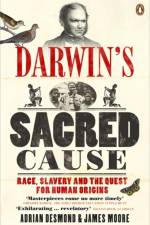
In this remarkable book Adrian Desmond and James Moore, world authorities on Darwin, give a completely new explanation of how Darwin came to his famous view of evolution, which traced all life to an ancient common ancestor. Darwin was committed to the abolition of slavery, in part because of his family's deeply held beliefs. It was his 'Sacred Cause' and at its core lay a belief in human racial unity. Desmond and Moore show how he extended to all life the idea of human brotherhood held by those who fought to abolish slavery, so developing our modern view of evolution.Through massive detective work among unpublished family correspondence, manuscripts and rare works, the authors back up their compelling claim. Leading apologists for slavery in Darwin's day argued that blacks and whites had originated as separate species, with whites superior. Creationists too believed that 'man' was superior to other species. Darwin abhorred such 'arrogance'; he declared it 'more humble & ... true' to see humans 'created from animals'. Darwin gave all the races - blacks and whites, animals and plants - a common origin and freed them from creationist shackles. Evolution meant emancipation.Darwin's Sacred Cause restores Darwin's humanitarianism, tarnished by atheistic efforts to hijack his reputation and creationist attempts to smear him. Desmond and Moore argue that only by understanding Darwin's Christian abolitionist inheritance can we shed new light on the perplexing mix of personal drive, public hesitancy and scientific radicalism that led him finally in 1871 to publish The Descent of Man, and Selection in Relation to Sex. The result is an epoch-making study of this eminent Victorian.
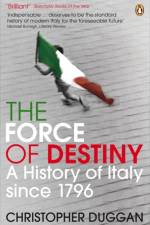
The greatness of Italy's culture and way of life have had a powerful attraction for many generations of visitors. This has created an overwhelming sense that Italy is a fundamentally benign and easy going country. The Force of Destiny, Christopher Duggan's immensely enjoyable new book, lays waste to this idea. While sharing everyone's enthusiasm for Italy as a place, he strongly distinguishes this from its political role over the past two centuries, which has been both vicious and ruinous for Europe as a whole.
After a period of forced exile and solitary wandering brought about by his radical views on religion and politics, Jean-Jacques Rousseau returned to Paris in 1770. Here, in the last two years of his life, he wrote his final work, the Reveries. In this eloquent masterpiece the great political thinker describes his sense of isolation from a society he felt had rejected his writings - and the manner in which he has come to terms with his alienation, as he walks around Paris, gazing at plants, day-dreaming and finding comfort in the virtues of solitude and the natural world. Meditative, amusing and lyrical, this is a fascinating exploration of Rousseau's thought as he looks back over his life, searching to justify his actions, to defend himself against his critics and to elaborate upon his philosophy.
Friedrich Schiller (1759-1805) was one of the most influential of all playwrights, the author of deeply moving dramas that explored human fears, desires and ideals. Written at the age of twenty-one, The Robbers was his first play. A passionate consideration of liberty, fraternity and deep betrayal, it quickly established his fame throughout Germany and wider Europe. Wallenstein, produced nineteen years later, is regarded as Schiller's masterpiece: a deeply moving exploration of a flawed general's struggle to bring the Thirty Years War to an end against the will of his Emperor. Depicting the deep corruption caused by constant fighting between Protestants and Catholics, it is at once a meditation on the unbounded possible strength of humanity, and a tragic recognition of what can happen when men allow themselves to be weak.
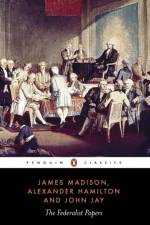
Written at a time when furious arguments were raging about the best way to govern America, The Federalist Papers had the immediate pratical aim of persuading New Yorkers to accept the newly drafted Constitution in 1787. In this they were supremely successful, but their influence also transcended contemporary debate to win them a lasting place in discussions of American political theory. Acclaimed by Thomas Jefferson as 'the best commentary on the principles of government which ever was written', The Federalist Papers make a powerful case for power-sharing between State and Federal authorities and for a Constitution that has endured largely unchanged for two hundred years.
Born in Newgate prison and abandoned six months later, Moll's drive to find and hold on to a secure place in society propels her through incest, adultery, bigamy, prostitution and a resourceful career as a thief ('the greatest Artist of my time') before she is apprehended and returned to Newgate. If Moll Flanders is on one level a Puritan's tale of sin and repentance, through self-made, self-reliant Moll its rich subtext conveys all the paradoxes and amoralities of the struggle for property and power in Defoe's newly individualistic society.
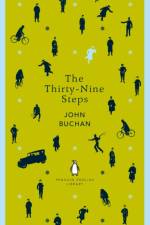
Richard Hannay has just returned to England after years in South Africa and is thoroughly bored with his life in London. But then a murder is committed in his flat, just days after a chance encounter with an American who had told him about an assassination plot which could have dire international consequences. An obvious suspect for the police and an easy target for the killers, Hannay goes on the run in his native Scotland where he will need all his courage and ingenuity to stay one step ahead of his pursuers.
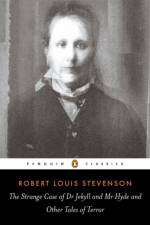
Everyone has a dark side.Dr Jekyll has discovered the ultimate drug. A chemical that can turn him into something else. Suddenly, he can unleash his deepest cruelties in the guise of the sinister Hyde. Transforming himself at will, he roams the streets of fog-bound London as his monstrous alter-ego.It seems he is master of his fate.It seems he is in complete control.But soon he will discover that his double life comes at a hideous price...
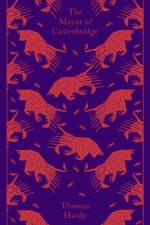
In a fit of drunken anger, Michael Henchard sells his wife and baby daughter for five guineas at a country fair. Over the course of the following years, he manages to establish himself as a respected and prosperous pillar of the community of Casterbridge, but behind his success there always lurk the shameful secret of his past and a personality prone to self-destructive pride and temper. Subtitled 'A Story of a Man of Character', Hardy's powerful and sympathetic study of the heroic but deeply flawed Henchard is also an intensely dramatic work, tragically played out against the vivid backdrop of a close-knit Dorsetshire town.
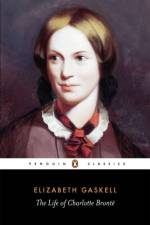
Elizabeth Gaskell's biography of her close friend Charlotte Bront was published in 1857 to immediate popular acclaim, and remains the most significant study of the enigmatic author who gave Jane Eyre the subtitle An Autobiography. It recounts Charlotte Bront 's life from her isolated childhood, through her years as a writer who had 'foreseen the single life' for herself, to her marriage at thirty-eight and death less than a year later. The resulting work - the first full-length biography of a woman novelist by a woman novelist - explored the nature of Charlotte's genius and almost single-handedly created the Bront myth.
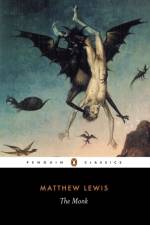
Ambrosio, the worthy superior of the Capuchins of Madrid, falls to the temptations of Matilda, a fiend-inspired wanton who, disguised as a boy, has entered his monastery as a novice. Ambrosio then falls in love with one of his penitents and finally kills her in order to escape detection. However, he is discovered, tortured by the Inquisition and sentenced to death. Although extravagant in its mixture of the supernatural, the terrible, and the indecent, the book contains scenes of great effect. The novel is a prime example of 18th century Gothic, written partly in response to Walpole and Radcliffe and enjoyed a considerable contemporary vogue.
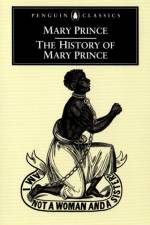
The History of Mary Prince (1831) was the first narrative of a black woman to be published in Britain. It describes Prince's sufferings as a slave in Bermuda, Turks Island and Antigua, and her eventual arrival in London with her brutal owner Mr Wood in 1828. Prince escaped from him and sought assistance from the Anti-Slavery Society, where she dictated her remarkable story to Susanna Strickland (later Moodie). A moving and graphic document, The History drew attention to the continuation of slavery in the Caribbean, despite an 1807 Act of Parliament officially ending the slave trade. It inspired two libel actions and ran into three editions in the year of its publication. This powerful rallying cry for emancipation remains an extraordinary testament to Prince's ill-treatment, suffering and survival.
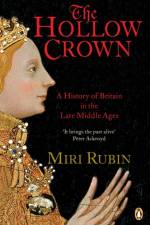
There is no more haunting, compelling period in Britain's history than the later middle ages. The extraordinary kings - Edward III and Henry V the great warriors, Richard II and Henry VI, tragic inadequates killed by their failure to use their power, and Richard III, the demon king. The extraordinary events - the Black Death that destroyed a third of the population, the Peasants' Revolt, the Wars of the Roses, the Battle of Agincourt. The extraordinary artistic achievements - the great churches, castles and tombs that still dominate the landscape, the birth of the English language in The Canterbury Tales.For the first time in a generation, a historian has had the vision and confidence to write a spell-binding account of the era immortalised by Shakespeare's history plays. THE HOLLOW CROWN brilliantly brings to life for the reader a world we have long lost - a strange, Catholic, rural country of monks, peasants, knights and merchants, almost perpetually at war - but continues to define so much of England's national myth.
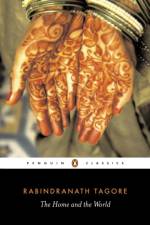
Set on a Bengali noble's estate in 1908, this is both a love story and a novel of political awakening. The central character, Bimala, is torn between the duties owed to her husband, Nikhil, and the demands made on her by the radical leader, Sandip. Her attempts to resolve the irreconciliable pressures of the home and world reflect the conflict in India itself, and the tragic outcome foreshadows the unrest that accompanied Partition in 1947.
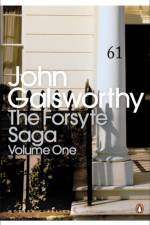
The Forsyte Saga is the first part of John Galsworthy s magnificent, well-loved Forsyte Chronicles, which trace the changing fortunes of the wealthy Forsyte dynasty through fifty years of material triumph and emotional disaster. The Forsyte Saga begins as the nineteenth century is drawing to a close, and the upper middle classes, with their property and propriety, are becoming a dying section of society. The Forsytes are blind to this fact, clinging to their conventions and brilliant respectability . As dignified Soames Forsyte struggles to uphold the old moral code in the face of the social revolution resulting from the Great War, his wife Irene s extraordinary beauty causes even more disruption. The bitter feud between them comes to split the Forsyte family for two generations.
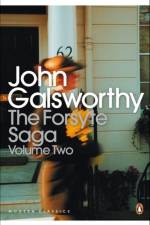
In this second part of John Galworthy's trilogy of love, power, money and family feuding, a new generation has arrived to divide the Forsyte clan with society scandals and conflicting passions
The stories collected in this volume reflect the rich tradition of medieval Jain storytelling between the seventh and fifteenth centuries, from simple folk tales and lives of famous monks to sophisticated narratives of rebirth. They describe they ways in which a path to peace and bliss can be found, either by renouncing the world or by following Jain ethics of non-violence, honesty, moderation and fidelity. Here are stories depicting the painful consequences when a loved one chooses life as a monk, the triumph of Jain women who win over their husbands to their religion, or the rewards of a simple act of piety. The volume ends with an account of vice and virtue, which depict the thieving and destructive passions lurking in the forest of life, ready to rob the unsuspecting traveller of reason and virtue.
Half mythical, heroic and sagacious, the emperor Vikramaditya is widely regarded as India's greatest monarch. This collection of stories tells of the ruler's fabled encounter with a vetala, a genie who inhabits the body of a corpse. The emperor begs the spirit for his help against a mighty necromancer and is told in return twenty-four tales, each of which presents a situation he might face as a king and culminates in a riddle that he must solve. With each answer, Vikramaditya displays his deep wisdom, proving himself to be the ideal monarch and winning, in the twenty-fifth tale, the guidance he needs from the vetala to destroy his powerful enemy. Written down in medieval times but inspired by an oral tradition stretching back centuries, these wise and witty tales rank amongst the great masterpieces of Sanskrit literature.
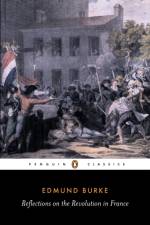
Burke's seminal work was written during the early months of the French Revolution, and it predicted with uncanny accuracy many of its worst excesses, including the Reign of Terror. A scathing attack on the revolution's attitudes to existing institutions, property and religion, it makes a cogent case for upholding inherited rights and established customs, argues for piecemeal reform rather than revolutionary change - and deplores the influence Burke feared the revolution might have in Britain. Reflections on the Revolution in France is now widely regarded as a classic statement of conservative political thought, and is one of the eighteenth century's great works of political rhetoric.
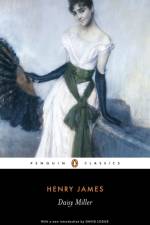
Travelling in Europe with her family, Daisy Miller, an exquisitely beautiful young American woman, presents her fellow-countryman Winterbourne with a dilemma he cannot resolve. Is she deliberately flouting social convention in the outspoken way she talks and acts, or is she simply ignorant of those conventions? When she strikes up an intimate friendship with an urbane young Italian, her flat refusal to observe the codes of respectable behaviour leave her perilously exposed. In Daisy Miller James created his first great portrait of the enigmatic and dangerously independent American woman, a figure who would come to dominate his later masterpieces.
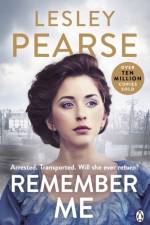
Based on a true story, Remember Me brings Mary Broad vividly to life in this moving story of a woman triumphing against overwhelming odds. She made one mistake, and now she'll never see home again . . .Mary, a Cornish mariner's daughter, makes the biggest mistake of her short life when she steals a silk hat. Convicted and sentenced to be transported to Australia, she endures horrific conditions aboard ship before landing in a brutal and barbaric country. It will take all her courage just to survive. But Mary is also determined to make something of herself in this rugged man's world. And she dreams that one day she will find a way of crossing the cruel seas that lie between her and home . . .Santa Montefiore and Penny Vincenzi fans will swiftly fall for Lesley Pearse's mesmerising novels - you'll want to read them again and again . . . 'With characters it is impossible not to care about . . . this is storytelling at its very best' Daily Mail'An emotional and moving epic you won't forget in a hurry' Woman's Weekly'Utterly riveting, brilliant' Closer
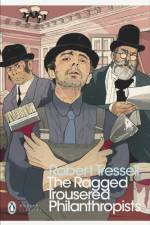
The Ragged Trousered Philanthropists tells the story of a group of working men who are joined one day by Owen, a journeyman-prophet with a vision of a just society. Owen's spirited attacks on the greed and dishonesty of the capitalist system rouse his fellow men from their political quietism. A masterpiece of wit and political passion and one of the most authentic novels of English working class life ever written.
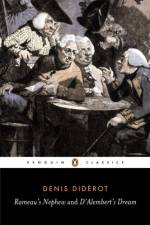
One of the key figures of the French Enlightenment, Denis Diderot was a passionate critic of conventional morality, society and religion. Among his greatest and most well-known works, these two dialogues are dazzling examples of his radical scientific and philosophical beliefs. In Rameau's Nephew, the eccentric and foolish nephew of the great composer Jean-Philippe Rameau meets Diderot by chance, and the two embark on a hilarious consideration of society, music, literature, politics, morality and philosophy. Its companion-piece, D'Alembert's Dream, outlines a material, atheistic view of the universe, expressed through the fevered dreams of Diderot's friend D'Alembert. Unpublished during his lifetime, both of these powerfully controversial works show Diderot to be one of the most advanced thinkers of his age, and serve as fascinating testament to the philosopher's wayward genius.
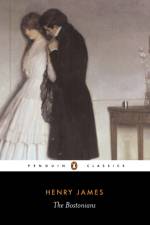
Published in 1886, The Bostonians begins with the arrival in Boston of Basil Ransom, a young Mississippi lawyer in search of a career. Through his cousin, Olive Chancellor, Ransom comes to meet Verena, the beautiful daughter of a charlatan faith-healer and showman. When they hear Verena talk, Olive hopes to win the girl over to the feminist cause, Ransom is attracted to her looks, and a battle for possession of the girl begins.With its discussion of the situation of women and its uncompromising depiction of the city and the media, THE BOSTONIANS is a modern novel which is immediately accessible and relevant today.
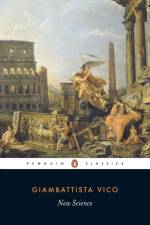
Barely acknowledged in his lifetime, the New Science of Giambattista Vico (1668-1744) is an astonishingly perceptive and ambitious attempt to decipher the history, mythology and laws of the ancient world. Discarding the Renaissance notion of the classical as an idealised model for the modern, it argues that the key to true understanding of the past lies in accepting that the customs and emotional lives of ancient Greeks and Romans, Egyptians, Jews and Babylonians were radically different from our own. Along the way, Vico explores a huge variety of topics, ranging from physics to poetics, money to monsters, and family structures to the Flood. Marking a crucial turning-point in humanist thinking, New Science has remained deeply influential since the dawn of Romanticism, inspiring the work of Karl Marx and even influencing the framework for Joyce's Finnegan's Wake.
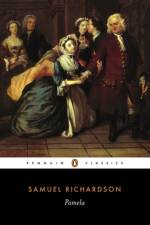
Fifteen-year-old Pamela Andrews, alone in the world, is pursued by her dead mistress's son. Although she is attracted to Mr B, she holds out against his demands, determined to protect her virginity and abide by her moral standardsPsychlologically acute in its explorations of sex, freedom and power, Richardson's first novel caused a senastion when it was published. Richly comic and lively, PAMELA contains a diverse cast of characters ranging from the vulgar and malevolent Mrs Jewkes to the agressive but awkward country squire.
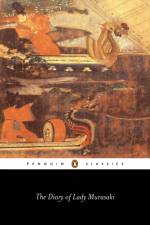
The Diary recorded by Lady Murasaki (c. 973-c. 1020), author of The Tale of Genji, is an intimate picture of her life as tutor and companion to the young Empress Shoshi. Told in a series of vignettes, it offers revealing glimpses of the Japanese imperial palace - the auspicious birth of a prince, rivalries between the Emperor's consorts, with sharp criticism of Murasaki's fellow ladies-in-waiting and drunken courtiers, and telling remarks about the timid Empress and her powerful father, Michinaga. The Diary is also a work of great subtlety and intense personal reflection, as Murasaki makes penetrating insights into human psychology - her pragmatic observations always balanced by an exquisite and pensive melancholy.
Abonner på vårt nyhetsbrev og få rabatter og inspirasjon til din neste leseopplevelse.
Ved å abonnere godtar du vår personvernerklæring.