

















Gjør som tusenvis av andre bokelskere
Abonner på vårt nyhetsbrev og få rabatter og inspirasjon til din neste leseopplevelse.
Ved å abonnere godtar du vår personvernerklæring.Du kan når som helst melde deg av våre nyhetsbrev.

Daniel Breazeale presents a critical study of the early philosophy of J. G. Fichte, and the version of the Wissenschaftslehre that Fichte developed between 1794 and 1799. He examines what Fichte was trying to accomplish and how he proposed to do so, and explores the difficulties implicit in his project and his strategies for overcoming them.
Einstein's general theory of relativity is introduced in this advanced undergraduate textbook. Topics covered include geometric formulation of special relativity, the principle of equivalence, Einstein's field equation and its spherical-symmetric solution, as well as cosmology.
Crystallography and diffraction are widely used throughout science for studying structure. The aim of this book is to show, through relevant examples and without relying on complex mathematics, that the basic ideas behind crystallography and diffraction are simple and easily comprehensible.
A witty, irreverent guide to the birth, development, and state-of-the-art of one of the most important theories in Earth Science. The book explains how modern plate tectonics accounts for phenomena such as great earthquakes, tsunamis, volcanic eruptions, and how it controls conditions at the Earth's surface, including global geography and climate.
Drawing on philosophy, law and political science, and on a wealth of practical experience delivering emergency medical services in conflict-ridden settings, Lepora and Goodin untangle the complexities surrounding compromise and complicity.
Alan H. Goldman presents an original account of the relationship between philosophy and the novel. With reference to key literary works including Hemingway's The Sun Also Rises, Twain's Huckleberry Finn, and Conrad's Nostromo, he defends theories of literary value and interpretation, and explores themes in novels relating to moral agency.
Inventing the Market explores two paradigms of the market in the thought of Adam Smith and G.W.F. Hegel, bridging the gap between economics and philosophy, it shows that both disciplines can profit from a broader, more historically situated approach to the market.
A clear introduction to the major works of Kierkegaard that highlights the Lutheran framework of his thought, the book combines exposition of the texts within their philosophical, theological, and historical context with an engaging critical dialogue that brings Kierkegaard into debate with twenty-first century thought.
David O. Brink offers a reconstruction and assessment of John Stuart Mill's contributions to the utilitarian and liberal traditions. Brink defends interpretations of key elements in Mill's moral and political thought, and shows how a perfectionist reading of his conception of happiness has a significant impact on other aspects of his philosophy.
Fragmentation is a potential problem in an international legal system that has seen the creation of new courts and tribunals around the world, with the chance for different judicial approaches to develop in different courts. This book addresses this issue by analysing judicial practice in three areas: genocide, immunities, and the use of force.
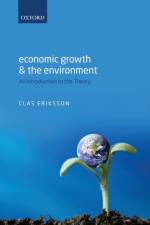
How can we reconcile economic growth with the need to protect the natural environment? Will scarcity of natural resources eventually force economic growth to cease? This book introduces key models and shows how modern growth theory can be used to shed light on the relation between economic growth, natural resources, and the environment.
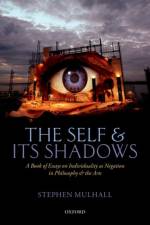
Stephen Mulhall presents a series of multiply interrelated essays which explore the idea of selfhood as a matter of non-self-identity: for example, as becoming or self-overcoming, or as being doubled or divided. He draws on Nietzsche, Sartre, and Wittgenstein, but also on works of opera, cinema, and fiction.
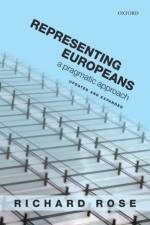
A major new reassessment of the problems facing the European Union by one of the world's leading political scientists. The author shows exactly how the EU must adapt to the demands of representing its citizens if it is to survive at all.
The Social Evolution of International Politics critically engages with all the key grand theories of international politics and provides interesting solutions to some of the 'great debates' between those theories, from realism and neoliberalism, to the English School and constructivism.
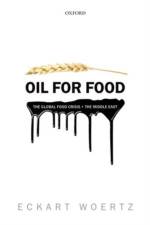
Oil for Food draws on extensive sources and interviews to tell the story of how Arab Gulf countries reacted to the 2008 global food crisis. It argues against the hype created around so called land grabs and analyzes the geopolitical implications behind the investment drive of Arab Gulf countries in food insecure countries like Sudan or Pakistan.
Duncan Pritchard offers an original account of perceptual knowledge. He argues that it is paradigmatically constituted by true belief that enjoys rational support which is both factive and reflectively accessible to the agent. This resolves the issue between intermalism and externalism, and poses a radical challenge to contemporary epistemology.
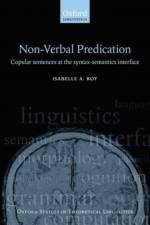
This book concerns the interpretation and structure of non-verbal predicates in copular sentences (i.e. sentences with the verb 'be'). The author provides a unifying analysis based on a ternary distinction between defining/characterizing/situation-descriptive predicates.
Christopher G. Timpson provides the first full-length philosophical treatment of quantum information theory and the questions it raises for our understanding of the quantum world. He argues for an ontologically deflationary account of the nature of quantum information, which is grounded in a revisionary analysis of the concepts of information.
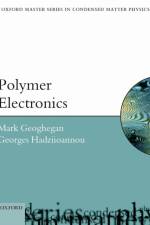
Polymer electronics lies behind many important new developments in technology, such as the flexible electronic display (e-ink) and modern transistor technology. This book presents a thorough discussion of the physics and chemistry behind this exciting field, appealing to all physical scientists with an interest in polymer electronics.
This book is about the evolution of developing countries in the world economy situated in its wider historical context, spanning centuries, but with a focus on the period since the mid-twentieth century. It traces the rise and 'catch up' of the developing world and the shift in the balance of power in the world economy.
Questions about the nature of law, its relationship with custom, and the distinctive form of legal rules, categories, and claims, are placed at the centre of this introduction to the study of law and anthropology. It brings empirical scholarship within the scope of legal philosophy, while suggesting new avenues of inquiry for the anthropologist.
C. Stephen Evans defends the claim that moral obligations are best understood as divine commands or requirements; hence an important part of morality depends on God. God's requirements are communicated in a variety of ways, including conscience, and that natural law ethics and virtue ethics provide complementary perspectives to this view.
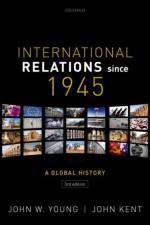
International Relations since 1945 offers undergraduate students a comprehensive and accessible introduction to global political history since World War II. Clearly structured, and with a balance of description and analysis, the text is also supported by a range of helpful learning features and an accompanying website.
Tom Licence discovers why medieval society invested so much in hermits and recluses, and examines how they gained their saintly reputation.
The book discusses fundamental aspects of Quantum Field Theory and of Gauge theories, with attention to mathematical consistency. Basic issues of the standard model of elementary particles (Higgs mechanism and chiral symmetry breaking in quantum Chromodynamics) are treated without relying on the perturbative expansion and on instanton calculus.
A comprehensive account of the contribution and failings of one of the most important institutions in the world - the corporation. It gives an accessible and insightful analysis of why the problems of the corporation - financial crises, mismanagement, poverty, and pollution - are increasing and what can be done to address them.
The elegance in science is not always obvious, but it does play an important role. Here, Ian Glynn selects historical examples from a wide range of sciences to draw out the principle of elegance, highlighting the role of beauty and simplicity in science, and relating it to important philosophical issues related to inference to the best explanation.
Through an innovative combination of image and text, Peter Atkins explains the processes involved in chemical reactions. He introduces the 'tool kit' of basic reactions, such as precipitation, corrosion, and catalysis, and shows how these building blocks are brought together in more complex processes such as photosynthesis.
The second edition of the leading authority on the law of company meetings provides the most detailed analysis available and has been updated with recent developments in case law and legislation.
The story of King Arthur - probably the most famous and certainly the most legendary of medieval kings.
Abonner på vårt nyhetsbrev og få rabatter og inspirasjon til din neste leseopplevelse.
Ved å abonnere godtar du vår personvernerklæring.