



















Gjør som tusenvis av andre bokelskere
Abonner på vårt nyhetsbrev og få rabatter og inspirasjon til din neste leseopplevelse.
Ved å abonnere godtar du vår personvernerklæring.Du kan når som helst melde deg av våre nyhetsbrev.

Bruce Friedman's How to Teach Effectively is a valuable tool to help teachers maximize their students' performance results and learning experience. Creating active learning experiences enables students to understand and retain more information in the long term. In an easy-to-use, accessible format, this book provides both theory and specific techniques that will help you engage learners with different backgrounds and learning styles. This new edition provides useful information on integrating technology in the classroom and conducting online courses. Whether you are a graduate student, a new trainer, or an experienced professor, this book will help you identify your personal strengths and provide you with the tools to be a truly effective teacher.
Benjamin Sammons argues that the poems of the so-called "Epic Cycle" were constructed using the same traditional devices as the Homeric epics. From this insight he sheds new light on the overall form of these lost poems and offers fresh interpretation of the few remaining fragments.
The book argues that Anaxagoras's theory of extreme mixture, with a share of everything in everything, is underpinned by an ontology of physical causal powers (the opposites), which exist as endlessly partitioned. Anaxagoras is thus the first ante litteram 'gunk lover' in the history of metaphysics; his reality is atomless.
The Age of Silver considers how commerce fueled the emergence of the novel around the globe, examining the evolution of epochal works of national literature from Don Quixote in 1605 to Robinson Crusoe in 1719.
Embodiment--defined as having, being in, or being associated with a body--is a feature of the existence of many entities, perhaps even of all entities. Why entities should find themselves in this condition is the central concern of the present volume. The problem includes, but also goes beyond, the philosophical problem of body: that is, what the essence of a body is, and how, if at all, it differs from matter. On some understandings there may exist bodies, such as stones or asteroids, that are not the bodies of any particular subjects. To speak of embodiment by contrast is always to speak of a subject that variously inhabits, or captains, or is coextensive with, or even is imprisoned within, a body. The subject may in the end be identical to, or an emergent product of, the body. That is, a materialist account of embodied subjects may be the correct one.But insofar as there is a philosophical problem of embodiment, the identity of the embodied subject with the body stands in need of an argument and cannot simply be assumed. The reasons, nature, and consequences of the embodiment of subjects as conceived in the long history of philosophy in Europe as well as in the broader Mediterranean region and in South and East Asia, with forays into religion, art, medicine, and other domains of culture, form the focus of these essays. More precisely, the contributors to this volume shine light on a number of questions that have driven reflection on embodiment throughout the history of philosophy. What is the historical and conceptual relationship between the idea of embodiment and the idea of subjecthood? Am I who I am principally in virtue of the fact that I have the body I have? Relatedly, what is the relationship of embodiment to being and to individuality? Is embodiment a necessary condition of being? Of being an individual? What are the theological dimensions of embodiment? To what extent has the concept of embodiment been deployed in the history of philosophy to contrast the created world with the state of existence enjoyed by God? What are the normative dimensions of theories of embodiment? To what extent is the problem of embodiment a distinctly western preoccupation? Is it the result of a particular local and contingent history, or does it impose itself as a universal problem, wherever and whenever human beings begin to reflect on the conditions of their existence?Ultimately, to what extent can natural science help us to resolve philosophical questions about embodiment, many of which are vastly older than the particular scientific research programs we now believe to hold the greatest promise for revealing to us the bodily basis, or the ultimate physical causes, of who we really are?
In Meaning in Our Bodies, Heike Peckruhn argues that scholars who appeal to the importance of bodily experiences need to acquire a robust and nuanced understanding of how sensory perceptions and interactions are cultural and theological acts of making meaning.
Welfare, Work, and Poverty provides the first systematic and comprehensive evaluation of the impacts and effectiveness of China's primary social assistance program - Minimum Livelihood Guarantee, or Dibao - the world's largest welfare program. The text offers new empirical evidence and draws policy lessons that are timely and useful for both China and beyond. It is essential reading for those interested in learning about and understanding contemporaryChina.
This collection features 10 essays on a variety of topics in Kant's ethics. Part 1 addresses questions about the interpretation and justification of the categorical imperative. Part 2 is concerned with the doctrine of virtue, while part 3 delves into various issues pertaining to Kant's moral psychology of evil.
The book presents clear instructions on coping with changes in functioning associated with injury, aging, illness, and pain. Chapters teach how to restore mood and self-esteem, manage stress and frustration, maintain strong social ties, cope with chronic pain, function efficiently when memory ability declines, and master self-motivation and time management.
The first comprehensive academic survey of British musical theatre from its origins, The Oxford Handbook of the British Musical offers both a historical account of musical theatre from 1728 and a range of in-depth critical analyses of key works and productions that illustrate its aesthetic values and sociocultural meanings.
The Oxford Handbook to Biblical Narrative is a state-of-the-art anthology that highlights biblical narrative's aesthetic characteristics, its ethical and religious appeal, its organic qualities as communal literature, its witness to social and political negotiation, and its uncanny power to affect readers and hearers across disparate time-frames and global communities.
This book is a collection of articles by the renowned music education scholar and arts education advocate, Charles Fowler (1931-95). Serving as Education Editor at Musical America from 1974-1989, he published numerous articles about music in schools and society. This text is a curated selection of the most cogent articles, along with critical commentary.
This book is a collection of articles by the renowned music education scholar and arts education advocate, Charles Fowler (1931-95). Serving as Education Editor at Musical America from 1974-1989, he published numerous articles about music in schools and society. This text is a curated selection of the most cogent articles, along with critical commentary.
This volume brings together Terence Horgan's essays on paradoxes, both published and new. A common theme unifying these essays is that philosophically interesting paradoxes typically resist either easy solutions or solutions that are formally/mathematically highly technical. Another unifying theme is that such paradoxes often have deep-sometimes disturbing-philosophical morals.
Around the middle of the eighteenth century, the leading figures of the French Enlightenment engaged in a philosophical debate about the nature of music, prompted by the controversial views of the composer-theorist Jean-Philippe Rameau. Their dialogue was one of extraordinary depth and richness and dealt with some of the most fundamental issues of the French Enlightenment. In the newly revised edition of Music and the French Enlightenment, Cynthia Verbaupdates this fascinating story with the prolific scholarship that has emerged since the book was first published.
The Oxford Handbook of Contemporary Buddhism offers a comprehensive collection of work by leading scholars in the field. They examine the historical development of Buddhist traditions throughout the world, from traditional settings like India, Japan, and Tibet, to the less well known regions of Latin America, Africa, and Oceania.
Jennifer Radden finds, within Robert Burton's religious and humoral explanations in his Anatomy of Melancholy, a remarkably coherent account of normal and abnormal psychology with echoes in modern day clinical psychology.
The only textbook of its kind, An Introduction to the Languages of the World is designed to introduce beginning linguistics students, who now typically start their study with little background in languages, to the variety of the languages of the world.
Like race, gender, and sexuality, disability is a social and cultural construction. Music, musicians, and music-making simultaneously embody and shape representations and narratives of disability. Disability - culturally stigmatized minds and bodies - is one of the things that music in all times and places can be said to be about.
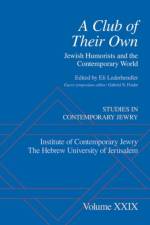
Volume XXIX of Studies in Contemporary Jewry provides a nuanced account of the history and development of Jewish humor, while also making a case for the importance of humor in studying any culture.
Presenting a novel approach for the study of law in the Dead Sea Scrolls, this book is conveniently divided into concepts and practices, highlighting the discrepancies between the two. It is a valuable study for anyone interested in Jewish law, legal history, sectarianism and communal life.
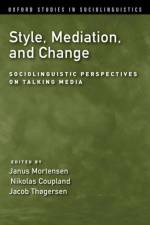
Mediated talk is organised around familiar styles - styles of person, relationship and genre. But media also consistently remake and re-style these familiar patterns. This book brings together original research of media styling in different national contexts and languages. It highlights and theorises how creative acts of mediated styling can promote social and sociolinguistic change.
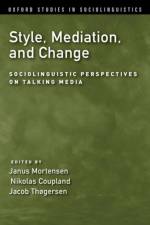
Mediated talk is organised around familiar styles - styles of person, relationship and genre. But media also consistently remake and re-style these familiar patterns. This book brings together original research of media styling in different national contexts and languages. It highlights and theorises how creative acts of mediated styling can promote social and sociolinguistic change.
Cajun Breakdown examines the social and cultural roots of Cajun music's development through 1950. The idiom's synthetic nature suggests an extensive and intensive dialogue with popular culture that extinguishes the myth that Cajuns were an insular folk group astray in the American South.
In the biblical story of Jael and Sisera (Judges 4-5), the heroic Jael takes a tent peg and nails the Canaanite general Sisera's head to the ground, thus saving Israel. Colleen Conway analyzes re-imaginings of this story across the centuries, in visual art, poems, plays, and novels, and shows how the cultural productions of an ancient biblical story intersect with broader conversations about the often conflicted, and sometimes violent, relationship between thesexes.
Emergence develops a novel account of diachronic ontological emergence called transformational emergence and locates it in an established historical framework. The author shows how many problems affecting ontological emergence result from a dominant but inappropriate metaphysical tradition and provides a comprehensive assessment of current theories of emergence.
What Do Philosophers Do? takes up the leading arguments for radical skepticism from an everyday point of view. A range of philosophical methods are examined and employed, for a revealing portrait of what philosophers do, and perhaps a quiet suggestion for what they should do, for what they do best.
This book develops and defends a theory of responsible belief. The author argues that we lack control over our beliefs, but that we can nonetheless influence them. It is because we have intellectual obligations to influence our beliefs that we are responsible for them.
Abonner på vårt nyhetsbrev og få rabatter og inspirasjon til din neste leseopplevelse.
Ved å abonnere godtar du vår personvernerklæring.